


Maybe, in 1001 days, Scheherazade will tell this differently.
Jean-Luc Godard in Ici et ailleurs
(Here and Elsewhere, 1976, with Anne-Marie Miéville).
“We’re talking solidarity with students and workers, and you’re talking dolly shots and close-ups,” called Jean-Luc Godard into an outraged crowd on May 18, 1968, during that year’s infamous Cannes Film Festival. Audience members, anticipating a screening of Carlos Saura’s Peppermint Frappé (1967) and undoubtedly wearing their slickest clothes, shouted feeble nons while Godard’s peers—among them a youthful Jean Pierre-Leaud, poster-child of radical malaise—clutched the curtains of the main theatre shut. During the first week of May, the skies of Paris had been blotted black by refusal, with masses of workers striking to resist their exploitative conditions, and students forming barricades against repressive police in the dark. Within three weeks, this fervour had mobilised the entire country; two-thirds of France’s workforce were on strike. For Godard, François Truffaut, and their allies, the demand was obvious: how could this festival—a spectacle of lavish galas, minor celebrity scandals, and gold-frond-spangled trophies—possibly continue, undeterred by those painful echoes of terror and resistance? It didn’t.
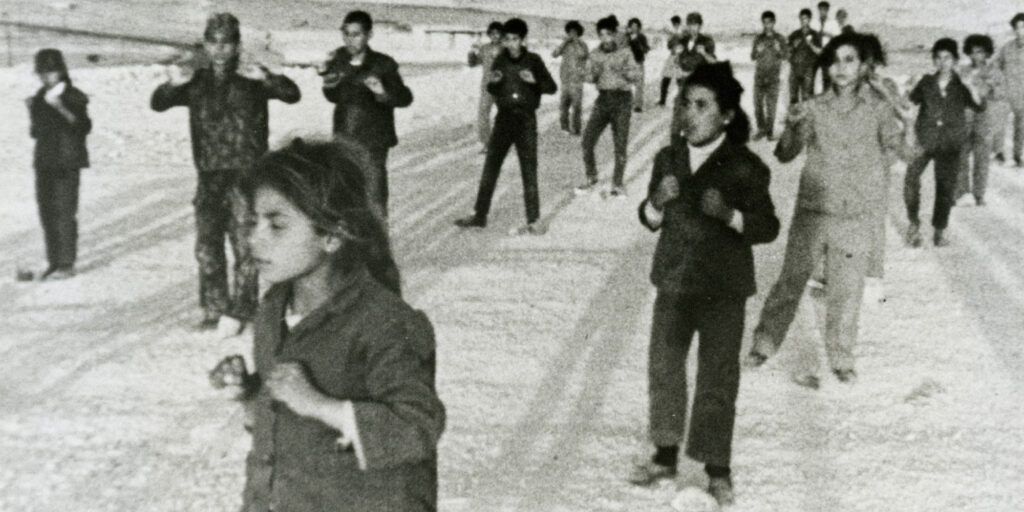
Godard, an ardent advocate of Palestinian sovereignty, collaborated with the Palestinian Liberation Organisation (PLO) to document the revolutionary activities of the fedayeen, self-sacrificing Arabic militants fighting for Palestinian liberation, in Jordan in the early 1970s.1 In August 2025, as Israel continues to escalate its genocidal project in occupied Palestine, the appeal made by Godard in 1968 for the film industry to oppose state violence and act alongside protesting students and workers reverberates with little response. While Israel has now destroyed all universities in Gaza, principled students across the world protest the complicity of their own institutions in Israel’s genocide, against sharpening surveillance tactics and coercive disciplinary threats.2 Meanwhile, dock workers in Greece and France recently heeded calls from the Palestinian-led Boycott, Divestment, Sanctions (BDS) movement by refusing to transport masses of military cargo to Israel. Within the Western film industry, however, expressions of solidarity mostly remain meagre: a dress which, precisely fanned and captured from the perfect angle, resembles a Palestinian flag. Or an Oscar awarded to the creators of a documentary about life under Israeli occupation, No Other Land (2024), by an awards body who later offered only a paltry statement when Israeli settlers brutally attacked one if its Palestinian directors, Hamdan Ballal, and are yet to speak on the recent murder of one of its essential subjects, activist Awdah Hathaleen.
Advocates of Palestinian sovereignty have long appealed to arts institutions, including film-related organisations, to sanction the state of Israel and express meaningful solidarity with Palestinians. Since 2004, a founding arm of the BDS movement, the Palestinian Campaign for the Academic and Cultural Boycott of Israel (PACBI), has called for cultural institutions to boycott art sponsored by the Israeli state, as well as work which promotes the ‘normalisation’ of Israel’s colonising regime. Despite the consistency of these calls, recently amplified by prominent grassroots organisations including Film Workers for Palestine, a status quo of resounding silence remains within the international film industry, with only a few standout organisations and publications clearly delineating their strategies in response to Israel’s terror.3 A disparity between the film industry and other arts industries is represented by PACBI’s page listing arts organisations that have pledged support of PACBI, which includes only one film-specific organisation (Queer Cinema for Palestine) and zero Australian entries.
Throughout his incendiary career as a filmmaker, observer, provocateur, and theorist of the modern world, Godard fastidiously documented the deaths of cinema. There was its failure to represent the horrors of the Holocaust (“six million people were killed or gassed, principally Jews; and the cinema was not there”4); its incapacity to metabolise a phenomenon of politically radical cinema in the wake of 1968’s so-called cultural revolution; and, later, the catastrophic advent of television (a medium Godard despised and adored at once). In these terms, cinema’s latest failure to reckon with and manifest solidarity with Palestinian lives en masse as Israel continues its project of ethnic cleansing, a genocide livestreamable even on our smallest screens, represents an unfathomable rupture in the history of film. Despite the ubiquity of the moving image in relation to Israel’s genocide, whether as propaganda, surveillance footage, or self-taped videos by Gazans requesting survival resources from idly scrolling viewers, there has been no major collective movement in the Western film industry to act. There has also been no significant movement among film critics and practitioners to platform insurgent Palestinian filmmaking and reconsider the relationship between the moving image, state power, and resistance.5 A fate worse than death, cinema is mummified in a skin of its own complacence.
As Godard pointed out during his 1978 lecture series Introduction to a True History of Cinema and Television, the phrase to be critical holds a double meaning: to evaluate and to challenge, but also to be urgent, dire.6 Like many of Godard’s statements, this entendre is both banal and profound. It cuts through any notion of film-criticism-as-luxury-product, an activity best performed in relative peace. The current escalation of Israel’s genocide in Gaza is a critical juncture which marks blatant cultural as well as humanitarian crises—including a crisis for the moving image. This context demands a decisive intensification of critique and inquiry regarding the past, present, and future of the medium.
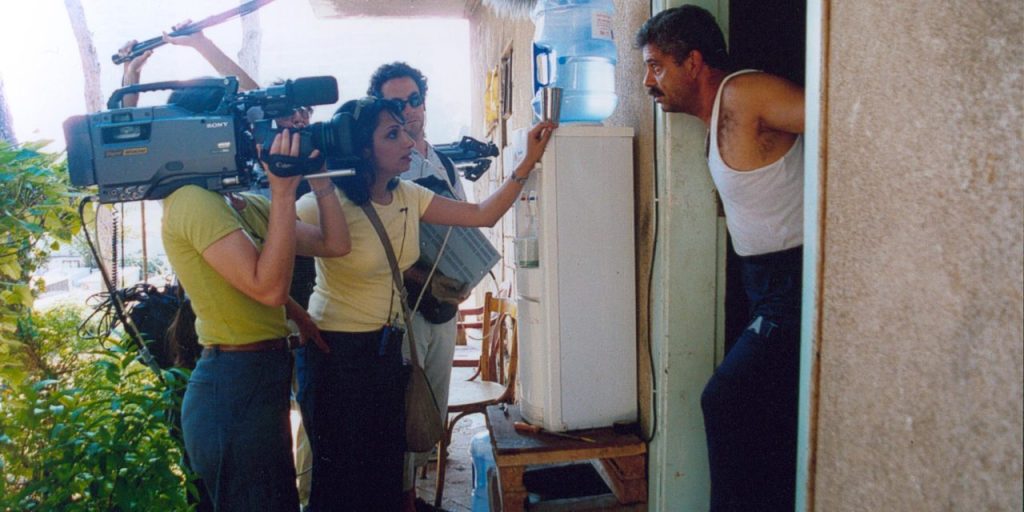
Israel has long recognised—and feared—the political significance of film for Palestinians, systematically destroying Palestinian cinemas and film archives since the 1948 Nakba as part of a cultural ethnic cleansing process scholar Ilan Pappé names ‘memoricide.’7 In a recent interview with Amanda Barbour, Naser Shakhtour, the director of the Palestinian Film Festival in Australia, recalled the looting of the Palestine Research Centre during Israel’s 1982 invasion of Beirut. As Shakhtour states: “Archives are dangerous to those who seek to appropriate history.”8 Reclaiming the moving image is a matter of survival for Palestinian filmmakers, whose work often salvages, converses with, and builds upon the remains of these archives. “I confront not the absence of visual archives, but the presence of their remains,” writes Palestinian filmmaker and theorist Azza El-Hassan in her incredible 2024 text The Afterlife of Palestinian Images. El-Hassan’s imaginative 2004 documentary, Kings and Extras: Digging for a Palestinian Image sees El-Hassan searching for film from the looted PLO Media Unit, shards of which eventually form her film’s haunted ending. Elsewhere, in her ongoing The Void Project, El-Hassan melds archival and filmmaking practices to restore radical Palestinian filmmaking, particularly by women, produced by the Palestine Film Institute (PFI) in Jordan and Lebanon throughout the late twentieth century.9
While Palestinian practitioners are necessarily cognisant of the power of images, the Western media continues to dismiss footage and images of atrocities in Gaza. This is evident when platforms prioritise publishing statements by Israeli spokespeople denying the ongoing occurrence of a man-made famine targeting Gazans, in contradiction to the overwhelming availability of images attesting to malnutrition, starvation, and the weaponisation of lifesaving aid. The testimonial primacy of Israeli speech over Palestinian evidence—including visual and audiovisual evidence—has been indicated clearly by journalists from the Australian Broadcasting Network (ABC), who shared their concerns during a November 2023 meeting following the unlawful termination of temporary staff member Antoinette Lattouf after she voiced criticism of Israel’s genocide via her personal social media channels. According to publicly available meeting notes, “several examples were given […] highlighting our tendency to afford Israeli spokespeople a wide berth to tell and shape the story, virtually unchallenged, while distrusting Palestinian/Arab sources” (in June of this year, NewsCord and Deepcut News published detailed analysis of this ongoing bias). The usual primacy of the image as a conveyer of ‘truth’ has here been inverted, revealing the extent to which the perceived legitimacy of an image depends on relationships of power and subjugation among the image’s capturer, subject, and viewer.
Another layer to this disturbed politics of truth emerges when we consider the ways in which growing panic surrounding AI-induced imagery has been tactfully exploited by the state of Israel’s upholders. IDF officer and spokesperson Effie Defrin, for instance, recently insisted that images of malnourished Gazans are mostly “fake” and “distributed by Hamas,” allegedly “creating an image of starvation which doesn’t exist.” These allegations are especially egregious when we consider Israel’s own concentrated use of AI technologies to swiftly identify airstrike targets. In contrast to Godard’s reflections on the Holocaust, continually available footage of cruelty is now witnessed without being recognised—a shocking dissonance that rattles the very meanings of film and reception. Godard’s faith in images was such that he once said, “even terminally scratched, a small rectangle of 35mm is capable of redeeming the honour of the whole of reality.”10 Is this no longer the case? It is the responsibility of film practitioners and critics to explore and interrogate this fractious context—one in which the democratisation of filmmaking technologies has coincided with the increasing abuse of the image as a field of oppression and denialism.

At this crucial moment, cinema-as-industry busies itself with another project: the safeguarding of film as a nostalgic fetish object. At 2025’s Cannes Film Festival, 57 years after the festival’s climactic cancellation in 1968, a new film about Godard premiered: Nouvelle Vague (2025), an account of the shooting of Godard’s influential debut paean of destructive youth, À bout de souffle (1960), directed by America’s king of boyish sentiment, Richard Linklater. The trailer is a direct remake of the original trailer for À bout de souffle, comprised of petite black-and-white vignettes narrated in soporific voiceover, listing their contents: “Un jolie garcon. Une jolie fille… Un flipper. Un café.” “A pretty boy. A pretty girl… A pinball machine. A coffee.” Linklater’s pristine version of Jean Seberg arrives, parroting, “New York Herald Tribune! New York Herald Tribune!” Where Godard’s plosive approach to form queried the often-seamless artifice of cinema, a varnish perfect for concealing underlying political allegiances, Linklater’s glossy pastiche indicates a superficial ode to the French New Wave as Pinterest mood-board, sapped of surprise and revolutionary potential. Godard’s tendency towards visceral frisson, in the hands of Linklater, becomes a lullaby of familiar abstractions—smoothly made-up faces; cute lace-up leather trainers; a chic bistro—more suitable to the world of advertising.
The trailer for Nouvelle Vague closes out with a frigid call-to-action. It’s a phrase that sounds suitably tautological, like a closed circle, in French: “Un film du cinema.” In English, “A film for the big screen.” With this epilogue, Linklater’s trailer departs from Godard’s, which instead proclaimed À bout de souffle to be “The best film around now.” In the Western mainstream, any drive to deploy cinema as a method of liberation and critique has been deferred by another bare-bones imperative: the notion that Western cinema itself is under attack by ambiguous forces and must be saved. In response to pandemic-hastened cinema closures and the growing monopolies of streaming services, consumer activities such as regularly attending movie theatres, watching film prints, collecting Blu-Rays, and purchasing print film criticism have strangely taken on an aura of political action. Even U.S. military propaganda as blatant as the Top Gun and Mission: Impossible franchises manage to accrue an impressive—even transgressive—ambiance, so long as their spokesperson continues to tout the importance of seeing his face on the mythic ‘big screen.’ While a smugness about the safeguarding of cinema sui generis proliferates, more difficult questions about the capacity of the moving image to propagandise, erase, or oppose mass political violence—Why cinema? What cinema? Whose cinema?—hover unanswered.
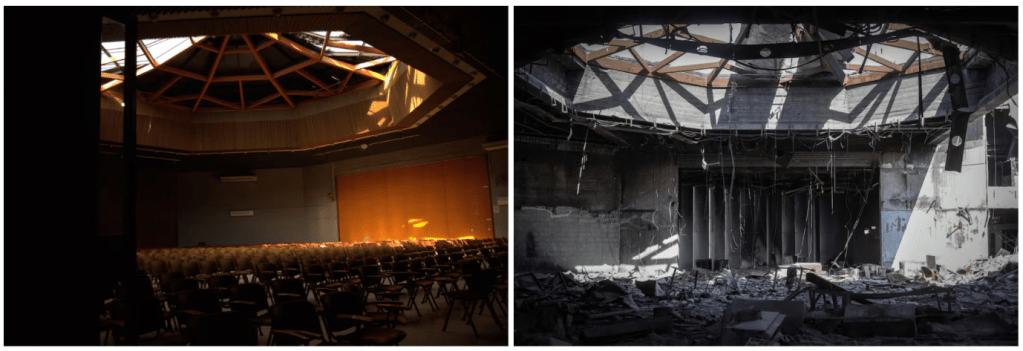
On 28 November 2023, film and festival director Khalil Al-Mozian shared a photo of the Rashad al-Shawa Cultural Centre, a theatre in Gaza which used to hold film festivals, including Mozain’s Red Carpet Human Rights Film Festival, struck to grey rubble. In 2017, The Electronic Intifada reported that, after many of them had been razed, only two cinemas remained in the West Bank. In 2019 one of them, Nablus’ Cinema City, closed. Despite the decimation of Palestinian screening facilities, Western onlookers have commenced no collective movement to use their resources to support the continuation of Palestinian cultural memory through film. Instead, international film festivals have systematically policed criticism of Israel and declined to express solidarity with Palestine. Examples of this are sometimes blatant. At this February’s Berlinale, Queerpanorama (2025) director Jun Li was reported to police by a festival jury member for proclaiming the pro-Palestinian phrase, “From the river to the sea,” during a speech delivered on behalf of actor Erfan Shekarriz, who had boycotted the festival due to its prior history of anti-Palestinian sentiment and repression. More insidious are the programming and marketing choices overseen by many film festivals’ executive departments, which indicate an erasure of Palestinian cinema and a neglect to engage in discussion about Palestine, let alone manifest support.
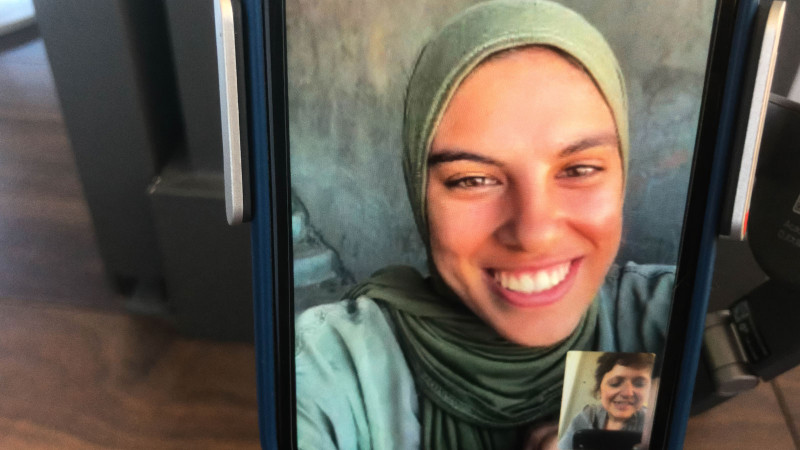
This August’s Melbourne International Film Festival (MIFF), where Linklater’s fantasy of a neutered New Wave will have its Australian premiere as a heavily promoted festival ‘Headliner,’ is an eerie example of the industry sidestepping their moral responsibility by straining to create a semblance of supposed balance in their program. Of the more than 275 films appearing in this year’s festival, four of them are, in some way, about the occupation of Palestine. Of these four films, one of them was created by Palestinian filmmakers: Once Upon a Time in Gaza (2025), directed by twins Tarzan and Arab Nasser; and another, the documentary Put Your Soul on Your Hand and Walk (2025), from the Iranian filmmaker Sepideh Farsi, is about a Gazan subject, Fatma Hassona—a photojournalist killed by an Israeli airstrike alongside six family members on 16 April 2025, the day after the announcement of the film’s upcoming world premiere at Cannes. Neither film is categorised as a festival headliner, instead placed in the festival’s ‘Africa & Middle East’ and ‘Documentaries’ sections respectively. Neither is foregrounded by the festival’s frenetic social media promotion campaign, remaining absent from any of their Instagram posts, and mentioned only briefly—or not at all—in their lengthy press releases. Neither film will screen in the festival’s most iconic venues, such as The Astor Theatre, The Capitol, or The Forum, instead playing on more peripheral, smaller screens. Neither film will screen as part of the festival’s regional tour. Each will play just twice; and no special events—such as panel discussions or Q&As—will be hosted in response to them.
These two films are seemingly counter-programmed beside two documentaries which, also featuring Palestine, are prefaced in the festival’s assets by a certain sympathy for the state of Israel and a stark misreading of Israel’s genocide as a mutual conflict. The first is Brandon Kramer’s Holding Liat (2025), a documentary about the family of two Hamas hostages, about which Jordan Mintzer of The Hollywood Reporter writes, “At a time when people feel obliged to choose which side of the Israeli-Palestinian conflict they stand on, Holding Liat takes a thoughtful middle ground.” During a recent interview with The Australian Jewish News, Kramer himself embraced this stance. The second is Israel Palestine on Swedish TV 1958-1989, an archive of journalistic footage by Swedish documentarian Göran Hugo Olsson, which MIFF’s programme presents as a chronicle of “violently intertwined history,” “conflict,” and an unspecified “contested landscape.” This acrobatic phrasing, reflecting an obfuscating vernacular now ubiquitous across every facet of the Western media, desperately attempts to avoid ideology. In doing so, it adopts one of flagrant denial. The carefully manufactured both-sidedness of MIFF’s program represents a dominant thrust of today’s film industry, as it seeks to maximise the festival’s audience and donors while pre-emptively pacifying critique.
The unveiling of MIFF’s program came two weeks after I mounted a campaign asking the festival to cease their then-planned partnership with the UK-founded international streaming service MUBI in response to MUBI’s decision to accept an investment of 100 million USD from Sequoia Capital—a venture capitalist company which has contributed significantly to Israeli military development start-ups, with weaponry already in action destroying Palestinian lives. MUBI’s public statement, which justified their decision to accept funding from Sequoia Capital and iterated their refusal to consider disinvestment, exemplifies the risks of an indiscriminately ‘pro-cinema’ ideology. MUBI don’t accept or deny their choice as a moral failure, but divert attention to the sacred product their complicity will allow them to foster: cinema. After gathering signatures through private channels over the course of five days, I sent an open letter to MIFF’s representatives with 194 signatures, among them filmmakers, film workers, critics, and concerned audience members. The letter stated:
“As critics, film practitioners and dedicated lovers of film, we are incredibly concerned about MUBI’s recent decision to accept a major investment by Sequoia Capital, a venture capitalist company that has contributed to funding an Israeli military defence start-up, and thus directly facilitated the development of weapons used to systematically decimate Palestinian lives […]
In light of MUBI’s acceptance of warmongering, we ask MIFF to cease your partnership with MUBI in order to maintain your vital core values of inclusion, integrity and respect…”
While our letter asked MIFF to cease their announced collaboration with MUBI on the live-scored event, ‘Julia Holter: The Passion of Joan of Arc,’ it was sent with the hope of pressuring the organisation to enact a public statement of solidarity with Palestine. Such an expression, I thought, could cause a belated ripple effect within the Australian film industry, which still lags behind its counterparts in other cultural spheres. While the Australian literary and journalism fields have seen the rise of outlets such as The Sunday Paper, Lamestream, Deepcut News, and ETTE Media, as well as dedicated ongoing pro-Palestinian solidarity from publications including Overland, Meanjin, and Kill Your Darlings, to counteract the dominant censorship of pro-Palestinian speech and writing, there has been no equivalent movement across the film sector. Of course, there are glimpses of hope, such as in the extraordinary volunteer-run journal Senses of Cinema, which published a landmark dossier about Palestinian cinema earlier this year (‘Enduring Frames: Cinema, Solidarity, Palestinian Resistance’); or at the Melbourne Cinémathèque, which will screen a retrospective of films by the inimitable, Nazareth-born maestro of searing cinematic auto-fiction, Elia Suleiman, this October. Mired by market interests, however, more amply resourced organisations fail to follow suit.

Perhaps my hope was naïve, especially considering the festival’s most recent public remarks regarding Palestine, made in 2010 by then-Executive Director Richard Moore. In 2009, the festival faced critique from British director Ken Loach, who withdrew his film Looking For Eric (2009) in response to MIFF’s sponsorship by the state of Israel that year. In 2010, as MIFF continued to accept Israeli state funding, Isabelle Stead requested a film on which she worked, Son of Babylon (2009), a Palestinian co-production, cease screening at the festival, to which Moore petulantly responded: “Re the question of festival sponsorship; it is entirely a matter for our independent arts organisation to seek sponsorship wherever we see fit.” “For the record,” he went on in the email exchange published by Crikey, “I find your comparison between Israel and an apartheid state odious; we shall have to agree to disagree on this issue.” While MIFF’s leadership has since changed, to this day the organisation has made no concerted attempt to distance itself from its prior, well-documented posture of denial and complicity.
In response to our letter regarding MIFF’s collaboration with MUBI, MIFF peeled MUBI’s logo from their website and assets without a word of public explanation. Unlike Chile’s Valdivia Film Festival, however, which has wholly turned down any films distributed by MUBI in solidarity with Palestine, MIFF will show several films courtesy of MUBI Australia and New Zealand. Moreover, MIFF did not take this opportunity to audit their lingering associations with Zionist bodies. One of MIFF’s long-time partners is Schwartz Media, which owns The Saturday Paper, The Monthly, and Black Inc. As The Sunday Paper, which formed in May 2021 in response to the monopolisation of Australian arts media by the Schwartz entity and similar ‘progressive’ fronts, reports, Schwartz Media is owned and operated by Morry Schwartz, a vocal supporter of Israel who oversees the organisation’s “unofficial but widely known editorial policy” of excluding coverage of Israel’s inhumane occupation of Palestine.
Meanwhile, one of MIFF’s venues this year is the Gandel Lab at the Australian Centre of the Moving Image (ACMI), which is funded by the Gandel Foundation. As Sunday Paper co-editor Matt Chun discusses, Gandel Foundation owners John and Pauline Gandel have actively and excessively contributed to Israel’s genocidal project. The couple personally housed Zionist leader Benjamin Netanyahu in occupied Jaffa in 1988, while John Gandel—who on 13 October, 2023, stated that Israel had “no choice” but to go “all out” in attacking Gaza—features on a handwritten note of ‘Tier 1’ donors leaked from Netanyahu’s office. One booked-out MIFF event to be held at the Gandel Lab will be a talk titled ‘Theory and Practice: Cinema and Cultural Exchange.’ ACMI’s Gandel Lab is also the home of MIFF’s Accelerator Lab, an intensive four-day program “nurturing tomorrow’s top screen directors on the journey towards their first long-form works,” which begs the question: is Israel’s genocide an appropriate ground on which to gestate the future of Australian cinema? Or is the only thing being accelerated our willing compliance, and the perverted ideology that the continuation of cinema—in whatever skeletal, soulless form—is enough?
When Godard and Truffaut closed the curtains on Cannes 1968, they did not do so out of any belief that cinema itself was trivial, that it should not be seen and talked about during moments of crisis. “The issue isn’t whether or not to see films right now,” said Godard. “It’s obvious we have to show and see as many movies as possible, and that is our goal.” Rather, to shut down the festival was to cement and leverage the political status of film work as labour, to hold practitioners of the medium accountable to think deeply about its use and consequences. By harkening to this moment, I am not calling for a boycott of any cultural organisation (I don’t have the authority to do so), but asking that this accountability is applied by film institutions, practitioners, critics, and filmmakers to the status of cinema within this present crisis. This means abandoning any presumption of cinema’s innocence and any inherent trust in the businesses that dispense cinema as their product. It means applying criticism not only to specific films, but to the structures through which they are financed and distributed. It means enacting dialogue with cinemas of liberation to resist the medium’s absorption by the interests of the military industrial complex. To close the curtains on the industry’s performance of business as usual will only clear a stage for new questions and responses to emerge.
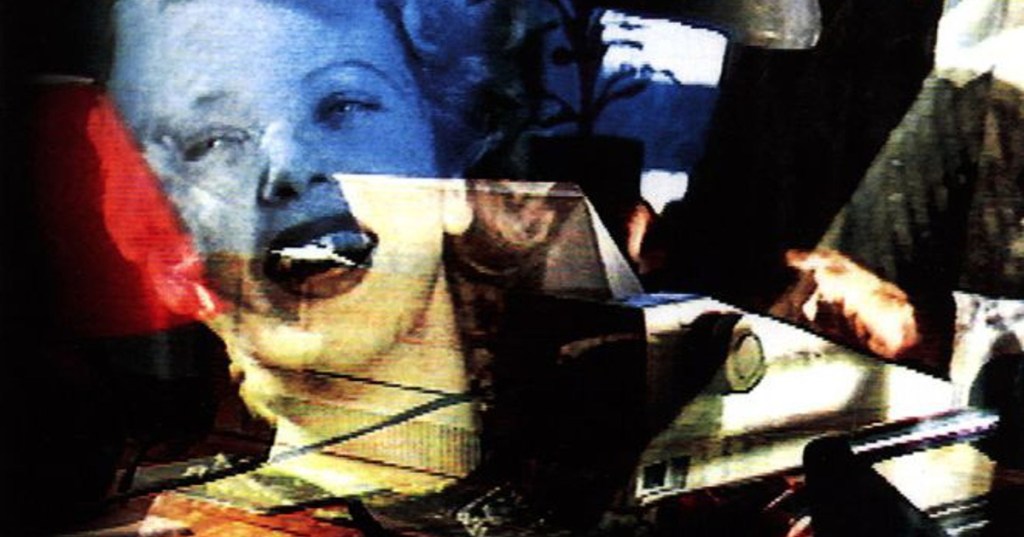
Always, for Godard, a dedication to pointing out cinema’s collective failures—its myriad deaths—was far from fatalistic. Godard ceaselessly reinvented the political energies of montage, honing, particularly through his 1988–1998 video series Histoire(s) du cinéma, a technique of superimposition primed for exposing invisible mechanics of complicity, revealing the dependence of bourgeois cinema’s glamour on images of atrocity, oft hidden but ever-present.11 Godard did not mourn cinema, but stretched its fatal wounds as fresh starting points, seeking to reanimate the form with militant force up until his own death. Now, as there remains no sign of Israel ceasing their project to vanish Palestinian life, it’s critical for us to do the same.
To support the continuation and innovation of Palestinian filmmaking, donate to the Palestine Film Institute (PFI). The PFI is an international not-for-profit organisation which facilitates the work of Palestinian filmmakers through education, production, funding, and distribution assistance, and the preservation of Palestinian film heritage.
**********
Indigo Bailey is a Tasmanian writer and editor living in Naarm/Melbourne. In 2023, she received the Island Nonfiction Prize for an essay about rain sound. She has written for HEAT, Island Magazine, The Guardian, and Kill Your Darlings, among other publications.
- Godard initially documented the resistance of the fedayeen in Jordan with Jean-Pierre Gorin for the project Jusqu’à la victoire (Till Victory), which was abandoned after the fedayeen were massacred in Amman from 1970-1971. In response, Godard collaborated with Anne-Marie Miéville to rehabilitate the footage, creating the self-critical montage film Ici et ailleurs (Here and Elsewhere). The fractious history of Ici et ailleurs is comprehensively explored in two essential Senses of Cinema essays: ‘The Impossible Temporality of Revolution and Cinema in Jean-Luc Godard and Anne-Marie Miéville’s Ici et Ailleurs’ by Suja Sawafta and Emma Ben Ayoun; and ‘Ici et ailleurs: The Backstory’ by Rula Shawan. ↩︎
- See Overland’s reportage of the surveillance and persecution of student protesters at the University of Melbourne, including this piece by Shillan Shebly, Elizabeth Strakosch, and Natalie Ironfield: ‘Rebranding repression: the University of Melbourne’s elite capture of antiracism,’ 22 June 2025. ↩︎
- Some key exceptions include Screen Slate, who in September 2024 formalised their “ongoing alignment” with PACBI’s principles and explicitly committed “to not crossing the international picket line for Palestine.” As already indicated, the Australian publication Senses of Cinema has also clearly designated their stance on Israel’s genocide and consistently published rigorous and wide-ranging research on Palestinian cinema and film cultures. ↩︎
- Quoted in Sawafta and Ayoun, ‘The Impossible Temporality of Revolution and Cinema in Jean-Luc Godard and Anne-Marie Miéville’s Ici et Ailleurs,’ May 2025. ↩︎
- Of course, standout exceptions exist, for example, Another Gaze’s curated streaming platform Another Screen and, locally, this year’s inaugural Brunswick Underground Film Festival (BUFF). ↩︎
- See the text translated by Timothy Barnard and published by Montreal-based press, Caboose. ↩︎
- See ‘The Memoricide of the Nakba’ in The Ethnic Cleansing of Palestine, 2006. ↩︎
- ‘Changing the narrative, with Naser Shakhtour,’ Senses of Cinema, May 2025. ↩︎
- See more information and watch some of the films restored by El-Hassan at thevoidproject.org. ↩︎
- Quoted in Hito Steyerl, ‘Documentarism as Politics of Truth,’ translated by Aileen Derieg, Transversal, 2003. ↩︎
- See Gavin Smith’s interview with Godard, ‘Interview: Jean-Luc Godard,’ Film Comment, March-April 1996, particularly his discussion of A Place in the Sun (1951) and George Stevens’ footage of concentration camps, interlaid in Histoire(s) du cinema. ↩︎

