


When video game designers work with horror genres, a common tendency is to reduce the material to iconography—a wardrobe of ready-made, instantly recognisable tropes, detached from their original contexts. Cat-and-mouse multiplayer romp Dead by Daylight (2016), for example, boasts a roster of playable killers taken from highly divergent franchises, among them Halloween’s Michael Myers, Hellraiser’s Pinhead, and The Ring’s Sadako, yet each inclusion amounts to little more than a playstyle variation, within a competitive match mould that stays much the same. With indie experiment Night At the Gates of Hell (2022), developers Jordan King and Henry Hoare take a more attuned approach, citing as inspiration not intellectual property but the sensibilities of two Italian genre specialists best known for their zombie flicks of the late 70s and 80s: Lucio Fulci and Bruno Mattei.
The period during which these two filmmakers made their most iconic works was a revitalising one in Italian horror, thanks largely to Fulci’s 1979 Zombi 2—not in fact a sequel, but a flagrant cash-in on George A. Romero’s Dawn of the Dead (1978). Thanks to Fulci and his collaborators’ rebellious touches, the film goes beyond its mercantile raison d’être, with disgusting, boundary-pushing gore and a haunting, ironic tone all of its own. In its wake, exploitation specialist Mattei—more expedient, less of an artist—was enlisted to create his own version of Dawn, directing 1980’s Hell of the Living Dead. His greatest fame, however, is—ignobly—as the ghost-director replacement for Fulci after he was axed during the production of Zombi 3 (the latter’s career never fully recovered from the resulting fiasco’s stain). Posthumously, Mattei seems destined to languish in obscurity; Fulci, on the other hand, enjoys a deity-like status in the memories of gore hounds. Yet, in the present time, as horror attracts prestige productions and Palme d’Or laurels, even he retains a putrid stink that wards off complete legitimisation.
The names Fulci and Mattei may be relatively exotic in the context of video games, but for bedroom developers like King and Hoare, the mining of cinephilic horror territory has been a successful modus operandi. In recent years, a fertile crop of short DIY horror efforts emulating VHS, CRT (cathode ray tube displays), and blocky, early-3D PlayStation games has carved out an online niche. This is thanks to the seminal, streamer-friendly works of Benedetto Cocuzza (a.k.a. Puppet Combo), under whose micro-label Torture Star Video Night At the Gates of Hell was published. With quickly made efforts inspired by slasher and exploitation works, such as the Texas Chainsaw Massacre-inflected Power Drill Massacre (2015), Cocuzza provided a model that bears the fruits of a lesson well-learned: that in horror, jaggedness and raggedness can be turned to significant advantage.
*
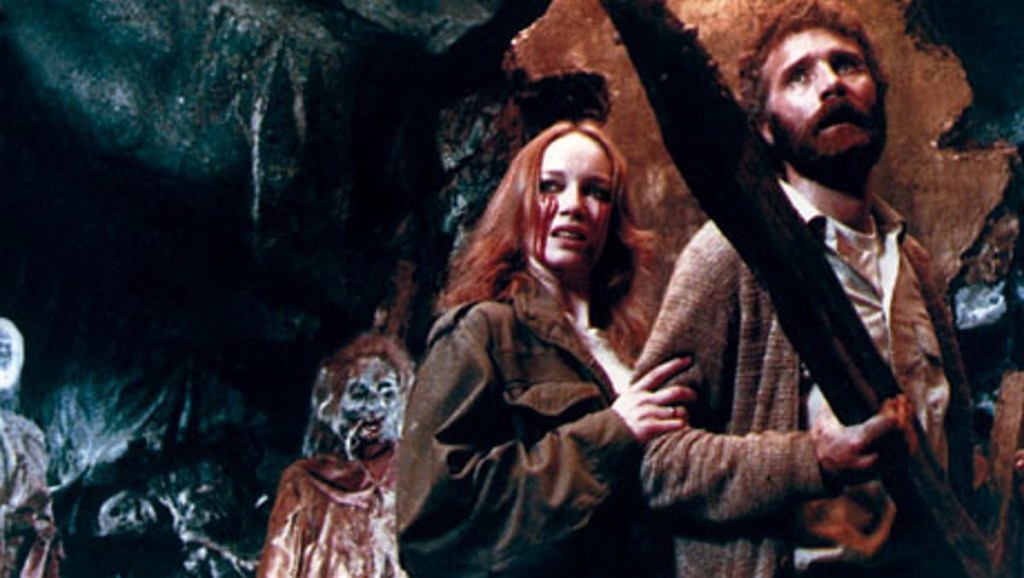
Night At the Gates of Hell takes its basic premise—a supernatural apocalypse brought about by a hanged priest—from Fulci’s City of the Living Dead (1980). The film’s arrhythmic narrative and editing experiments are not really recreated, though there is a dreamlike feel as the player moves through isolated environmental vignettes, following a drip-feed of foreboding written notes that outline soon-to-be-zombified characters in the briefest of sketches. The game’s main playable protagonist, David, accompanied by the body of his recently deceased wife, embarks on a journey that eventually unravels the truth, fending off repeated zombie ambushes with a revolver as he goes. In stripped-back survival-horror fashion, the player searches for knives and ammunition to protect themselves. Headshot wounds, as in Zombi 2, are vital.
Fulci and Mattei’s deployment of thrillingly disgusting zombie effects—the best of them made with a painterly eye and a doctor’s nerve—are key to the interest of their films. Take for instance the iconic foul-toothed ghoul on proud display on Zombi 2’s poster: dappled with thick white paste and brown dirt, a tangle of worms scooped up by his eye socket, fresh from his underground resting place. The impressive tactility of such images aren’t exactly easy to cheaply recapture in a game engine, but Night At the Gates of Hell is nonetheless filled with a playful variety of simply drawn rotting, ulcerated, zombified creeps, almost all uniquely textured and modelled. Enemies differ in size, shape, and state of decomposition: from tall, hooded, pus-faced cultists, to a group of skittering skulls with spinal cords still attached who wriggle along the ground like mice. The skeletal mother superior from Mattei and Claudio Fragasso’s nunsploitation film The Other Hell (1981) makes a brief, unwelcome appearance, as does a strange, rubber-faced being that peeks its head up through some broken floorboards, its existence left mysteriously unexplained. Downed zombies spray their surroundings with streams of red liquid, with a few bespoke animations reserved for special moments: these include a body bitten in half by a rabid shark and a surprise re-enactment of Zombi 2’s famous eye-gouging scene.
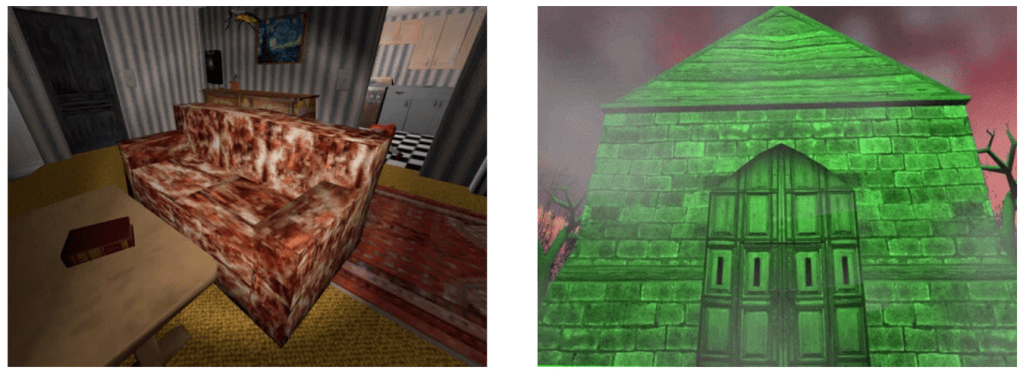
Eschewing the lurid splendour of watching Zombi 2 on a film print or digital restoration, King and Hoare instead simulate the levelling, low-res gait of VHS home viewing. The game’s viewport is curved and overlaid with vertical scan lines to give the impression of an old CRT screen, its crude models and textures bestowed with hazy, indeterminate life. It’s possible, for example, to be uncertain at first glance whether the busy, peach-coloured texture of a living room couch is putrid flesh or just a gauche design. The game’s scuzzy palette leans into musty browns and greys, with occasional washes of unearthly green, red, and magenta that nod to the vivid gelled lighting of Dario Argento’s Suspiria (1977).
The game’s prologue makes for a snarl of an opening statement. Here you play as Liam, a chauvinist creep impatiently hoping to get his rocks off at a squalid picnic rendezvous with his girlfriend, Razor. The pair’s exchange is lent a fair dose of snark thanks to the voice acting of Nathan Wilson and PrincessPowPow, a streamer and OnlyFans model. The latter, for me, is the cast’s most valuable contributor, serving up in her short appearance more than one choice, wry line reading, including a memorable rendering of “You can get lost if you don’t come back with a condom on your dingy.” Razor’s shirt comes off in the blink of a mouse click, and a strange, low-poly sex scene is suspended before it starts. But by the time Liam fetches the requested protection and returns, a zombie gang has cornered Razor and is ripping her apart, one of the ghouls shaking a mouthful of disembodied breast as if to gloat.
The scene, with its implicating lack of safe moral distance and estranging use of blocky nudity, recalls Striptease (2009), a short conceptual game by prolific experimentalist Stephen Lavelle (a.k.a. Increpare). In it, the player slides jumbled tiles in order to reassemble the scantily clad body of a stripper named Candy who, literally objectified, takes off pieces of clothing as a ‘reward.’ The puzzles (similar to a real type of softcore adult game) are interspersed with text-based dialogue, the last of which takes place between Candy and a male patron, who starts harassing her. We then jump forward to the game’s final puzzle, where Candy puts her regular clothes back on her body, now bruised. Though the player’s relationship to the story is ambiguous, one disturbing thought occurs in retrospect: we might have been looking through the eyes of the assailant himself.
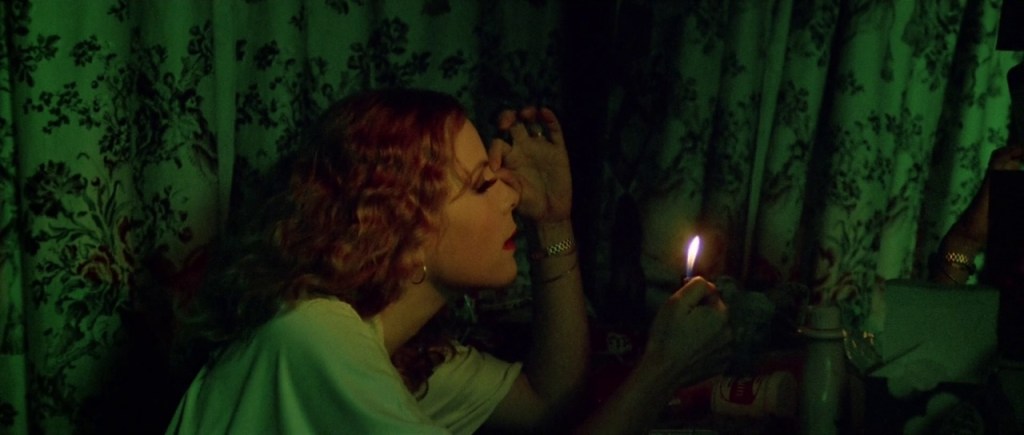
The squirmy, discomforting possibilities of POV identification have been much-exploited in modern cinema, a particularly acrid illustration being Fulci’s own Psycho (1960) tribute, The New York Ripper (1982), a sexually charged giallo featuring a deranged killer who murders women while emitting an off-putting, duck-like quacking. Such tactics have the potential to find even more direct expression in games, a phenomenon discussed by Jesper Juul in the fifth chapter of his book The Art of Failure: An Essay on the Pain of Playing Video Games (2013). Beyond traditional narrative, video games are well-placed to (though only rarely) explore agent regret—the special guilty significance of “I did it”—since distressing events can be tied to the player’s own first-person, in-world actions. Night At the Gates of Hell doesn’t actually contain narrative-altering choices, but we do return to illusions of them; there’s a victim of the cultists that David is unable to save, a firearm supplied to an ally which leads to unforeseen destruction. When Liam makes a confession booth deal with the zombie priest (the devil’s handmaiden), there’s a rhyme with what occurred just before—dodging an unwanted pregnancy, he now aids a force incepting something even worse: the undead apocalypse.
The roughness of the game’s non-propagating sound design also becomes a virtue when turned to the purposes of violent fright. In ‘Woodside Apartment,’ its second, most effective chapter, dread-inducing, multi-throated gasps crescendo from out of nowhere. Growls and thumps announce hostile presences through walls, pointing towards action that seems to unfold just out of sight. During the lulls between action, the game’s sound mix is kept quite low, only to be cruelly ruptured by blood-curdling volumes, which assault the player with shock.
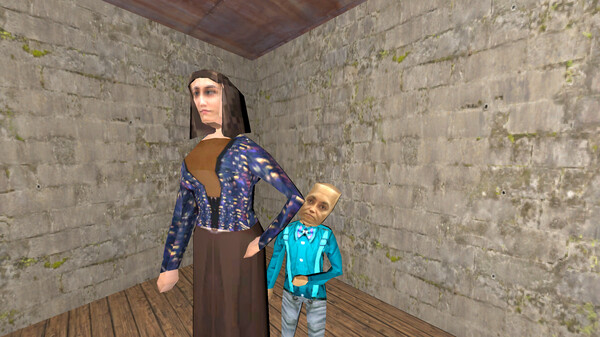
Once David meets up with a motley gang of survivors, the game finds a broad and blue comic register, making hay with a dim-witted ship’s ‘captain,’ and Charles, a paper-bag-faced ‘child’ with a grotesquely incestuous attachment to his mother. Charles conjures up a role played by Peter Bark, an adult dwarf cast to odd effect as a young boy in Andrea Bianchi’s 1981 zombie flick, Burial Ground. The dialogue scenes tip over from silly into the uncanny. Character mouths unmoving, idle animations like animatronics, they harken back to both the primitive cutscenes of early 3D games and the mismatched, cross-lingual dubbing practices of the Italian film industry’s past.
*
Throughout his life, Fulci suffered terrible personal loss, with the suicide of his wife in 1969 followed by the death of his daughter in a car accident shortly after. There can be few expressions of spurned faith more potent to a Catholic than the hanged-priest-turned-Satanist of City of the Living Dead, perhaps best summed up with the maestro’s own words: “I have realised that God is a God of suffering.” Night At the Gates of Hell does contain a few devastating moments: the violent sobs of the aforementioned cultist victim; a protective, fearful mother clinging to a crucifix to ward off her ‘satanic’ kid. However, the tragic notes are more often gestured to rather than palpably felt. There is a standout moment at the end of the apartment level: David’s wife, reanimating, lets out a series of operatic wails, beckoning him back deliriously like a siren. But the depths of tortured feeling found in Fulci’s work are only glimpsed, and the game’s ending, an action film deus ex machina, works against the apocalyptic premise it effectively sets up early on. The developers rarely reach for the lyrical, tonal layering of Fulci’s best scenes; Zombi 2’s Fabio Frizzi-scored underwater zombie shark sequence—ridiculous, terrifying, serene, and sensual all at once—finds no near comparison.
Nasty, cheap, and gratuitous, King and Hoare’s games are not the sort of thing likely to amass indie-darling accolades; horror, of all genres, cannot be for everyone without surrendering its essential tools. Video games and the once vulgar medium of film share a twin fate: they’re disreputable cultural forms that have become sanctioned focal points of middlebrow attention. This development is not in itself a bad thing, but it often arrives hand-in-hand with a sanitising impulse, along with a dubious premium placed on ‘tasteful’ restraint. Night At the Gates of Hell occupies a refreshing position, then. Culturally self-conscious yet wild and ill-mannered, it’s a sludgy reminder of the virtues of art that dredges up the venomous muck of the mind.
**********
Austin Lancaster is a screen critic with bylines at Rough Cut, KinoTopia, Senses of Cinema, and Rock Paper Shotgun. A versatile writer, he likes to take up perspectives that cross boundaries between different art forms, with particular interests in indie games, world cinema, and philosophy. His latest writing can be found at his newsletter, ‘Umby Cord’.

