

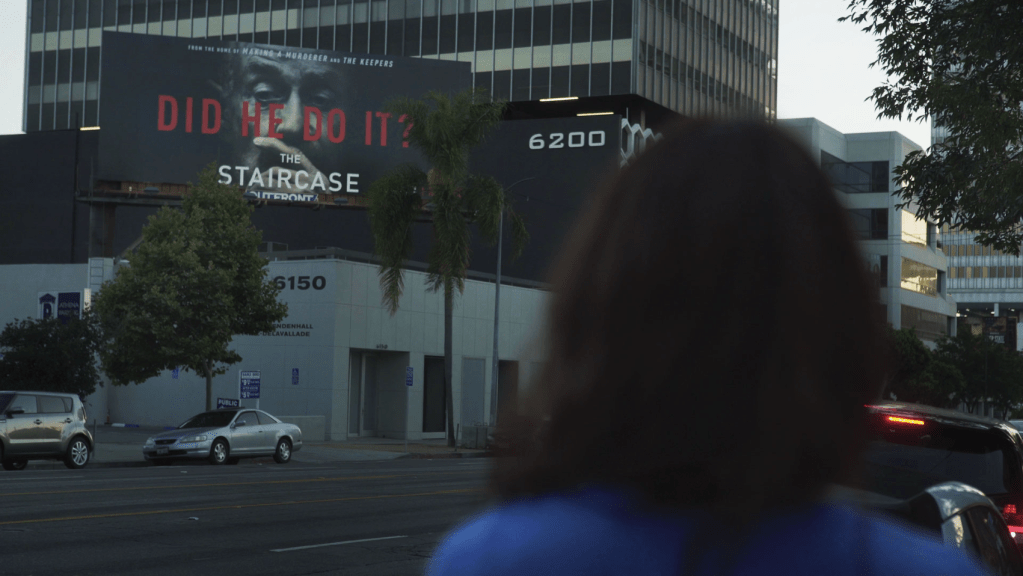
Subject opens with a scene of Margie Ratliff, a participant in the 2004 true crime docuseries The Staircase, driving past a towering billboard depicting her father. “I can’t describe how painful it is to relive my mum’s death over and over again,” she says. The image of her father’s face, shadowy and tightly cropped, is set behind bold, capitalised text: DID HE DO IT?
This is not archival footage. The advertisement is for Netflix’s 2018 re-release of the original series, which follows the trial of Margie’s father for allegedly murdering her mother. By this point, it had already spawned two sequels, and was soon to be fictionalised into a hit HBO series starring Sophie Turner as Margie. Her ordeal is a testament to the obscured risks of signing a participant consent form.
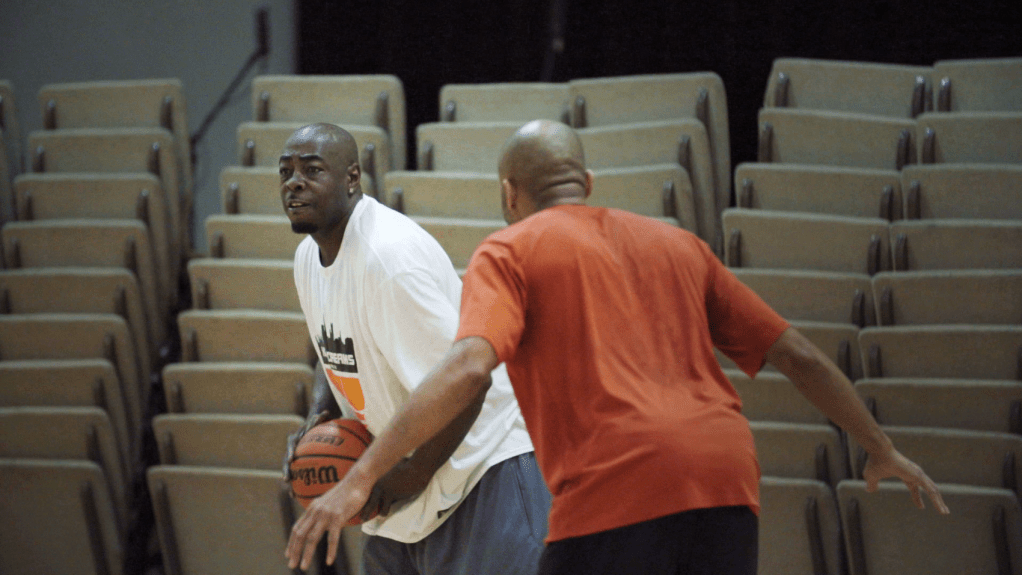
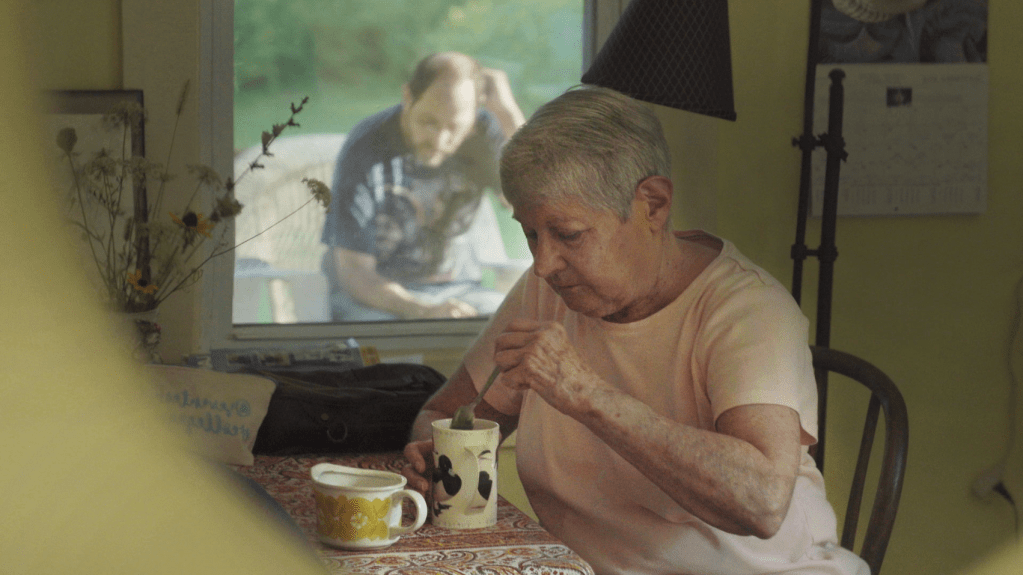
Subject, which was co-directed by Jenifer Tiexiera and Camilla Hall, chronicles Margie’s story alongside those of the participants of other critically acclaimed documentaries like Hoop Dreams (1994), Capturing the Friedmans (2003), The Square (2013), The Wolfpack (2015), and Minding the Gap (2018). Their experiences aren’t all negative, but most struggle with the whiplash of overnight celebrity and extreme scrutiny.
Tiexiera and Hall pay particular attention to the documentary boom of the streaming era, in which the hunt for lurid scandals has normalised extractive storytelling. But the film also touches on documentary filmmaking’s ethnographic origins, revealing a medium marred by power imbalances from its conception.
“A documentary is not capturing someone’s story, it’s becoming part of someone’s story,” says Toronto International Film Festival programmer Thom Powers, one of Subject’s interviewees. Far from mere documentation, he describes an “intervention” that does not end once the camera stops rolling. Subject argues for greater autonomy for participants navigating these interventions—an alternative to extractive filmmaking that values stories more than the people who lived them.
Note: the following interview has been edited for length and clarity.
Thomas Phillips: Subject traces a long history of questionable documentary practices going all the way back to Nanook of the North (1922). What is it about the form that has made documentary filmmaking so susceptible to exploitation for so long?
Jennifer Tiexiera: I think [Nanook of the North’s] heart was in the right place in the sense of wanting to open other people’s eyes to other cultures and countries. I just think that gaze was very tainted. And then, as the form evolved, at least here in the United States, you had to have money to make documentaries. It wasn’t something that was as accessible as it is today. So when it’s only a certain group telling the stories, whether it’s intentional or not, you’re only getting one perspective. Which, in my opinion, can be dangerous.
TP: Some of your interviewees in Subject have been traumatised by public scrutiny. How did you and Camilla approach them and earn their trust with this in mind?
JT: When it comes to the trust-building, we entered it with all the participants as a partnership. It’s called Subject for a reason. We knew that we wanted to make the film with them, and a lot of these participants are filmmakers in their own right. Ahmed [Hassan] shot on The Square [as well as being a key subject], Mukunda [Angulo, from The Wolfpack] has a history of making film that I am floored by, and Margie majored in documentary.
This was where we developed the idea of something called ‘continued consent.’ It’s constantly checking in, re-evaluating where we are in the project, re-evaluating the relationship, how we all feel about the project. There was a point where Margie had to take time off and we didn’t know if she was going to come back. Even in this situation we make tons of mistakes.
TP: After directing Subject, you developed a public resource for documentarians called a consent calendar. How does this calendar work and what prompted you to create it?
JT: It just became very clear how problematic building trust was when you’re handing them a document that historically is so predatory once you start reading the fine print. These younger PAs or associate producers slide in and they’re like, “Oh, we just need to sign this, it’s just paperwork.” And then it’s like, “We own you and your image in perpetuity in the universe forever.” And sometimes they even went a step further and had life rights involved, which some of our participants had experienced. Then you find that out later and it feels like, “Oh, you lied from the very beginning.”
I had the opportunity to work on a series for HBO right as Subject was coming out called Unveiled, where I had numerous survivors talking about the abuse they suffered at the hands of an organisation called La Luz Del Mundo. Many of them were sharing their stories for the first time. So, like in Subject, there were three to five conversations before a camera was even mentioned.
There was no way that we could make that decision without understanding: one, if they understood the implications of being in a documentary. Two, if they were in the right headspace to relive those situations. Three, whether they thought they could be anonymous or show their faces. So that’s something that we built into this consent calendar. Like, this is the day where they should decide. Because this was a network situation, it was the day when I lost my power.
TP: What happens when you lose that power?
JT: When you’re going up the ladder with network approvals, at the end of the day we do have to deliver a product. If it’s not an independent film it’s important that you’re very clear with your network, or distributor, or streamer from the very beginning about your intentions and that they hire you based on those intentions so you don’t find yourself going down a road where a lot of change happens at the top very quickly.
TP: What do you think constitutes ethical documentary editing and how did Subject’s editor [Lauren Saffa] approach this process?
JT: I’ve been a documentary film editor for 23 years now and this was really my impetus for making this film with Camilla—we were both having existential crises about our jobs. At that point I think I’d edited ten or fifteen feature-length docs, and I would form this deep bond with these people that I had never met, not really understanding their hopes and dreams for the project or why they were participating in it in the first place. I only had what the director told me. I really don’t edit anymore unless it’s on my own project because unless an editor is a co-director or a producer, it’s hard to make ethical choices because you’re flying by the seat of your pants a little bit.
We did a cut [of Subject], but we workshopped it for a year before it premiered; it was about four months [working] with the participants. Each of them had final say over their sections, and that scares a lot of people. But in this case, it really made sense because it was such a partnership leading up to that. They weren’t pulling out big parts, it was mostly anything that didn’t feel right or could be re-triggering to them.
TP: How do you think the recent flood of documentaries competing for virality has affected industry ethics?
JT: It’s a double-edged sword. We’ve had exposure like we’ve never seen and it’s made documentaries accessible in a lot of ways. On the other side, it’s made it so corporate. When you’re working against the bottom line, some of the first things to go are ethics. Ethics take time and they’re expensive.
TP: Some of Subject’s interviewees make a case for paying participants for their time—something conventional journalism frowns upon in case it sways objectivity. What’s your stance on this issue?
JT: Every time it comes to a famous pop star or a politician or an athlete we have no problem paying them. It’s negotiated because they can afford to make sure that they get paid. But in the most infamous story of Hoop Dreams, they just paid to keep the lights on so they could keep filming this family who gave them so much of their life.
I believe in making sure that my participants don’t suffer at all in participating in this with me. I believe in making sure that we pay them for their archive and childcare if they need it—and meals. Do I off the bat offer a performance fee? I do think that’s problematic, but hey, we’re doing it for all these other people. I think it should just be a little bit more consistent.
TP: It’s widely documented that participating in documentaries can have unpredictable outcomes. In your experience, why do people still feel so compelled to share their stories despite the risks?
JT: I just think it’s human nature. We’re storytelling beings. It can come with intense scrutiny but it also can be the most cathartic, beautiful process as well. I think documentaries have this incredible power to make you not feel alone and to remove stigma. It’s one of the best parts of humanity that we’re willing to connect to one another that way.
Subject is currently streaming on SBS on Demand.
**********
Thomas Phillips is a Naarm-based writer and radio producer. His work has appeared in The Guardian, the BBC, Vice, The Millions, and elsewhere.

