


I tell my piano things which once I used to tell you. I think a lot about these words written by Chopin to his dear friend and/or lover Tytus Woyciechowski in 1829. The intimate language of letter-writing to a beloved ‘You,’ I think, is in kinship with the language of piano playing. Indeed, Chopin hated playing in public concert halls, preferring to play for his close group of friends at soirées, or simply playing only to one person at a time.
Listening to Ryuichi Sakamoto play the piano in Opus creates the sense that you are intruding upon an intimate exchange. You become an eavesdropper. You sense the pianist is conversing not to the audience, but to a ‘You’ beyond the room. Or perhaps to the self. Isn’t it strange and marvelous how even when we write only to ourselves in the pages of a diary we begin with ‘Dear’ as if speaking in confidence to a loved one? As if there are things about ourselves that we don’t realise are secrets until there is someone else listening.
I didn’t realise Opus would be a largely wordless film until 15 minutes in. I had expected a more traditional biographical documentary that led us through archival footage of Sakamoto’s life and career, interviews with family and friends, conversations and re-enactments. Aren’t our preconceived notions of the genre of biographical documentary also strange? How can a film encapsulate a person’s life?
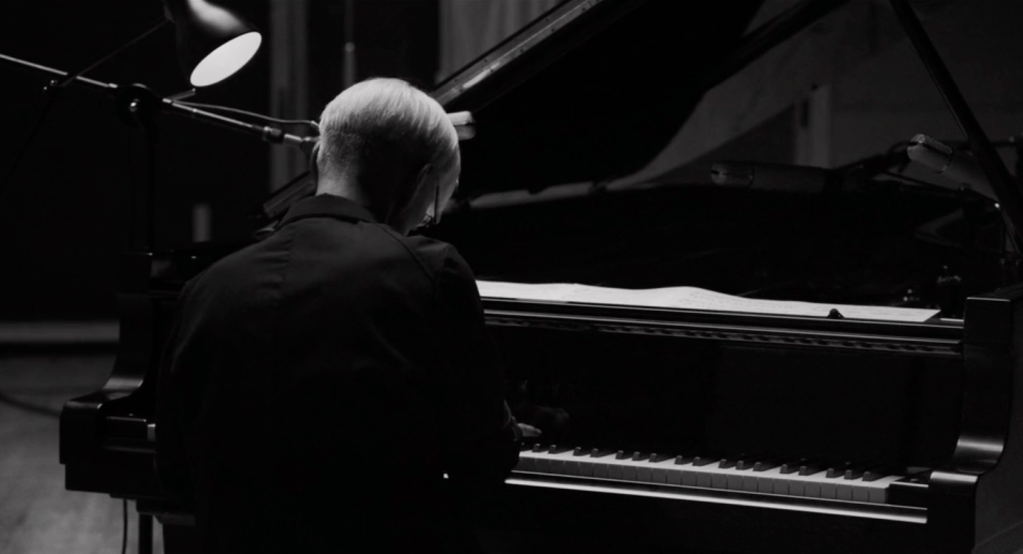
Opus is essentially a filmed musical recital of compositions handpicked by Sakamoto spanning his career, including his beloved film score entries ‘Merry Christmas, Mr. Lawrence’ and ‘The Last Emperor.’ Sakamoto’s musical voice contains echoes of Bach’s yearning suspensions and counterpoint (as in the chorale-like ‘andata’) and Debussy’s blending of Asian and Western musical languages (as in the gentle, pentatonic melodies of ‘Merry Christmas, Mr. Lawrence’). Shared amongst Sakamoto’s compositions is a stripped-down minimalism that never feels derivative in its charm and is often deeply moving in its measured simplicity. The documentary is made entirely of scenes in which Sakamoto is alone at the piano, filmed in rich tones of black and white by his son, director Neo Sora. Opus was born from Sakamoto’s desire to perform one last time, knowing that he was dying from a terminal cancer that would claim his life in 2023. However, Sakamoto was too ill to sit at a piano for the hour or two required for a live concert, so a filmed recital was instead proposed.
There are inevitable differences between listening to a recital on film and listening to a recital live. Unique to the medium of film is cinematographer Bill Kirstein’s lyrical use of light and frame, to create at times the illusion of stark, expansive landscapes—sheet music floods the upper half of the screen like a blinding horizon, microphone stands loom like trees, the lid of the piano surrounds Sakamoto’s face like a cave. In a particularly striking shot near the end of the film, the first in which we see the entire grand piano side-on, Sakamoto plays in darkness save for the light of a lamp, the details of which dissolve into the shadows to give the illusion that the lamp is a disembodied, hovering full moon. Interviewed by Dennis Lim at the 61st New York Film Festival after the North American Premiere of Opus, Sora says the intention was to mimic the passage of time over a day—night, morning, midday, evening, night—around which Sakamoto rearranged the track order to evoke each transition. Woven into the film is a hyperfocus on the passing of time.
What remains of a performance once it has passed? Where does the music go once the hands leave the keys? Once your hands are no longer able to press them? There’s always a sense of frailty and vulnerability in live performance. I feel nervous when I see a soloist at the piano alone on a concert stage, in the moments of bated breath before the first note, no matter how seasoned the performer. I think there’s something uniquely lonely and vulnerable about the piano as an instrument. There’s a recording of Krystian Zimerman playing Chopin’s ‘Piano Concerto No. 1’ in E-minor with the Polish Festival Orchestra and at exactly 7:45 minutes there is a pause where the orchestra dies away and Zimerman holds the pause a little longer than is usual and re-enters with the piano solo in E-major a little quieter than is usual. In that moment there is the illusion that this is someone who is entirely, impossibly, devastatingly alone while surrounded by an orchestra onstage. Only the piano is capable of such loneliness.
What remains of a performance once it has passed? Where does the music go once the hands leave the keys? Once your hands are no longer able to press them?
—Xiaole Zhan
And a solo pianist, alone on a stage, is entirely exposed. There’s something painfully tender about hearing a soloist lose their way, even momentarily, during a live performance—especially a remarkably practiced one. I am reminded of the famous last recital of Dinu Lipatti on September 16, 1950, who died of Hodgkin’s Lymphoma at the age of 33 only three months later. His doctor had begged him that afternoon to cancel the performance. Last-minute cortisone injections enabled him to make his way to the piano bench with a high fever. The recital unfolded flawlessly until a fumble near the end of the program during Chopin’s ‘Op. 64 No. 3 Waltz’ in A-flat major. He recovered with a breathless performance of the famous ‘Grande Valse Brillante, Op. 18’ in E-flat major, only to find himself too exhausted to begin the last waltz of the recital (the final programmed piece of his career): the heroic ‘Op. 34 No. 1’ in A-flat major. The audience was silent as Lipatti left the stage. However, he unexpectedly returned, beginning to play a piece that was not on the programme, but was well-known to all who had followed his career—‘Jesu, Joy of Man’s Desiring’—a simple Bach chorale which had been the first work he played at his first recital.
Sora foregrounds the necessary frailty of live performance even in film. About halfway through the recital we hear the only spoken words in Opus, with Sakamoto pausing after a moving performance of ‘Aqua’ to say, “I need a break,” and then barely whispering, “This is tough. I’m pushing myself.” Later, in the performance of ‘Bibo no Aozora,’ Sakamoto stumbles and stops during an improvisational section of the piece, playing a chord over and over with different variations and considering each harmony but never feeling that one is quite right. During his NYFF interview, Sora describes this moment as his father searching for “a path in the woods that doesn’t exist.” This rendition was the second of three takes, with the third being a seamless performance, but Sora decided to keep the imperfect take because “there was something a little bit more… mysterious about this one.”
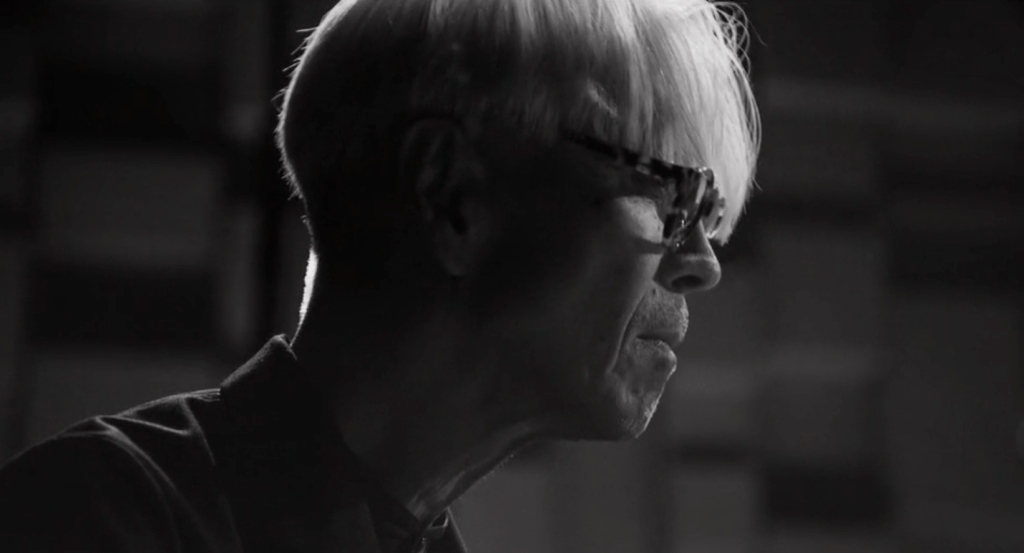
This circles me back to the question: how can a film encapsulate a person’s life? In Opus, the humane, expansive mystery of musical performance is part of the answer. There’s something about the gaze of the camera itself, whose closeness to Sakamoto’s playing feels almost sheepish, as if a cameraman trying not to breathe too loudly, that renders not only the film’s audience, but anyone in the room in live time with Sakamoto, as eavesdroppers and intruders. And I think this is simply a consequence of the inherent privacy of a person at a piano—even in a room holding a technical crew, sound engineers, and filmmakers, Sakamoto is entirely, paradoxically, spellbindingly alone.
The piano itself is an instrument of impossibility and mirage. Chopin envied the strings because of the seamless connecting of one note to another, ‘legato,’ that is possible on a violin but can only be achieved through illusion on the piano. A note played on the piano is not sustained but begins to die away as soon as it begins. The pianist is one who learns to string together echoes. The piano is an instrument of memories.
The pianist is one who learns to string together echoes. The piano is an instrument of memories.
—Xiaole Zhan
Perhaps the truest autobiography of an artist is exactly what can be achieved in a wordless recital of music played on a piano. It is intensely moving to witness a person at the piano, knowing that there is something there that cannot be claimed, a private and solitary joy that is not ours to entirely know, a secret letter that is not ours to intercept. In this way, the dignity and privacy of personhood is very much like a melody on the piano—illusory, vanishing, and magical.
Ryuichi Sakamoto | Opus is now showing across Australia.
**********
Xiaole Zhan (they/them) is a Chinese-New Zealand writer and composer based in Naarm. They are the recipient of the 2024 Kat Muscat Fellowship and a 2024 Wheeler Centre Hot Desk Fellowship. They were also the winner of the 2023 Kill Your Darlings Non-Fiction Prize and the 2023 Charles Brasch Young Writers Essay Competition. As a composer, Xiaole is the 2024 New North Emerging Artist. Their name in Chinese is 小乐 and means ‘Little Happy’ but can also be read as ‘Little Music.’

