


“Blondes make the best victims,” Alfred Hitchcock once said. “They’re like virgin snow that shows up the bloody footprints” (The Sunday Times, 1973). With her platinum hair pulled back into a French twist à la Kim Novak in Hitchcock’s Vertigo (1958), the victim status of Irish-born whistleblower Maureen Kearney is repeatedly called into question in Jean-Paul Salome’s latest film The Sitting Duck.
Based on true events, the film sees the indomitable Isabelle Huppert as Maureen, who works as a union representative in the French nuclear industry when she attempts to expose covert dealings between the multinational group Areva and the China General Nuclear Power Corporation. Huppert’s character is criticised and harassed by her male superiors, which soon escalates to threatening phone calls and unknown vehicles tailing her. Soon, Maureen is assaulted in her home by an unknown assailant and discovered bound to a chair in the basement by her cleaner. Horrifically, she’s left with a letter ‘A’ carved into her stomach by means of a knife also used to sexually assault her.
In Salome’s film, mirroring real life, the police who investigate Maureen’s assault immediately question the validity of her story, and the narrative surrounding the attack is manipulated by those supposed to aid her. Suspected of staging her own attack to gain attention and sympathy, Maureen begins to lose close allies and public sympathies.
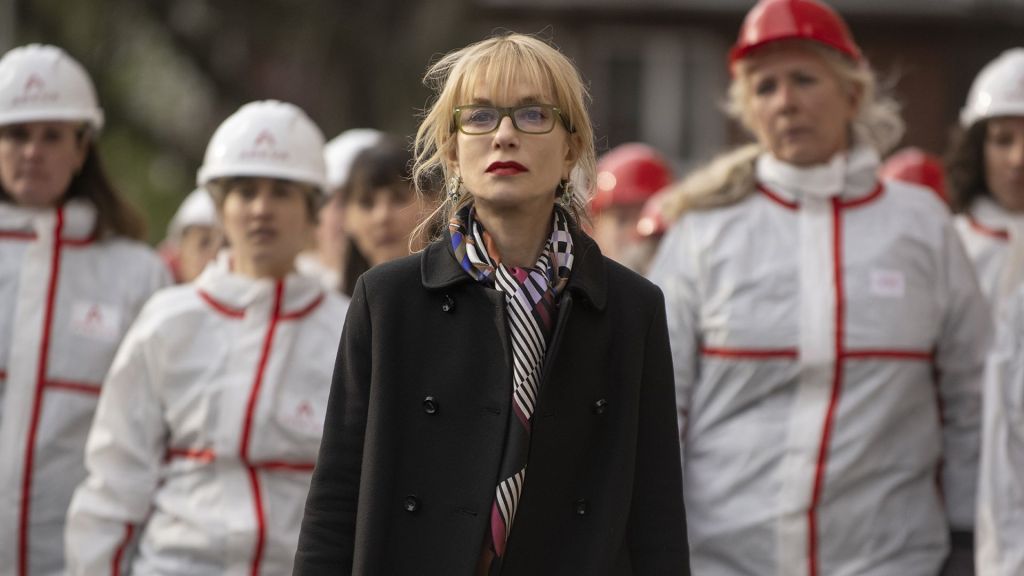
In portraying these true events, The Sitting Duck (co-written by Salome and Fadette Drouard) is a tale of political intrigue and paranoia that interrogates society’s idea of a ‘good victim.’ The real Kearney quietly resisted the oppressive system of justice she found herself up against; throughout the investigation and subsequent trials regarding her attack, she did not perform loud displays of emotion, even when a previous assault was used to gaslight and victim-blame her. She did not seek pity, and her primary concern was the protection of her family, not herself (Grégory Gadebois appears here as Kearney’s husband).
The film takes place across the 2010s, and the growing momentum towards the #MeToo movement is felt in its later stages. This dramatisation of Kearney’s experience has numerous intricate threads, and The Sitting Duck admirably attempts to weave them into a cohesive tale. However, the film is bifurcated by opposing genres, a paranoid thriller and a traditional court drama, ultimately falling underwhelmingly between the two. The allusions to Hitchcock stop short at Huppert’s styling and performance (it’s easy to believe Hitchcock would’ve loved Huppert’s pragmatic approach to acting; plus, she would’ve made been fascinating in Marnie). The visual style of the film is subdued and unintrusive. The flat lighting and basic blocking might be interpreted as an attempt to avoid aestheticising Kearney’s assault, and the everyday quality of the film’s look adds a level of absurdity to the interruptions to her life. However, one also misses the style of films such as Vertigo or the Jane Fonda-starring Klute (1971), in which more expressive, shadowy visuals establish a greater sense of dread.
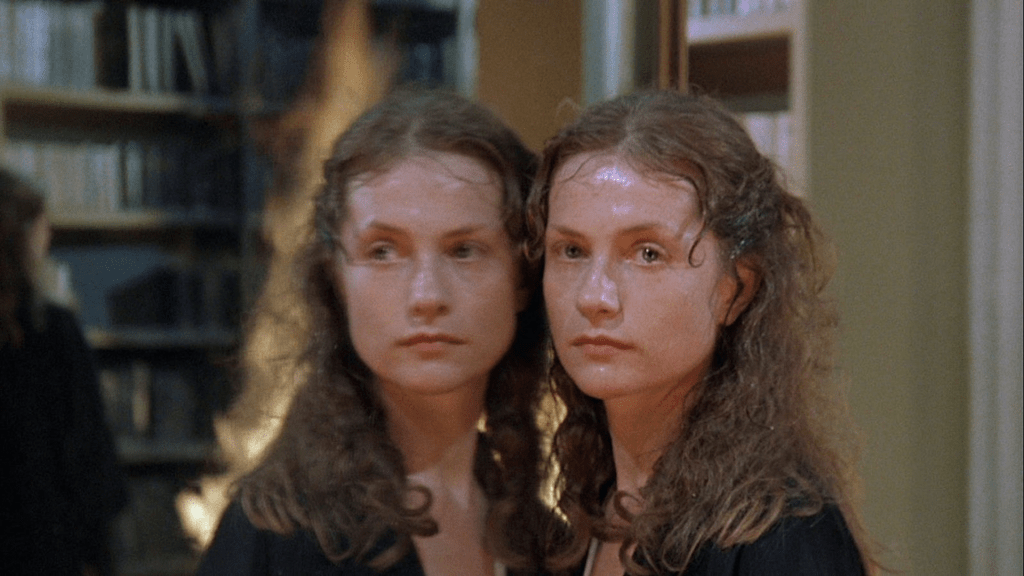
The real draw of the film is in seeing Huppert add another complex leading role to her wildly impressive resume. Though not amongst the greatest of her performances—such as in The Piano Teacher (2001), La Cérémonie (1995), or Malina (1991)—her portrayal of Kearney has many of the hallmarks that have become synonymous with the iconic French actress. In the film, Huppert maintains her signature steeliness; her withering blank stares are deployed to both comic and dramatic effect. And who wouldn’t savour the simple pleasure of Isabelle Huppert putting on a red lip, or Isabelle Huppert in a hard hat, or Isabelle Huppert scolding men?
The actress’ portrayal of Kearney recalls her masterful work in Paul Verhoeven’s searing Elle (2016), in which her character, Michèle, endures a similarly violent ordeal. Both women, in their approach to retribution, invite us to question our own ethical boundaries, and Huppert, for her part, resists the temptation to plead for our sympathy. In Elle, she exudes power and thorniness with bleak humour and a loose physicality that indicates confidence, whereas in The Sitting Duck, Huppert’s trademark blankness transmits a sense of fragility beneath a tough exterior. As Kearney, she employs a stiffer physical quality and allows her eyes to well with tears, despite the character’s attempts to maintain her composure under pressure.
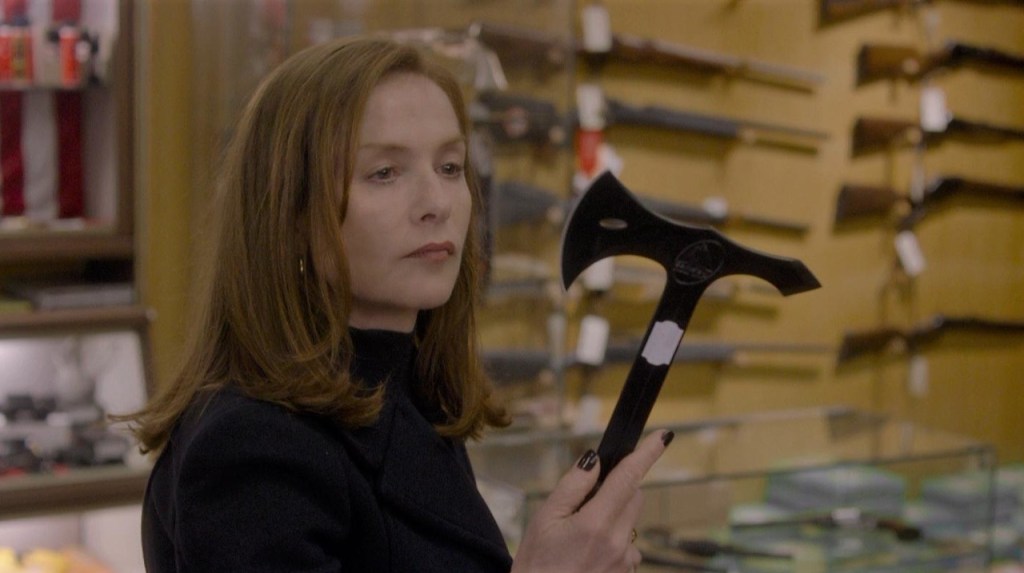
Throughout The Sitting Duck, Huppert faces brutality, humiliation, and interrogation. Like the real-life Kearney, the actress’ refusal to lean into heightened emotion or warmth can provoke accusations of being icy or calculating. But here, in her embrace of unknowability, lies her genius. She is sparing when it comes to displaying vulnerability, and it’s clear Salome has used our established relationship with the star to question Kearney’s reliability as a narrator. As the particulars of her assault case are investigated in The Sitting Duck, Salome invites us to question the plausibility of the incident through police re-enactment, during which Huppert telegraphs very little. Viewers can rarely get ahead of a Huppert character; whenever she appears, it is reasonable to assume that her character will not be as they seem. With her minimalist approach, Huppert grants the audience space to make up their own mind about her character’s nature, not diminishing her performance to reductive ideas of ‘relatability’ or ‘likability.’
Huppert’s style of acting doesn’t lend itself to overt transformations—in The Sitting Duck, there is notably no trace of the real-life Kearney’s Irish accent in her performance. But surface-level representations are not to Huppert’s taste, so while her name alone conjures some of the most memorable on-screen images of all time (take any scene from The Piano Teacher or her burst of laughter on that bus in Things to Come [2016]), you’re unlikely to find her in a compilation video of ‘good acting.’ Huppert has always been more concerned with a stirringly internal transformation—something you cannot detect until it has already taken hold.
The Sitting Duck is now showing across Australia as part of the Alliance Française French Film Festival.
**********
Andrew Fraser is a writer, performer & filmmaker based in Sydney, Australia. He holds a Bachelor of Fine Arts (Acting) from the National Institute of Dramatic Art and is an alumni of the MIFF Critics Campus. He has worked on multiple film and television projects including Heartbreak High, Birdeater, Three Thousand Years of Longing, Bump and Mr. Inbetween. His writing has been featured in the MIFF Revue, Kinotopia and The Big Issue, and he is a regular guest critic on ABC Drive Radio.

