

Historicism gives the “eternal” image of the past; historical materialism supplies a unique experience with the past.
—Walter Benjamin, ‘Theses on the Philosophy of History’ in Illuminations (1969)
Film adaptations of well-regarded works require a certain kind of courage. The weirdly conjugal terms with which the merit of the adaptation is judged—its ‘faithfulness’ to the original text, for example—disregard the consequences of a transposition from one medium to another. Film will impose its own technical demands on the narrative that prevent a complete fidelity to the original text—not to mention the space for creative liberty that should be afforded to filmmakers in their deviations. You need only look at the film adaptation’s analogue in art history, the proliferation of visual interpretations of (the same few) biblical or mythological scenes, to perceive this prejudice against the medium.
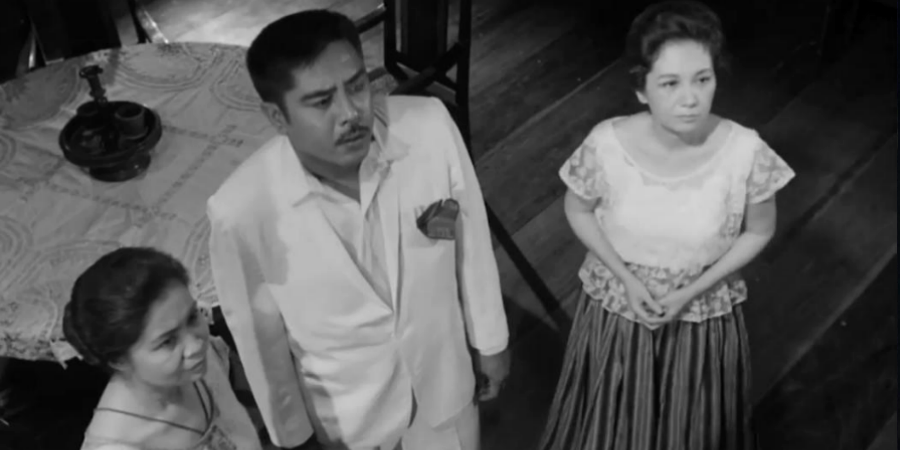
It is with this generosity and open-mindedness towards adaptations that I can comfortably proceed with my displeasure at Lamberto V. Avellana’s A Portrait of the Artist as Filipino (1965), adapted from Nick Joaquin’s 1950 play of the same name. Both texts follow Candida and Paula Marasigan, daughters of artist and former general of the 1896 Katipunan revolution, Don Lorenzo. Clinging to their childhood home and the eponymous portrait—a parting responsibility from their father that seems to embody both the power of symbolic representation and the ease with which it can be weaponised—the drama largely unfolds in the domestic space of the Marasigan house, with the stage play’s action set entirely in the sala.
Both the film and play begin with the end. In the opening scene, we learn from Bitoy Camacho, the son of a former family friend who also serves as a sort of one-man Greek chorus throughout, that the story takes place in Intramuros on the eve of WWII. Bitoy’s monologue describes an Intramuros in ruins, the Marasigan house—and family—destroyed. As in many of Joaquin’s stories, the spatial-temporal setting is indelibly linked not just to narrative but also to character. Often, the structures inhabited by Joaquin’s protagonists are also imbued with a sinister sentience that blurs the line between place and person. And in Portrait, the house itself seems almost an antagonist, holding the sisters hostage. Their father’s portrait is a watchful warden. The other characters’ machinations to coerce Paula and Candida into selling the painting, and their home, are couched in terms of the sisters’ freedom.
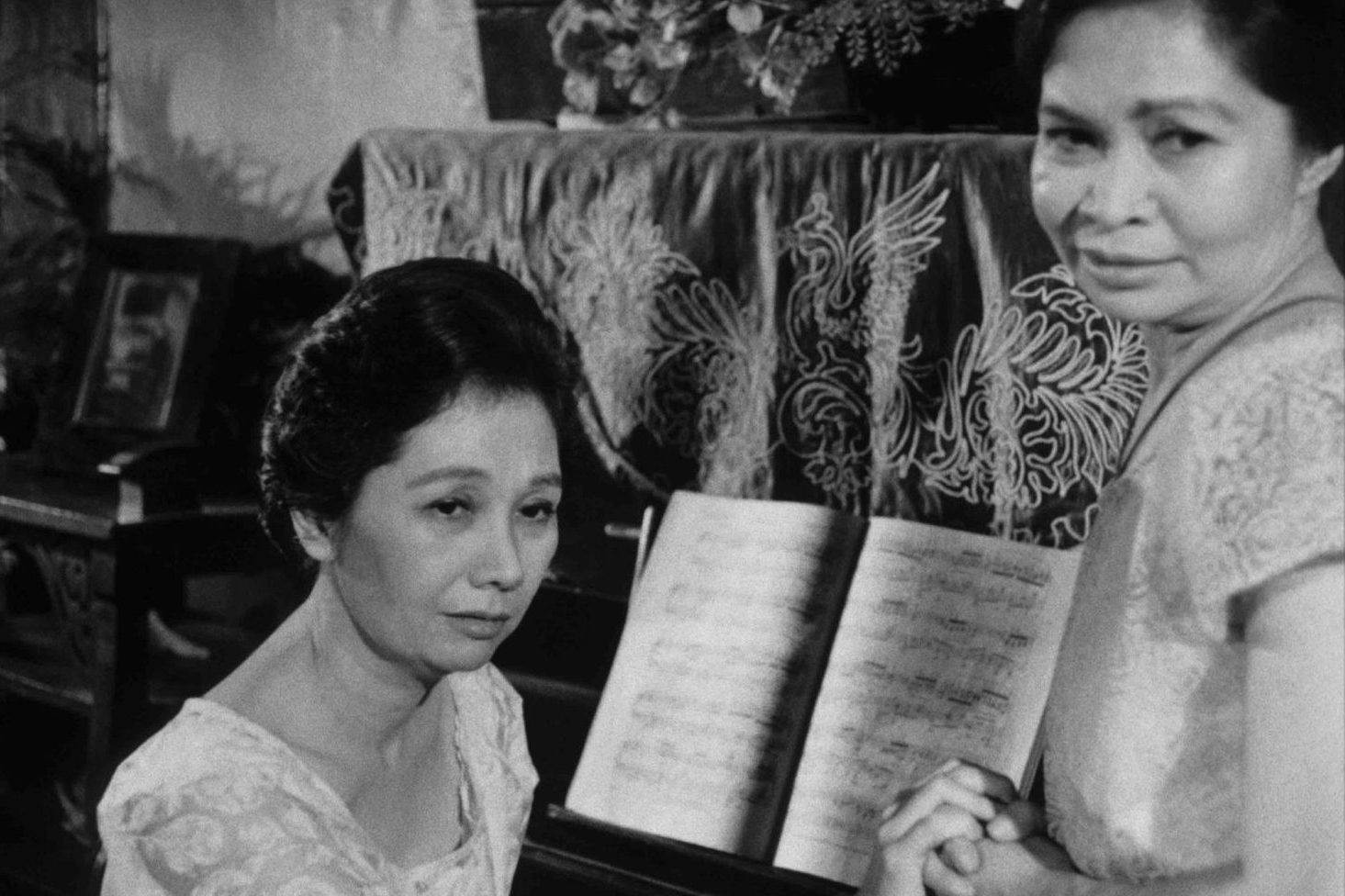
Avellana’s adaptation adheres to most of the play’s plot points. Where the film diverges is in the liberties it takes with its characters, in the portrayal of both Don Lorenzo and his Janus-like portrait (neither of which physically appear in the play), as well as the deletion of a scene in Act I involving Bitoy and his colleagues from a local paper. Though these differences have, admittedly, little to no impact on the narrative arc, the inclusion of the former and exclusion of the latter shows a fundamental misunderstanding of Joaquin’s critique of historicism, removing his experiment with temporality and the nuance this brings to the construction of Filipino subjectivity.
In staging Portrait, Joaquin positions the painting on the “invisible ‘fourth wall’ between stage and audience,” complicating the boundary between the drama’s fiction and the viewer’s reality.1 The portrait thus acts as both boundary and threshold. For while the theatregoer’s and reader’s gaze are impaired (the portrait remaining unseen to us), Joaquin simultaneously transmutes this gaze into the surveilling eyes of the portrait. Doing so makes the spectator a participant on the stage. The actors actively meet our eyes, even playing on our ignorance and intrigue when looking at Don Lorenzo’s painting.2 Through his characters, Joaquin thus confronts the dictating gaze that seeks to construct a convenient Filipino subjectivity. The painting, unseen as the actor-audience interface, not only allows for a self-reflexive re-appraisal of the Filipino by the Filipino, but its placelessness supplants linear history with Foucault’s concept of genealogy, which “expose[s] a body totally imprinted by history.”3 The idea that Filipino identity is “molded by a great many distinct regimes,”4 of forces always in flux that defy a primordial truth. In the interpenetration of stage and reality, the viewer uses their imagination to co-construct the portrait and map their own pre-conceptions, influenced by their context and positionality, onto the metaphorical canvas. This layering of temporalities gives way to a more rigorous interrogation of a Filipino subjectivity not bounded by the binary of colonial subject or a nationalist and racial essentialist “pre-colonial, ‘pure’” indio.5
In making the portrait visibly material, Avellana forecloses what academic Josen Masangkay Diaz describes as Joaquin’s “re-imagination of time and space [which] treats subjectivity as the basis for a historiography that challenges historicism itself as a mode of colonial governance and the impetus for nationalist paradigms of self-determination.”6 Avellana creates a symbol of Joaquin’s portrait. Or, in Benjaminian terms, he transforms the “Retrato del Artista como Filipino” into an eternal image. But by doing so, he robs us of the experience of it. Its very fixity overwrites the mode of creation and reception that Joaquin originally foregrounded through the portrait’s immateriality. In the film, the Utopian space where the nuances of Filipino historiography and identity were teased out disappears.
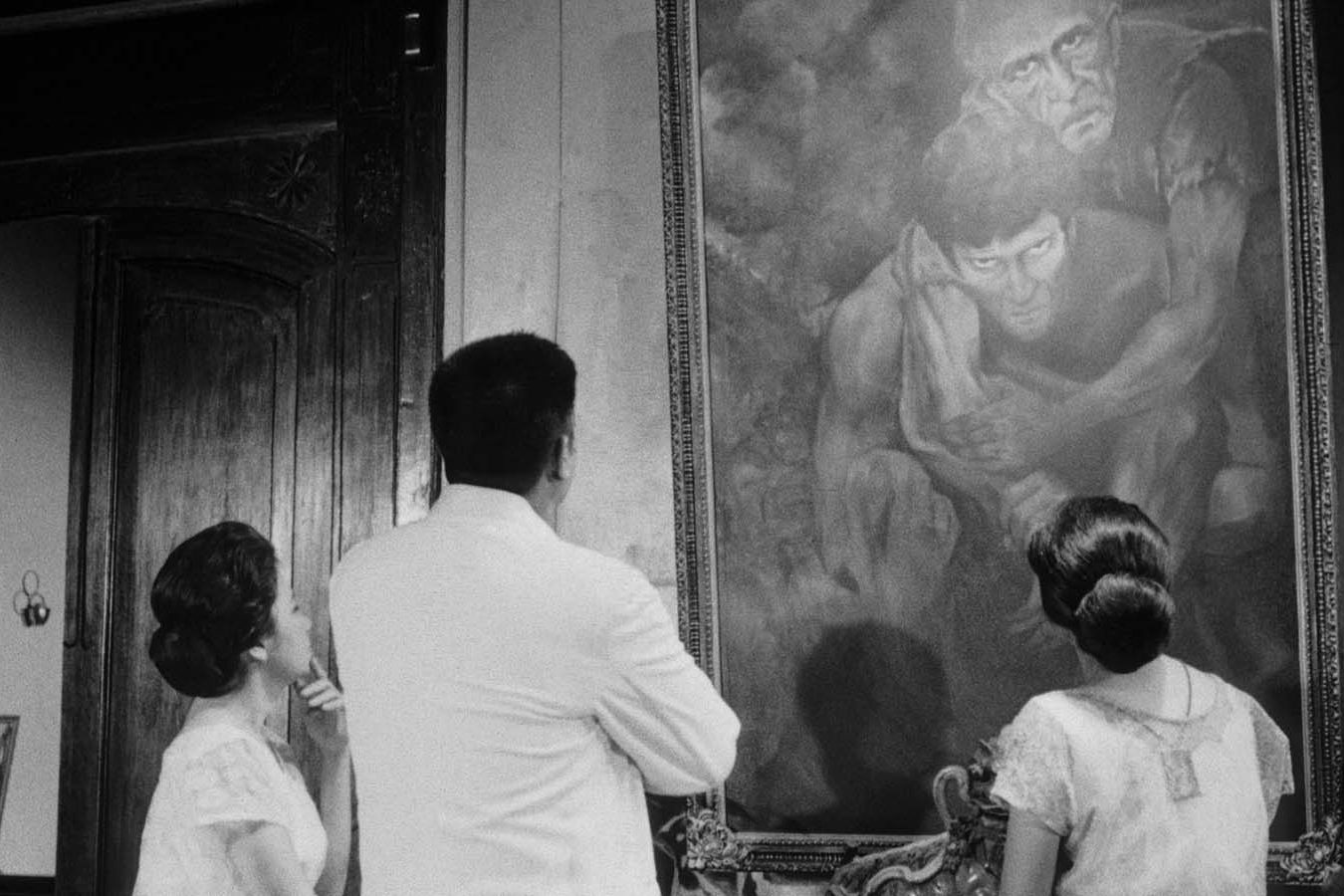
Don Lorenzo is similarly invisible in the play, sequestered in his room just off-stage (or off-page). This disembodiment is another strategy of temporal experimentation, with Don Lorenzo’s occlusion imitating a haunting. Because what is a haunting but the intrusion of the past into the present? Here the artist’s absence ironically magnifies his presence, until the Marasigan house itself seems an extension of him. Moreover, since our conception of Don Lorenzo comes from the other characters’ impressions of and relations with him, Joaquin was able to characterise him as a mosaic of his past selves. This further overlapping of histories is negated by the film, as Don Lorenzo’s corporeality (portrayed by actor Pianing Vidal) roots the character in the narrative’s contemporary time and place.
At best, the film’s portrayal of the artist amounts to a few inconsequential scenes, and at worst, it glorifies Don Lorenzo’s cult of celebrity which Joaquin, I believe, was critical of. The cult of celebrity is established by two scenes in particular: the depiction of Don Lorenzo’s suicide and his emergence from his room in the finale of the film. The former scene is directly preceded by one depicting Don Lorenzo vigorously painting the portrait and then presenting it to Candida (Daisy H. Avellana) and Paula (Naty Crame-Rogers) as “a painting by Lorenzo Marasigan … [which] surely must be worth something.” A work of art that they could “sell if they wish.” Again, there is the removal of ambiguity, here being Don Lorenzo’s intention in bestowing the portrait to his daughters. The film’s suicide scene is thus framed as a father’s last sacrifice to accompany his last (material) gift. Avellana’s lingering close-up shots on the actor, scored to the crescendo of orchestral music interpolated with crashing thunderstorms, in all its glorious ostentatious drama, also gestures to the elevation of the ‘national artist’ to a god-like figure. For one can’t help but draw an analogy to Jesus’ own sacrifice, especially since Avellana cuts to Paula and Candida kneeling in prayer just as Don Lorenzo takes his suicidal leap.
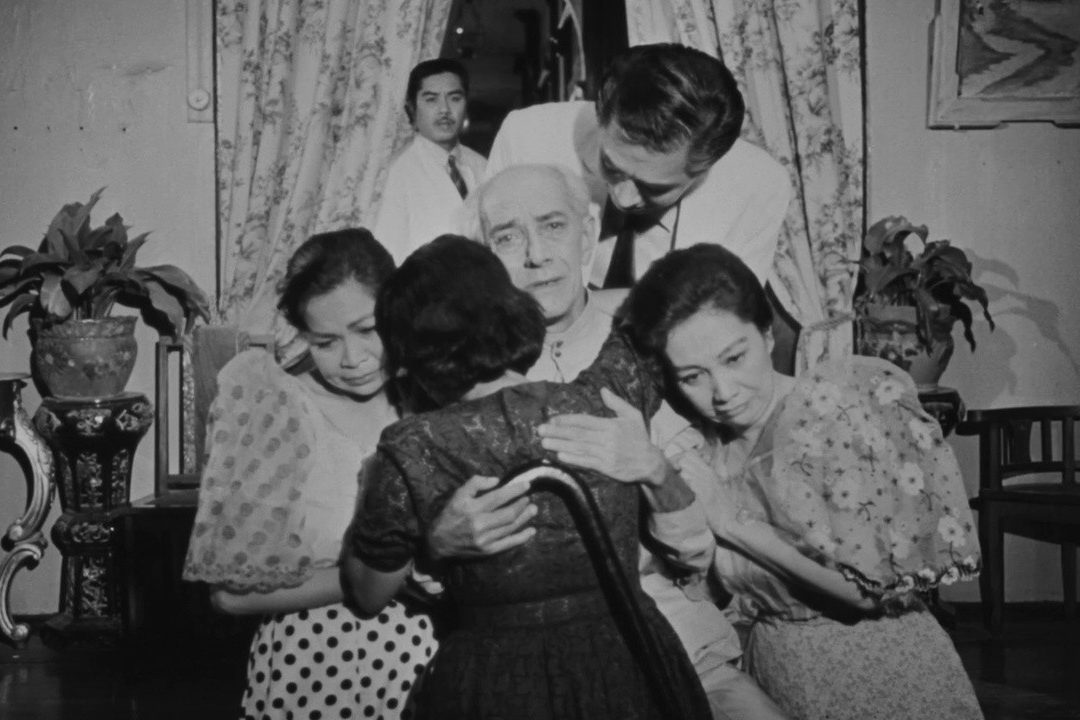
The second scene exemplifying this cult of celebrity is the fulfilment of Joaquin’s curtailed deus-ex-machina—though Don Lorenzo eventually leaves his room in the play, he never appears on stage. The artist thus eludes us, appearing only to the actors, much like his painting. Avellana instead gives in to this device’s easy resolution, just as he further cements the biblical hermeneutics of his interpretation. Even the arrangement of the actors in the reconciliation scene is composed almost like the Pietà, with Don Lorenzo as the Virgin bearing his children. Benjamin’s sense of “the eternal image” of history here has a more religious undertone. Nevertheless, the experience of uncertainty evoked by Joaquin’s inversion of the ‘god in the machine’ is eliminated. Intramuros’ destruction, described by Bitoy at the end of the film and play, is made impotent. The film reassures its audience that the Marasigan family are together in death, as they were not in life. Joaquin’s suspension of a happy ending lingers: like a memory, it gives us a space for contemplating the after, to remember that Intramuros, once the seat of the Spanish-colonial government, was reduced to a “man-made hell” by the end of the war.7 Where Joaquin sought to haunt, Avellana instead immortalised.
The film’s fundamental misunderstanding of Joaquin’s text is also evident in the decision to axe the scene between Bitoy and the journalists in Act I. Seeking to write about both the portrait and the artist, the reporters devolve into an argument about the merits and implications of both. This ensuing discussion on art’s autonomy from or obligation to society, in the cruel cynicism of the reporters’ views, elaborates Joaquin’s thesis on what art should do. “Art is not magic. Its purpose is not to enchant—but to disenchant!” are Bitoy’s parting words to the sisters at the end of the scene.8 This disenchantment can be seen as an experience of disillusionment: for the journalists, this is embodied by their lack of class solidarity (which in turn is reflected in the shallowness of their ‘leftist’ cultural critiques that Joaquin mocks and satirises).
But for Bitoy, there is also a desperate hope to use this disenchantment as a generative force. To disenchant is a form of disruption reminiscent of Benjamin’s “awareness that [the revolutionary classes] are about to make the continuum of history explode.”9 The presence of the journalists, people whose work is concerned with current affairs, represent an emphasis on the play’s jetztzeit: a “time filled with the presence of the now.”10 Besides being the eve of WWII, the journalists as occupied with the present also point to the final days of the Filipino as belonging to someone else, the war acting as a deadly delivery that birthed the Philippines as an independent nation. Writing in the infancy of the Philippines as a sovereign state, Joaquin perceived once more a jetztzeit (crudely translating to ‘now-time’) “ripe with revolutionary possibility.”11 The play sought to escape capitulation “to the very philosophy of history that brought about modern imperialism,”12 while Avellana’s film simplified the narrative into an interpersonal family drama reminiscent of the telenovelas I used to watch with my Lolas.
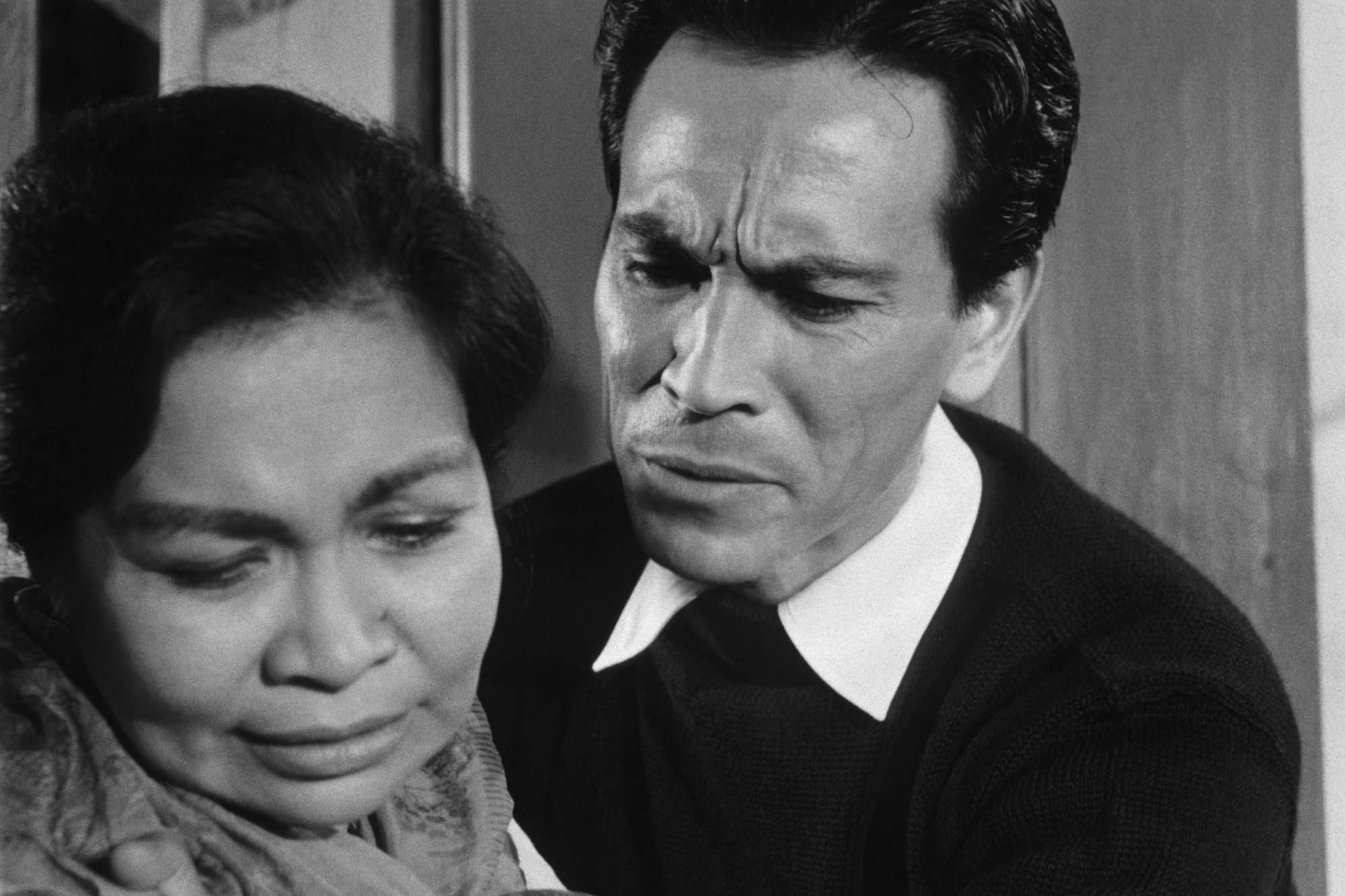
Though I personally dislike the adaptation, I believe that were it not so beholden to Joaquin’s original text, the film’s narrative would be able to stand on its own. By centring the story around the familial drama, the film makes more intimate the relationships between characters. Paula and Candida are afforded greater agency, going beyond Joaquin’s caricature of helpless spinsters. Because of this, the bond between the sisters feels more immediate and recognisable: the protective bordering on co-dependent dynamic that often forms between women. Tony Javier’s character is also rendered more nuanced and affective by Conrad Parham’s performance. While Joaquin does try to render Tony’s character more sympathetic through monologues about his past, the play ultimately antagonises him. In contrast, the range of emotions displayed by Parham complicates the audience’s opinion of his character: from his intense anguish and destitution when Tony finds that Paula has destroyed the portrait he saw as his salvation, to the cocky arrogance with which he seduces Paula in the first place. Avellana’s addition of the post-coital scene between Tony and Paula, the display of tenderness between them, humanises these characters. This quieter scene also breaks the intensity of the play’s pace, the constancy of its conflicts.
One could make the argument that an adaptation is just a form of interpretation, and that to make Joaquin the sole author of Portrait is to, per Roland Barthes, “impose a limit on that text, to furnish it with a final signified, to close the writing.”13 And so maybe this particular adaptation is a part of the total existence of Portrait’s ongoing writing? Wasn’t it from Joaquin that I gleaned what Barthes has called “the multiplicity of writing … [where] everything is to be disentangled, nothing deciphered”?14 The familial drama is certainly one strand of Joaquin’s tapestry. I want to believe in the film’s own merits, obscured as they are in the shadow of Joaquin’s text. But even as I believe the film to be a work in its own right that deserves to be restored and re-watched by a new generation of audiences, its disavowal of Joaquin’s critique of residual colonialism and emerging Filipino nationalism deserves a critical appraisal. Because it somehow feels like a capitulation to white hegemony for the film to ignore this anti-assimilationist sentiment, and the technique of un-representation with which Joaquin’s Portrait communicated this.
A Portrait of the Artist as Filipino is currently free to stream via SBS On Demand.
**********
Gabe Tejada is an emerging writer and art curator based in Naarm. Their words have been published by art galleries and magazines across so-called australia.
- Nick Joaquin, “A Portrait of the Artist as Filipino,” in The Woman Who Had Two Navels and Tales of the Tropical Gothic, by Nick Joaquin (Penguin Classics, 2017), p. 296. ↩︎
- Joaquin, “Portrait,” p. 302. ↩︎
- Michel Foucault, “Nietzsche, Genealogy, History,” In Language, Counter-Memory, Practice (Cornell University Press, 1977), p. 148.
↩︎ - Josen Masangkay Diaz, “‘We Were War Surplus, Too’: Nick Joaquin and the Impossibilities of Filipino Historical Becoming,” Kritika Kultura 24, (2015): 63, url: https://archium.ateneo.edu/kk/vol1/iss24/2/. ↩︎
- John D. Blanco, “Baroque Modernity and the Colonial World: Aesthetics and Catastrophe in Nick Joaquin’s A Portrait of the Artist as Filipino,” Kritika Kultura 4, (2004): 13, url: https://archium.ateneo.edu/cgi/viewcontent.cgi?params=/context/kk/article/1061/&path_info=_5BKKv00n04_2004_5D_202.1_Article_Blanco.pdf. ↩︎
- Diaz, “We Were War Surplus,” p. 69. ↩︎
- George E. Jones, “INTRAMUROS A CITY OF UTTER HORROR; Americans Find Dead, Dying, Wounded in Shambles of Manila’s Old Citadel,” New York Times, February 25, 1945, https://www.nytimes.com/1945/02/25/archives/intramuros-a-city-of-utter-horror-americans-find-dead-dying-wounded.html. ↩︎
- Joaquin, “Portrait,” p. 336. ↩︎
- Walter Benjamin, “Theses on the Philosophy of History,” in Illuminations, ed. Hannah Arendt (Schocken Books, 1969), p. 261. ↩︎
- Benjamin, “Theses on the Philosophy of History,” p. 261. ↩︎
- “Oxford Reference: jetztzeit,” Oxford University Press, https://www.oxfordreference.com/display/10.1093/oi/authority.20110803100020224. ↩︎
- Blanco, “Baroque Modernity,” p. 26. ↩︎
- Roland Barthes, “The Death of the Author,” In Image-Music-Text, translated by Stephen Heath (Hill and Wang, 1977), p. 147. ↩︎
- Ibid. ↩︎
 Rough Cut