

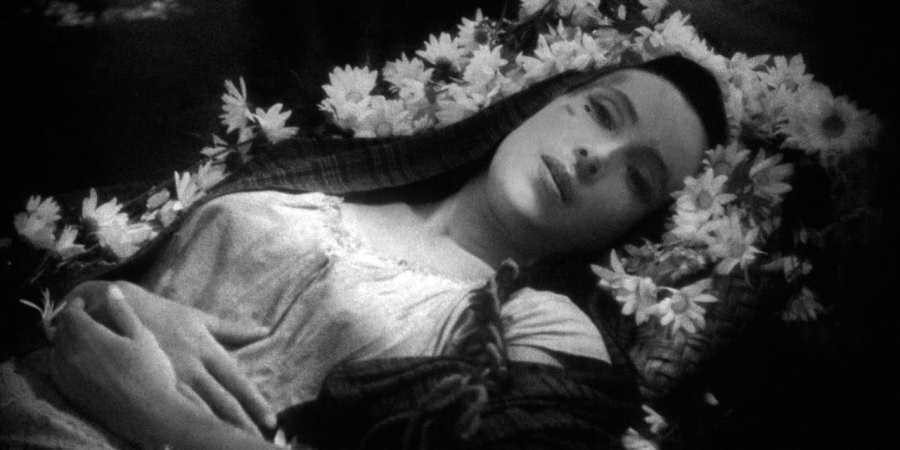
In the early 1930s, Mexico’s film industry found itself on the cusp of its most important cultural and economic boom. After taking on new celluloid technology from the United States and receiving a boost of funding from its national bank, the country was set to incubate a revolutionary period of films later to be known as the Golden Age of Mexican Cinema. Auteurs, including director-cinematographer duo Emilio Fernández and Gabriel Figueroa, garnered international recognition for their works, disseminating a clarified image of Mexican cultural identity to a global audience while navigating themes of love, structural inequality, faith, and revolution.
Almost a century later, in the year 2025, the Melbourne Cinémathèque hosted six key films from this era under the season title ‘Cine de Oro: Treasures of Mexico’s Golden Age.’ The selected films formed a rich tapestry of the time, including three of Fernández’s works—María Candelaria (1944), Enamorada (1946), and Victims of Sin (1951)—and the Oscar-winning magical realist drama Macario by Roberto Gavaldón (1960). Over the course of the season, I was utterly delighted by the vibrancy that consistently shone through that black-and-white grain. With highly evocative cinematography and fiery performances from world-class actors, including Ninón Sevilla’s exuberant portrayal of the vivacious and virtuous dancer-hero Violeta in Victims of Sin and the heart-breaking tears of Dolores Del Río in María Candelaria, this Cine de Oro season boasted a liveliness that transcended time.

Amidst the brightness of the films were darker shadows: intriguing explorations of virtue, faith, and death. This season’s protagonists were often those at the bottom of society’s ladder—María Candelaria’s eponymous heroine is an isolated Indigenous woman born of a sex worker; Macario’s titular protagonist is a woodcutter who can barely afford to feed his family; Victim of Sin’s Violeta is a dancer who is left with nothing after losing her job to take in an abandoned baby. These characters’ struggles with the stark inequalities of their lives are depicted empathetically. But despite their virtues, they are continuously, if not endlessly, punished by the films’ narratives.
Violeta is the only one of the three to make it out of their story alive. Victims of Sin is an excellent breath of fresh air in the feminist sense—Violeta is a fearless protagonist, unafraid of sticking up for herself and other women. Multiple times throughout the film, groups of women rally behind her, helping to raise money for a friend’s medical costs, teaming up to chew out a despicable man, and later joining forces to capture that same man and put him behind bars. Violeta’s womanhood is neither ignored nor used as a narrative tool to humiliate her: she’s gorgeous, talented, charming, and holds a strong personal sense of justice. She shows strength and virtue to the highest degrees, emotional yet unshakeable at her core. As I sat watching her in the theatre in September, I quietly wondered if I despised this—that by displaying such a flawless heroine, the film implored us all to act virtuously and sacrificially in Violeta’s vain, even if we would suffer as she did.
The baby Violeta takes in at the start of the film belongs to the fellow dancer Rosa (Margarita Ceballos). Having fallen in love with the villainous pimp and criminal Rodolfo, Rosa is promptly discarded by him after birthing his child. Later, following Rodolfo’s demand, she discards that child in a bin. After this, she sits at a table in a crowded club, away from everybody else. The crowd urges a famous singer, played by Pedro Vargas, to perform a song for them. Having spotted Rosa, he sings a shattering number directed at her, his gaze never leaving the crystalline tears falling from her face:
Divine clarity, the tears from your diaphanous eyes, like crystal drops.
Why did fate make you a sinner if you don’t know how to sell your heart?
By puritan standards, Rosa is not a virtuous woman. She has a child out of wedlock and abandons it to chase after love. The film never tells us where Rosa ends up after this scene, never causes her to suffer more, and never gives her Violeta’s happy ending. Yet it allows her this gentle moment of empathy, framing her like Mother Mary amidst the chaos of her inner turmoil. Though Rosa is never shown receiving redemption, she is held in compassion by a stranger in a crowded room.

Though she is as virtuous as Violeta, María Candelaria’s María meets a tragic and violent end. Bullied by the community for her background and hated for her beauty, her only dream is to make enough money to marry her beloved fiancé, Lorenzo (Pedro Armendáriz). The jealousy and hatred of the community, however, leads to Lorenzo’s imprisonment; to María’s exploitation by a foreign painter; to her humiliation; and ultimately, to her death. Again and again, María acts virtuously, showing none of the burning resentment that her oppressors have for her in droves. Again, I wondered to myself in the theatre—should I despise this? Isn’t this just misery porn? Then María stands before a looming statue of the Virgin Mary amidst her solemn misery and proclaims: “And you? You never hear us…You never look at us…With us, you are tough, you are bad.” And I think to myself, Oh, there’s something there. But María retracts her rebuke after the priest reprimands her for it. She takes it back and apologises. She still dies, anyhow. None of her virtue could have saved her. The painter who exploited her mourns his mistake years later.
María is an Indigenous woman, chosen by the painter for her “exotic” beauty. She is poor and can only make money from selling native flowers, while her fiancé sells vegetables to a local villain who resents María for refusing to marry him instead. She lives with Lorenzo in a hut on the other side of the river from the town. The only person in the community who is on her side is the priest, and he could not have saved her. Viewing María Candelaria with a decolonial lens, I wonder if faith is just another form of violence—Catholicism was brought over by the Spaniards during colonisation and used as yet another tool for assimilation. María’s brief critique of faith, then, is nothing short of revolutionary. I wonder if it could have saved her.
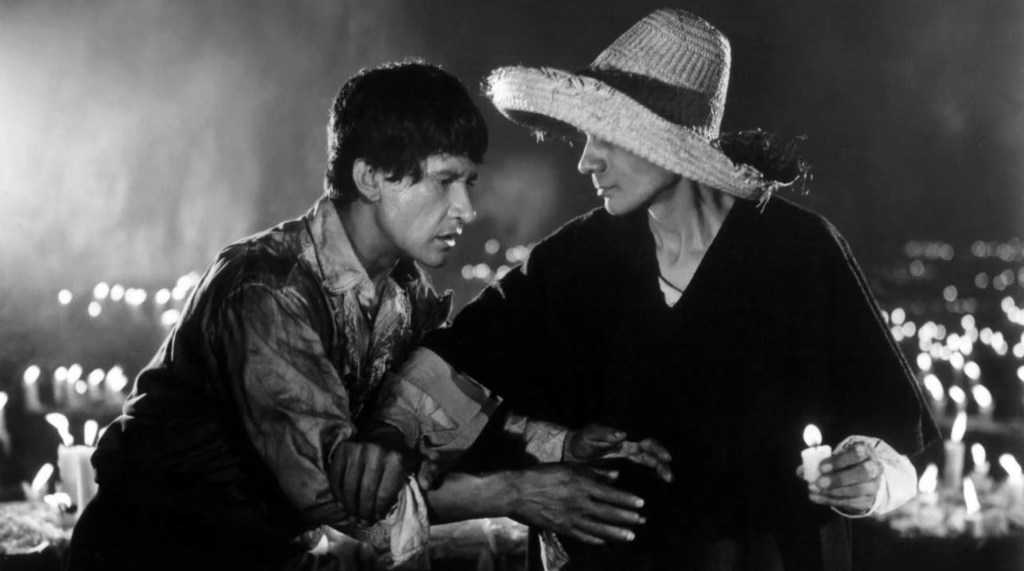
Like María, Macario’s Macario (Ignacio López Tarso) has just one dream. The film opens in a setting of poverty and with the colour of death. It’s the Day of the Dead in colonial Mexico and Macario’s family cannot afford the lavish offerings that other families boast. Macario is a woodcutter. He provides the fuel for fires that melt wax for candles he cannot afford and lights the ovens that bake bread his family will never eat. He provides the life force for his community yet is forced to watch quietly as the local rich man’s procession of roasted turkeys pass through town, his mouth watering. He has never known the taste of something just his own and he aches for it. That night, he goes to bed hungry and dreams of puppets at a banquet table: the wealthy puppets are attacked by the poor ones and finally the poor can eat—except none of the food is left for Macario and he awakens, crying out: “Save some for me, save some for me.”
Macario tells his wife he has resolved to never eat again. Not until he can eat a whole turkey, all by himself, not having to share it with anybody else. After his wife steals and cooks a turkey for him, stating, “I, too, have always wanted something just for myself, something that I didn’t have to share with anyone else,” Macario leaves for the forest to feast on his secret meal. However, before he can take his first bite, he is called on in succession by the Devil, God, and Death. After dismissing the Devil’s flashy attempts to buy a piece of his meal, Macario is then met by God, who also requests a piece. Macario falters, his expression sombre as he points out the disingenuous nature behind God’s request: “You’re not interested in this little piece. You’re interested in a gesture of goodwill.” He’s right—why ought a god, who has everything, ask a poor man for the only thing he’s ever wanted for himself? “For you, it’s just a dead animal. For me, it is everything.”
Of the season’s protagonists, Macario and María are the only ones who are born into and live within the lines of poverty. They are also the only ones who question faith after God neglects their needs. They are the ones who lead virtuous lives but are rewarded in the end by no one but Death. In his essay ‘Aesthetics of Hunger,’ Brazilian director Glauber Rocha reflects on the necessity of depicting hunger and suffering in film, especially for colonised peoples. The violence of that depiction, he claims, “before being primitive—is revolutionary.” The stories of these protagonists, particularly of María and Macario, reveal an institutionalised suffering viewers are unable to look away from. Faith and virtue could not have saved them, the films make that much clear—it is the revelation of their suffering through their stories that will. Faith and virtue are ultimately extricated from one another in these films. The virtue of these characters comes not from the faith which often betrayed them, but rather from their own resilience, strength, and moral goodness.
Many films contain the same themes of faith, of love, of revolution, but those of the Cine de Oro shine through for a reason. I’m reminded now of how Mexico’s relationship with faith is unique compared to the rest of the Catholic world: although the nation adopted Catholicism, there remain older traditions unshaken by colonialism, the most prominent being the Day of the Dead. I wonder now, as María denounced her Catholic faith, if a precolonial religion might have saved her instead; if Death’s arms were kinder than the Virgin Mary’s. Meanwhile, Macario leaves God behind and finds a small cave to sit by with his meal. Death appears then, wearing a humble hat and a threadbare poncho. His cheeks are sallow, eyes sunken and dark. “It’s been thousands of years since I last ate,” he says. “Can you share a little bit with me?” Macario agrees to share his meal and after eating, Death asks Macario why. “Because you were hungry,” Macario replies. “Hungrier than I have ever been.”
As I mull over the great films of this Cinémathèque season, I’m struck again by the colour, the liveliness, and the earnestness of its protagonists. I’m struck by the recurring presence of an unshakeable virtue in its characters; a dedication to righteousness; and the preservation of humanity despite one’s miserable circumstances. As the Mexican film industry thrives again with the New Mexican Cinema movement sparked in the 1990s, I would be thrilled to sit in a theatre once more and see what’s grown in the stories of Mexican cinema and what remains triumphantly steady.
**********
This piece was commissioned in collaboration with the Emerging Writers’ Festival—a Melbourne-based festival which facilitates the development of writers’ skills, careers, and connecting with community through a range of participatory events and writing opportunities.
**********
Liên Ta (she/he) is a writer, theatre maker, and editor based in Naarm. His works revolve around themes of family, queerness, culture, and community and take the form of poetry, short fiction, creative non-fiction, and multimedia art. She has written for Screen Australia, her artworks have been exhibited with Creative Brimbank and Trocadero Gallery, and she has written for and performed in Melbourne Fringe. Her works have appeared in various publications including More than Melanin and CAMP Mag. She has edited for Voiceworks, HOISZN, and Myriad magazine and currently freelances as a writer and editor.
 Rough Cut