


What does it take to sustain a Dictator’s fantasy? The glamour of urban buildings, developed infrastructure, and new hospitals screams: our people are doing great, and progress is imminent. From the 1960s to the 80s, this was the idea Ferdinand Marcos’ regime tried to uphold in the Philippines. Various edifices were built to represent prosperity. Yet like most disguises, their illusion could be easily shattered to reveal a reverse counterpart: the slums of Manila. Hidden behind the immovable concrete structures of a changing city were the flimsy, do-it-yourself assemblies of homes made of plywood, tarp, and spare roofing sheets. Outside were narrow, unpaved roads with puddles. People milled about, surrounded by dense rubbish that suffused the waters; a hotchpotch of life, waste, and survival. The cost of feigning prestige is always the poor who are neglected by the government, hidden in a feeble attempt to erase their existence.
Amongst the grime of a place like this, the films of Filipino director Lino Brocka humanised the slums to outsiders, revealing the harsh state of the Philippines. Under Martial Law, declared by President Marcos Sr. in 1972 to consolidate power and suspend civil liberties, art was heavily censored. Alongside him was his wife, Imelda Marcos, a proclaimed patron of the arts who backed this movement, assuring that nothing sexual, vulgar, or ugly would appear on Philippine screens. This did nothing but prop up a mirage, far removed from reality. Brocka was strategic; he didn’t need his characters to send an outright message of opposition. Instead, Brocka let the spaces his characters inhabited do the talking—the slums themselves were the real story, the narrative a kind of façade. A shot can contain a thousand words. This is never more crucial than when resisting an oppressive regime.
i. Insiang (1976)

A young woman named Insiang (Hilda Koronel) traverses these neighbourhoods of poverty, clutching a bag of fresh clothes she was hired to clean. It feels a little out of place to have such pristine things in a slum like Tondo, Manila. She passes by makeshift clotheslines and fences, where neighbours’ laundry lies out to dry, smoke and fumes of waste be damned. Tondo exudes danger, sending a message that not everyone can survive in a place like this. It’s hard enough as it is, but how much more for a woman?
Your cold-hearted mother (Mona Lisa) takes to bed a man, Dado (Ruel Vernal), who seems unashamedly hungry for you too, and your boyfriend is a coward who cannot even protect you. Dado sweet-talks his excuse for crossing a sacred boundary. He simply couldn’t hold himself back anymore, the mother only an excuse to get closer. Meanwhile Bebot (Rez Cortez), the boyfriend, leaves you after a night full of hollow promises.
All the men in Insiang’s life, including her absent father, have disappointed her. This realisation causes her to take matters into her own hands, enacting the most silent yet lethal form of revenge. She plays into Dado’s lust, convincing him she now reciprocates his feelings. Lured into a lovestruck state, Dado beats Bebot up after Insiang confides in him about his betrayal. Insiang manipulates her mother into a helpless rage, provoking her to ruthlessly stab Dado, ultimately sending her to jail—the third and final target. A deliberately motionless Insiang watches this all unfold. When poverty, loneliness, a lack of power, and the haze of the slums stack against you, you might have no choice but to surrender to the game.
ii. Manila in the Claws of Light (1975)

Manila can be quite the enigma, the capital centre the rest of the country can’t help but be drawn to. You come in with a gamble, wide-eyed at the endless possibilities of success. The big city no longer seems like a mirage. Right in your grasp is the key to your dreams, so you work hard and play harder. Manila is the place to be.
Julio (Bembol Roco) is against a wall. The man in front of him sports an excited look—ready to devour, to make use of the pesos he spent to be in this very moment. Julio lets whatever is happening unfold right in front of him, the prospect of decent cash too good to pass up. The client takes his time through Julio’s body, while his pet dog tries to have a lick at their feet. It’s okay, Julio tries to endure for his long-lost lover, Ligaya (Koronel again), who he’s come to Manila to find. She’s supposed to be working at a factory and furthering her studies, but Julio’s gut tells him otherwise. A male companion shares that he can only afford his nice apartment and food on the table because of a job like this. The pay in this dingy bordello may be heaps better than at Julio’s prior construction job, where he earned far less than stated on paper and was disposed of like trash when he wasn’t needed anymore. However, Julio decides he does not have the willpower needed to stomach this work, and proceeds to find another job. Survival is extremely important, but it’s also a distraction from the task at hand. Where is Ligaya?
Maybe trusting one’s gut pays off. Ligaya is not a factory worker, just as Julio feared. She was forced into prostitution, trapped in a single room where men could do whatever they wished. Ligaya is sold to a Chinese businessman to be his wife and is hindered from leaving the house. Empty promises of a future vanish into thin air. Manila, for all its pledges to make the world your oyster, is a daunting entity: you must know the ways in which to navigate it. A single misstep can see you slipping into the cracks, never to see the light again. Julio and Ligaya have given up a perfectly peaceful life in the countryside, only to uncover a Manila of murky brothels, exploitative labour, slums burned to the ground, and deaths caused by the city’s ruthless conditions. Is this the urbanised “City of Man” the news wants us to believe? Truly, is this the Manila the government waxes poetic about? It might just be one big sham.
iii. Bona (1980)
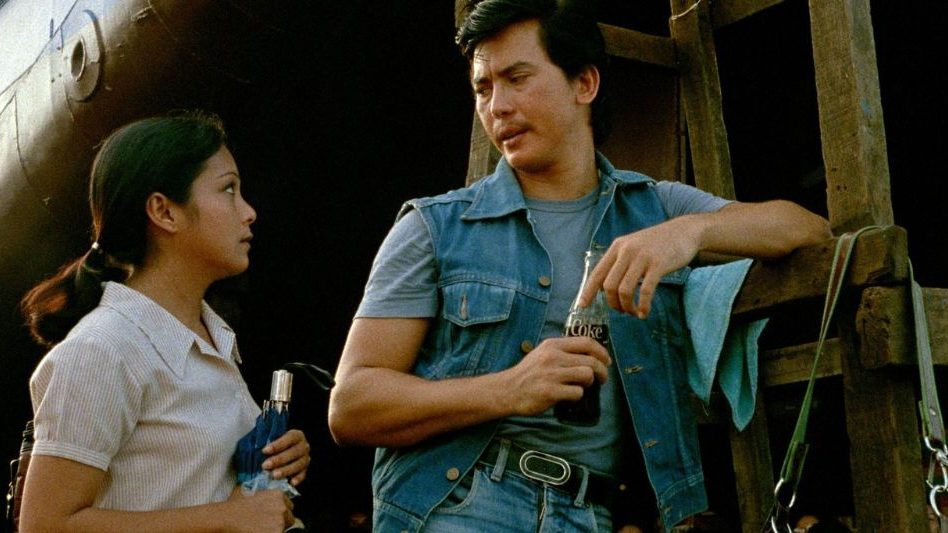
You can encounter many kinds of people in the slums, even film actors. Not the country’s top stars of course, but even bit players can garner some admirers. In an attempt to live a life independent of her suffocating family, Bona (Nora Aunor) offers herself to a small-time actor, Gardo (Phillip Salvador), she is a huge fan of. She moves in with him and follows him around on-set, whether as a quasi-assistant, groupie, or maid, who knows. No one can understand why she’d voluntarily be a servant to this manchild of a microcelebrity.
Living in the slums won’t stop its residents from throwing parties for moments worth celebrating. A feast is in session, for someone is getting married. Different kinds of Filipino food splay across the table; the infamous Lechon or suckling pig graces the spread with its scrumptious presence. All the neighbours and guests gather in the slums’ muddy roads for a photo, where Bona stands slightly off-centre. There’s a melancholic look in her eye as she gazes at the newlywed couple. The groom, Nilo (Nanding Josef), long ago expressed his interest in courting Bona and giving her a good life. Bona never gave him the light of day, too caught up in a spell of her own making. Yet in this moment, Bona realises she could have been the bride today. Bona probably wouldn’t have to give Nilo baths, as she does Gardo; he’d be a gentleman and take on the task of filling the heavy house tubs with water from the communal fountain. He wouldn’t bring other women home, knowing someone who loves him is already right there. Whatever, she discards this thought as soon as it comes. That is not the reality she lives in. She has a handsome celebrity to feed tonight.
Even in the slums, desire, stardom, and dreams can still exist. Ambition isn’t dampened by fragile houses. Children occupy themselves with games; friends tease you for trying to flirt with a woman; and musical jam sessions happen in public without shame. Happiness, community, and fantasy are no less present in spaces like this. And if accessing this joy means serving a man you are a fan of, even if he pays you dust, then who can judge?
iv. Cain and Abel (1982)

Polluted air is exchanged for another kind of stench: the moral rot of a rich, money-blinded family. A matriarch’s iron fist is felt throughout the decaying mansion. It is her wishes, and hers only, that are followed. Señora Pina (Mona Lisa) has no regard for those below her, and favours one of her two sons, Ellis (Christopher de Leon), a sheltered juvenile trapped in a man’s body. All it takes for Ellis to get the full inheritance to the family farm is to coax his mother with smooches. Lorens (Salvador again), who has been doing the dirty work of maintaining the land and has a family to feed, receives far less. They don’t know it yet, but the utter dysfunction of their family will crush the order of their rural town.
The brothers lock horns on every and any affair, from something as small as bedroom occupation, all the way to murder. Hostility laces every interaction in the household, each exchange an attempt to gain power. Lorens’ wife Becky (Baby Delgado), Ellis’ new girlfriend Zita (Carmi Martin), and Rina (Cecille Castillo), the mother of his illegitimate child, all try to take their respective man’s side. But this romance is punishing. When each woman gets eradicated like pawns in a game of chess, the burning rage in each brother’s belly erupts in uncontrollable flames.
Guns, guns, and more guns: an ungovernable frenzy breaks out, a full-blown war between Ellis and Lorens as they try to avenge their massacred women. They each manage to build up gangs of their own, full of bored men who seem to want to fire guns for the sake of it. It’s not like they’ll be jailed for something many others are doing. Blood is everywhere, from the roads to the hands of those who pulled the triggers, even the hands that unzipped Zita’s dress.
It seems nowhere is safe, there is no more regard for consequence. It’s anarchy—all this chaos makes you wonder where authority lies in this state. Yet a look outside the mansion, beyond its town, lies a horrific realisation that this happens all over the country.
* * * *
Brocka’s efforts to bring to light the voices of the hidden earned him a rightful spot as a National Artist for Film and Broadcast Arts in the Philippines in 1997. These four films, selected for the Melbourne Cinémathèque’s recent retrospective of Brocka’s work, have displayed the grit of the country. This is the reality that the regime tried to trample—what lies beneath the mask of an emerging metropolis are the poor who struggle to make ends meet.
In a state of censorship, it is the voice of the people that is first suppressed, but places can have voices too. The slums and the city have their own language, just as capable of speaking about the untold truth as its occupants are. It’s in the trash people sleep right next to; in the city’s dark alleyways; in the blood on the ground. Brocka’s films continue to serve as a reminder to open our eyes to what our surroundings are saying.
In 2025, the quest for truth in the Philippines continues. Various flood control projects across the country have failed to perform, resulting in homes wiped out by fierce rains that have left many Filipinos stranded. This crisis has vehemently exposed the systemic corruption that has failed the country’s people, after it was found that billions up to trillions of pesos intended for these projects were pocketed by politicians and contractors. With the proof right in front of their eyes, many Filipinos have upheld the resistance Brocka had a hand in pioneering by expressing their fury online and on the streets. This is an extremely vital moment in the history of the country, as they battle the parasite of injustice and deception which has festered for far too long. Like the slums, when these failures speak for themselves, we can channel Brocka by directing the lens at them.
**********
The Melbourne Cinémathèque screens films on Wednesdays at ACMI in Federation Square. Screenings are presented in partnership with ACMI, and supported by VicScreen. Full program and membership options—including discounted membership options for students—are available at acmi.net.au/cteq.
**********
Sydney Leoli Reyes is a Filipino writer currently based in Naarm. She is a recent media communications graduate with a screen specialisation. Her fascination with the ability of a film to showcase raw humanity has inspired her to explore this in writing. Sydney has written reviews for films that have debuted in diverse international festivals worldwide.
 Rough Cut