

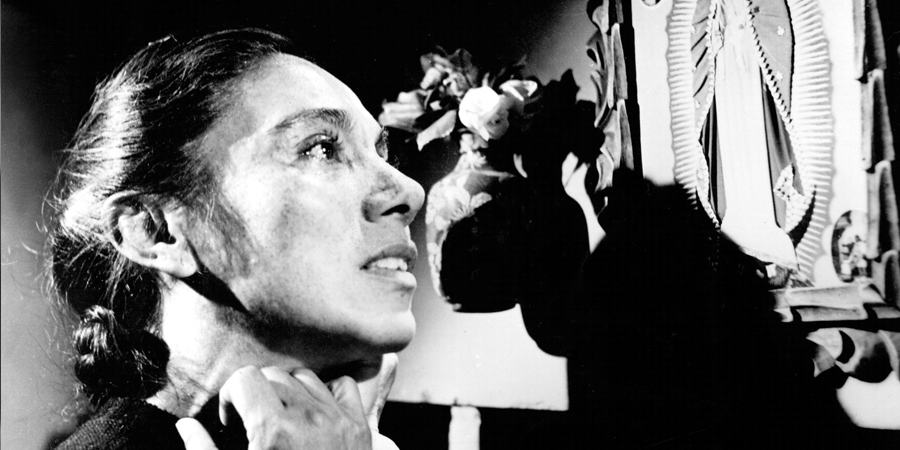
Whose neck shall I stand on, to make me feel superior? And what will I get out of it? I don’t want anything lower than I am. I’m low enough already. I want to rise. And push everything up with me as I go.
—Esperanza Quintero in Salt of the Earth
The suppression of Herbert J. Biberman’s 1954 film, Salt of the Earth, was deliberate. The defiantly political film was written, directed, and produced by blacklisted communists at the height of the McCarthy era, and dramatises the true events of a miners’ strike in New Mexico. Remarkably for its time, the film interweaves the Chicano miners’ fight against labour exploitation, racial discrimination, and women’s oppression. Told entirely from the perspective of a miner’s wife, Esperanza Quintero (Rosaura Revueltas), it is an unapologetic call to solidarity and resistance.
Many declare Salt of the Earth to be the only McCarthy-era film officially blacklisted by Hollywood and the American government. To grasp why it was suppressed, we must turn to the political climate of its time, which began with the rise of the House Committee on Un-American Activities (HUAC). Senator Joseph McCarthy—while not directly involved with the HUAC—came to symbolise this period, spearheading a dangerous campaign of political repression against those associated with the U.S. Communist Party throughout the 1940s and 1950s. This Red Scare was triggered by hostility toward the Soviet Union, as the wartime alliance fractured after World War II.
Anti-communist panic had immediate consequences for working-class Americans. One of the fiercest battlegrounds was the labour movement—beyond fear of foreign communism, HUAC targeted domestic unions, many with ties to the Communist Party. Communists had played a vital role in organising during the Depression, connecting economic demands with racial and gender justice. The International Union of Mine, Mill and Smelter Workers—crucial to the events that inspired Salt of the Earth—was one such case. Its militancy won key victories in wages and workplace safety, but also placed it under intense scrutiny.

As political anxieties deepened, HUAC turned from labourers to Hollywood, convinced that films could introduce subversive ideas under the guise of entertainment. In 1947, nineteen industry figures were subpoenaed, giving rise to the ‘Hollywood blacklist,’ which barred communists and suspected sympathisers from employment. The blacklist, driven by anticommunism—but also by sexism, racism, antisemitism, and hostility to unions—destroyed countless careers. While much has been written about the ‘Hollywood Ten,’ of which Biberman was a part, many other names remain erased, their work silenced.
Salt of the Earth emerged from this repressive context. Three blacklisted figures—writer Michael Wilson, producer Paul Jarrico, and Biberman—carried forward their political commitments. Rather than cowering before the brutal injustices served by HUAC, they turned their expulsion from Hollywood into an opportunity to create something truly radical. Made independently outside of Hollywood’s studio system, Salt of the Earth was based on the true events of the 1951 strike at the Empire Zinc Corporation. It was also made in collaboration with the same men and women who participated in that struggle. Drawing on the lived experiences of miners’ families—many of whom play themselves in the film—and spoken in both English and Spanish, Salt of the Earth was not just transgressive but progressive, fundamentally demonstrating that the fight for economic justice is inseparable from the fight against racism, patriarchy, and the bosses. For this reason, it comes as no surprise that the film came under intense scrutiny and surveillance during its making.

Central to the film’s vision is its focus not just on the miners but on the women whose collective action ultimately turn the tide of the strike. Narrated by Revueltas as Esperanza, the story follows a poor, pregnant Chicana whose life undergoes a radical transformation as she becomes more politically involved. Positioning Esperanza as narrator rather than one of the men is a radical choice that gives voice to the most oppressed, highlighting how solidarity across gender, race, and class creates new forms of freedom.
The film’s imagery draws heavily on Soviet montage, Italian neorealism, and documentary realism to capture the lives of its characters with striking subtlety. In contrast to the sheen of Hollywood, these stark visuals remake ordinary gestures into symbols of struggle. Yet the film also toys with grandeur: the opening shot shows Esperanza chopping wood, accompanied by commanding, orchestral music typical of a big-budget studio production. This scene of mundane domestic labour is elevated, foreshadowing Esperanza’s journey from subordination to empowerment and suggesting that the struggles of everyday life can mark the beginnings of triumph and agency.

This intimate portrait of Esperanza’s life sets the foundation for the film’s broader historical and social narrative. “How shall I begin my story that has no beginning?” she asks, before recalling how Anglo settlers displaced Indigenous peoples, seized control, and imposed centuries of exploitation and racism. Living in poverty with other Mexican-American families, Esperanza faces daily struggles of sexism and racism. Ramon (Juan Chacón), her husband and a respected unionist, belittles her at home. We understand his sexist behaviour to be a projection of the racism and exploitation he and his fellow brothers endure at the hands of their bosses, who have implemented hasty working procedures that seem only to endanger the Mexican miners. His anger at unequal pay, unsafe conditions, and racial injustice culminates in a bitter question: “So why should I risk my life? Because I’m only a Mexican?”
After one miner is gravely injured, the men finally strike for equal wages, safety, and dignity. Negotiations with the mining company drag on, fuelling both optimism and despair. When Ramon is arrested on the picket line on bogus charges—a scene tensely interspersed with sequences of Esperanza giving birth to their third child—the women’s frustrations deepen. On the picket line, the wives discover how interconnected their struggles are, from poor housing to financial insecurity. They continue to collaborate, pressing for issues in the home—namely, housing and sanitation—to be union demands. Solidarity emerges through conversation and collective recognition, as their frustrations morph into a unified voice that grows as the company delays deliberation. The picket line very quickly becomes not just a place of protest but of community and shared knowledge.

When courts suddenly invoke the Taft-Hartley Act to bar the men from picketing, the wives step forward, marching with children despite police harassment. What began as a male-led struggle becomes, through necessity, a women-led movement. With the men confined to the home, the dynamics shift further; the husbands take up domestic labour and discover its exhausting demands. “Three hours just to heat enough water to wash this stuff?” they lament with exhaustion, as they hang out washing on the line. Hot water, they declare, “should’ve been a union demand from the beginning.” These moments underline how the strike has expanded beyond wages into a deeper reckoning with gendered inequality.
Yet as women reshape the picket line, the state responds with increased brutality. When police arrest them, the women resist bravely, even physically fighting back. Here, the film makes it clear that real change arises from women’s assertion of power—a shift that transforms the union and Esperanza herself. After her initial reluctance to sign a petition for better living conditions without her husband’s approval, Esperanza slowly builds courage, emerging as a key figure in the strike while Ramon still struggles to respect her authority. In a heated exchange, Esperanza pleads with him to see how monumental the strike has become, inspiring hope and solidarity across the town. When he raises his hand to strike her, she stares him down, bravely: “That would be the old way. Never try it on me again—never.”


By film’s end, the strike eventually wins meaningful gains in wages and conditions. In an extraordinary climactic moment, the police—in collaboration with the mining company—attempt to evict the Quintero family. Just as hope for the strike appears lost, with no agreement yet reached, droves of miners, unionists and their families arrive at the house in protest, outnumbering both the police and company bosses. They unite to encircle the home, and by standing together, prevent the eviction and bring the strike to a close. The true victory of the movement, however, lies beyond material concessions. While her husband finally does grow to respect and treat her as an equal, Esperanza’s passage from silence to leadership reflects a broader change: women who were reduced to caretaking and domesticity are now central to public struggle, remoulding the future of their communities.
Though suppressed and shown in only a handful of theatres in the U.S., Salt of the Earth has endured as a vital piece of cultural memory. It challenges the racism, sexism, and class exploitation embedded in capitalist systems, and its resonance continues in contemporary struggles for equality. Yet the price of making the film was severe—Revueltas was deported, with her career derailed by the blacklist. When asked decades later if she regretted doing the film, she responded that she’d been totally aware of the repercussions of her involvement: “If the circumstances were to arise again, I would do the same.”

Esperanza’s story endures because it affirms a universal truth: liberation is never solitary. To rise, as she learns, is not to stand on another’s neck but to lift everyone upward together. Before the feminist movement entered the wider social consciousness in the late 1960s, Salt of the Earth stood as an early feminist film—one that would only be fully recognised and celebrated in the decades that followed. Its resounding moments of resistance reverberate beyond the screen, crystallising both Esperanza’s transformation and the film’s bold vision of women’s liberation and class struggle.
Salt of the Earth is currently free to stream in Australia via Plex.
**********
Maudie Osborne is a Melbourne-based writer, critic, filmmaker, programmer, and socialist-feminist organiser. She volunteers with Unknown Pleasures, a screening series showcasing vital Australian independent cinema, and contributes to community broadcasting on 3RRR. Her work bridges creative practice and activism, fostering diverse voices in film and writing.
 Rough Cut