

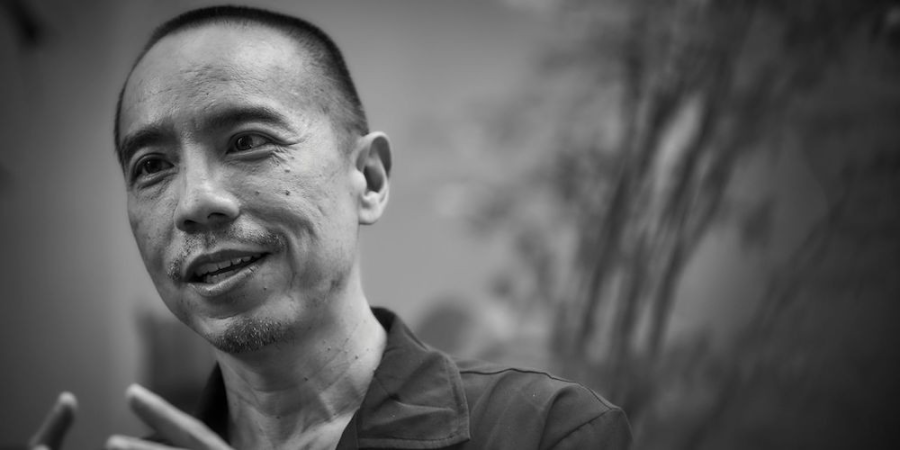
One of the most influential figures to experiment with the moving image in recent decades, the Thai filmmaker, screenwriter, and producer Apichatpong Weerasethakul has cultivated a profoundly perceptive audio-visual language which transcends the medium of cinema. Often distinguishable by their non-linear engagements with time and space, Apichatpong’s works—spanning film, installation, theatre, and performance—embody a deeply personal connection between individual and environment. Waking and dreaming seemingly dissolve within his work, as reality itself ventures into unknowable territories. Liberated from epistemological and ontological dogmas, abstract modes of perspective emerge from Apichatpong’s sound images, indelibly guided by his Buddhist philosophies of rebirth, self-transformation, and personhood. In navigating recurring themes of memory (both personal and collective), time, and identity, Apichatpong’s vast body of work stands as a testament to both the transcendental power of the moving image and the intimacy between humans and landscape.
At their forthcoming event Music, filmmaker-curators Jen Atherton and André Shannon, who work under the moniker Garden Reflexxx, will offer Australian audiences a rare opportunity to experience Bullet (1993), the largely unseen, hitherto unavailable debut short film by Apichatpong. Shot on Super 8, Bullet is an experimental work that explores cinema’s relation to time and light. The film’s abstracted visuals—intensified by flickers of light against a black backdrop—foreshadow key elements that would come to be distinctive in Apichatpong’s cinema. Taking place at the Sydney Opera House on the 29th of October, the evening features debut work from an ensemble of local and international artists, including Bhenji Ra, Daniel Jaffe, Mia Khin Boe, Reetu Sattar, Ryan Trecartin, and Sarah Rodigari. Ruby Arrowsmith-Todd, credited for supplying dramaturgy, has also assisted in producing the event. As Shannon informed me, her role was akin to that of a “guidance counsellor,” lending her expertise in film programming to “legitimise and co-conspire with [Garden Reflexxx] to bring Sydney community and Sydney film culture to life.” Through Music, Garden Reflexxx invite us to explore the sonorous as much as the visual, cultivating an affective interplay that is as equally captivating for the ears as the eyes. Screened alongside a silent lightshow, this presentation of Bullet will be a truly unique encounter with the foundational work of one of cinema’s most ethereal voices.
Ahead of Music and the much-anticipated return of Bullet, I interviewed Apichatpong to discuss what his debut short means to him over 30 years later. Our conversation delves into the collective ritual of cinema, whilst also exploring some of the thematic concerns constitutive across his body of work, such as the audio-visual dynamic and the voyage into the unknown. Here, Apichatpong generously offers poignant insight not only into his philosophies pertaining to cinematic practice, but also into life itself: “I’m just enjoying working on the installation and going out to the sun, and that’s all. It’s really simple,” he tells me.
Note: This interview has been edited for length and clarity.
Oscar Bloomfield: From a personal standpoint, this is a very special moment for me, particularly due to how influential your cinema has been throughout my young career. Memoria, for instance, really changed how I viewed cinema and what it is capable of. I distinctively remember the profound feeling of walking outside after the screening and the fresh breeze hitting my face. It was really nothing I’ve ever felt before, like I had walked into a new world.
Apichatpong Weerasethakul: Thank you, that’s really sweet of you. I always have the question to myself of why I make film. You know, it’s not really useful, and it’s a very personal inquiry. But, when I hear something like that, I stop asking. Every film has its own life and its own function to different people.
OB: Completed in 1993 whilst you were an architecture student at Khon Kaen University, Bullet has since been largely inaccessible to audiences. For a vast majority of those in Australia, it will be their first time seeing it. Can you speak about the context of Bullet, perhaps how the project emerged, and what the film means to you now?
AW: I haven’t looked at it that much. The last time I shared this film was in the exhibition context. We showed it with a retrospective in a museum, and it fit very well because of its abstraction. That was the last time I saw it, and again […] before sending it to Sydney [for Music]. For me, of course, it brought back memories. It was a reminder of my first encounter of experimental film, and what I was trying to do. Coming from an architectural background, I viewed the film almost as a building to be constructed. In this case, it was about building up the frames to look at it quite linearly through time. So, I worked with the optical printer. With this machine, I was alone there to make a ‘map,’ and then to go one-by-one to synchronise with the sound which is also on the film [via a] magnetic tape. Those few years of studying were always film; the digital was not really common. It’s something that when I look at it, I still miss and want to explore more. When I went back to Thailand [after later studying in Chicago], I started to be more into a storytelling mode.

OB: You’ve previously suggested that architecture and film are closer aligned than what people may think. I would imagine that those architectural building blocks stuck with you throughout your career. Bullet, in a way, seemed to lay these foundations.
AW: Yeah, you’re right. [Bullet] is ‘experimental’ in the sense of that word. You know, ‘experimental film,’ because I didn’t know what I would get, and also to understand the relationship between the exposure, the chemicals, and time. It’s really a pure dance with the medium. I miss that! I really value this work. I think it works in the gallery context because it activates the space. There’s a flash, and you’re aware of watching this animal. So, I’m curious about how it will be in the screening in Sydney, in the cinema, its original context.
OB: For Music, it’s interesting that film will be presented alongside a “silent light show,” with the screening described as “a playful wink, eye-to-eye, between light, projector, audience, and filmmaker.”1 I’m curious to hear more about Bullet’s involvement, and how it may fit into the program—experimentally, sensorially?
AW: The program is all first work, right? It fits into that context, but it also manifests my innocent fascination with time. I remember working on this film, and it’s also like breathing; the frame comes and goes. It’s the same idea as of now that I have of cinema and cinema watching. To be half awake so that you’re aware of your breathing and that you’re watching with other people. Some films make you forget everything, but for me, I still want to remind people that this is a collective ritual.
OB: The notion of ‘music’ within your work is also noteworthy. For me, the environment often constitutes the ‘music’ to your films. Atmospheric sounds adopt a certain ‘musical’ composition in their own respects. I remember your mention of the “sound of the air” within one of your earlier interviews. What does the air sound or feel like to you?
AW: Yeah, really good point. I was fascinated by the air that, once the projector is turned on, becomes a living thing—awake and breathing. As simple as to hear the noise of the air of the film itself… this buzz. Especially in the old films, you see it’s really analogue and really noisy. Also in documentary film, 16mm—it’s a really, let’s say, ‘dirty’ sound. It’s not even air sometimes; it’s the sound of the analogue signal. That, I’m fascinated with. We play with it in Memoria. At one time, you think it’s silent, but when [Jessica, the film’s protagonist] touches her head, it’s totally zero dB. Right now, I’m also working on a project on the wind. There’s something about this invisible presence that sometimes we really forget that we’re navigating and connecting with. We’re in this one giant ecosystem, and we affect it—everyone. It’s the same way that the air of the cinema—of the film—connects the audience. That’s the idea.
OB: Sometimes I find myself wanting to close my eyes and just listen to your films. Your masterful attention to sonic landscapes appears to frustrate the privilege typically attributed to visuality. Memoria immediately comes to mind here, where sound is equally, if not more, crucial than visuality. Like Jessica’s, the viewer’s experiences are really mediated by the commanding presence of these sounds. The audio-visual dynamics that emerge from your work are nothing short of magical, and I’m wondering how you position these two phenomena alongside one another?
AW: Sometimes they’re really integrated. Of course, it’s a sound design, but after a while, you have to think that they’re one. Like I said about breathing, it’s part of the body. That’s why I really insist on showing even my short films in the cinema. Memoria is a good case. People were really upset that it doesn’t go to streaming [platforms] in the US. They thought that it was ‘elite.’ After all, my film is not really a popular one in the first place. I view it as again a collective event that is listening together. It’s not about watching the content only on the laptop. It’s together with the sound, and the speakers that the movie is designed for in that setting. I’m very particular about that.
OB: Another dominant thematic thread throughout your work is the unknown. In this respect, your work masterfully situates itself within liminal spaces. The boundaries between reality and illusion, the real and surreal, and the waking and sleeping, to name only a few, become imperceptibility narrow. I’m interested in the blurred threshold wherein the known and the unknown intersect. In relation to your films, what do you think the unknown, and the state of not knowing, can reveal—both about cinema and us, its viewers?
AW: It’s our nature to know everything. Especially now, everything is so uniform and so precise. Let’s say, with Google Maps, you know how many minutes until you arrive at a certain place. It’s become a precious thing to not know, and to not be afraid about not knowing. When you go to different places, or encounter nature, you don’t know sometimes what’s going on, but you appreciate the movements and the texture. That’s enough, I think, in nature—but in the man-made, you automatically think it needs to be explained or have a proper function. I think that’s why art is really fascinating, because it points to us, something beyond the known and logical.

OB: I love the feeling of presentness, and the state of being content with the now, that permeates your work. So, taking a brief break from talking about cinema: I’m wondering what makes you feel present?I know you’ve mentioned being outdoors and immersed within the environment, but is there anything else? What does present look like to you?
AW: Well, it’s about just reminding oneself… like I’m talking to you, attentively listening to you, instead of thinking of other things. I think that’s enough. We tend to really highlight experience. Like, okay, we have seen ‘this,’ we go to ‘this,’ and we think, “Oh, I don’t want to go back because I like this experience.” These are things that people attach to and then become uncomfortable living, but I have to think in the Buddhist way: everything is a highlight, such as speaking to you and finding the ways to answer your questions. Like here, I’m in Amsterdam, I’m just enjoying working on the installation and going out to the sun, and that’s all. It’s really simple. There are many other things to see—the museums, the van Gogh Museum… I haven’t done those things, because for me, it’s just being with what’s around me that’s enough.

OB: There are no black-and-whites within your films; meaning becomes a mysterious, allusive, and polyvalent sensation that reveals itself in many different shapes and forms. Something new emerges on every re-watch. I remember you mentioning, in relation to Memoria, how “Jessica is cinema,” and that really stuck with me. I’d like to wrap things up with a rather interpretative question: As we move through time and space, existing as bodies in perpetual flux, what can we learn from Jessica today? If she is cinema, what does she reveal to us?
AW: I think it ties to the previous answer, because cinema in itself is just image and sound. When you make film, you just collect sound and image. Jessica is just like that, a non-judgemental entity that goes through space. Like Hernán, the Colombian guy who remembers everything. All the memories are in sound waves embedded in the rocks and trees. So, I think like that. Not only in one lifetime, but we persist, passing along these memories that impact one another. It’s kind of a romantic view: cinema as a recorder of humanity.
Alongside an incredible cohort of short films, Bullet is screening apart of Garden Reflexxx Presents: Music on the 29th of October at the Sydney Opera House.
Meanwhile, Apichatpong’s Museum of Contemporary Art Australia (MCA Sydney) exhibition, in collaboration with Rueangrith Suntisuk and Pornpan Arayaveerasid, titled A Conversation with the Sun (Afterimage): Apichatpong Weerasethakul, is currently running until 15th of February 2026.
With sincere thanks to Jen Atheron, André Shannon, and Mod Kamonpan for facilitating this special opportunity.
**********
Oscar Bloomfield is a doctoral student, film writer, and casual academic at Deakin University. Focussing on the filmic imaginations of Michelangelo Antonioni, his research situates itself at the axis where critical and creative practice intersect.
- Quoted from Garden Reflexxx’s press kit for the event. ↩︎
 Rough Cut