

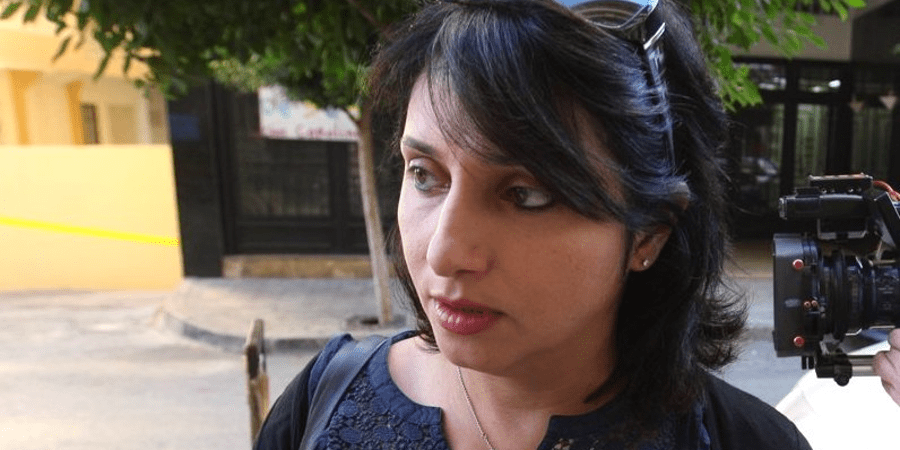
I have sometimes perceived the absence of visual archives that can be used as evidence or proof of a vivid past as an advantage: a form of liberation, as it has freed me from having to deal with factuality. Instead, I can simply imagine the past as I wish it to be. I can construct my own fantasies of it.
—Azza El-Hassan, The Afterlife of Palestinian Images, 2024, pp. 127-128.
In her 2001 film News Time, Azza El-Hassan portraits a group of four boys as they scout and scavenge rubble-strewn streets for packs of Marlboros. “Packs are manufactured in America… America is like Paris… No one can talk to Americans, or deny them the right to move,” says one of them dreamily. The boys tell El-Hassan stories of martyred classmates. The children share many things with one another: their findings, piled in boxes to exchange for prettier, more kid-friendly goods; a joie de vivre ignited by El-Hassan’s camera; and refugee status in the documents of the apartheid ethnostate of Israel. The boys, who El-Hassan has since pledged to film again one day, were not her first choice of subject. Her lens fell upon them after her plan to shoot the romance between her neighbour and his shy wife dissipated, their family fleeing the state’s strikes on the West Bank during the second intifada. Itself a product of her curiosity and resourcefulness, El-Hassan’s focus on the bowerbird-like boys offers a succinct mirror image of the director’s own art of exhumation and salvage. “I want to see if something can emerge out of the ruins.”
While El-Hassan’s body of work has long been undistributed and inaccessible in Australia, for three decades she has cultivated a unique mode of lucidly subjective, ‘autoethnographic’ filmmaking, an approach which embraces witnessing and speculation alike as emancipatory tools. El-Hassan’s work arises from a rich tradition of insurgent Palestinian cinema, but also from the erasure of this very history. Patchworking found footage, home videos, and conversations with friends and strangers, El-Hassan’s films are always concerned with exposing the distortive and traumatic effects of Israel’s regime, particularly of the looting, destruction, and hijacking of Palestinian archives. But melancholia is nowhere to be found here. The director conceives loss as an active process, and Israeli occupation as a pathetically cyclical failure at the feet of insistent Palestinian creativity. “This is the idea: you try to put things back into use in order to eject the effect of violence and to have continuation in your life,” she explains.
In Kings & Extras: Digging for a Palestinian Image (2004), El-Hassan maps the impossible. Ostensibly searching for the missing archive of the Palestinian Liberation Organisation’s (PLO) Palestine Film Institute, which disappeared in Beirut when Israel invaded in 1982, El-Hassan travels between Palestine, Lebanon, Syria, and Jordan to pursue archival remains, spurred by a breadcrumb trail of shadows, myths, and ghosts. A formative ghost is Hani Jawherieh, one of three co-founders of the Palestine Film Institute, killed with his camera in his hands in 1976. Jawherieh is also the father of El-Hassan’s childhood friend Hiba, who first introduced El-Hassan to the existence of the missing archive. As El-Hassan explains to me, however, for her the ‘mystery’ of the archive is above all a provocation—a way to wrest absence into presence, and an invitation for her diverse interlocutors to say, Yes, and…

Expanding the participatory quality of her films into cyberspace, since 2019 El-Hassan has worked under the umbrella of The Void Project, both an artistic production house and a channel through which she collects knowledge about Palestinian cultural materials from members of the vast Palestinian diaspora. (Three definitions of void: not valid or legally binding; unoccupied; free from.) In a special interview conducted ahead of a Rough Cut screening of Kings & Extras in Naarm on 11 October 2025, El-Hassan spoke with me about the film’s motives and legacy; her reluctance to choose between documentary and fiction; and her upcoming feature, The Lost Film of My Mother.
Note: This interview has been edited for length and clarity.
Indigo Bailey: I understand Kings & Extras came out of your interest in locating the lost archive, and particularly your relationship with the family of Hani Jawherieh. But I also read in your book The Afterlife of Palestinian Images about the destruction of your own archives in Ramallah in 2003. Could you speak to me about the idea’s genesis, and whether it was informed by that personal experience?
Azza El-Hassan: To be honest, I don’t think Kings & Extras is a film that really searches for the archives. If you remember, there’s a clip at the beginning of the film where I show footage taken from the Israeli Military Archive, and I say that my producer has acquired this material that we think Jawherieh shot. We asked them to tell us who the cameraperson who took these shots was, but they wouldn’t respond to our email. So, from the beginning of the film, there is this suggestion that, most probably, the Israelis have the archives. What I was more interested in was: How do we deal with loss? I think this is what the film does. It’s about how people create different stories to cope with loss. And in the process, while I move, I make my own archive. So, there is an archive that is lost, but there’s an archive that replaces it, which is made in the present.
It’s interesting you mention what happened to me in 2003, because [throughout] the whole book, I keep mentioning how the loss of personal archives is never recorded. We end up not knowing that this is an ongoing process: every day, Palestinians lose photos and films, and it becomes, in a way, insignificant compared to the loss of life, for example now in Gaza. But it is happening now, all the time. Now, I’m working on a film that is specifically about me losing my own personal archives, including family videos, and having to recreate these videos to compensate for the loss.

IB: The shape of Kings & Extras, which many have described as a road movie, feels intuitive, organic, and sometimes accidental. I was wondering: to what extent did you plan this film before it was made, and how much did it depend on these discoveries made along the way?
AEH: To be honest, I plan everything. I’m not a filmmaker who just goes to locations and works. I planned I was going to film in the graveyard, that I was going to talk to people in the streets, whatever. I think this is the difference between fiction and documentary. In documentary, you have to be able to just let things happen, and I do that. While I plan, I also allow what happens in the location to happen. And what happens is more surprising, and in a way more beautiful. For example, the ‘madman’ [a man El-Hassan approaches at the end of the film to ask about the fate of the archive, who is seen scrubbing the number ‘48’ from a sports jersey]. I planned to interview him, but I didn’t plan for him to be cleaning 1948. His own madness and world took the film into that, but it ended up being the final scene of the film. I didn’t try to force him to stay in one place. I followed him, and he took me to the shirt.
IB: He has an incredible presence. Did you know him already?
AEH: He used to scare me. Ramallah and Jerusalem are very close. The trip between them should not take more than ten minutes, but because of checkpoints, it takes hours. Next to this checkpoint at the entrance of Ramallah, there is a refugee camp where this man lives. So, whenever you would be crossing and having to stand at the checkpoint for hours, he would come and talk to people. But he wasn’t very fond of women, so he would be a bit aggressive with women, and it scared me. And usually, when I’m scared of something, I confront it, so going with a camera made it easier to approach him. Then when I approached him, I discovered how tender and sweet he is, so it shifted the relationship.
I didn’t choose for this to be the final scene from the beginning. When you’re editing, the film grows, and you start thinking [of] where it’s going to take you. Since the film is about losses, it was only logical to end it with the greatest loss of all: when Palestine, as a geographical space, in 1948, was wiped out of the map. So, it was only logical to go back to that point when I end the movie.

IB: There’s a beautiful passage in The Afterlife of Palestinian Images where you talk about how, amidst the grief of dispossession, you also feel somehow liberated by the absence of archival images because you don’t feel bound by fact. Could you talk more about this approach?
AEH: Loss even on a personal level is never an easy thing to cope with, but even for personal losses, there is an element of personal liberation in them. For example, we all love our parents and wouldn’t want to lose them, but when we lose them, we do not panic. I remember during COVID, my son said to me, “It’s good that granny is not alive, so we don’t have to worry about her health.” He was an eight-year-old boy expressing that he is somehow liberated from having to worry about his gran. So, yes, loss and liberation do come, many times, hand in hand. I’m always shifting because I work a lot on what happened, what is happening, and where we are going. I refuse to deal with the present or the future without connecting to the past. But I also do not want to be a hostage of it.
So, I think the liberation is in being able to know it. I’d like to see the images and have the choice to work with the material, but maybe not necessarily [to do so]. In The Afterlife of Palestinian Images, I talk about restoring films and thinking, maybe I can do something with them. But then I decide not to. It doesn’t have to be the case that, if you find the materials, you have to develop a new film out of them. Just the right to watch in itself, the right to have access to the material, should definitely be there.

IB: I also watched your film News Time recently. Your films challenge the idea that the urgency of mass political violence negates the validity and usefulness of cinema, which of course isn’t as fast-paced as ‘news’. How do you apply this today? Do you think that right now is ‘news time’?
AEH: I think Palestinian cinema has always struggled with this. What is cinema at the end of the day? It’s the ability to create your own logic of what is happening in front of you, to reorganise the world and see it in different ways. Sometimes, especially when there is a crime being committed, reorganisation might seem like meddling with the truth, which no one wants to do because they want the truth out. But also, we are human beings, and human beings need to think and reflect. So, I think there will always be this element of, “Is it news time?” The resistance to the idea of [a moment] only being news time happens through cinema. Cinema is what says: No, let’s look at the little details. Let’s look at it in a different way. Let’s see what it’s doing to us, and to you, the one who is watching.
IB: Who are your main influences? What led you to become a filmmaker early in your life?
AEH: Well, my mother was a lawyer, and I went to study law at university. I remember thinking when I got there that this is not really what I wanted. I always loved acting and writing, so I thought I wanted to do something else, and I applied for the Film and Television department. I got accepted, and my parents lost it. I went ahead with it, and I remember at one point they said to us, “People who want to study documentary, go to one side, and people who want to study fiction go to the other side.” I didn’t think about this question before. It came out of the blue to me. So, I had to decide very quickly, and I remember thinking, “No, I want to talk about Palestine,” so I should go to documentary. I went to the documentary side and then, as I started to make documentaries, I realised I definitely did not want to make journalistic documentaries, so I didn’t do it for the reason I chose it. I did something completely different. Who I’m influenced by? By everybody. I think, you know, we all give each other something. It might not, sometimes, be a filmmaker. It could be people in your life that influence you.
IB: And strangers, people in the street?
AEH: Yes. People love to be filmed. They feel special. They like to give you a piece of themselves when you show them you are interested in them.

IB: I wanted to talk as well about your work with restoration and The Void Project. Could you talk about how you see restoration and how you began the project?
AEH: In the book, I begin by talking about a film sequence in Kings & Extras, where I go to Syria and meet this cameraman, and he has a film from the Palestine Film Institute. I get very excited and take it from him to develop it, but I discover there is nothing left on it because it’s been kept in situations that are not film appropriate. I say this experience touched me so deeply, because I could suddenly see that, although there was nothing left on the film, the mere presence of this film reel enabled me to imagine. So I imagined a different future and made my own film out of the lack of images. I want to see if something can emerge out of the ruins.
I don’t see the search of The Void Project as an archival project. I’m trying to put things back into use, because what the Israelis are doing is destroying stuff so we can no longer use it. For example, they keep saying now that they are bombing Gaza so that it will no longer be inhabitable. Well, what if it remains inhabitable, even if they keep bombing it? This is the idea: you try to put things back into use in order to eject the effect of violence and to have continuation in your life. It’s very difficult to be cut off from things. You need this element of continuation.
IB: In Kings & Extras, you talk about how momentous the Palestine Film Institute archive was. It was three rooms of film reels! So many of the ideas you talk about depend on having physical materials. Most of your films are shot digitally. Does working digitally and using the internet bring something else to the search for liberatory images?
AEH: This is a huge debate about Palestinian preservation and archives, because many people see the digital and virtual world as offering a space for Palestinians, where they can accumulate material away from Israeli violence. For example, the Palestinian Museum, like all museums in the world, work on digitisation, but it holds a different meaning in Palestinian society. They want to make copies to preserve in case the original is destroyed. So yes, for sure. Also, we have to think that Palestinian society is segmented and scattered all over the world, like in South America there is a huge Palestinian community, in Europe, in the Arab world… It’s everywhere. Because the land as a space is not accessible to many, having the digital world is a way of connecting and communicating. So, yes, it brings lots of important value in Palestinian modern narratives.
IB: I’m curious about your work with Arab Lutfi and Layali Bader. You thank them in your book and have worked with their films as part of The Void Project. Can you talk about your relationships with their work?
AEH: During the seventies, I was a child in Beirut. I did see the films of the Palestine Film Institute being screened at that time, and I used to dream about growing up and joining all these people. It was a very emancipated environment; people who wanted to change the world. And Arab and Layali, they belong to the second generation of the Palestine Film Institute, and their films represent woman filmmaking within the institute. Of course, there were other women who worked there, but they talked to a lot of my wishes and dreams. Also, their films are very different to the films that were made by men at that time, which says a lot about women filmmaking in times of liberation movements.
In Palestinian cinema in general, there was tendency in the beginning to want to talk about the grand issue, which is the loss of Palestine. Most women and men worked in this way. But the ones who dared to experiment and focus on other things were women filmmakers, and this was probably dismissed by their counterparts as focussing on personal issues. But, later on, this became the most prominent way to work. Women and men would work in this way. But I do think women were the ones to start working this way within the Palestine Film Institute. And by the way, an interesting fact that few people know is that the Palestine Film Unit was established by a woman, Sulafa Jadallah, and later on the men joined her. So, in a way, it was a woman, feminist project.
IB: Can you tell us more about the documentary you’re working on now?
AEH: I’ve been working for a long time on a film that speaks of how much I struggled to cope with the loss of my mum, who I lost to cancer, so it had nothing to do with the political situation. I lost all her videos, which could’ve helped me process the loss. So, the film is about me trying to process the loss. I’m editing the film now. It’s in its final stages. Its original working title used to be, ‘My Mother and Other Revolutionary Mothers’; it’s now, ‘The Lost Film of My Mother.’ It tells the story of my mum and my relationship with her and how much I miss her. Since all the films I had of my mum have now been destroyed, I decide to recreate, to make a film, partly borrowing from other people’s archives, from world news archives, casting actors, you know, all of this to replace home movies that were gone. So that’s the project I’m working on. Hopefully I’ll finish it in a few months, and you can screen it.
With our friends at Static Vision, we will present a special fundraising screening of Kings & Extras, alongside Jean-Luc Godard and Anne-Marie Miéville’s Here and Elsewhere (Ici et ailleurs) (1976), on Saturday 11 October. Pay-what-you-can tickets are available here.
All funds raised will be donated to Bridge of Solidarity, an anti-capitalist, grassroots mutual aid organisation providing food and necessary goods to some of Gaza’s most vulnerable, including people without phones, English skills, social media, wealthy or living relatives.
With thanks to Azza El-Hassan for donating the right to screen her film.
**********
Indigo Bailey is a Tasmanian writer and editor living in Naarm/Melbourne. In 2023, she received the Island Nonfiction Prize for an essay about rain sound. She has written for HEAT, Island Magazine, The Guardian, and Kill Your Darlings, among other publications.
 Rough Cut