


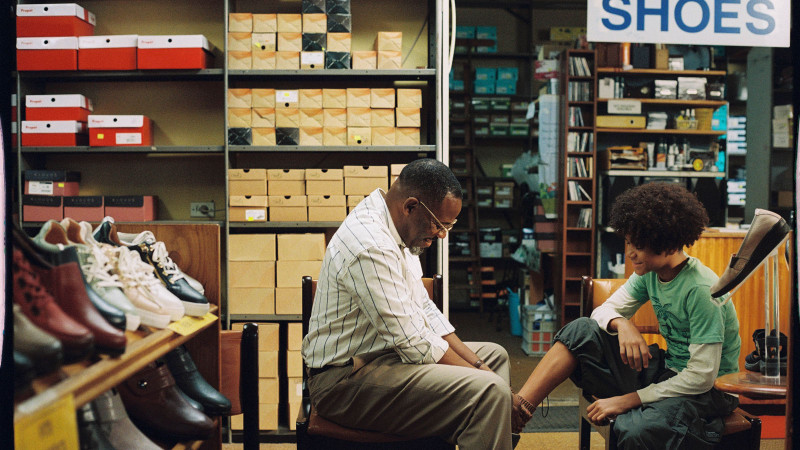
Pasa Faho declares itself with a tree aflame. Opening on this image, beautiful and perilous, the film ignites immediate attention. Kalu Oji’s debut feature is a joyously triumphant tale of familial and communal kinship set in a timeless suburban Melbourne. It follows Azubuike (Okey Bakassi), a shoe salesman and father, and his 12-year-old son, Obinna (Tyson Palmer), who returns to live with him after a period of absence. As they navigate their revised relationship, an eviction notice threatens Azubuike’s store of 10 years. This quietly radical comedy-drama weaves poignant reflections on diasporic Igbo identity and the migrant experience within and across generations. As the film unfolds to explore diverging ideals within members of Azubuike’s Igbo community, these conversations about assimilation and the illusion of a ‘better life’ swell with nuance, as Pasa Faho refuses to shy away from the insidious colonial legacy of endless progress and expansion in so-called Australia. Oji and I discussed these aspects and more in our conversation, which took place on the unceded lands of the Wurundjeri and Boonwurrung people of the Kulin Nation, which hold centuries of storytelling traditions and histories of creativity that inspire our own work and practice.
The film’s title is a play on words of ‘parts-of-a-whole’: ‘pa-sa-fa-ho.’ It approaches the idea of wholeness on every scale: querying what it means to be a piece of a puzzle within a family, community, heritage, and history. Oji previously worked on a short film in 2017 with the same name, which explored a similar set of ideas. It was during the filmmaking process for this feature-length Pasa Faho, Oji explains, that his relationship to the concept of wholeness “expanded and grew,” allowing him to explore the concept in ways he “hadn’t even thought about before.” The title is apt, considering Pasa Faho is the feature debut for Oji’s collective, TEN DAYS, of which producers Mimo Mukii and Ivy Mutuku, cinematographer Gabriel Francis, and script supervisor Ranima Montes are a part. The film feels like a proclamation of their mission as a collective: “born from lived experience […] we craft stories that echo where we come from, speak to who we are, and hold space for the communities that shaped us.”
“After the first time working together—with the four of them and with a broader community as well—it just made sense,” Oji explains. He notes their Venn diagram of thematic and aesthetic interests. “You have fun together with people that you gel with.” The collective’s ethos of playful collaboration beams through the narrative’s celebration of culture, “From the first time working together and then hanging out as people, it felt quite clear that wherever the relationship goes, it’s something that we’re going to continue pursuing and exploring for as long as it feels good.”
Oji reflects that the artists who make up TEN DAYS have “built a shared language and a shared understanding,” so that “the jump from short to feature felt like an extension or expansion. The relationships felt like a natural progression of the way we’d been working already.” While the collaborators’ roles often overlapped when creating shorts, with the amplified scale of Pasa Faho, Oji observes that “everyone really takes ownership of their own department and steps into their roles in ways that we hadn’t as much before.” This was reflected in pre-production, as Oji remembers moments when Mukii and Mutuku’s roles as producers progressed far beyond his comprehension, bringing a curious excitement to the feature making process. “We were able to relinquish even more control,” he says.
Oji considers that there was an increased consciousness of TEN DAYS’ collaborative methodology in making their most recent short, What’s In A Name (2022). Oji’s role as a writer is akin to that of an architect, sketching the structural seeds to the projects. “You create this document, essentially the blueprint,” he tells me. “Let them take it in their hands; mould and shape it and build on that common understanding. Let the script become something which is open to being broken open and be open to [it] taking on new forms and different shapes.”
The bilingual Igbo-English world of the film embodied this from the script’s first iterations. Even in the beginnings of the writing process in 2020, Oji knew he wanted to explore the whole spectrum of Igbo identity. “I knew from the jump it was going to be in Igbo and in English. I have one understanding of what it means to be Igbo. I’m born here. I’m not born in Nigeria, I didn’t move over, and I don’t have the same set of experiences as Azubuike and a lot of other characters in the film […] I grew up having a very basic knowledge of Igbo and picked it up more as an adult.” One thing was clear: to gain a richer understanding for each character arc, he needed to learn from people who had experiences closer to Azubuike. This open-ended process began prior to casting the film. “It was, again, about handing over this blueprint,” Oji explains. “Sharing intention, getting on the same page, and letting the actors and workshops guide what the final words on the screen are going to be—how best and most honestly to communicate these ideas.” This openness is a testament to the film’s mindful commitment to tell the community’s stories from within, informed by a sensitivity to its nuances.
Characters Azubuike, Amaka (Laureta Idika Uduma), and other elders of the community are given the time and space to reflect on their identity as migrants away from the homeland. So often, the discourse surrounding diasporic identities is led by the youth, making these moments of the elders’ raw confessions a beautifully unexpected inclusion. For Oji, this is the crux of the project: “I was trying to capture a truth that I see around me […] When you’ve moved out to a country like Australia, there are expectations. There is a mental juggling of mind and spirit that’s required to succeed, or even just to stay afloat.” There is no shame in this struggle, the film seems to say. Depicting these vulnerabilities strengthens the ties within a community and across generations. “With those conversations, so much is kept inside or behind closed doors.” The film delicately manoeuvres these candid struggles in tandem with the pride placed in hard work and excellence. “We’re not necessarily going to share that stuff, especially with family back home. I wanted an artefact to capture a truth.”

In the film, Azubuike is learning about his own masculinity while trying to impart it to his son, Obinna. Meanwhile, Obinna is sensitive to his father’s attempts to teach him Igbo values and traditions. Children and teenagers are also central to many of Oji’s previous shorts, notably the conflict ingrained in dynamics with their parents: “I’m drawn to characters like Azubuike or Mary from Blackwood [Oji’s 2019 short]. In all my family, I see characters who try and try their best and don’t always succeed […] Along the way, those characters stumble, and fall, and make mistakes, and break things. Viewing those characters through a child’s eyes is something I want to continue to explore on screen.” Having this tension unfold captures the journey for both the parent and child: “Maybe in the films I make, the children are this beautiful reflection of the parent and of this inner child; this thing that was once really rich and vivid and lively in the parent that, through what they’ve gone through in their life, they have put on the back shelf or had to suppress.” The past lives of parents seem an inevitable inheritance, yet, as with Azubuike’s relentless attempt to make Obinna into a better man than himself, it is tinged with bittersweet struggle. “A big part of all those characters is their teaching or example-setting. Maybe that’s the most tender form of love.”
As the first Igbo-English film to be produced in Australia by VicScreen, Pasa Faho makes visible a community obscured within the Australian cinematic canon. An overdue voice among many, perhaps it’s only natural that the story finds its voice by listening. The film interrogates a binary that often plagues audiences’ thinking, that of specificity and universality. Pasa Faho is carved with a deep reverence for the community it seeks to represent and opens possibilities for new kinds of resonance. “This film is an artefact, and that’s how I wanted to make it; that’s how I want it to feel,” Oji expresses. “This is one perspective. This is a film that I wrote. There are thousands, tens of thousands, one hundred thousand African-Australian perspectives and experiences in Victoria and beyond. I’m hoping there’s a universality in the experience of Azubuike, or Obinna, or Amaka, and all the other characters; like a piece of history is being captured.”
Oji has spent significant time considering this riddle of spectatorship. He pulls at two layers—firstly, the specificity of familial relationships to the African-Australian diasporic experience, and how this might translate across Africa. He thinks of the “Ghanaians and Ethiopians who come and watch [and] can see pieces of their uncle or dad and the way they speak.” But the film is far from a closed narrative—if anything, Oji is welcoming us in. These complex relationships, interrogations of pride, ego, and one’s sense of self, “are all things […] people are going to be able to connect to in some way or another,” he concludes. “You could have a character in the most specific set of circumstances, but they’re often dealing with things that you can relate to in some capacity. That’s the beauty of it. We all have relationships. We all have relationships that don’t always go so well. We all have a sense of self, and we all have periods in our life where that sense of self is challenged and that can take on so many different specific forms, but that’s still, in a way, a universal truth.”
I recall one of the first times I went to see a play in a theatre as an adult, after buying rush tickets that found my friend and I seated humbly at the very back. Being more attuned to seeing films, I expressed to my friend, a seasoned theatre-goer, that I didn’t think our experience was entirely effective, that the nosebleed section must’ve hindered the full breadth of our perspectives. Only certain audience members were able to see the details of the set and facial expressions of the actors in their full glory. I’ve been spoilt by the intimacy of a cinematic close-up, its momentary transcendence of screen and spectator. She replied slowly, I remember, musing at my naïve complaint, that my sentiment wasn’t entirely untrue. Yet, she explained, at the same time, the physical experience within that theatre—staging, acting, sound, lighting, vision—is crafted for audiences at every distance to resonate to some capacity.
There is always distance, but Oji is working on closing it. Pasa Faho generously guides viewers to watch it with open arms, asking audiences to celebrate those who might find themselves sitting ‘closer.’ Oji hopes the film ripples beyond the cinema walls: “I hope someone who grew up like me can go watch Pasa Faho, have their own response to it, have their own ideas sparked or feel compelled to go and have conversations with their older ones. Or people who grew up like Azubuike or Amaka or Chinedu (Dozie Ezigbalike)—the older man who gives that monologue—can all go and watch it, reflect and feel compelled to go and have conversations with their next generations or family back home.” It goes both ways, I suggest. Oji replies: “Hopefully, hopefully, hopefully.”
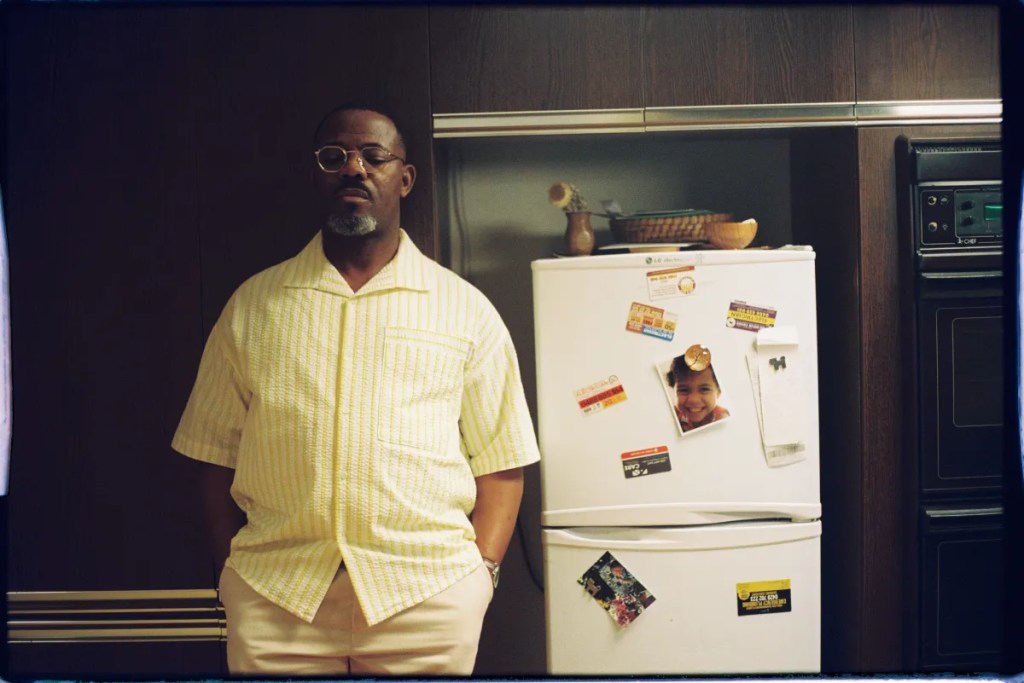
Pasa Faho is a love letter to the Igbo-Australian community, penned with clarity and warmth. In these careful collaborations with artists and community, Oji and his team work to shift the paradigm of diasporic art from mere representation to an authentic expression with pure, jubilant Igbo conviction. After speaking to his community in order to create this film, Oji brings us into the conversation, too. It gently nudges at the internalised wounds we may find too confronting to face alone—with family, community, or history—to the forefront. This process of healing reverberates through the tenderly heartfelt narrative. This film at once demands you to relinquish yourself, swallowing you whole. Yet it also demands something of us: full participation and dialogue in, and outside of its world. Hopefully, hopefully, hopefully this film will seep into your reality. May you glean, reconstruct, collage, reimagine morsels of the knowledge Pasa Faho and those who came before you offer. We owe it to each other to try to understand our inheritances.
Pasa Faho premiered at the 2025 Melbourne International Film Festival. It will screen at the upcoming CinefestOZ and Darwin International Film Festivals.
**********
Michelle Huang is a Naarm-based writer born in Pōneke, Aotearoa. She is interested in films as transformative experiences beyond the cinema.
 Rough Cut