


Leaving is the unutterable aspiration of Alain Resnais’ characters. Yet they are creatures fated to linger; winged but swollen with regret, entrenched in that inviolate soil of the past. This desperate condition is perhaps most manifest in his Last Year at Marienbad (1961) and Muriel, or The Time of Return (1963), both of which place a diaphanous Delphine Seyrig at the helm of memory.
Certainly, going somewhere else is the evident solution for the characters X (Giorgio Albertazzi) and A (Seyrig) in Marienbad. Torment is sempiternal at that vast hotel, in which they and other whispering, moneyed figures consort. A chateau of temporal sorcery, mirrored corridors and false exits—change has no place in such shaped cruelty. X will continue to insist that an affair with A took place last year: “Have I changed so much? Or are you pretending not to know me?” A will continue to deny this: “It was not me. You must be mistaken.” And M (Sacha Pitoëff ), A’s apparent lover, will continue to watch, draped sullen around a stuccoed wall.
A stately puzzle. One attempts to arrange its image-shards of time and place by the credits’ roll, to form a truth under which all those nascent untruths may be laid. A is an amnesiac who promised to leave with him. M and X are the same person. This is a dream. This is last year. This may involve a stuffing, for the logical viewer: I picture wiry arms thrusting scene after scene into thin skin casing, attempting to mould a Cartesian truth. Or confetti, for the ecstatic poet. Somewhere between, these image-shards form a labyrinth around my own truth of the film—but carved by what design?
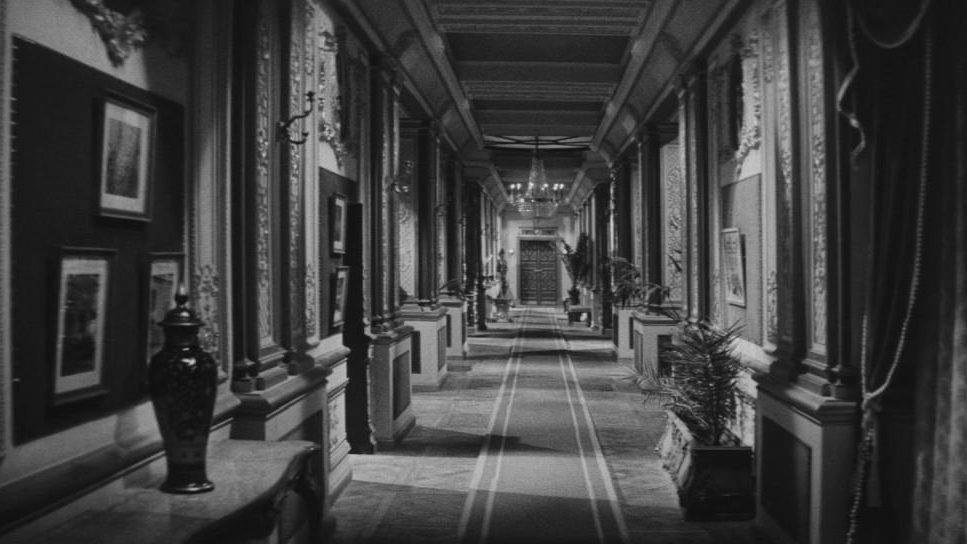
Freudian Abwehr suggests that the defensive mechanism of forgetting is labyrinthine in structure. Walls are erected around the truth by a demented Daedelus. The path is then a trail left by latent memory. I must work back through those misty bends. Elsewise take Bachelard, for whom a labyrinth is the contorted, writhing path that dreamers leave in their wake; a fleeting road, a scenting. Marienbad immortalises this brief labyrinth as painter Rogier van der Weyden does the rolling hills of Mary’s skirt folds in The Magdalen Reading, in that moment’s fall of the garment. I re-enter a dream through the image of the hotel, that great baroque intestine, stumbling in stupor along its artifice. Passages dreamt and remembered become one. The labyrinth of Marienbad is a briny rope of forced revisitation, a refrain.
* * * *
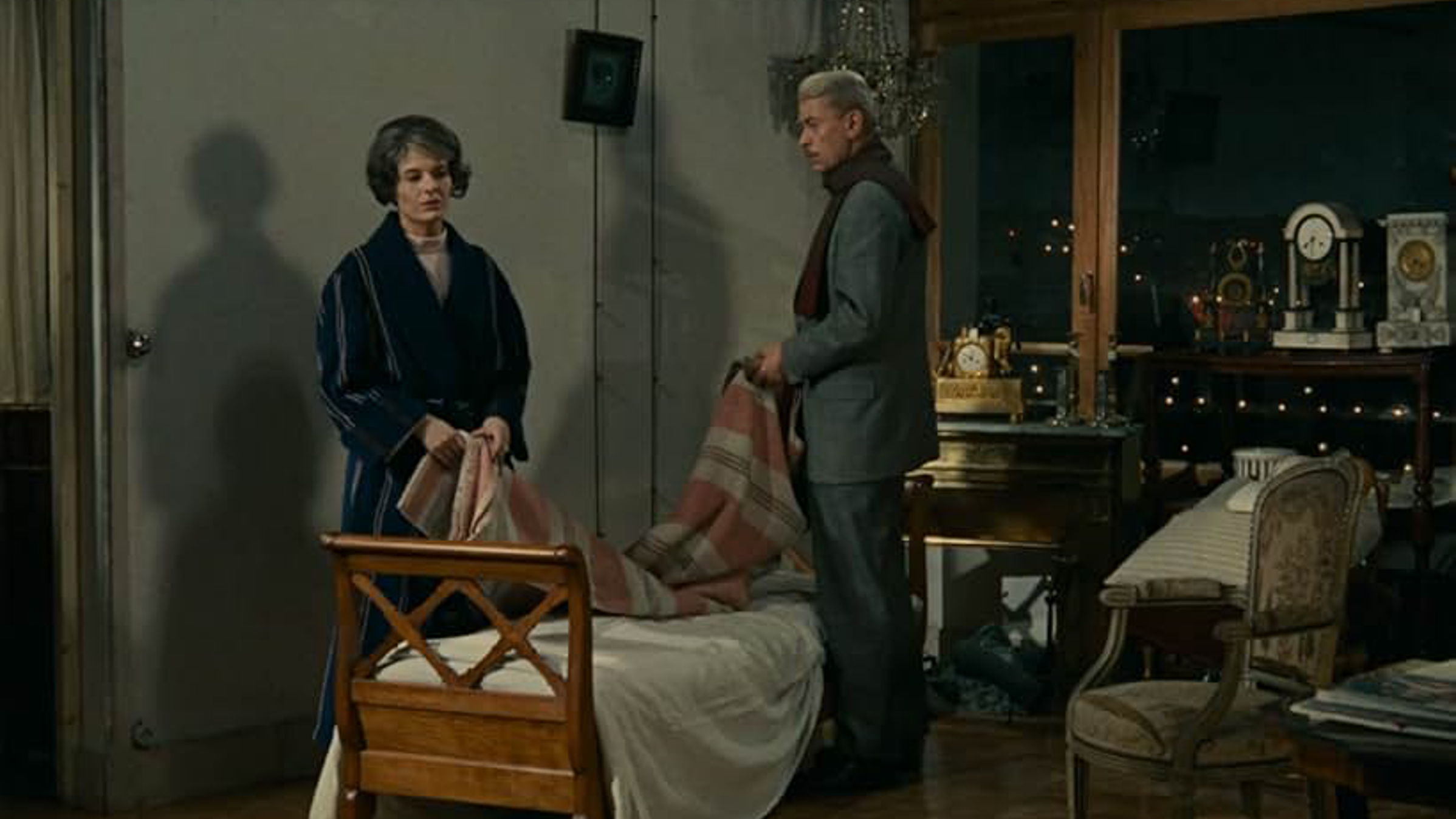
The past is firm and familiar in Muriel, a crude effigy of missed opportunity. It looms giant, eclipsing any slender notions of the present. The characters are flat, familiar symptoms of the fast-moving world, united only by their shared sense of mourning over the rhythms of a former life. Wishing to rekindle their romance, widowed antiques dealer Hélène (Seyrig) invites her old lover, Alphonse (Jean-Pierre Kérien), to stay with her in the coastal town of Boulogne-sur-Mer. He arrives immediately from Paris with his young mistress, Françoise (Nita Klein), who pretends to be his niece. The three spend some months living together, along with Hélène’s stepson, Bernard (Jean-Baptiste Thiérrée), a malcontent recently returned from the Algerian War. He spends his days avoiding the others, traipsing around town, brooding about some vague, veiled happenings of old.
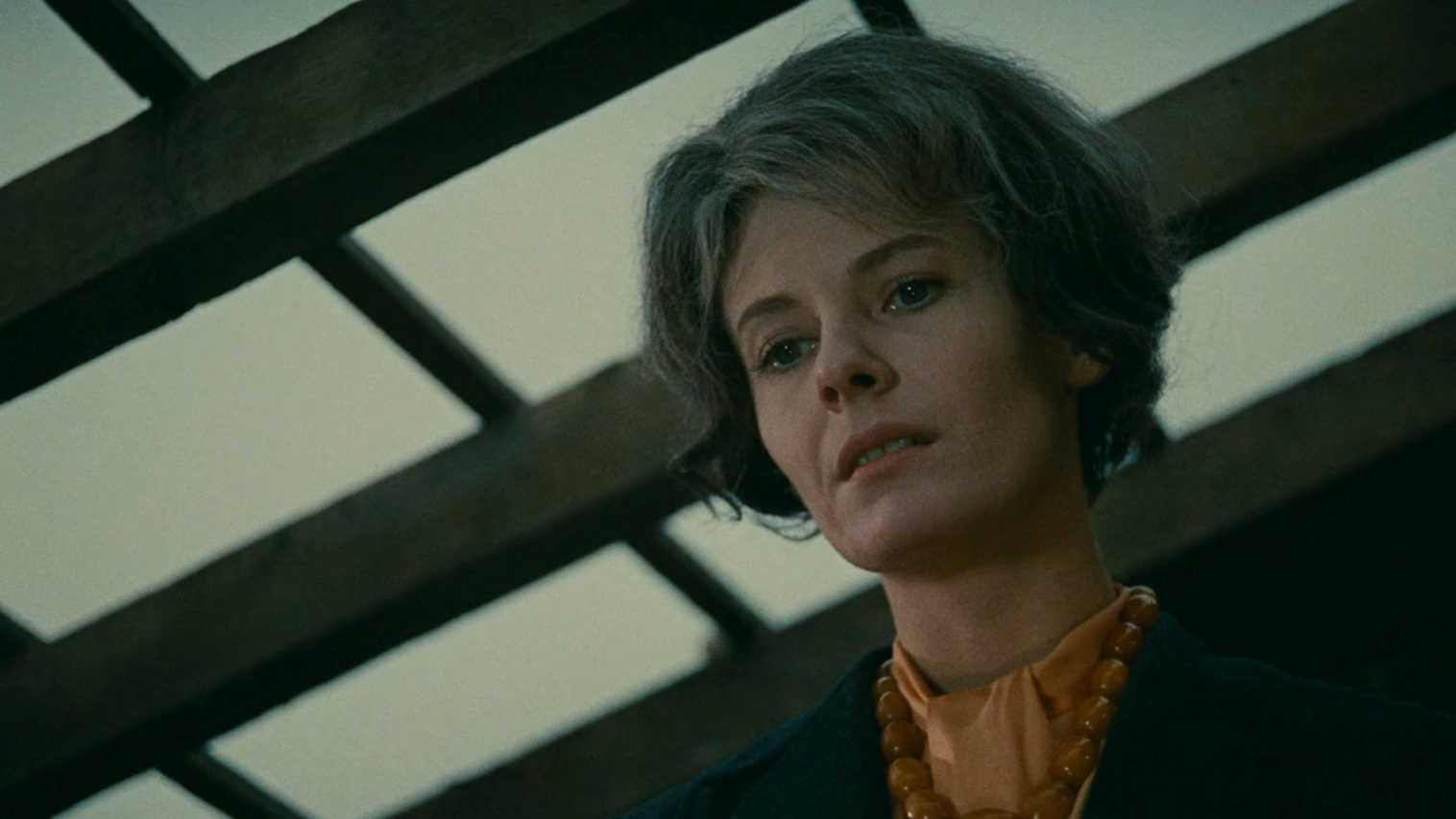
The film bubbles along, sustained by the soft heat of its impermanence. Conversations overlap as a leaky fugue. Dialogue becomes slivered memory. Hélène’s apartment is a showroom furnished chiefly by what she intends to sell. The objects and sundries of home blink by in a flurried montage: a clock, a chandelier, a doorknob, a bowl of glass fruit. They eat chicken chasseur on bone china, “on sale as of yesterday.” The cabinet, already paid for by the neighbour, holds Bernard’s neatly folded clothes. A white shirt sleeve peeks out of the top drawer, slightly ajar, stifled by that glutinous air of ever-approaching dislocation.
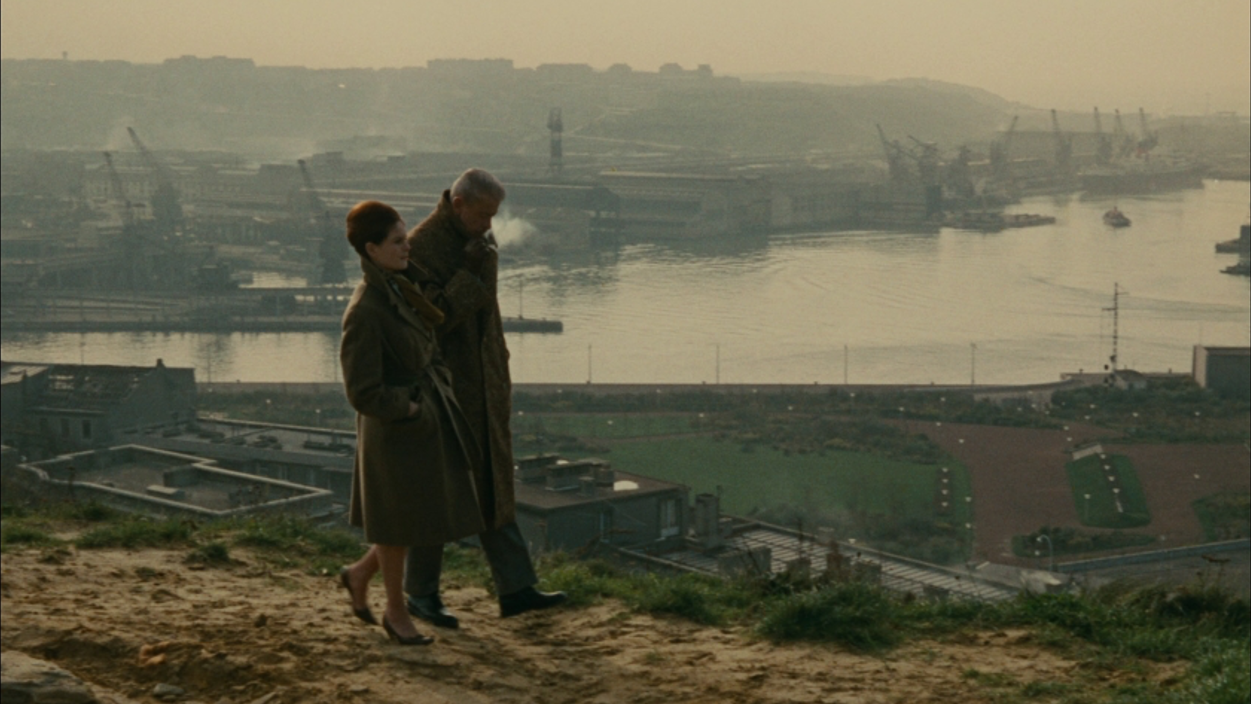
Muriel is indeed a study of proximity, a peopled tide. Its characters are enlivened only by their elliptical incursions into the past. Their endeavours to rewrite bygones are limp against the backdrop of the town’s ongoing postwar rebuild. The Allied bombings have left Boulogne-sur-Mer cobbled and half-known, as new buildings burst up like warty growths along familiar streets. One of Hélène’s acquaintances, an architect, tells at dinner the story of a failed, collapsing apartment project: “Yes, that tall building shaped like a toolbox. The work was a thousand pages… But the house slid. And the cliff retreated. So we’re waiting for it to fall down. It’s new, it’s empty and we’re waiting for it to fall down.” Hélène does not realise. She beams beside him, a giddy, greying child.
* * * *
A year ago I noticed in my inbox an email from my high school, thanking the community for its donations toward the redevelopment of the forty-year-old school hall—its ‘reimagining.’ Friends of the hall had raised well over the amount required to begin construction on the red-bricked edifice. Renders attached to the email revealed a mild, contemporary design: a vanilla slice of timber flooring, ivory bricks and goldish laminate walls.
My school friends and I conferred at some length about the hall, over dinners, over drinks. Much of our juvenile years had been spent in that building; by some primitive sense of refuge, at twelve or thirteen we had selected it as our part-time habitat. The hall was dimly lit, comparatively unpopulated and smelled reliably of rosin, coffee beans and a not unpleasant artificial frangipani. So there we dwelled: skipping chemistry in its adjacent rooms, huddled in winters by the heating vent in the foyer, exchanging sulks and secrets between its foldable aisle seats.
* * * *
What is the destination of the untrammelled mind’s journey into the past? To what purpose disturbing the dust on a bowl of rose-leaves.1 In Marienbad X and A hope to arrive at a truth, shrouded in those tall fabrications. So we search, X and A and I, along three dark paths. Did they share that conversation in that tidily shrubbed garden? Was that Rosmersholm performed in that ballroom? Was A raped by X? “One evening, I went up to your bedroom… I loved your fear that evening.”
Narrated by X, the film may well be his fragmented, reluctant admission of guilt, or a hallucinatory defence of his acts, as he relentlessly reinscribes them into romance. That its images are perfidious constructions of the mind is apparent in their illogicality. I am made privy to X’s attempts to assemble his favourite version of events—everything else is immaterial. Dialogue is repeated in various corners of the hotel. Characters stay frozen in time, mid-conversation, as the camera waltzes me around their shadows. The atonal score by Francis Seyrig (brother of Delphine) heightens this sense of oneirism. Discordant chords melt into each other in one interminable torrent, drowning out diegetic footsteps and pleasantries. It comes to a halt only as X approaches A in her bedroom, and she screams—a shrillness which pierces through the cloak of his invention. The camera pans around the room frantically, before pulling into an unwilling close-up of her frightened face. X then becomes irredeemable. He walks to elude fate. Run slowly, slowly, horses of the night!2
When we all cross paths again, I find X and A’s legs have been hobbled together. X will spurn destiny, and A has decided to follow. With sudden preternatural strength they tear out of the trail and into the lawn—trampling through its geometrical perfection, an arbour of damp hope, and all of paradise—only to find themselves lost once more in promise, that pale venal serpent.
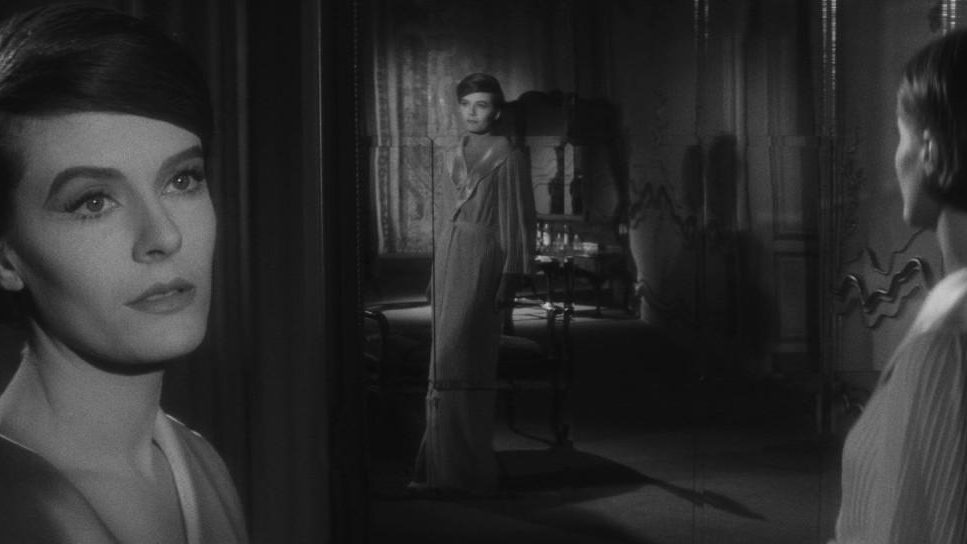
Muriel’s labyrinth is rebuilt over and over, around the same nebulous stuff of the centre. Hélène clings doggedly to this eternal task; I am reminded of the widow in Hiroshi Teshihagara’s Woman in the Dunes (1964)—her sticky, sand-rippled body, digging but always buried. Bernard’s attempts to escape the past are equally abortive. The title character, Muriel, is revealed to be an Algerian woman Bernard helped torture during the war. It is then guilt which roots his disaffection. He shoots dead his accomplice Robert in a hollow act of justice and takes a one-way train from Boulogne-sur-Mer. He walks the same path elsewhere. In his place a new toolbox will grow, or a slight dandelion.
* * * *
Seyrig’s performances in both films teeter on the threshold between person and place. There is a translucent quality to her presence as A and Hélène. The settings of Marienbad and Muriel are observed and understood through the characters’ subtleties of behaviour, an amorphous offering of clarity. It is A in Marienbad who conducts time and space, while X’s labyrinth is built around her apparent bearings and utterances around the hotel. Unbeknownst to him, it is she who awaits him at the centre and determines his fate—by choosing to follow him as he forges the way, she dooms him to a deathless pursuit for as long as she walks by his side. In Muriel, Seyrig portrays Hélène as a gesture of surrender, evaporating into her surroundings as a modest mist. She is her own showroom, harbouring relics of the past which beg to be relinquished. She is Boulogne-sur-Mer, a structure of paradox; impervious to change, yet always situated at that throbbing point of tension between past and present.
* * * *
Tonight that great hall lies disrobed of dignity, unpeopled and unknown. I float by stockinged over biscuity rinds of plasterboard, my feet tickled by the piled rockwool. Those white pillars stand tall yet. From behind them, a pair of weathered hands sweep in at my throat—their precise fingers tighten with that exact shade of pressure as I remember. Leaves drop from sinewy power cables hanging sore from the ceiling. A kettle whistles low somewhere. As I struggle for air, my bare arm is pulled with a familiar strength, and my spectre is twisted free by creamy eyelids, long black hair. And we run out—arm in arm, mouths agape—onto that dewed green oval. Those opalescent giggles I have held onto.
Between the sustainable carpet and perforated ceiling, something of ours will surely remain, held sweet in the enhanced acoustics and collaboration for girls. Clamped between bricks, or laced with a stray fibre of the old carpet, drifting along the reedy vapours of an Air Wick.
And what of Theseus? My ship is a ship that sails me back to and from Crete, my Crete, elected and everlasting.
**********
The Melbourne Cinémathèque screens films on Wednesdays at ACMI in Federation Square. Screenings are presented in partnership with ACMI, and supported by VicScreen. Full program and membership options—including discounted membership options for students—are available at acmi.net.au/cteq.
**********
Jamie Jungyoon Tak is a Naarm-based researcher, writer and production designer. Her current Masters research performs a phenomenological inquiry into Czech Golden Age animation as a haptic return to childhood ludic pleasure.
 Rough Cut