


Throughout her work, Athina Rachel Tsangari continually skewers the concept of borders, evoking an eerie sense of globalised placelessness where everywhere and nowhere is home. Amidst her cinema of exile are the playful physical extrapolations on the concept of ‘fitting’ in her short Fit (1994); the anonymous hotel rooms of various cities in her debut feature The Slow Business of Going (2000); the ruinous industrial ghost town of Attenberg (2010); and the group of men in Chevalier (2015) who dock their luxury yacht in Athens and remain onboard to continue their trivial contests of manliness.
Despite her seemingly scant feature directorial credits, Tsangari is one of the most influential figures of contemporary Greek cinema. Her experience as a programmer includes assisting the first large retrospective on Greek cinema for MoMA in 1993, and as an educator she founded the Mediterranean Screenwriters Workshop and currently teaches at CalArts. In Athens she founded the company Haos Film to foster productions independent from government funding, through which she supported Yorgos Lanthimos’ early features. As she explained in a 2016 documentary, “I see the term ‘filmmaker’ as a total state. Which is not just about directing… It’s directing films, it’s producing films, it’s teaching, it’s programming, it’s writing about old films or your peers’ films. It’s about living cinema.”1 Her borderless approach to film practice could stem from a nomadic life, having lived and studied across New York and Texas during the 90s, before returning to Greece in the 2000s. She currently resides in Los Angeles.
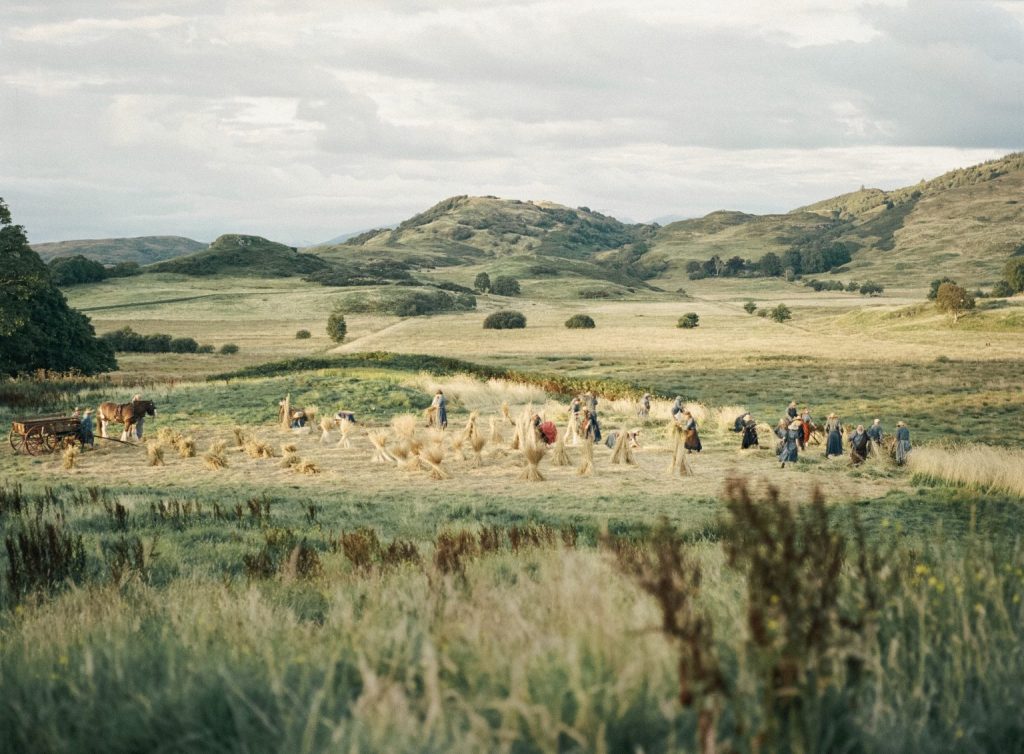
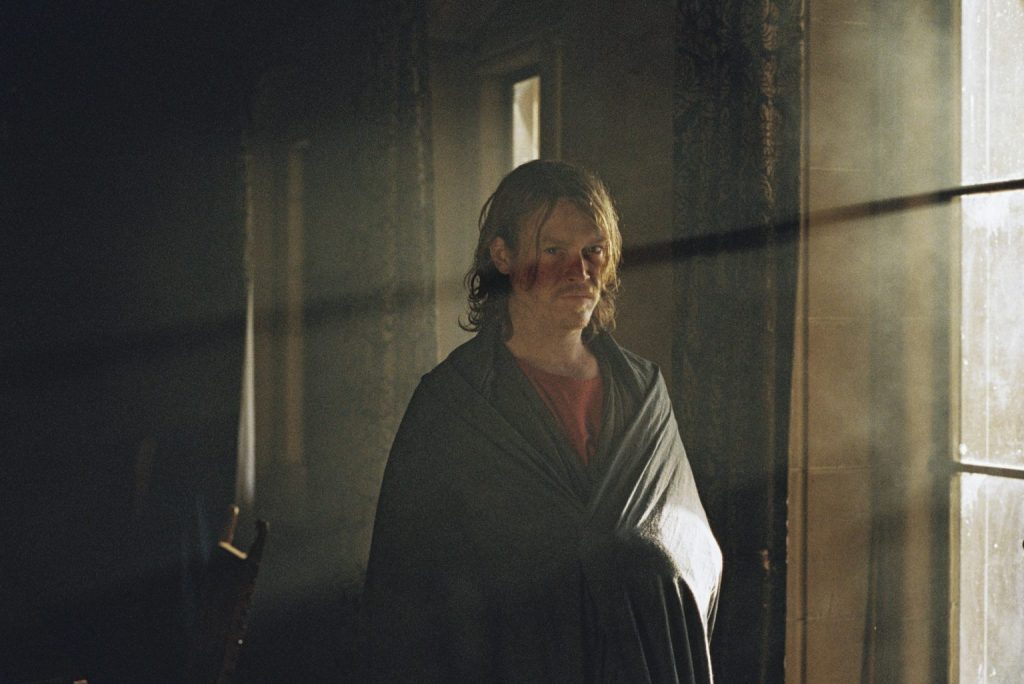
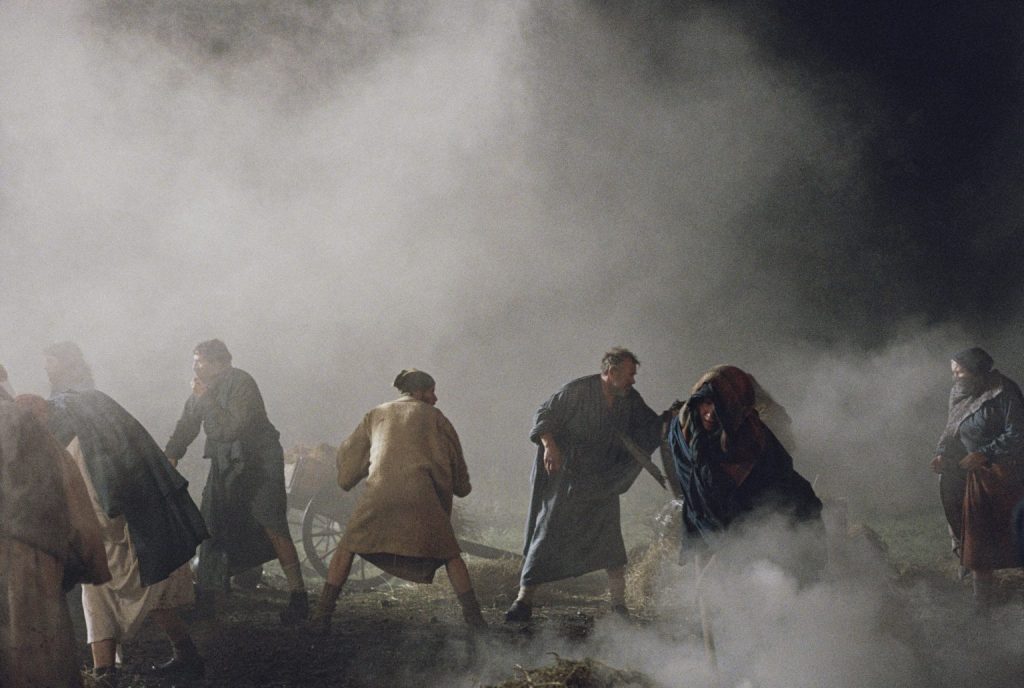
Tsangari’s latest feature Harvest, an ambiguously historical ensemble drama adapted from Jim Crace’s 2013 novel of the same name, and her second in English after Slow Business, is ostensibly unlike anything she’s directed before. Yet, as she explains in our interview, the film explores the social and political origins of the alienation present in her previous work. Featuring painterly Super 16 cinematography by Sean Price Williams, the film follows Walter (Caleb Landry Jones) as his feudal farming village falls into turmoil during its acrimonious transfer from the land’s benevolent administrator Master Kent (Harry Melling) to the snivelling and cutthroat Master Jordan (Frank Dillane). The lucid setting imaginatively crafted by production designer Nathan Parker confirms no specific time or place, yet evokes Scotland’s Highland Clearances of the 18th and 19th centuries, as well as England and Wales’ inclosure acts beginning from the late Middle Ages, when private landlords took control of large swathes of common farmland and exiled the peasantry.
Note: The following interview has been edited for length and clarity.
Andréas Giannopoulos: This is the first time you’ve directed a film that’s an adaptation. What interested you about the novel?
Athina Rachel Tsangari: That it was very much about being weak, and being unable to really do anything about the encroaching catastrophe of community.
AG: Is that something you’re feeling at the moment?
AT: Yes, aren’t you?
AG: The novel has a sense of placelessness that rhymes with your own work. Was that a factor?
AT: Yes, it was. I thought of it immediately not as a period film. I didn’t really want to specify what the time or place was. In the end we shot in Scotland, but really it could have been anywhere.
AG: Why Scotland?
AT: I didn’t want it to be in the English countryside. I was looking for somewhere that had a sense of the end of the world and at the same time, the beauty of an unadulterated nature. The western part of Scotland, which is actually where the Highland Clearances were happening, seemed to beautifully fit what I was looking for. My producer Rebecca O’Brien is originally from Scotland and knows the area. So the two of us got in a car during the pandemic and just started looking for the place. And we found it.
AG: The process for your other films has involved creating scenes through a lot of improvisation with your actors. Working from a novel for Harvest, was this still part of your process?
AT: Yes, it’s always the last part of my process in writing right before I direct. That’s how the shooting script gets constructed in the end. [For Harvest] we all got together in Oban for about a month before we started shooting, and we rehearsed, and danced, and walked the land together. And I would update the script every evening with all of the changes as they were occurring. When I get on set, there is no improvisation. It’s all set already, but there’s lots of freedom between the first draft of the script that the cast receives and the shooting script.
AG: It sounds very similar to Mike Leigh’s process of improvisation. Is that a knowing influence?
AT: For sure. Mike Leigh, John Cassavetes, Ken Loach. I come from theatre, so this is very natural to me: working the script through endless rehearsals until you distill it to its essentials. At the same time, I’ve prepared the sensory map for the film while writing the script. So there is quite an extensive mood board and references. It’s like a springboard for my collaboration with the creative team.
AG: Is that something you just did for Harvest, or on your previous films as well?
AT: Yes, and Harvest even more so, because we had quite small means to create this world and then [present] its destruction. So it was important to be very specific about the visual language.
AG: What did that map look like? Was there anything in particular that stood out and made its way into the film?
AT: Lost of paintings, especially Romantic-era Flemish and Scottish [paintings]. Some J. M. W. Turner, who was actually painting during his time on an island across the bay from us. In terms of films, it was a lot of 70s New Hollywood anti-Westerns. McCabe & Mrs. Miller [1971] was an important inspiration for it.
I remember exchanging lots of Andrei Tarkovsky’s polaroids with Joslyn Barnes, my co-writer and a producer of the film. In the end, because we shot with natural light at the change of seasons, with all this very fine rain, it ended up looking like some of these polaroids that had landed on the mood board early on in the process. And then, a lot of research. Archival photos from the last 100 years of that area of the Highlands—the south Highlands that haven’t actually changed very much—and its people. And lots of music that in the end was the inspiration for the score that we did.

AG: What kind of music?
AT: We worked a lot on rehearsing harvest songs and traditional Gaelic songs from the area, and then lots of punk. The whole idea was about using synthesisers together with very handmade acoustic instruments. So that’s how the score was created.
AG: Is the finished film of Harvest similar or different to what you had envisioned?
AT: It’s very much the film that I set out to do. It’s shorter! The original cut was four-and-a-half hours long. There’s some stuff that I think works better in the shorter cut, and some other scenes that I think were more in the spirit of the film when they were longer. But this is what we do during the edit. There were some compromises.
Some people that have seen the film at festivals comment that it’s too long, and others say the opposite, that it’s too short. Some films really are made for the big screen, and we really made this as a community in a very communal way, responding to natural light and recording natural light—as well as recording the Earth itself with microphones, and all the rustlings and beings within nature. We really made it to be an experience bigger than a little rectangular window on your screen.
AG: Were you very involved in the process of the sound?
AT: Yes, a lot, because I’m really interested in sound. The sound editing with sound designer Nicolas Becker probably took as much time as the picture editing. It was also because we had so many microphones going. I had a very good, big ensemble cast and I really wanted everyone to be mic’d. Our set recordist Théo Serror was incredible. He was really mixing a symphony of voices, and all of these then had to be edited. So it was complicated.
Robert Altman has always been my huge inspiration for sound, in all of his films, but especially Nashville [1975]. It’s really incredible. It was such a breakthrough because this kind of live sound recording completely changes the way that you direct actors. It really allows this organic, live, uninterrupted shooting. Basically, there’s no hierarchy between main cast and—what they call—background cast. Everything is in the foreground and everything is constantly present.
Once I start shooting, I don’t stop until the scene is done. So everyone is constantly there. We don’t do specific shots for a specific part of the scene or for specific people. Nashville really changed cinema. Altman is a one of my heroes since I was very, very young. Somehow along the way, you kind of create this little universe of other filmmakers that you steal and borrow from.
AG: The film ends with a dedication to your grandparents and their farmland. I’m reminded of the grandmother in The Slow Business of Going and Petra Going’s monologue about her alienation from her family’s old way of life. Having made Harvest, how do you feel about this now?
AT: It’s a return to that. A reckoning. The Slow Business of Going was a film about being in perpetual exile from home, whatever ‘home’ is. Harvest traces the first steps of this exile, whether it’s forced or voluntary. One of the reasons I made the film was because a big chunk of our land in Greece is now a highway. Another sort of land loss or land theft, no matter how you see it. So in a way, it’s a full circle.
AG: You’ve often described your way of working on films as very slow. What was it like coming back to this process after directing television on the series Trigonometry (2020)?
AT: I don’t mind taking time between movies. In fact, I cannot do it any other way, because I really have to find the right movie that I absolutely need to do. With directing television I had acquired more speed. So that was valuable to me and is one of the main reasons I did it. Also, directing Trigonometry was how I got to work with Sean Price Williams extensively, so I knew that he was the right one to shoot Harvest. At this point we work without having to talk to each other.
It was a brutal shoot. It was an incredible process of preparing it, and I had so much support and time from my producers and from my cast, who came a month before we started shooting—which never happens—to rehearse, get acclimated, and prepare the characters. Then we lost a week of shooting from the budget, so I had to adjust. We all had to adjust. It was brutal. Sometimes we’d do four or five scenes a day. We really needed to be a team in order to do that, and I had to have acquired this speed of just going from one scene to another and being very focused and making decisions really fast. I actually really loved working this way.
AG: How long was the shoot overall?
AT: It was around five weeks.
AG: For a film like Harvest that’s really not long! It seems that this is the way things are going with many feature films: budgets are getting smaller and things are getting harder to do. Does that worry you about the future of cinema?
AT: It depends on the kind of cinema. There are movies with unlimited funds. I’m not going to talk about Mission: Impossible as an example, which is a franchise I really admire, and a kind of filmmaking and stardom that I also really admire. But, any one of the Marvel or DC movies could finance 20 years of Greek cinema. In the end, it’s really not about the money. It’s about having the time. The fact that I was allowed the time and space to prepare so that I could be in Scotland for almost two years to be able to cast real people for all of the villagers, to be able to really breathe, and sleep, and wake up to the land without having two days and a half here and three days there, and location fees, and all of that. It was an incredible gift.
At the same time, this was a very specific decision between my producers and myself, so there was a harmonious kind of understanding of the process. I find that rare. Once the director starts fighting with producers about very basic principles, the movie gets lost, and I feel like we never lost the movie. I mean, the movie got lost in all the ways it needed to get lost in order to find itself, but as a team, we never lost the movie. So it’s not so much about the money, but having the right team. Most of the films that I’ve directed or produced have cost under a million US dollars, and I never really felt like I was missing anything.
AG: Is this something that your students at CalArts struggle with? Are they optimistic or pessimistic about the future of the art?
AT: I really empathise with them, every day. They are so unfortunate to be coming of age as filmmakers in this era. I think they’re devastated already. All of them have come out of the pandemic, while the world right now is falling apart in every way possible. And, in a very short amount of time lots of us, and lots of them, are going to be replaced by automation. But at the same time, as in every time there is a radical change of an era, it’s also exciting, because it’s all about reinvention and readapting. There have been many, many deaths of cinema, and cinema is undead. I’m looking forward to the next chapter of the death of cinema.
AG: There are many filmmakers who are currently working constructively and pointedly with these issues, such as Hong Sang-soo.
AT: Hong is actually a huge inspiration in particular, especially at a school like CalArts. He’s a model of how to create your film world within your real world, and shoot within your means, and keep doing it. There are such sturdy ethics behind that decision of his. So, I’m not one to complain. Every time there is a rupture, there are all these new fissures that are revealed to us. A crisis can be very fecund.
Harvest will screen at the 2025 Sydney Film Festival on June 7 and 8. It will also show at the 2025 Melbourne International Film Festival, with screening dates to be announced.
**********
Andréas Giannopoulos is a Melbourne-based filmmaker and co-curator of the Melbourne Cinémathèque.
- Athina Rachel Tsangari: Cinema on the Edges, ‘A Portait by David Thompson,’ 2016. ↩︎
 Rough Cut