


A young woman stands before a shiny screen planted in a big white mall. As it plods through a series of sombre advertisements—for Beyond Blue, the Make-A-Wish Foundation, a line of Swiss luxury watches represented by a scowling Ryan Gosling—she remains still and mute. Around her, food court chatter forms a rolling sigh, and flags bearing the word SALE repeat ad infinitum. Her lips curl slightly. She reaches out, presses her fingers to the pixels, likely feels a gentle zapping. Then, a flurry: when Gosling cycles back, she launches forward, kisses the screen, and dashes off like a child.
This is one of the many playful, orphic vignettes that comprise Malls (2024), the voraciously original feature debut of Adelaide filmmaker Daniel Tune, for whom the failing infrastructure of late capitalist life is a kind of silly putty. Malls collages wordless digital footage of two baby-faced, vagabond mall rats—identified only in the closing credits as Noodles (Gabriel Bath) and Lou (Emily Pottinger), although they might as well be named Adam and Eve. In Tune’s imaginative and (not unimportantly) affordable take on cinéma vérité, Noodles and Lou are fictional beings, but their surroundings—from dinky public street toilets to dazed passers-by—are so starkly real they approximate the uncanny.
Noodles and Lou live separate lives in Tune’s bisected portrait, which conveys not only the alienation of an impossible union under the crush of consumerist society, but a tenacity in grasping semblances of enchantment nonetheless. By and about 21st-century youth, Malls is a welcome reminder of young peoples’ capacity not simply to receive corporate messages as if in a state of hypnotised inertia, but—whether through rage, lust, or plain boredom—to bend these messages into unrecognisable, sculptural forms.
Lou’s modus operandi is patience—a virtue which jars so astoundingly with her frenetic world that it comes to feel perverse. At one point, she browses a DVD rental store with shameless and serious care, scanning the spines of Y2K pornography as if they were butterfly specimens in a museum vitrine. Elsewhere, she strokes the shadowy façade of a sex shop, gazing hard into the blown-up, vandalised visage of a vibrator poster girl. Meanwhile, Noodles’ encounters are clownish—funny, gross, tragic. Moments and spaces that would elsewhere be transitional—or transactional—for Tune are the thing itself: art, poetry, romance. Cinema is no conveyer belt, no this and then that. It’s only now and now and now. Often hellbent on testing the boundaries of his precarious environments, in one scene Noodles swallows—slowly, sequentially—the jellied red caps from a bag of strawberry and cream candies, piling the milky whites into a tower on his knee until they almost fall.

A film that has completely reshuffled my sense of the possible in contemporary Australian filmmaking, Malls will screen as part of a trilogy created and presented by the Adelaide community film collective Moviejuice—of which Tune (along with Shea Gallagher and Louis Campbell) is a founding member—on Saturday the 31st of May at Static Vision’s inaugural Brunswick Underground Film Festival. Tune is responsible not only for the film’s direction, but for its cinematography and editing—a transfixing bricolage of immersive observational footage and electric experimental sequences. Noodles and Lou are first introduced, individually, as spotlit, moon-like faces surrounded by darkness, soon consumed by palimpsestic layers of projections riddled with commercial messaging. Still, their eyes look to the camera as if inviting us in. At the heart of Malls is a humane simplicity, remarkably expressed through the abiding gazes of Tune’s subjects, and the respect with which he films their grimy rituals. With its understated, lyrically obscure performances from Bath and Pottinger, Malls treats even the act of using a wobbly e-scooter as a dining table with a Bressonian grace. The film was also co-written by Tune and his actors—a collaboration reflected in the lived-in quality of Bath and Pottinger’s embodiments, which never strain to transmit explanation or emotion.
Malls is a love story in form though not in narrative. Whether it’s via the film’s small family of collaborators themselves, or through Noodles and Lou, Malls reveals cinema as an interface, an apparatus of connection between people when all else has failed. In ‘The Moviejuice Mindset,’ a manifesto published by the collective in 2023, they write of the enduring importance of cinema as a social force in the face of insidious commodification. Speaking of their dynamic local screening events, they stress the vitality of cinema in inciting collaboration and communion. “In our view, it is the making, sharing, and discussion of our art and our history that is the foundation of the deepest bonds between people,” they write. “Though social and technological forces have conspired to keep us separated and alone, to make us believe as if it is just 8 billion individuals and an endless sea of data, the truth is no matter how much power stacks the deck, it cannot truly obliterate that essential transcendence of art and connection.” Moviejuice are rightly critical of structures of industrial filmmaking and funding, but their underlying message is freeing. Never risking didacticism, Malls embodies Moviejuice’s mission completely. While channelling contemporary loneliness with brutal sincerity, Tune’s film never collapses into nihilism, rooted as it is by a sincere trust in its own form. Although Noodles and Lou are divided by duration, they inevitably share a screen, and thus a home. Malls’ tagline is fitting: ‘A Structural Romance.’
Despite Malls’ interest in the hyper-digital and egregiously commodified realities of its characters’ lives, it remains anchored by physical sensations. The footage itself has an especially material quality; surfaces are never totally smooth, carrying instead their own sultry grain, a blueish way of rendering light. With the film’s lolling pace, striking colour schemes, and—later—droning guitars evoking the nascent sound of The Velvet Underground, it is as if the audience and Tune’s vagabonds alike are moving through glitter-specked honey—an unnerving but never simply unpleasant feeling. Instead of mimicking the over-effusion of ‘content’ that we so-called consumers are bombarded with daily, Tune asks what happens when this cruel deluge is countered by another way of being: the slow and sustained attention of the flâneur/flaneuse. While Lou and Noodles seem to yearn for satisfaction-through-consumption, they also defy capitalist expectation. Idle ghosts with nowhere to be, they haunt the over-productive city with a confused and melodic aimlessness.

Malls metabolises influences from international cinema with a deep and unpretentious awareness. To me, Noodles and Lou feel most like digital-age descendants of the star-crossed stragglers of Leos Carax’s ecstatic 1991 tragedy The Lovers on the Bridge: blinding painter Michèle (Juliette Binoche) and fire-eating performer Alex (Denis Lavant). At once divided and bound together by poverty and despair, Michèle and Alex invent new ways to destroy and re-contextualise Paris. Houseless, they possess their home, the Pont Neuf and its surrounds, with resplendent defiance, whether by jet-skiing on the Seine or ball-dancing to the explosions of fireworks. It is not only that there are clear traces of Lavant—who would go on to mangle urban landscapes as Monsieur Merde in Carax’s Tokyo! (2008) and Holy Motors (2012)—in Noodles’ grotesqueries. But also that, like Lovers, Malls presents private fetishes and fantasies as indivisible from so-called public life, and proposes romance not as an organising principle, but as a welcome glitch in the system.
In his recommendation of the film, Adelaide filmmaker and critic Bill Mousoulis describes Malls as “a dazzling slow-cinema study of consumerism and alienation.” The moniker ‘slow cinema’ feels apt considering the palpable influence of the work of Taiwanese director Tsai Ming-liang, one of the most celebrated harbingers of so-called ‘slow cinema’ internationally, on Tune’s film. The attentiveness of Malls—its willingness to witness the bodily realities of its characters, whether they are walking, eating, or lying immobile—resonates with Tsai’s aesthetics of endurance, such as in his recurring portrayals of muse Lee Kang-sheng, who often moves as if his muscles are debating in which direction to go.
But Malls, like much of Tsai’s work, is perhaps less about slowness than it is about displacement, about time forced out of joint. In Tsai’s What Time Is It There? (2001), Lee’s character, Hsiao-Kang, is a street-side watch merchant. His father has just died, and his mother’s grief has hijacked all of their family rituals, throwing sleep and mealtimes by the wayside. After an enigmatic encounter with a one-time customer soon departing for Paris, Hsiao-Kang begins to adjust each of the city’s public clocks to Parisian time. It is as if he is trying to heal a disjunct between stubborn, forward-moving capitalist time and disobedient interior rhythms—the rhythms of loss or desire. Both What Time Is It There? and Malls expose that it is sometimes the same mechanisms that try to propel time unilaterally forward (the city clocks consulted by businesspeople, or the regimented rhythms of a shopping centre) that might also lead it to snap.
Importantly, however, Malls never asks us to forget that it is an Australian film; its city is not Paris or Taipei, but Adelaide. This is something the three Moviejuice films screening at BUFF each express, in richly varied ways—a broad consciousness of international and historical art and cinema, combined with a distinctly local and contemporary sensibility. Alongside Malls, BUFF will screen two films by Moviejuice peers: Aubrey Winslow and Jack Langford’s short Night of the Cryptoid, a Jon Moritsugu-esque daylit horror about a goth who discovers a monster wrought from trash, and Malls star Bath’s spirited first feature, Ships That Bear: an ambling, Thomas Pynchon-inspired surrealist epic, which Mousoulis named the best Australian film of 2023.

A maximalist phantasm, Ships That Bear begins with Fidel Castro landing in a stretch of Adelaide bushland and, by way of dance sequences and reflexive monologues swiped from the sixties, culminates at a faux Factory, where a cheap-wigged Andy Warhol is murdered by the muffled projection of a Valerie Solanas cipher. Bath and his collaborators tell the stories of their fractious, faraway subjects through an ethic and aesthetic of wilful contradiction. Moments before we see a woman in a beret walk by an Australia Post shopfront, we are met with a brazen ‘Large American City’ title card. Elsewhere, Cuban revolutionaries check their phones, surrounded by gumtrees.
Ships That Bear is a slippery, often incomprehensible film made up of abrupt shifts and confusions which, in the end, cede to an earnest, poetic simplicity. Overlain with charmingly slapdash effects—from heat-vision filters to cardboard intertitles and skittering stop-motion soldier figurines—Ships That Bear constantly threatens to explode its form. Embracing childish curiosity, it shamelessly presents itself as an enlivened document of a group of young artists learning by doing.
These films express not only a close recognition of their Australian settings but, through inventive uses of sound, image, and performance, each create experiences of displacement that uniquely reflect the disorientation wrought by living and making art on colonised land. In Ships That Bear, dislocation is a recurring joke, but there’s also something haunting about it; the film conveys an astute sense of wrongness, pointing towards living histories of imperialism. Night of the Cryptoid takes on a similar sensibility. While commercial Australian cinema remains stubbornly rooted in the colonially transplanted notion of the Australian Gothic, Winslow and Langford’s film sees footage of polluted bushland violently discoloured by fluorescent digital filters, adopting radioactive hues. Rather than abiding by readymade national conventions or erasing Australiana altogether to avoid inviting cultural cringe, Moviejuice’s burgeoning filmmakers showcase a serious drive to represent Australia in new ways, at once careful and provocative.
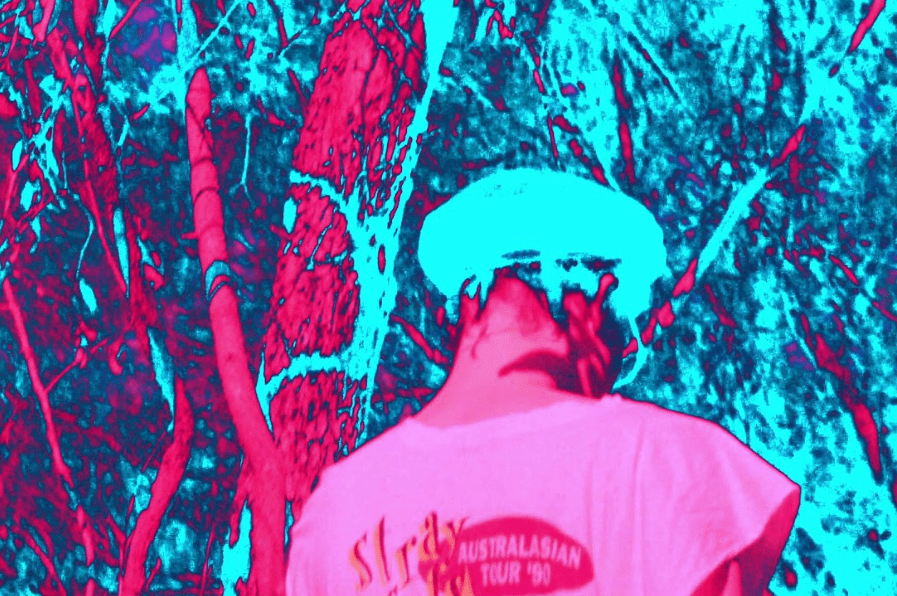
A passionate multiplicity resounds throughout Moviejuice’s films. In Ships That Bear, voices are constantly dubbed, sometimes by two actors at once, such as in a long passage set to a theatrical reading of Solanas’ SCUM Manifesto (1967). As the film moves through space and time, it careens between monochrome and colour, and actors are reincarnated as different characters. As with Malls and Night of the Cryptoid, Ships That Bear’s cast and crew is made up entirely of family and friends. While the film stages the death of one of avant-garde cinema’s heroes, within the context of Moviejuice’s proliferative and inclusive approach to art, this feels by no means nihilistic. Instead, it’s somehow cathartic, revealing the staunch persistence of underground and collective artmaking beyond the life of any individual figurehead. As they write in their 2023 manifesto, “The democratisation of cinema is already here.”
Malls, Ships That Bear, and Night of the Cryptoid will screen at Static Vision HQ on Saturday May 31st as part of the inaugural Brunswick Underground Film Festival. See more information about the session here.
**********
Indigo Bailey is a Tasmanian writer and editor living in Naarm/Melbourne. In 2023, she received the Island Nonfiction Prize for an essay about rain sound. She has written for HEAT, Island Magazine, The Guardian, and Kill Your Darlings, among other publications.
 Rough Cut