


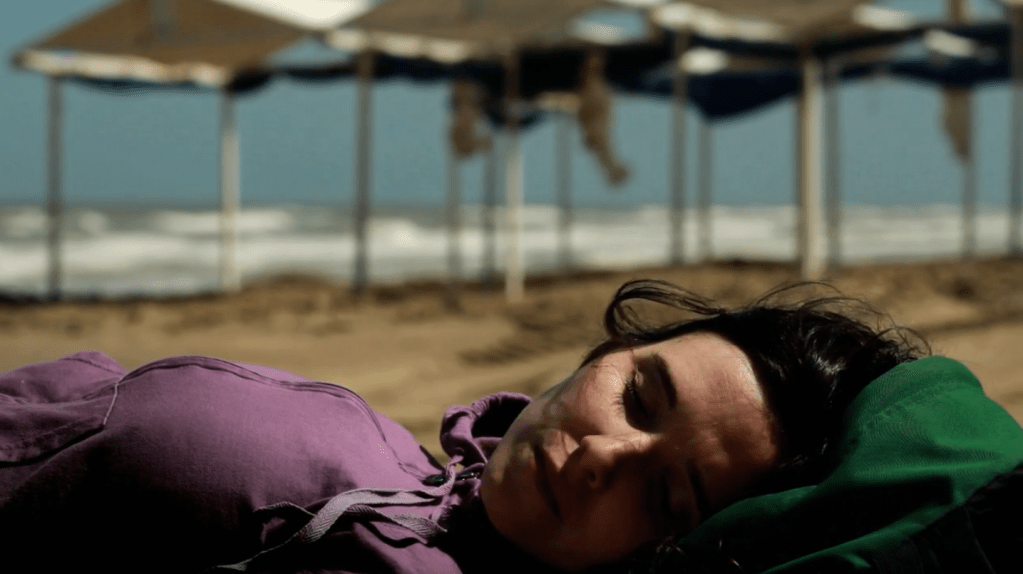
Reflections, distortions, matches, mismatches. Ideas of doubling and projection are the lifeblood of the work of Laura Citarella, an artist for whom cinema is akin to alchemy: a chance to mix disparate elements together, insisting that they will, at some point, connect—even if this connection is fleeting or nonsensical. In 2011, Citarella collaborated with Laura Paredes, then a newcomer to the screen, in her directorial feature debut, Ostende. The creative pair spawned a third Laura for the film: a quietly enigmatic Buenos Aires woman who commences a stay at the titular beachside resort during its forlorn offseason. The visit is a prize secured by her boyfriend’s successful appearance on a TV quiz show, during which he casually swiped a fragment of her identity—her family’s profession—by falsely informing the host he was raised by florists.
While Laura awaits her boyfriend’s arrival, her imagination is stirred by the presence of a trio of fellow guests—an older man, portrayed by Citarella’s father (Julio Citarella), and two beautiful young women—whose union is, to Laura, inexplicably sinister. As Laura assumes the role of voyeur throughout the course of the film, she also comes to mimic the defiant, bone-deep curiosity of her namesakes, Citarella and Paredes, and their capacity to spin knotty webs of myth, rumour, and intuition from a single stolen object or whisper. This ardour for fiction in all its slipperiness would spur their work together on Trenque Lauquen (2022), a passionate detour of mystique and misdirection spanning over four hours. Here, Ostende’s Laura is reconjured as a missing botanist, wilfully adrift in fantasies of historic lovers and mythic lagoons.
In an interview that accompanied our screening of Ostende at our Summer Sacraments event in partnership with our friends at Static Vision earlier this year, Citarella reflected upon Ostende in light of the making and release of Trenque Lauquen. She spoke generously about her filmmaking philosophies, her ongoing interest in multiplicity and contradiction, and the symbols—from hotel bedrooms to waterscapes—that have continued to ripple throughout her work since her first feature. Returning, revisiting, reincarnating—as Citarella tells me: “You are all the time shooting the same film.”
Note: the following interview has been edited for length and clarity.
Indigo Bailey: While the themes of Ostende resonate with classic noirs like Rear Window (1954) or The Conversation (1974), the mood of your film is so unique, and—in my view—Laura is a completely different kind of voyeur than we’re used to in cinema. What were your inspirations when first devising Ostende, and why did you want to explore this figure of the voyeuristic woman?
Laura Citarella: The main inspiration was the place itself. Before writing the script of Ostende with Mariano Llinás, I only had the idea of going to this hotel and making a film there. It’s a film, like Trenque Lauquen, that was invented from a place. The main idea was to ‘portrait’ a place—maybe before having a story or the actors.
When we decided to make this film, I had been producing many films—like Historias extraordinarias [2008], La Flor [2018], Castro [2009]—and I wanted to go back to directing. During university, I made shorts as a director, and then I also made a short called Historias Breves V: Tres juntos [2008]. I wanted to go back to that experience, but I didn’t have many clear ideas of what I wanted to do. So we decided to call this friend of ours who has this hotel [Ostende]. Many things have been written there. It has this mystique because, for example, Jorge Luis Borges, Adolfo Bioy Casares, and Silvina Ocampo used to go there for holidays. So it’s a ‘fictionable’ place—you can bring fiction to this place, and many people have invented things there.
When I decided to write this first film, I knew I wanted it to be a conversation between different kinds of cinema, between different styles of cinema. At that moment, I was thinking of Eric Rohmer and Hitchcock. [There was] also a little bit of Antonioni, of course. I thought, “How could I make a film that builds [upon] this idea of suspense or the thriller, interrupted with more Rohmerian ways of cinema?” So the film is all the time coming and going between these two possibilities.
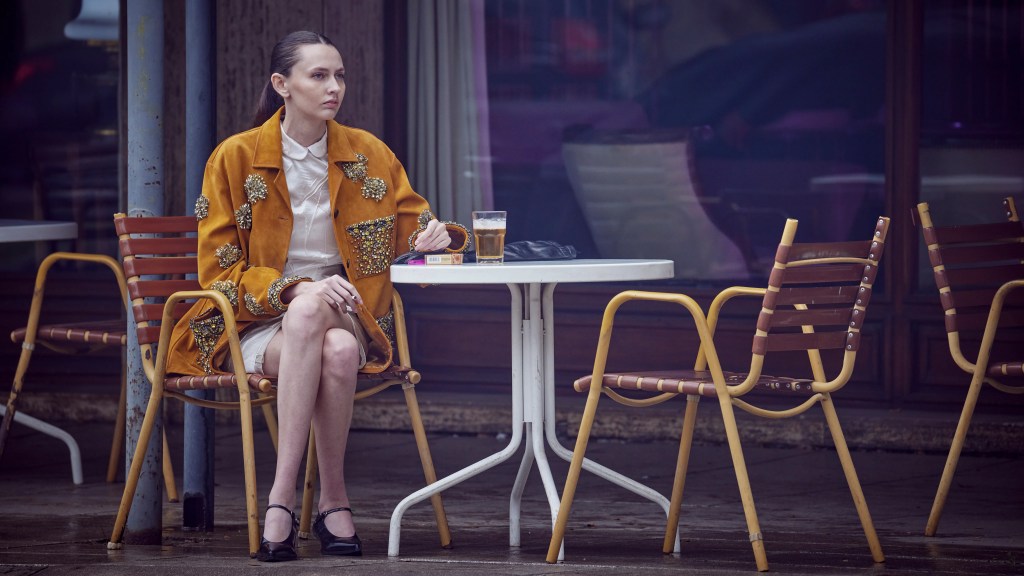
IB: I’m interested in how the idea of doubling often arises in your films. For example, in your short El affaire Miu Miu (2024), I love the scene where it’s revealed that the missing model has a secret room adjoining her hotel suite, which is identical except that everything is dishevelled.
LC: This is something I began to understand some months ago. It’s not something that I know every time I am making a film. I’ve also co-directed two films, La mujer de los perros [2015, with Verónica Llinás] and Las Poetas vistan a Juana Bignozzi [2019, with Mercedes Halfon]. The films are always the encounter of two things—or more, but usually two things. It is this marvellous event that you can cross two different things due to cinema.
For example, in the case of El affaire Miu Miu, it was very interesting to meld these two worlds: the province of Buenos Aires and the fashion world. It’s this idea of things that wouldn’t meet if it wasn’t for cinema. It’s something that happens because of cinema. When these things appear, for me it’s like a path to follow: things that wouldn’t meet in real life, but [which] cinema makes possible. In this encounter, I feel that the images that appear are images that were not known by the world or by the cinema itself. For me, that’s something interesting.
Then, in the case of the scene you’re talking about—usually, it’s important for me to build that the characters are never only one thing; they are always many things. For example, in Trenque Lauquen, Elisa Esperanza [Elisa Carricajo] is a doctor and she’s pregnant, and she has a life in the countryside with her girlfriend. In El affaire Miu Miu, the character played by Laura Paredes is this medium that works for the police, but she has kids. I had to take some things out because Miu Miu wanted the film to be less than 30 minutes, but I would’ve made it a one-hour short film, you know? There was this idea that she works not only as a medium and has these children, but also she works for a company or has her own store. It’s this idea of being a lot of things at the same time, which I think is very particular to the fact that most of these characters are women. I don’t want to define women, but there’s something about women in that they do a lot of things at the same time, or we can be a lot of things at the same time, and this is something that is not so usual for men.
So that’s why I also work with women, because I feel like these kinds of characters you can’t define in one word or in one sense are mostly women. I feel that this is something I’ve been finding in my day-to-day life. This idea of contradiction and of [there being] two sides of everything—not only of the characters—is very important. Because usually the narrative in cinema goes one way, and in the end the stories try to be closed—to be packed, you know? For me, opening these contradictions every time is like a game. I found that it’s a style, a way of making films or telling stories, of ‘portraiting’ people and places.
IB: I think the quality of being multiple is something Paredes does so beautifully and subtly in Ostende. Even though we know little about her character, it feels as if she can be anyone, and you can detect these contradictory feelings within her. Could you talk about working with Paredes for the first time on this film?
LC: Laura and I, we are very similar. We have many things in common. On that film, we discovered we have this understanding of each other. We both have this fanaticism—we are fans of creating fiction. Maybe we are drinking something and looking at a situation in the street, and we try to discover what’s happening there. This is something we enjoy. [During] Ostende, I felt we found this thing in common, which is of course something that most of the films made by El Pampero Cine have in common: this curious idea of looking and listening, which helps to build fiction, to create something. We had fun because we understood that this was our own chemistry, our own energy in common. So it was very easy for me to work with her.
We discovered that Laura had less experience as an actress at that moment, and I had less experience as a director, of course. So, we were also learning. In her case she was getting into the cinema because she comes from theatre, and she was used to doing other kinds of things. Of course, for cinema actors need [to do] less; if you do too much, it won’t help for the scene. So, she was learning, and I was also learning how to deal with this kind of scene.
Even though at the beginning we were a little bit lost because it was a different film, when we shot Trenque Lauquen it was similar to Ostende in many ways. We had something already; we had learnt something in Ostende that we could take to Trenque Lauquen. So now we have a very deep understanding of each other, and we can work as a team. When I work with Laura, I don’t feel I am directing someone. I am directing, but she is also proposing her own ideas, bringing her own drama to the scenes. So it’s the kind of encounter I was talking about; together we do something I cannot define. Something happens between us. Something we can only create together.
IB: I wanted to ask about the place of water in your films. From my geographically faraway perspective, when I imagine an Argentinian landscape, I wouldn’t start by thinking of the sea or waterways. But in Trenque Lauquen the lagoon is so important, and in Ostende the sea is essential—especially as it features in the incredible closing scene. Can you speak to this?
LC: It’s interesting because the moment where the character of Carmen Zuna in Trenque Lauquen—it’s me—goes to the beach, at the time Ezequiel [Pierri, Citarella’s husband], who is the actor of Chicho in Trenque Lauquen, was shooting me while we were on holiday in Ostende. I told him to take the camera and shoot, but I didn’t know if I was going to use this material for Carmen Zuna. I was just shooting my pregnancy and then I was going to discover what to do with it.
But what I feel is that you are all the time shooting the same film. You go back to places, and you want to shoot those places again. This is something that happens to me. I like to go back to Ostende. There is a shot [in Trenque Lauquen] that is exactly the same as the final shot of Ostende. And I really wanted to see how it worked to go back to a place, to shoot this place again, in another condition some years after, and with another purpose. For me, when you make a film in a place, like in Ostende for example, you go back to this place and always feel like you’ve lost something. It’s strange, the sensation, because you felt when you were shooting and when you finished the film that this place belongs to you. So when you go back to these places without the camera, for a holiday, you feel like you’ve lost this place. In a way, shooting the place again is like conquering it again, having this special relationship with this place.
It was nice to have this sensation of going back to [Ostende] with another purpose, with another mind, because in the passing of time you’ve changed. Now I was pregnant it was very different. When I shot Ostende, I think I was 30 years old or less, and I was not even planning to be a mother. So you go back, pregnant, and you feel that this place is the same, but it is no longer the same as [the one] you shot before. For me, going back to places is not nostalgic. It’s not that you have this melancholy. It’s more like experimenting—how do I look at this place again, ten years after?
So in a way, this was also the case with El affaire Miu Miu. I had made Trenque Lauquen and I thought, “What would happen if I go back and this time I bring this new world, the fashion world, to Trenque Lauquen?” I already know this place, I know how to shoot in Trenque Lauquen. I know who the actors will be—the actors are the same in El affaire Miu Miu and Trenque Lauquen. What happens is: everything is the same, but now I’m going to put the fashion world in conversation with the town and the province. The experiment is always something new, something refreshing. You discover new languages from this crossing of things. I like this idea of going back all the time, but not in the same way.
IB: After having made Trenque Lauquen and developing the character of Laura—or a version of her—further, I’m wondering how that affects, or if it affects, how you look back at Ostende?
LC: Ostende is a film where I was more rational to make it work. The character is all the time listening and looking and recreating fiction from the world; she is extracting things, building and bending fiction. And in Trenque Lauquen, I had this new challenge: to bring the character inside the fiction that in Ostende she’s looking at from the outside. It also has to do with the fact that when we started making Trenque Lauquen and when we started writing the script with Laura, [we realised] this character of Laura is no longer 20. She’s in her 30s.
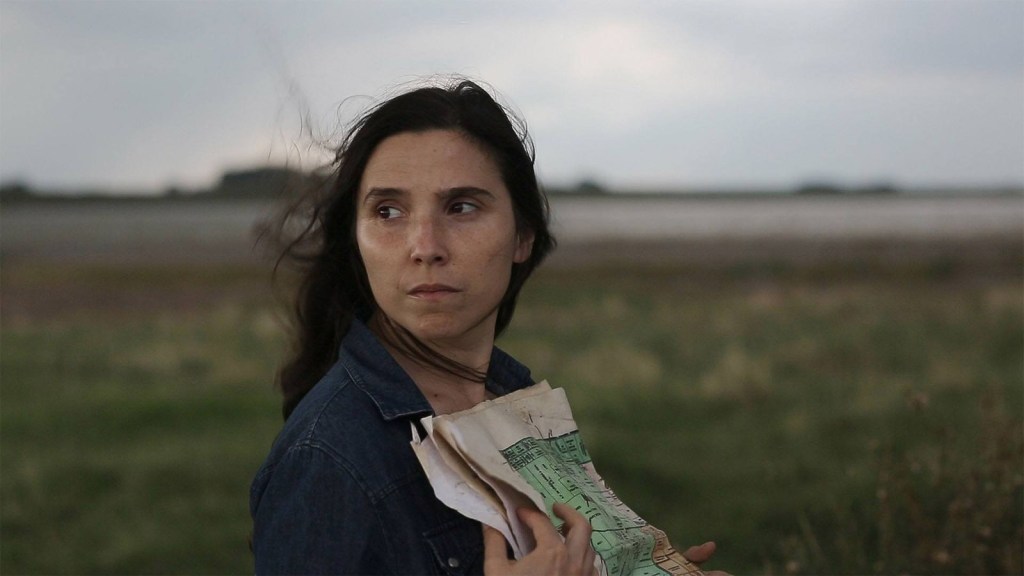
Laura had a baby the same year that we started to shoot Trenque Lauquen, and it was strange to see a woman of 30-something just looking at things and losing her time. It’s not so organic, no? We decided the same character some years after had to be more evolved with that fiction she was creating. She creates this fiction while she’s working with and involving another person, Ezequiel. Then she finds fiction in another thing, which is the creature in the lake and the doctor, but it is no longer her invention—it’s something that is really happening. It’s no longer a fantasy in her mind. In Ostende, the idea was all the time to build a story that was in her head, and you don’t know if it has a relationship with reality or not. For me it’s a more shy film in a way, because it doesn’t get into the action, in a way. It’s more like, everything is happening in limbo. So now when I see Ostende, of course I like it, but I have this sensation that it also documents ourselves when we were younger and had this idea of cinema that is not the same as we have now.
Ostende screened at Static Vision on March 1st as part of Summer Sacraments, for which this interview was conducted.
Ostende is available to watch online for free courtesy of Cinemargentino.
**********
Indigo Bailey is a Tasmanian writer and editor living in Naarm/Melbourne. In 2023, she received the Island Nonfiction Prize for an essay about rain sound. She has written for HEAT, Island Magazine, The Guardian, and Kill Your Darlings, among other publications.
 Rough Cut