


“The museum, in other words, has for a long time loved other people’s objects with a death grip. Can it surrender that deadly love? Afterwards new loves may bloom, new possibilities might emerge.”
Teju Cole, Tremor (2024)
A deep, liquid voice reverberates across a void of darkness. “As far back as I can go there has never been a night so deep and opaque.” Against this black screen the voice continues, and the camera reveals a wooden statue, sharply in focus, surrounded by the blurred motion of museum staff. Speaking in Fon, an Indigenous language of Benin, this narration is delivered by a statue of Ghezo, the King of Dahomey from 1818 to 1858, known simply as ‘26’—an inventory number assigned by museum staff. Long confined as a silent witness to history, alongside thousands of artefacts looted from Dahomey during the French Army’s invasion in 1892, 26 is here granted a voice. In lyrical prose, 26 recounts the experience of being suspended in eternal darkness for over a century, powerless and dispossessed: “Cut off from the land of my birth as if I were dead.”
Dahomey, winner of the Golden Bear at the 2024 Berlin International Film Festival, is French-Senegalese director Mati Diop’s second feature film. Through a negotiation between observational documentary and fantasy, the film follows the restitution of 26 royal statues. In 2021, after more than 130 years of captivity in Paris’ Musée du Quai Branly, the statues were approved to return to their land of origin, the present-day Republic of Benin. Across Africa, European colonial conquest and expansion during the 19th century saw the pilfering of countless artefacts of cultural heritage. These displaced objects held significant influence over the trajectory of European modernist art and often remain confined in the institutions of colonisers today.
In 2018, French Prime Minister Emmanuel Macron made a historic declaration, advocating for the necessary return of African cultural heritage, denouncing the colonial attitudes of French museum practices, and arguing in favour of permanent restitution. Following this, Macron commissioned the Sarr-Savoy Report (2018), which recommended legal amendments to enact the restitution of African cultural material. The report found that France alone is in possession of at least 90,000 African objects, sparking the first round of repatriation. Speaking with Interview magazine, Diop recounts the moment she was made aware of Macron’s speech, likening the bodily experience to that of vertigo. Diop credits this visceral reaction to “the fact that I realised that restitution had never really been something in my imagination.” This disruption of an anticipated reality, resulting in a feeling of expansion and potential, describes Diop’s inventive cinematic approach—sharp realism infused with poetry and mystery.
The director first established her interest in both social realism and the supernatural in her debut feature, Atlantics (2019), which followed a group of women in Dakar possessed by the spirits of their lovers and family members, who return to the world of the living to seek restitution from corrupt employers. The approach to storytelling in both Dahomey and Atlantics is one of magical realism, a term which invokes the hybrid of two seemingly incompatible concepts. Recognised as a powerful postcolonial device, magical realism is described by critical theorist Homi K. Bhabha as “the literary language of the emergent postcolonial world.”1 This format is “driven by desire at one level to grapple with reality and the epistemological systems in place for knowing it, and at another level to transcend here and now and imagine an alternative world.”2
In Dahomey, Diop demonstrates her parallel interest in depicting the world as it is and imagining experiences beyond the human realm. The film pivots between two worlds, where the stark realism of observational documentary footage is entangled with a cinematic vision of the extraordinary to tell a story that is equal parts poetic and cogent. Using magical realism as a powerful rhetorical device, the imagined inner monologue of the objects communicates their deep spiritual significance in the context of their original creation, in contrast to their status as solely anthropological or aesthetic objects from the perspective of European colonial powers.
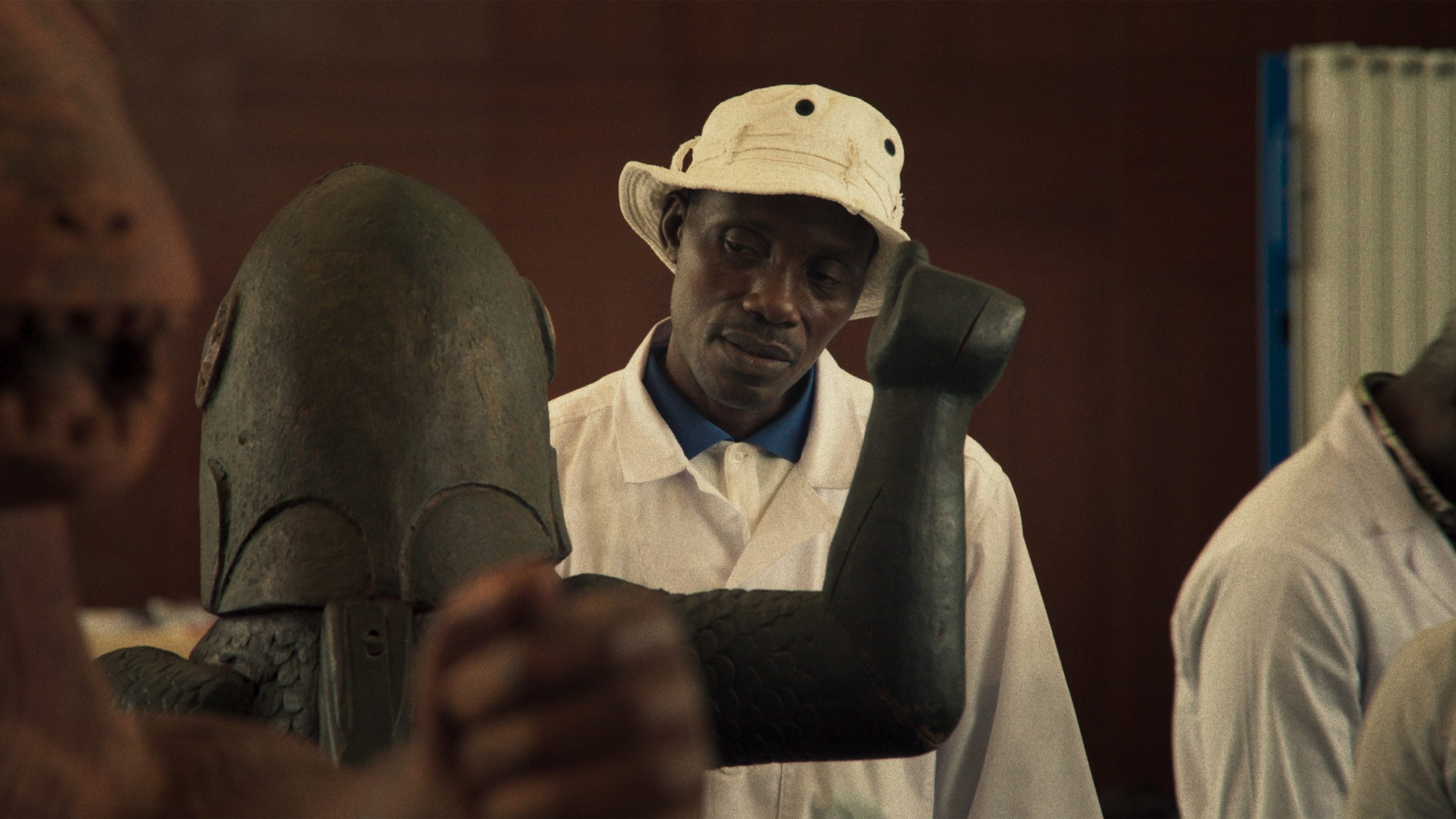
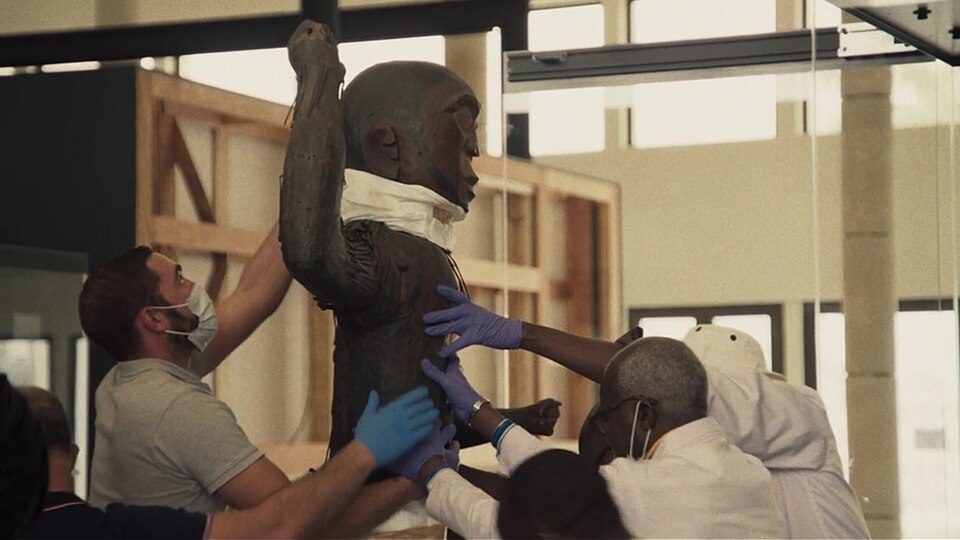
The opening segment of the film documents the preparations of the 26 treasures, carefully catalogued and packed for their journey back to Benin. The regimented museological processes feel cold and impersonal, underscored by the claustrophobic impression of the French museum, conveyed through tight shots and an eerie silence. Once again thrust into darkness, the sculptures are confined in shipping crates to embark on their homecoming journey across the sea. Here, 26’s monologue is deeply human, expressing apprehension around change and belonging: “I’m torn between the fear of not being recognised by anyone and not recognising anything.” The first glimpse of the sculptures’ destination is introduced in stark contrast to the sterile French museum environment. Loud and bustling, the country’s capital, Cotonou, is shown in moments of vitality, enlivened by clapping, singing, bells, traffic, and dance.
In Nigerian-American author Teju Cole’s novel Tremor (2024), the protagonist Tunde delivers a university lecture on 15th-century Benin bronzes, pilfered by British colonial armies and since contained in museum collections in the UK. Speaking to a British audience, Tunde explains the ‘plea’ that lives within the stolen Benin bronzes—the need “to rethink the idea that Western understanding surpasses that of the people who made and sacralised these objects, that aesthetic appreciation or critical practice exists only here.”3 Transitioning from 26’s anguished monologue—a plea in the form of a sympathetic appeal to the imagined experience of the statue—Diop reckons with some of the complex arguments made by Beninese people.
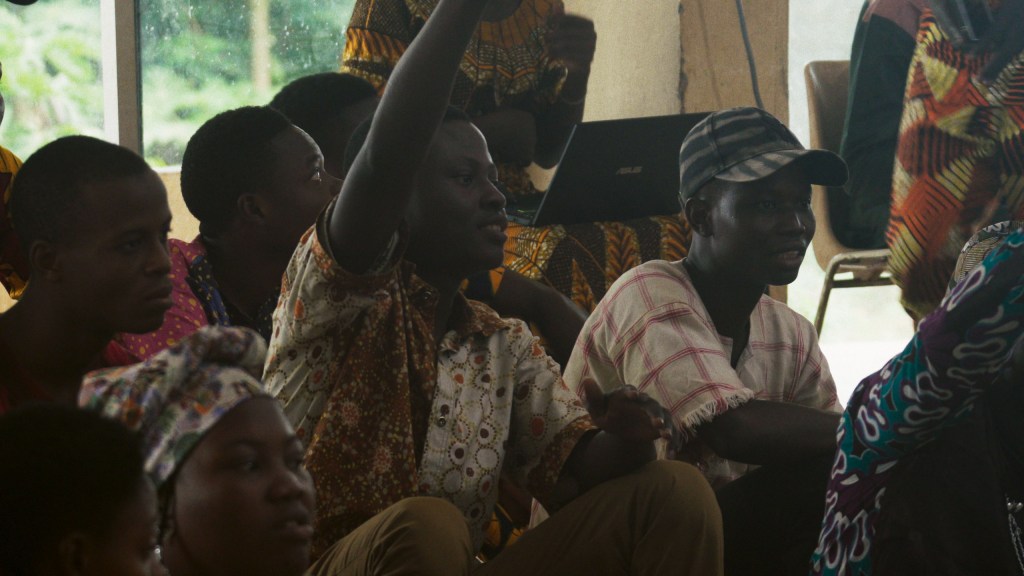
Following the still, sombre tone of the opening segment of the film, an electrifying debate between students at the University of Abomey-Calavi operates as something of a climax. Described by Diop as the “sole purpose of the film,” this second act demonstrates the enlivened response of the youth of Benin following the arrival of the sculptures. Shifting into the more restrained form of observational documentary, the student forum stresses the true complexity of repatriation, grounded not solely by academic theory, but by critical discourse marked by personal experience and visceral reaction. When one student speaks of her experience viewing the Benin sculptures for the first time, she recalls crying for 15 minutes and reflecting on the “ingenuity” of her ancestors.
A major point of conflict between the students is the bigger picture that this instance of repatriation sits within; that is, despite the homecoming of 26 artefacts, some 7,000 remain held overseas. Some identify the scale of this act of restitution as a ‘savage insult,’ merely to pacify the people of Benin, whilst others express frustration toward such critical comments. Other students are critical of the political agenda behind the act of repatriation, arguing that “Macron didn’t do this because we asked, he did it to boost his brand.” In response, one speaker implores the audience to “start by accepting the little [we] have and then develop a technique to get the others back.” With pared-back, attentive camera movements, Diop weaves the passionate, contrasting arguments to reveal the complex spectrum of attitudes toward repatriation, varying from praise to powerful criticism of the hand of the French government. The director refrains from privileging a single view, instead forming a study of the passion and mobilisation of student voices.
In the 2021 book Curating Lively Objects, arts critic and writer Paris Lettau dedicates a chapter to an interview with Australian artist Brook Garru Andrew. In this interview, prompted in part by Macron’s advocation for restitution, Andrew unpacks his artistic practice, which responds to the legacies of colonial archives, and discusses the resonance of issues of restitution within an Australian context. Andrew’s response to Macron’s public declaration echoes Diop’s feelings of bewilderment; he describes it as “transformational” and “both music and absurdity to the ears.”4 Following decades of ongoing activism from First Nations communities to return not only artefacts held in European collections, but also Aboriginal ancestral remains, work has begun to reconsider museum collections in order to facilitate the repatriation of cultural material to their communities of origin. However, many collecting institutions, particularly across Europe, still refuse the return of stolen First Nations material, evidencing the institution’s role in the perpetuation of colonial subjugation.
In conversation with Andrew, Lettau argues that the debates around repatriation can ultimately be distilled down to the basic question of power in the process of decolonisation: of who deserves to hold it and what they can do with it.5 During the student forum in Dahomey, the film cuts away momentarily to a museum curator in Cotonou, who addresses one of the most common counterarguments for the repatriation of cultural material. “Some people,” he explains, “Beninese included, said that Benin did not possess the means, either financially, materially, or in human resources, to look after these works. I must pass the torch, there has to be a younger generation in whom we place our trust.” This invalidation of the ability for non-Western museums to be custodians of their own cultural material is often put forward by colonial powers in order to justify their ownership of the objects, whilst also inhibiting healing and closure within former colonies. In Dahomey, 26 is given agency through voice, speaking to the life and experience of one of these artefacts. Simultaneously, the people of Benin are instilled with passion and empowerment regarding the fate of their cultural heritage, strongly demonstrating that the younger generation are prepared to care for such materials.
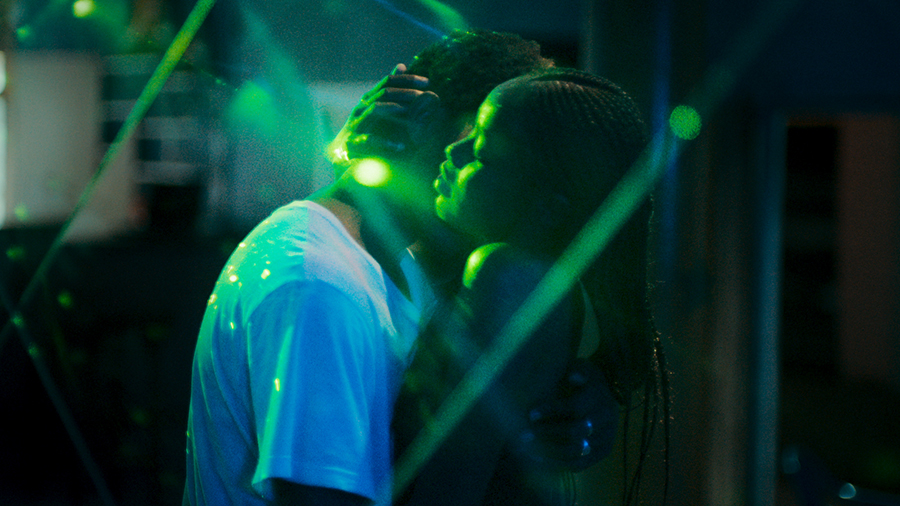
During the film’s debate scene, one student articulates the difference between material and immaterial cultural heritage and implores the others to recognise that despite the material losses of colonisation, the true essence of culture endures within communities. Vibrating in the aftermath of this passionate sequence, the film closes with dreamlike shots of Cotonou’s neon nightlife, at once rhythmic and inert. 26’s deep, echoing voiceover resumes, while the camera cuts between shots of figures bathed in moonlight, some working, some conversing, some sleeping. 26’s final line, “I see myself in you. I won’t ever stop,” confirms that the spirit of the Kingdom of Dahomey persists in each of these anonymous people, lingering within the city’s glimmering nightlife.
Dahomey is currently available to rent in Australia via Apple TV+ and Prime Video.
**********
Mia Palmer-Verevis is a curator and arts worker based in Boorloo (Perth). She is interested in the intersections between contemporary art and film, and has written for exhibition catalogues and online publications.
- Homi K. Bhabha, ‘Introduction,’ in Nation and Narration, (Routledge, 1995), p. 6. ↩︎
- Stephen M. Hart and Wen-chin Ouyang, ‘Introduction: Globalization of Magical Realism: New Politics of Aesthetics,’ in A Companion to Magical Realism, (Boydell & Brewer, 2007), p. 19. ↩︎
- Teju Cole, Tremor (Faber Fiction, 2024), p. 112. ↩︎
- Brook Garru Andrew and Paris Lettau, ‘Decolonising Archives: Killing Art to Write its History,’ in Curating Lively Objects, (Routledge, 2021), p. 25. ↩︎
- Andrew and Lettau, ‘Decolonising Archives,’ p. 34. ↩︎
 Rough Cut