


Haley Elizabeth Anderson’s intimate yet monumental film Tendaberry charts the changing seasons of one young woman’s post-pandemic year as it is marked by both precarity and poetry. This experimental coming-of-age drama artfully conjures Dakota’s (the dazzling newcomer Kota Johan) journey as a New York subway busker navigating love, work, and the shattering absence of her boyfriend, Yuri (Yuri Pleskun), as he leaves to care for his ailing father in Ukraine amid the Russian invasion. Peppered throughout the film is archival Super 8 and video footage from Nelson Sullivan, a prolific chronicler of Downtown Manhattan in the 1980s, which places both the audience and Dakota in close conversation with an expansive cosmology. Anderson’s film is immense in its scope and meditative in its tone, as it gestures to Dakota’s Dominican-American heritage and kinship within the sweeping historical waves of a changing New York.
Anderson is a filmmaker, screenwriter, and visual artist from Houston, Texas, whose projects often weave avant-garde documentary elements with more traditional narrative storytelling to explore themes of adolescence, racial identity, and socioeconomic insecurity. Tendaberry, which premiered at Sundance in 2024 and was nominated for the acclaimed NEXT Innovator Award, is her debut feature. Pointing to our own insignificance within the grand scheme of the universe, Anderson spoke about her experience working with Terrence Malick and shared the influences, ranging from Mary Oliver and The Avalanches to Jim Henson and Pee-wee Herman, which informed her filmic rendition of sonder—the feeling that everyone has a vivid interior life.
Note: The following interview has been edited for length and clarity.
Dylan Rowen: I would firstly like to say a huge congrats on your beautiful debut Tendaberry. How are you feeling after spending so much time on it and now seeing it out in the world?
Haley Elizabeth Anderson: It’s kind of crazy. You know, with the short films I made in grad school—which wasn’t that long ago—it felt like I could still keep them close to myself. But [with] Tendaberry [it] feels like letting something go—like letting other people take care of you. It feels great because I never imagined that we’d get here because it was a hard road, especially post-pandemic.
DR: It sounds like such a cathartic experience.
HEA: Yeah, definitely!
DR: I really appreciated how you started your film with an acknowledgment of the ancestral lands of the Lenape peoples, which settlers now call New York, on which your film is set. It was a really important way to start a film that I don’t really see other filmmakers do in the States, so I really want to thank you for attending to that.
HEA: Well, thank you for noticing. I don’t get to talk about that part a lot. Researching the history of Coney Island, they were literally the first people there and it should be recognised. I felt that was appropriate because in films you usually insert it in the end credits but I was like, “Well, it’s more important to state it from the beginning.” I needed people to be aware of that.
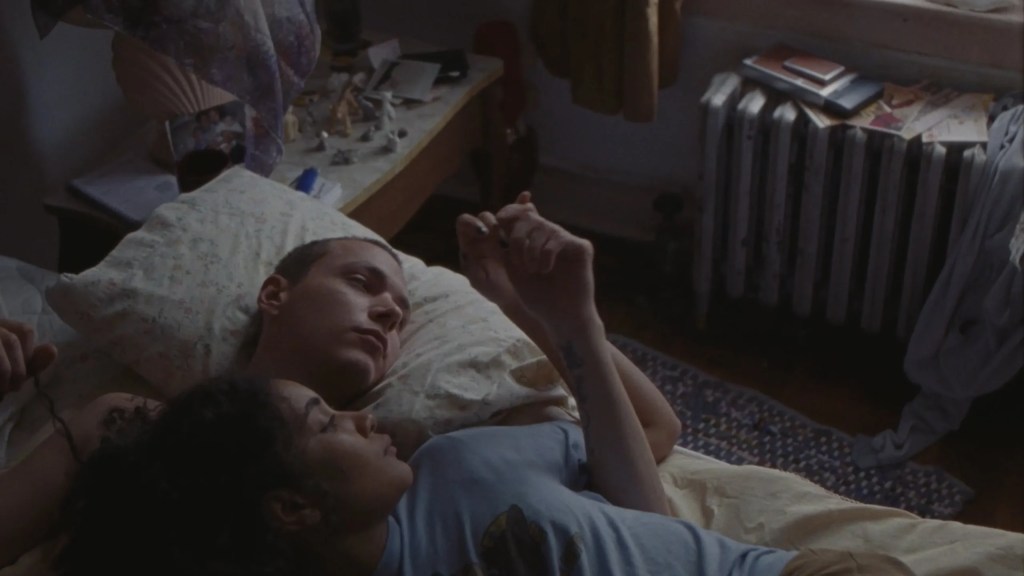
DR: Tendaberry’s epigraph is a Mary Oliver quote: “And what do you think love would be like? A summer day?” Your film has a very quiet literary sensibility. Can you share some of the influences behind your processes?
HEA: [Laughs] Oh my God—with influences I could go on forever. Mary Oliver is a huge influence on me. Just the way she writes through nature and her connection to it is something that’s always been special and has always spoken to me. The quote I chose from her is in the poem ‘West Wind’ [1996], which I have held with me since 2019. That year into the next one profoundly changed everything.
For other influences of mine, I’m always thinking about concept albums. For instance, The Avalanches’ album Wildflower [2016] is one of my favourite pieces of art of all time. Also, Ernest Hood’s experimental ambient concept album Neighborhoods [1975] is really wonderful. For me it’s always to do with music and sound. My goal is for someone to be able to listen to my film as an album and then experience it that way too.
DR: And speaking of influences, what directors of films inspire you or hold a special place in your heart?
HEA: For directing influences, they are sort of all over the place. I love Terrence Malick and his of way of working. I think it’s more his method of working that inspires me. Of course, I love Days of Heaven [1978]; it’s probably one of my favourite films. And of course, Tree of Life [2011] and The New World [2005].
But it always comes back to the city, you know. From 2014 to 2019 my camera app was just full of photographs of dollar stores and bodegas and all the weird things we take pictures of on the street. And I think this is where my production started. My old casting director Vicky Boone really opened my eyes to casting in a different way, which has fed into my directing process. Through that, I got to work [as a street caster] on a Terrence Malick film, and just that process was a huge influence on my life.
DR: The score feels so monumental and quiet at the same time. What was it like working with your composer James William Blades?
HEA: Oh my gosh. James is amazing. I worked with James on a three-channel installation I did in 2018/2019. It was the same process: we had zero time, but he still cranked out something amazingly beautiful. We worked [together] a couple of times on some commercials, which was also hectic. I feel like I’m always working with James in a very high stress time, but he always manages to deliver with his ability to create a soundscape and mix it with music.
So, for this film me and my DP [Matthew Ballard] started a playlist together in the beginning and added to it over the three years [of the film’s production]. I sent that to James. We were listening to a lot of Control and Duval Timothy and Carlos Niño and a lot of modern experimental jazz. James then always puts his own sort of spin on the sound inspiration, and he would say, “Yeah, you might be married to this, but let me do what I think, what I’m feeling.” That really helped me detach myself from things that I’d been tied to for a very long time. But he still holds on to the spirit of what we were going for.
DR: Speaking of music, could you talk about the process of filming in the New York subway, especially as it’s such an iconic and dynamic location where you have your lead actress singing—it’s almost shot like cinéma vérite. But I thought, like, anything could happen while filming. Could you talk a little bit about that?
HEA: Working with my DP Matthew Ballard is great. Matt is the kind of person who will take a camera in a backpack and climb a mountain if we have to. I love that about him and I’m like, “Matt, don’t ever change that aspect of yourself!” He’s very much a person that is going to give it all to a project, and I think that becomes really rare when DPs and even directors become more successful. I was a fan of Matt’s work before we even met. Actually, we met over Instagram. He reached out to me after he saw one of my shorts.
With shooting on the subway, Matt was great because he just was so willing to just go with us and hop the turnstile. You know, my lead [Johan] and I would meet on the subway and we just did it. It’s like a rule in New York: as long as you don’t have a tripod, you can film in the subway. I remember one day in the summer when we were shooting the summer scenes, there was one commuter who said, “Oh it’s the third one I saw today.” It was like that; we were the third production this train rider had seen that day. Anyway, I don’t think we were doing anything crazy, but there’s a lot of specificity about which cars and lines I wanted to be on because I don’t really like movies that don’t make sense spatially. Like when I’m living in New York, I want it to make sense to me. So, I tried as hard as I could to film the right train line going downtown to Brooklyn or to Coney Island.
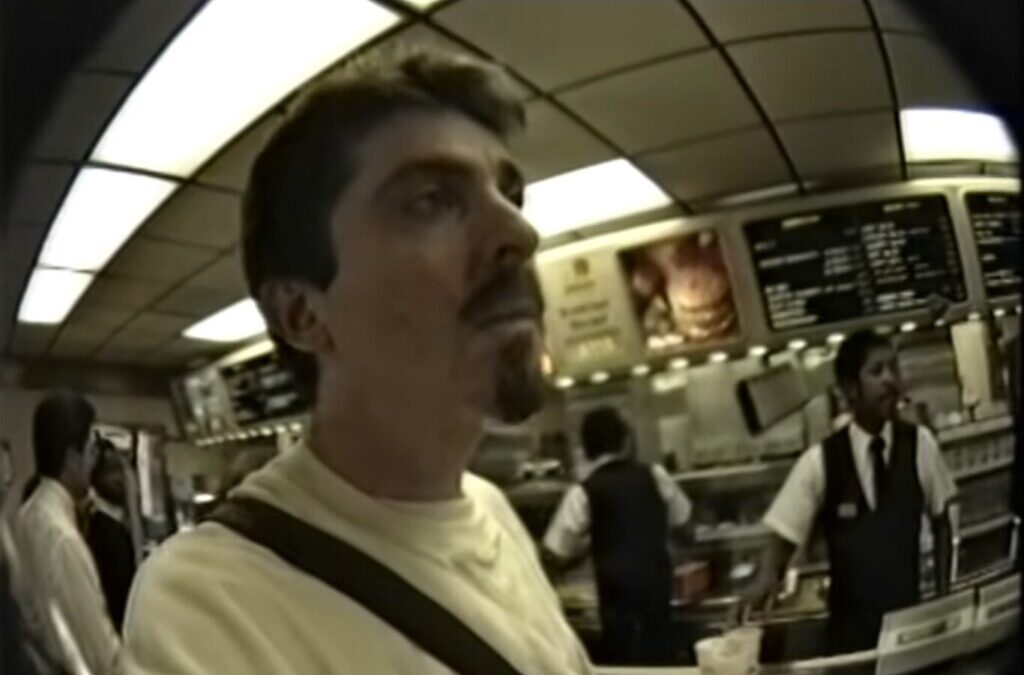
DR: I’d love to chat about the American videographer Nelson Sullivan, whose tapes you interweave throughout Tendaberry. Including these videos feels like a type of conversation with the past that’s still unfolding itself in the present. Could you talk about working with your editor Stephania Dulowski in crafting this feeling of being so close to the archive; it’s almost like touching the past, the way you combine traditional narrative storytelling with an experimental documentary approach. And coming back to that literary sensibility that you have, how the film is edited feels like a type of stream of consciousness which translates that pure raw feeling of New York.
HEA: Stephania, our editor, is a person who just gave so much to the film. I remember when we shot the first section and gave it to her. She edited it and we spent like a month-and-a-half before Sundance trying to figure it out. And with the archival footage, we needed to figure out the rhythm of the film. Originally, the film was about different people through a bunch of different vignettes. Once we had to cut all that out, I wanted to find something that retained the feeling that Dakota is a part of a bigger universe. That is not just about one person who is just wallowing in their pain, but I wanted to convey that her pain is everybody’s pain and vice versa. So, the archival videos really helped us hone in on that feeling.
Nelson Sullivan was someone I was familiar with before I moved to New York. I would look at his videos to familiarise myself with his scene and the Village. Once I moved here and we were looking through all the archival Coney Island, I remember [feeling] that because he’s talking to us, he feels so present. He is credited as being the first blogger, pre-internet. His world was just so rich, but it was also changing, and I felt like now we’re sort of going to the same thing. We’re constantly going through these hardships and changes, and I also felt like it was a great way to nod to him and the LGBT community and their part in shaping New York.
With the style of mixing it all together, Stephania was a great help: she knows what she’s doing and what to look out for. We would have these feedback screenings, and we’d [receive] this stack of notes and [then] just focus on the rhythm together, [working] with this distinct style that I really do think comes from watching Jim Henson’s stuff and a lot of Pee-wee’s Playhouse growing up.
DR: Regarding the film’s rhythm, it feels so marked by curiosity and a type of willing, improvised openness. How did that work day-to-day and what was your experience working with the actors and getting such tender performances from them?
HEA: It’s a balance of things. I love working with first-time actors because there’s that curiosity and there’s no expectation. Nobody does anything the same way twice. Everything is very open and free. Then at the same time, we do have time constraints. Working with Dakota and other first-time actors just keeps me on my toes. She helped develop the character and the story and we bounced off each other in that way. It was this constant collaboration between me and the actors. I had worked with a couple of them before on some short films, but that was a good way to bring in the past—to use the same bases and build relationships in that way.

DR: That sort of process really reminds me of the water motif you have that is so integral to both your film as well as to the history of New York. The ending of Tendaberry feels so joyous and cathartic. It feels like part manifesto, part poem—almost an ode to the future and to one’s insignificance in the grand scheme of Earth, you know? Could you talk about the writing process in finding this powerful voice to end your film?
HEA: Originally there was never a big end to the film like that. I was trying to find something that encapsulated what I was trying to say and—to be honest—I love a good montage. So, there were a lot of images we shot that were sort of lost in the body of the film. I was thinking: there has to be some sort of sequence that visually represents what I want the whole film to look like and to be about, which comes back to that idea of sonder. Like, everybody has an inner life, and your problems are so small and insignificant compared to other people’s, so you have to be mindful of that. It’s about having perspective about yourself and your stupid problems.
The writing process was literally just me taking notes on my phone over the three years that we spent to make it—things, thoughts, feelings, prayers, hopes. I was feeling a certain way and I just put that in my notes app, and by the end those made it into what Dakota says. I think capturing that idea is really important, but it wasn’t just the story about this sad girl summer, y’know. It’s really about this feeling of being one in like, billions and billions of sad girls, as there’s just a lot going on in the world. I really did want to press myself to see how the world changes from shot one to the last shot. And the world changed enormously. It keeps your mind full of how big and beautiful the universe is.
Tendaberry is now showing on MUBI Australia. It will also be screened at a special free MUBI X Film Club event at Miscellania on the 14th of May.
**********
Dylan Rowen is a writer and researcher based in Naarm. They are a PhD candidate in Screen and Cultural Studies at the University of Melbourne, where their research focuses on the representation of queens, fairies, and pansies in modernist literature and film.
 Rough Cut