


Screenwriter and director Alex Garland has long expressed a fascination with war. From the sex-deprived soldiers in Danny Boyle’s 28 Days Later (2003) to Annihilation’s (2018) government-led expedition into a hostile environment, various conflicts—and the people who participate in them—have always held a grip on his work. We see this even in his first novel, The Beach (1996), as Richard, the protagonist, is left undeniably mad while on a small island paradise off the coast of Thailand. Bickering with a hallucination of his dead hostel mate, Daffy, he tries to ground himself. But he discovers not where he is, but where his mind is: Vietnam. A place where, as his imaginary friend so gleefully reminds him, “losing your shit comes with the territory!” Unable to cope with the fact that his mind is now a shell, Richard fills it up with superficial military lingo, excited and sadistic thoughts about a run-in with the drug lords controlling the island, and a complete apathy for his fellow backpackers—all stemming from the war films he grew up watching.
Since The Beach, Garland has continued to expand his ideas on war and sensationalism. This includes last year’s Civil War (2024), which follows a group of horror-stricken war photographers documenting a dystopian American conflict. Wanting to achieve a new level of realism, Garland brought on US Navy veteran Ray Mendoza as both military supervisor and co-writer. With rattling gunshots, nauseating casualties, and muffled eardrums, the film offers a similar stylised cacophony to those presented by Stanley Kubrick, Steven Spielberg, and Francis Ford Coppola. Yet there is a casual, blunt edge to the horrors unfolding on-screen that makes them even more sickening.
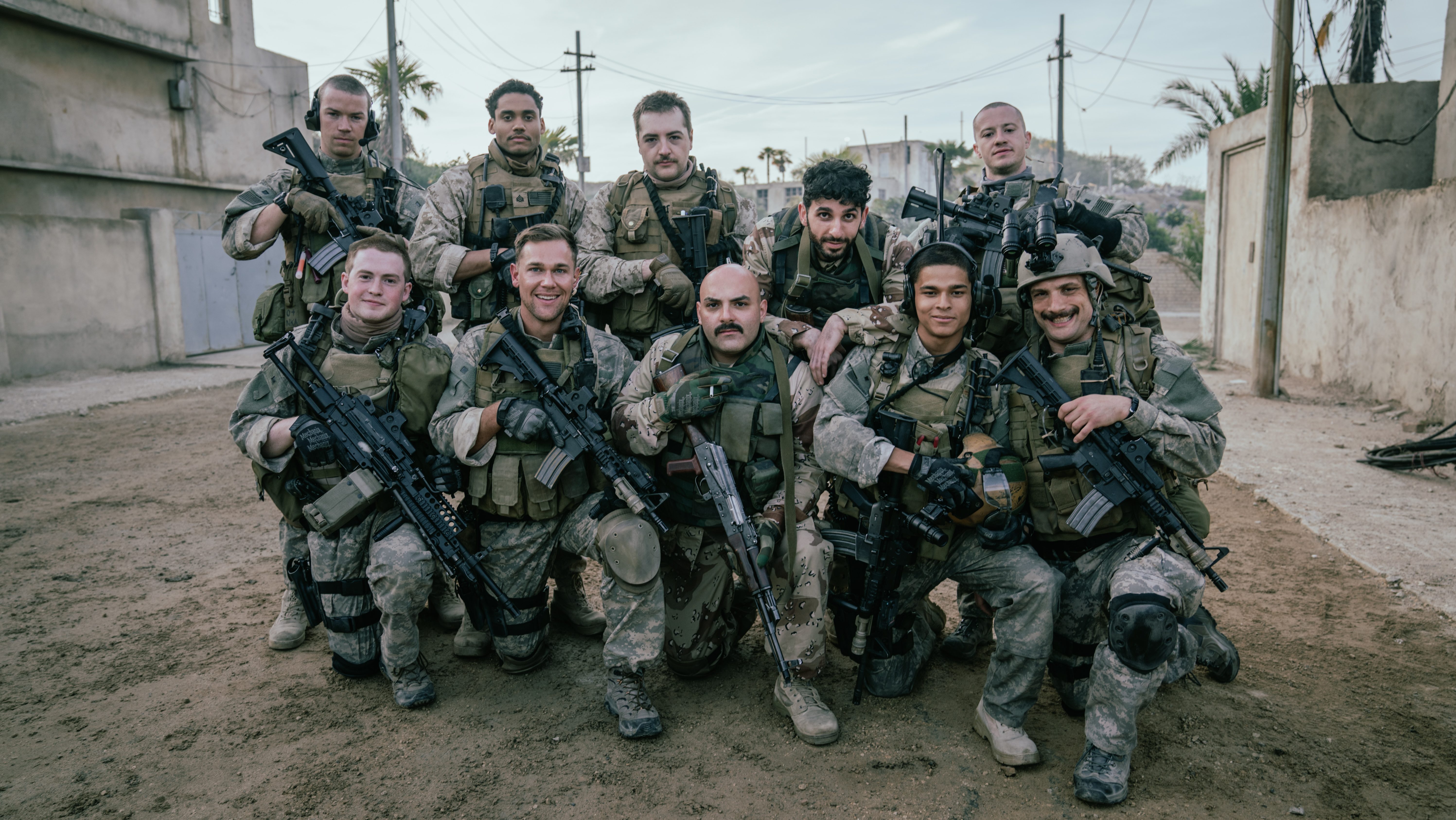
Teaming up once again, Garland and Mendoza now find themselves co-directing the equally confronting, yet evidently more personal, Warfare. The film recounts a 2006 reconnaissance mission Mendoza (played here by D’Pharaoh Woon-A-Tai) was sent on during the Iraq War. “This film uses only their memories,” we’re told in the opening, referring to Mendoza and the other Navy SEALs in his platoon. However, what at first looks like a bold and exciting opportunity—a veteran soldier and screenwriter coming together to reexamine the occupation of Iraq through subjective memories—turns into an immature, if harrowing, retread over the traumas of war. This is evident in the opening scene, where the boys crowd around a small television, ogling the scantily clad flashdancers of Eric Prydz’s ‘Call On Me’ music video. This sequence makes abundantly clear who we’re supposed to be empathising with; dressed in full combat gear and nursing loaded rifles, the boys giggle like drunk teens at a house party. Yet the choice to portray the soldiers as juvenile boys—casting baby-faced indie heavyweights like Will Poulter and Charles Melton—goes a long way to convince us that soldiers are often children; young men driven to fight wars they are not ready for, nor have any right to be involved in.
The film carries Garland’s visual touch—boxed-in characters, natural light with sudden shifts to hard monochromatic hues for emotional moments, and voyeuristic character perspectives. But these images lack their usual thematic weight. Gone is the glass enclosure from Ex Machina (2014) that cages Ava like an animal, only to trap Caleb when we suddenly switch point-of-view. Instead, the similarly claustrophobic shots in Warfare produce just that: claustrophobia. There is beauty in the camerawork, but none behind it. This bluntness creates, at most, basic emotional responses from the audience. We aren’t supposed to question any of Mendoza’s story; we’re just forced to witness it.
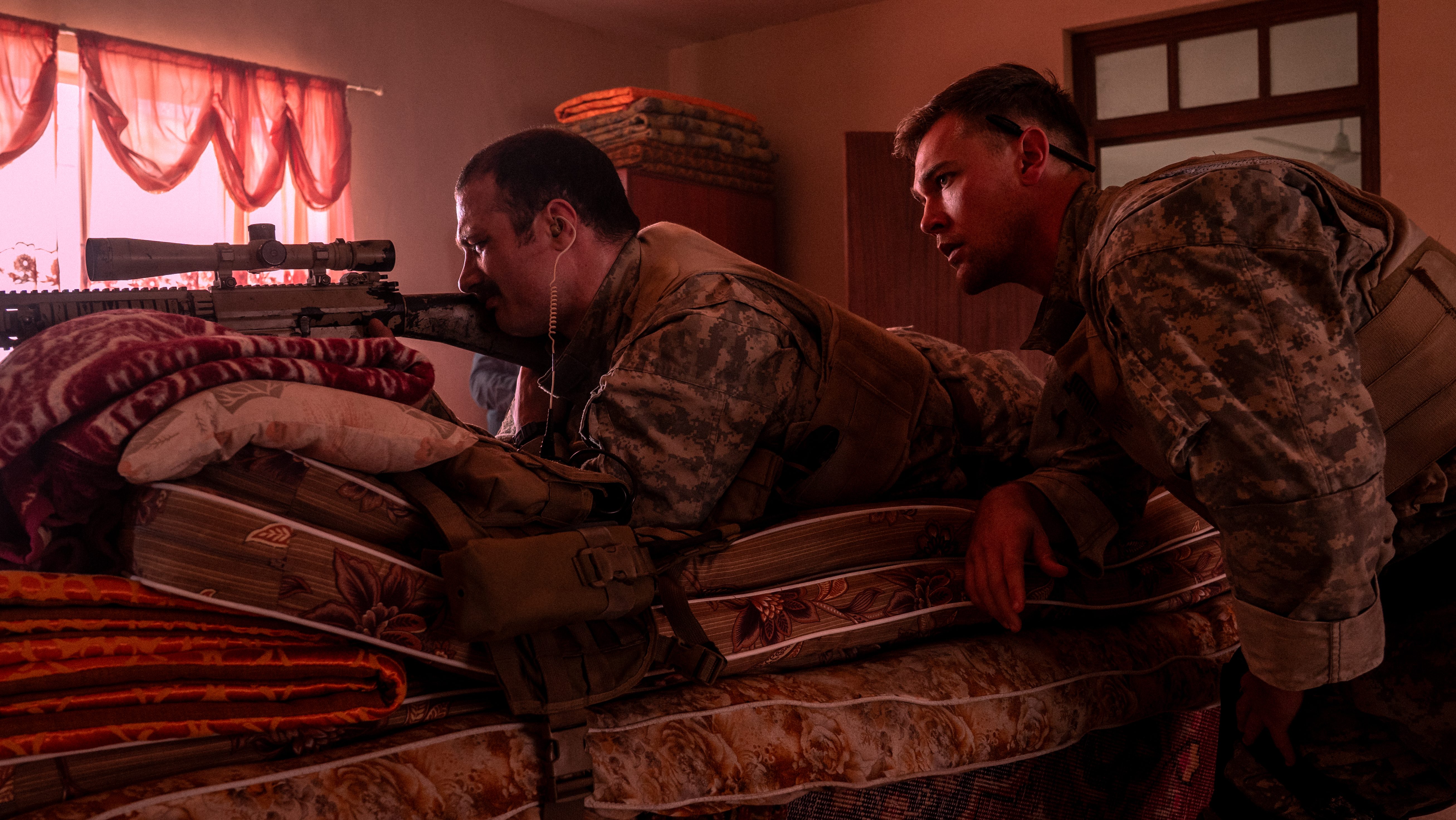
When Poulter’s Erik, Woon-A-Tai’s Ray, and the rest of the SEALs raid an Iraqi apartment for cover, extra care is taken not to agitate the clearly frightened family. Once entrenched in every available room, the team commits to a surprisingly mundane routine. Mendoza’s choice to highlight this banality arguably offers more tension than the ensuing firefights. The casualness with which Cosmo Jarvis’ Elliot lines up his sniper scope with the heads of Iraqi civilians, waiting for any one of them to turn traitor, is chilling. But it’s not always clear how this tension is being wielded—do we worry for the vulnerable, innocent bystander or the sniper who risks missing a hidden insurgent and endangering his platoon? Nevertheless, when a rogue grenade flies through the window, Hell soon bubbles up into the apartment and soaks the tiles, and the boys, head-to-toe in blood.
The ensuing carnage, screams, and general confusion is overwhelming. Later, after Ray drags a half-dead Elliot back into the house, he is immediately given the task of helping a screaming Sam (Joseph Quinn). As he applies pressure to his squadmate’s mangled legs—all while receiving obnoxious calls from comms and panicked yells from his team—it’s no wonder Ray disconnects his receiver. Mendoza delivers on his promise of a real-world nightmare: ringing ears, voices dried out from phosphorus burns, and pulped limbs dragging against tile.

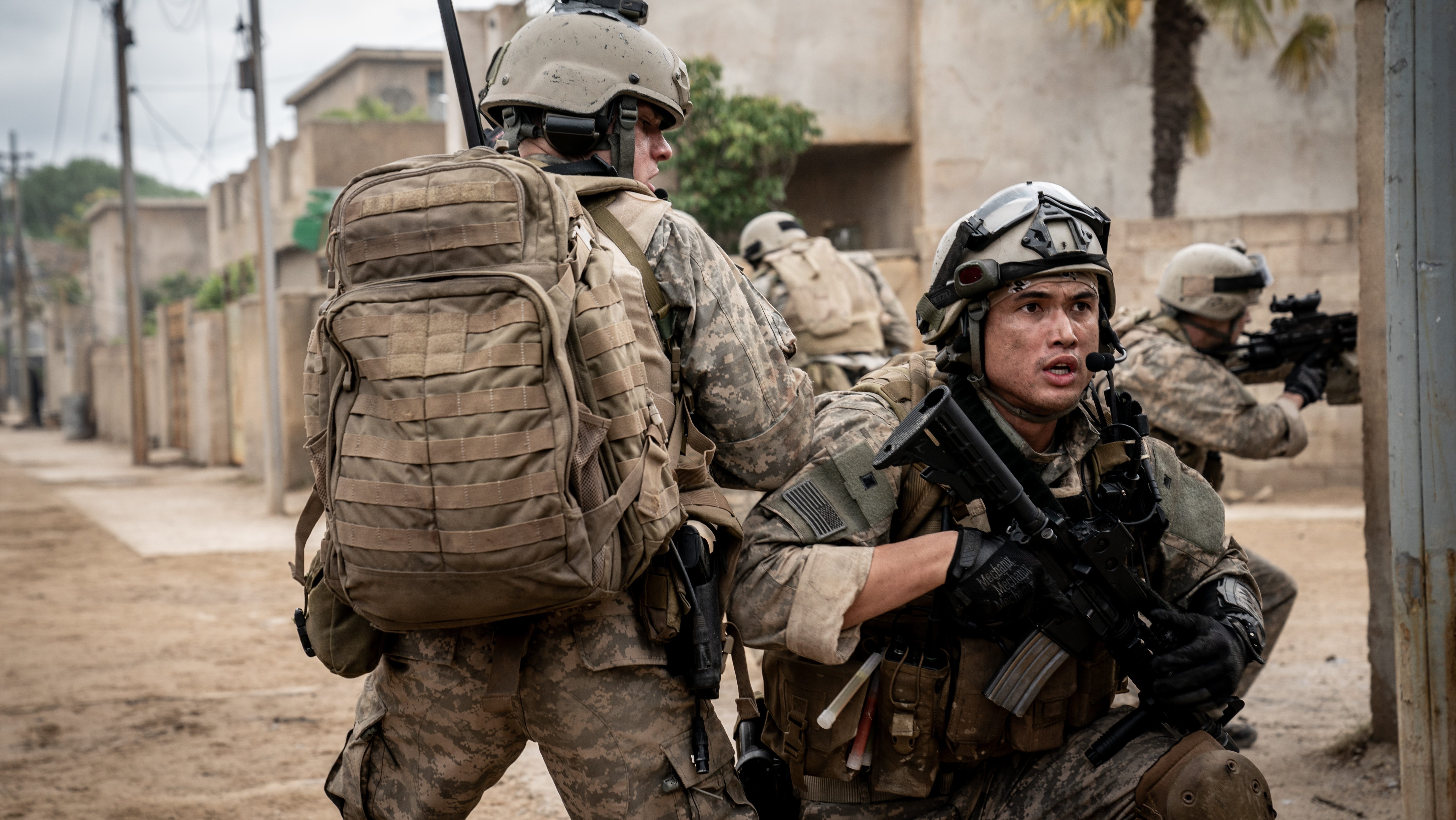
Yet Warfare finds itself defanged by the same narrow focus it touts as a selling point. The soldiers’ suffering is apparent, but the Iraqi perspective is not just watered down; their depiction is borderline inhuman. Between the faceless insurgents that attack the SEALs and the trapped family that read more as obstacles than characters, the framing of Iraqis as plain antagonists indicates a complete lack of empathy. Even if reception to Garland’s own Civil War was as mixed as its politics, it at least acknowledged fascism within the US; its chimera of new colonies suggested red/blue lines had been burned black with a conservative dictator at the helm. That film was not afraid to show soldiers at their darkest, depicting war crimes and genocide with Jesse Plemons as some sadistic poster-child for jingoism. Civil War begins to look ballsy beside the light condemnation present in Warfare; twenty years on from the US invasion’s litany of human rights abuses, the most Mendoza and Garland can offer is one careless soldier playing footsie with an injured Sam and a lack of air support from the higher ups.
Garland, who announced last year that he plans to take a pause from directing for the foreseeable future, has been vocal about the “pressure” he feels to deliver as a director, stating: “[Y]ou’re asking people to trust something that, on the face of it, doesn’t look very trustworthy.” He was talking of his actors and crew, but it’s equally true of an audience. He and Mendoza are asking us to trust the memories of US veterans. Moreover, to trust them over those of Iraqi civilians—the victims of this proven ‘unnecessary war.’ And frankly, that is a hard pill to swallow, especially given what we’ve dealt with on our own shores. Australian military lawyer and whistleblower David McBride is currently fighting his five-year sentence for leaking evidence of war crimes committed by the ADF in Afghanistan. This kind of moral duplicity within the military is nowhere to be found in Warfare, despite its claims to unflinching realism.
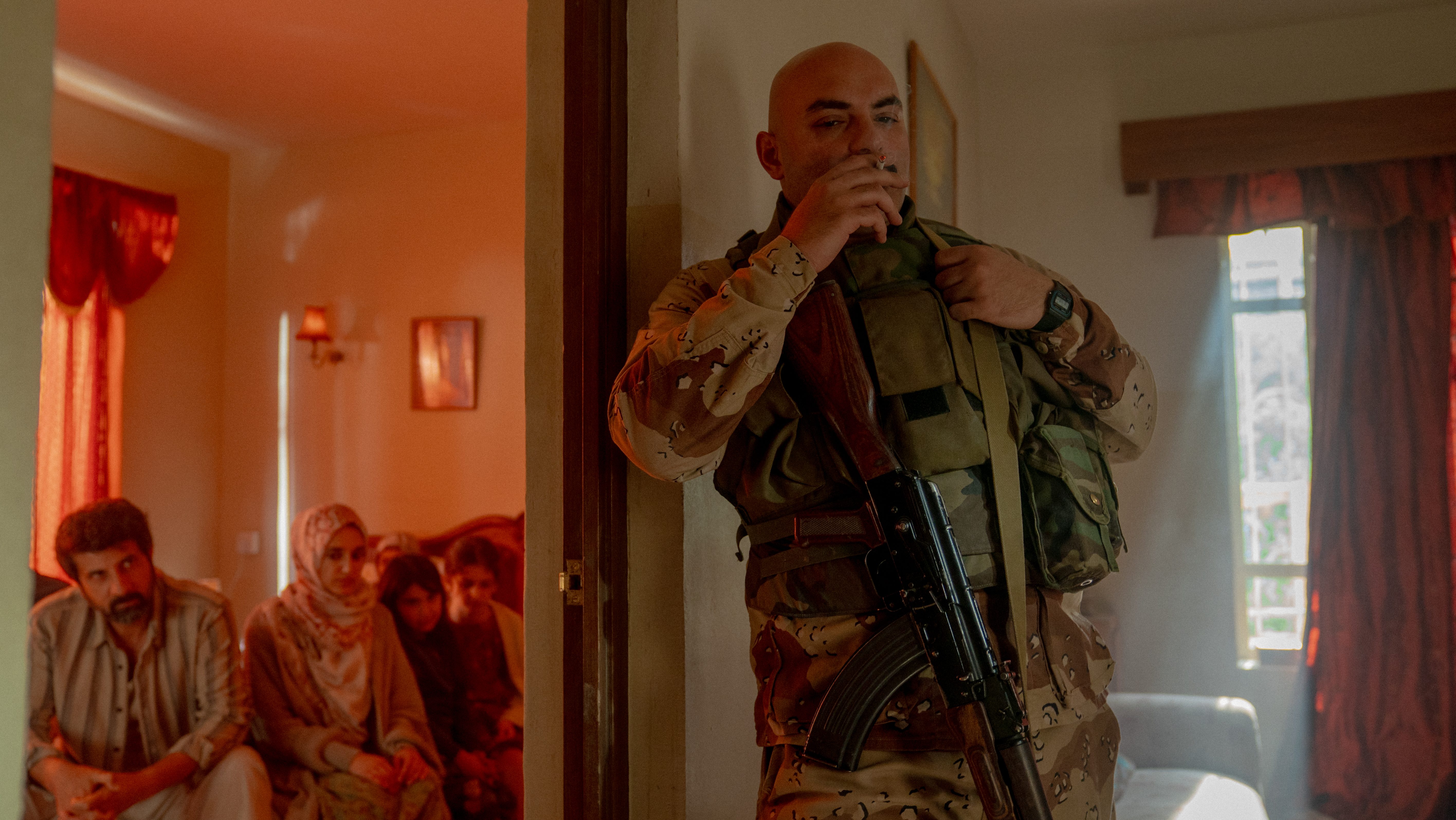
Towards the film’s end, when our crew of broken boys inevitably evacuates the area, we’re given a rather unceremonious switch in perspective, as we follow the Iraqi family whose house we have just spent the last 90-odd minutes invading. The father offers a stern look of reproach as he assesses the damage to his home and surrounding neighbourhood. Trudging through flooded halls and avoiding crumbling rubble, he, along with his neighbours, is left to wander the soulless streets we once saw full of life. As dust clouds darken their sky and residue fills their lungs, you wonder what will become of these men, women, and children, now reduced to ghosts for a war they never signed up for. After their five minutes are up, the credits roll, and they all but vanish.
Warfare is in Australian cinemas now.
**********
Finn Dall is a writer and critic interested in weird and wonderful stories. His work has been featured by ACMI, FilmInk, Kinotopia, and the Melbourne University Film Inquirer. You can follow him over on Letterboxd and Blusky @finnwritesdall.
 Rough Cut