Left of Field: An Interview with ‘In Vitro’ Directors Will Howarth and Tom McKeith
Indigo Bailey speaks to the Australian writer-directors about the inspirations and collaborations underpinning their moody, genre-melding futuristic thriller.
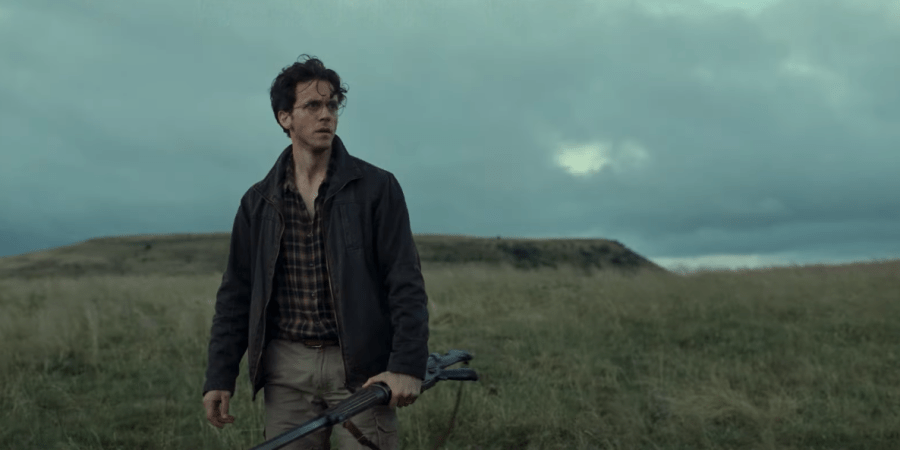
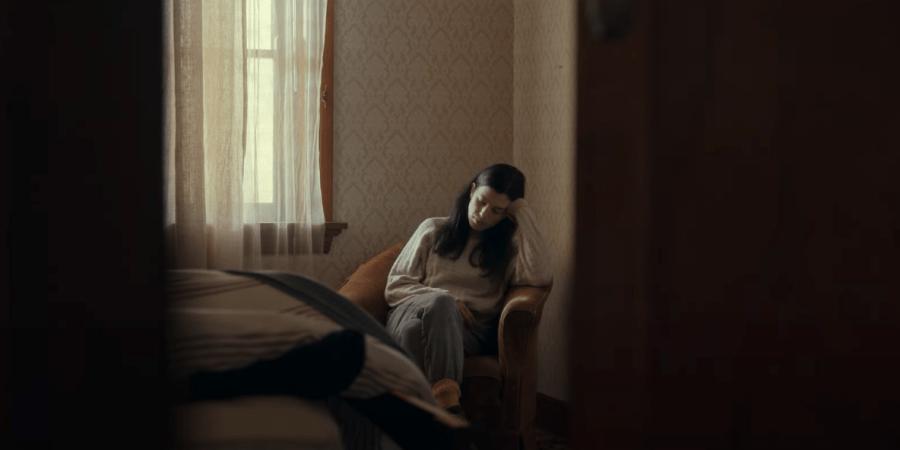
Where many science-fiction films depict future cities slashed by neon and scored by rabid electronica, the creators of In Vitro envisioned something different: a pastoral landscape tinged with nightmarish silence; fields from which all sounds of life have been laboriously excised. In lieu of urban cyberpunk tropes, Will Howarth and Tom McKeith’s Frankensteinian venture presents an isolated cattle farm, complete with a menacing, concrete abattoir, and greying with thirst amidst the heightening climate crisis. Relying on unsettling new biotechnology methods, the ranch is operated alone by married couple Layla (Talia Zucker, who also co-wrote the film) and Jack (Succession’s Ashley Zukerman), whose eerily quiet lifestyle is marked not only by their world’s bleak, apocalyptic air, but by the increasingly monstrous distrust surging between them.
As Howarth and McKeith told me during the film’s run at last year’s Sydney Film Festival, it’s a challenge to slot In Vitro into an existing genre template. As its tensions wax and emphases shift, it navigates the registers of taut, psychodramatic chamber piece and dystopian, sci-fi horror, meanwhile flirting with the moody shadows of the Australian Gothic. In this conversation, I spoke with the writer-directors about their mobile approach to genre; their intriguingly familiar rendering of the future; and how they collaborated with production, costume, and sound designers to evolve the film’s unnerving atmosphere.
Note: the following interview has been edited for length and clarity.
Indigo Bailey: I’m conscious you might want to steer clear of discussing the narrative, as it’s clearly a film that rewards knowing little about it beforehand. However, I wanted to ask what the initial spark was for the basic premise. On the one hand, the fundamental concept of this dystopia wrought by climate crisis feels topical, but elements of the film also hark back to the roots of science-fiction, particularly to Mary Shelley.
Will Howarth: You’re right that it’s difficult to talk about the spark without giving away too much about what we think is going to be really enjoyable for audiences to discover. What we can say is that the original idea came from Talia [Zucker]. She had the central sci-fi concept for the film, which Tom and I thought was a really interesting idea. There were some natural themes attached to this concept—things like love and coercive control, obviously ideas around domestic violence; those things naturally came out of Talia’s initial idea. It’s not like we sat down and said, “Hey, we want to write a film about these specific issues.”
Tom McKeith: I second that, and I think our intention was to create a film that was going to be an enjoyable watch—that had some twists and turns and some genre elements and that kind of thing—but for it not to just be that. We also wanted to give the audience something to chew on and to think about. We put a lot of work into trying to balance those two things and we really hope audiences come away reflecting on their lives and the discourses going on in the country at the moment.
Jack (Ashley Zukerman) and Layla (Talia Zucker), courtesy of Madman Films.
IB: You touched on genre a little just then, and I found it compelling how your film melded genre elements. I was thinking about horror, of course, but also of psychological thrillers and even avant-garde drama like Persona (1966). To what degree did you set out to play with genre?
TM: The previous films we’ve worked on together haven’t been heavily ‘genre.’ In particular, in aesthetic and approach to dialogue and performance level, for In Vitro we tried to bring an approach influenced by I suppose ‘out-there’ older films, things a bit more niche, but as you said it does have genre elements, too, and it was interesting to take on a project that had a bit more of a genre component to it. It is a real mashup; we hope that’s something audiences find fun. I know it’s been a bit of a challenge for Will to figure out how to position it, because I think in a fun way it’s a combo of lots of different types of films.
WH: Yeah, it has been interesting to pin down—if we have to—exactly what the genre is. Where we have gotten to is that this is probably a thriller with a futuristic edge. That’s as nailed-down as we’ve been able to get it. There’s a sci-fi concept at the core, which allows us to explore this story and the characters and the themes, but it really kind of plays like a thriller with some futuristic touches. But like Tom said, the fun thing is that it does move through different genres: the thriller, sci-fi, horror—and the tense psychological drama, as well.
IB: Speaking of that futuristic edge, the vision of the future you cultivated is unique in comparison with the cyberpunk aesthetics and accelerated, alien technologies we’re used to seeing in science-fiction. Your universe feels a lot more familiar. Can you speak to your choice to hone in on a rural space as a microcosm for this broader dystopian future?
TM: As you identified, there’s a sort of Gothic, scary, isolated, rural setting, which has its own aesthetic and feel, and a familiarity we didn’t want to stray too far from. We still wanted it to be identifiable and thought that familiarity might make it feel more immediate and scary as a domestic film. We thought that if it strayed too far into the future, with the tropes of conventional sci-fi, it might not have that familiar, domestic quality, which I feel works quite well. It’s a version of the future that isn’t so bright and that touches on climate challenges, so we were thinking of how the characters reusing technology could incorporate an odd, futuristic element and present an interesting take on the genre.
WH: I also thought it was a challenge to create a world that felt nonspecific in terms of time. Like Tom said, we wanted it to feel relatable and immediate, but also for it not to have a timestamp on it. So we went backwards; we had the characters reusing old technology and repurposing it, but the cool thing about that was that although we weren’t coming up with futuristic robot devices, it does place you in the future but without putting a timestamp on that future.
Two interesting things happened throughout this process. Firstly, working with Alexi Wilson, the production designer. For example, she came up with ideas for the vehicles. We had this conversation, “How are we going to do the vehicles in the film?” One future version is that they’re hover-cars, which we didn’t want to do—
TM: —That wasn’t her suggestion, by the way [laughs]!
WH: But Alexi had this really cool idea. She said, “Why don’t we make them look like old farm utes, except now they’ve kind of been repurposed as electric vehicles.” And we thought, “That’s cool, it looks like old stuff but we know it’s actually current because they’re electric vehicles.” Similarly, with our costume designer Emily Seresin, she went backwards in terms of thinking of industrial workwear, and so we started using older stuff. When all of that came together, it obviously placed us in the future but made that future nonspecific and a little bit familiar. I like how all those elements hang together.
TM: Another link between the film’s isolation and its vision of the future is the scarcity of the world it suggests, where something has happened to supply lines and manufacturing. By taking a subtle direction, it speaks to that world more broadly.
Courtesy of Madman Films.
IB: Speaking of collaborations with the rest of your crew, I’m curious how you worked with your cinematographer and sound designer to create such a unique atmosphere? I was intrigued by how isolated and restrictive it felt, although it’s also set in this vast pastoral space, which in another context could feel idyllic.
WH: First of all, working with Shelley [Farthing-Dawe, cinematographer], we spent a lot of time finding the right location, because, you’re right, it is beautiful and expansive, but it also feels Gothic, eerie, and incredibly isolated. I think it also feels different from other Australian outback thrillers. We don’t have the red dirt, scorched earth, gum trees, and big blue sky. We wanted it to feel different to that, and to slightly hint at a dystopian future—or certainly one in which the world has gone through a decline.
So, we spent a lot of time finding the right location with Shelley, then we just had to be really prepared when shooting the film because we didn’t have many days to shoot it. That meant that me and Tom and Shelley were very thorough in terms of knowing exactly how we were going to shoot things, because there was no time on set. I guess that’s the main answer: we were specific about what we wanted in a location to create a feeling that they’re on this beautiful property but, wait a second, it feels scary and remote and things aren’t quite right.
TM: Matt Perrott, who did the sound design, had a great idea at the beginning of the process that we almost managed to hold onto for the whole film. He really wanted to remove all the sounds of birds and insects from the sound design, because if you think about other films about the Australian landscape set in the country, that sound of crickets and birdsong is distinctly Australian and does make things feel kind of alive. It’s also extremely difficult to find audio filmed in exterior locations that doesn’t contain all that wildlife.
So basically, Matt stripped out about 90% of the alive sounds and replaced them with the sounds of wind or grass or whatever. We ended up putting in a few birds, mainly crows and birds we typically associate with the Gothic. It was a lot of work to execute this and he did a great job. It’s one of those things you probably don’t notice on a first watch, but I think it does really influence the mood. He also did some other great stuff with foley, and the mixer Sam Hayward did a great job emphasising the wind and the emptiness—you know, the rattling corrugated iron on the building, the wind chimes, those things that helped ramp up that mood.
WH: Most viewers probably aren’t conscious of it, but it’s interesting that, now for [Tom] and I, you really do hear the moments where Matt put the wildlife back in. There are certain points in the film where there’s a bit of life back on the property. A quick funny story: we got to the end [of the edit] and Matt had painstakingly removed every single bird sound but, in one of the last shots—we hadn’t noticed it—this bird flies through the frame, and Matt was like, “Please can we just remove that bird!” So, as a kind of VFX favour to Matt, we took that bird out. He’d just spent months removing every bird sound he could!
IB: You’re right that I didn’t notice there were no birds or insects when I watched the film, but looking back it makes more sense that it sounds so cavernous. To switch gears a bit—as we’ve mentioned, the film is so intensely focussed on the central couple and the buildup of tension and coercion between them. Could you tell me about the choice to focus on these two characters, and perhaps the challenges this posed for you as writers?
WH: I was going to say that ‘naturally’ the film is told through Layla’s perspective but, interestingly, it started out being told through the man’s [Jack’s] perspective instead. Early in the process, Tom thought it would be more interesting to tell it from the female perspective and we all went, “Yes, of course, that’s how we should be telling the story.” We ended up telling it very closely from Layla’s perspective, so as a writing challenge we had to be very careful about how and when she discovers particular pieces of information—especially about her partner and the nature of their relationship. So, we wrote it really carefully and got to a place we thought would work. Then we got to the edit and thought, “Huh, should we be revealing this at that point?” To answer your question, we ended up revealing more in the edit about the nature of their relationship than we thought we had to. Initially we were going to take a much more subtle approach—if you can believe it—but I feel like, in relation to Jack, we actually needed to reveal some things about him earlier than we thought.
Early in the process, Tom thought it would be more interesting to tell it from the female perspective and we all went, “Yes, of course, that’s how we should be telling the story.”
—Will Howarth
TM: As you can imagine, you go back and forth a thousand times on those kinds of things, because you also need an understanding of why Layla is still there living with Jack—so you need a sense of a connection between the two of them, but you also need a growing sense that things aren’t working in the relationship and of who they both are. It’s interesting how dramatically you can give an impression of a character without doing too much. For example, there’s one point where they are sitting and listening to country music together and it feels sort of ‘everyday.’ But at one point we had classical music playing in the background instead, and it dramatically changed our viewers’ interpretation of Jack and gave so much away, just through the choice of background music. It’s amazing how careful we had to be treading a tightrope in the edit to balance those elements.
WH: It was a big thing that we wanted to get right, because underneath the genre and concept stuff is this relationship, and that’s the story. So we spent a lot of time trying to get it right, particularly in the first act.
Courtesy of Madman Films.
IB: You talked about the relationship between Jack and Layla. I know Talia was present from the very start, but how did Ashley Zukerman come on board, and how did they work to evolve such a tense onscreen relationship?
WH: We had gotten to know Ash overseas, and Talia has known him for awhile. When the three of us were writing the film we had him in mind, and when we sent him the script, luckily he responded positively to it, and he got involved. In terms of those two working together, I think it involved a lot of conversations. Ash was very involved in the film—he’s also an executive producer on it—and between the four of us we’ve all become very close. So he was really part of the process; it wasn’t a case of him turning up, shooting his days, and leaving.
I know they [Ash and Talia] did a few interesting things in pre-production. Talia only told me about this recently, but they wrote diaries—like, personal diaries—about themselves and their relationship, and shared that back-and-forth with each other. We also did a lot of rehearsal. We had Ash in early and we moved through every scene of the film, and I know that Ash and Talia had a lot of discussions throughout that.
TM: The vibe behind-the-scenes was awesome between them and between all of us, as Will said. They did a lot of preparation and it was really fun working with both of them.
IB: And the other character in the film is the farmhand, who you play, Will. It felt like that character, since he’s the outsider, has such a peculiar and intense weight in the film. Could you talk a little about the genesis of that character—and Will, what you wanted to bring to that role?
WH: Well, he’s clearly the best character in the film, which is a start [laughs]. No—you’re right, he does have a peculiar weight because he’s the only outsider we meet. I guess we knew that character, how he would look and feel and behave, would be a glimpse into what the outside world was and suggest some of the economic decline happening in it. So that’s why Brady is the way he is onscreen. He also serves an important mechanical function in the plot, which was probably his genesis; he had to serve a purpose in that film. But apart from serving that purpose he has an interesting role because we meet him and probably suspect one thing about him, but I think he turns out to be quite a different guy.
TM: I agree with that, and think that by the end of his journey he turns out to be a nice counterbalance to Jack.
In Vitrois now showing in Australian cinemas.
**********
Indigo Bailey is a Tasmanian writer and editor living in Naarm/Melbourne. In 2023, she received the Island Nonfiction Prize for an essay about rain sound. She has written for HEAT, IslandMagazine, The Guardian, and Kill Your Darlings, among other publications.


 Rough Cut