


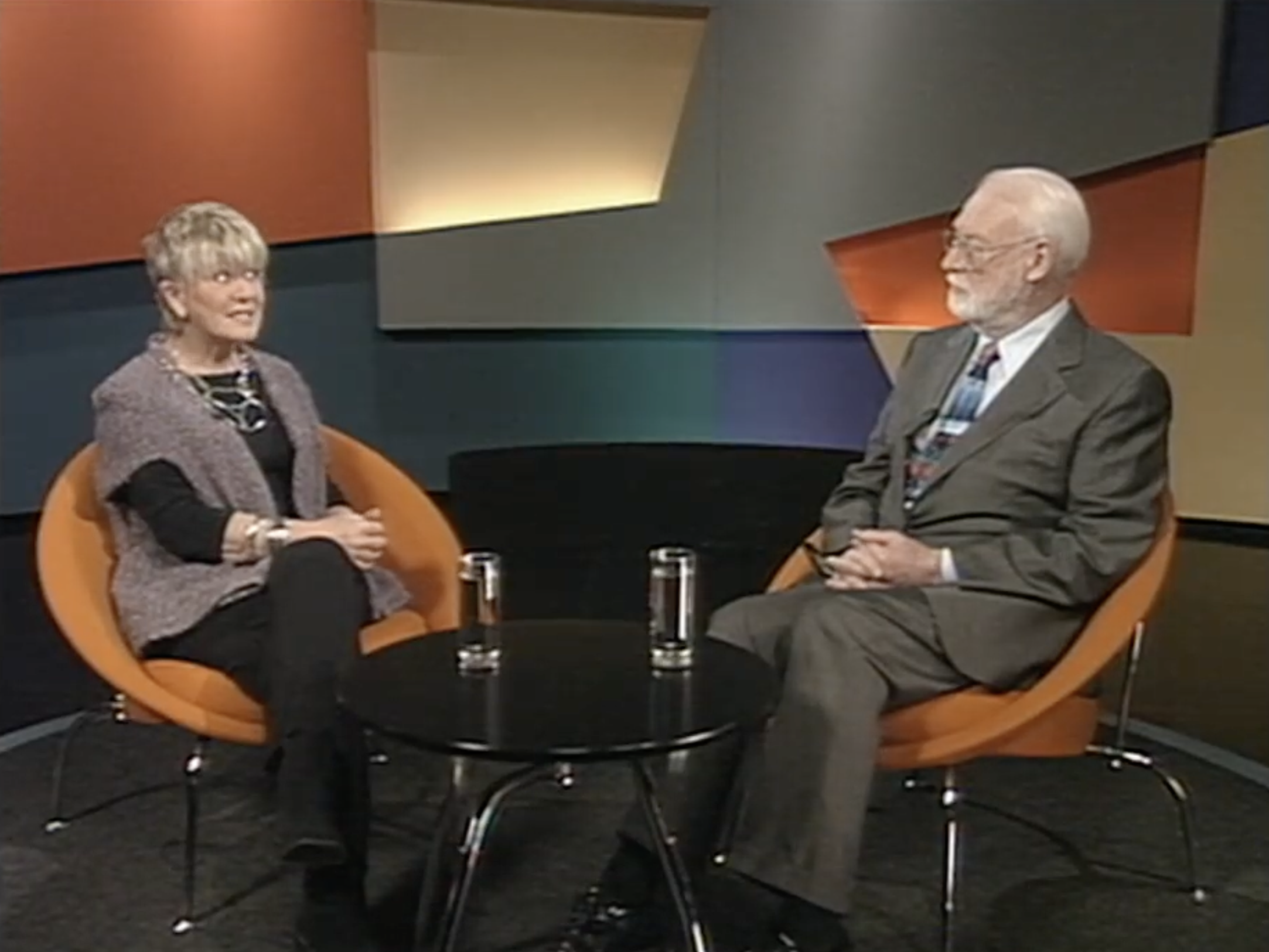
If you live in Australia and like movies, there’s a good chance you know of Margaret Pomeranz and David Stratton. How much you know will vary—maybe they’re just vaguely familiar names, maybe you’ve seen every episode of The Movie Show, maybe one of them is your uncle. Regardless, they’re undeniably iconic figures of the Australian film scene, and a new show at the Melbourne International Comedy Festival is spotlighting one of their most heroic moments. Refused Classification stars comedians and cinephiles Alexei Toliopoulos and Zachary Ruane as Margaret and David, respectively, in a documentary-theatre retelling of Margaret and David’s fight against Australia’s banning of Larry Clark’s controversial 2002 film Ken Park.
Though it’s a stage show, it displays an adoration for cinema that is characteristic of both Toliopoulos and Ruane, who also wrote the script. And it’s surprisingly energetic and propulsive, immersing audiences in historic moments—like an illegal Ken Park screening at Sydney’s Balmain Town Hall—with vivid immediacy. Funny, thought-provoking, and entertaining in equal measure, Refused Classification is likely to leave any film nerd feeling invigorated, educated, and maybe even a little proud to be a movie lover. In this interview, Toliopoulos and Ruane discuss the process of developing the show, their own controversial film opinions, and the legacy of The Movie Show.
Note: the following interview has been edited for length and clarity.
Ivana Brehas: How did you learn of this story and decide to do a show about it?
Zachary Ruane: I couldn’t say where I learned the actual story about the Ken Park fiasco and Margaret. I think I sit right in that age where that was just always something I was aware of—this little fight that happened around a movie.
Alexei Toliopoulos: It was 2003, so I was 12, and I knew about it at the time.
ZR: Yeah, I was 13. I remember it kind of going down. But then Alexei got re-obsessed with the particular episode where they talk about it.
AT: They played a repeat of it on SBS maybe two years ago, and I just happened to be at home watching free-to-air TV in the middle of the day—very rare. The episode came on, and immediately I knew what it was. They started reviewing 25th Hour (2002) by Spike Lee, and I remember that David liked it and Margaret was not a fan, then they did a very good slam review of The Core (2003), where they were both making fun of the movie and having a good time. And then, they started reviewing 2 Fast 2 Furious (2003), and I was like, “Holy shit. I know this episode. This is the episode where Margaret goes crazy for 2 Fast 2 Furious and gives this really passionate, from-the-gut review.” After that, they started talking about Ken Park. I had forgotten about that, and it just reawakened everything. I was like, “This is such a cool little time capsule. All these things that I remembered happened in this one episode.” It also made me feel a bit sorrowful that there wasn’t something like that on TV now—something that wasn’t just celebrating the arts, but also directly using its power and platform to fight for the arts in a really big and powerful way.
IB: If you both knew about the Ken Park thing from when you were 12 and 13, did that make Ken Park seem more appealing to you? Did the controversy make you want to seek it out?
ZR: Yeah, I think so. There’s that real mystery around it. There’s this list of films where, if they had been slightly less provocative, I may have never heard of them. Like, I don’t think anyone needs to know that A Serbian Film (2010) exists, but we do now because of these controversies. And everywhere else in the world, Bully (2001) and Kids (1995) might be Larry Clark’s more known, more renowned films, but because of what happened here, Ken Park is probably closer to the top of the pile for us. I was talking to my cousin about it, actually—he was, like, my cool cousin who was allowed to read FHM and Ralph Magazine [laughs]…
AT: Oh, my gosh. Wow.
ZR: And he would download movies…
AT: I’ve gotta visit this guy and find out about these cool things.
ZR: He told me he downloaded Ken Park when he was about 15, and I think he watched it with some friends, and they were excited because it was this illegal film. And he was like, “It was the biggest bummer of a movie” [laughs]. Like, it’s a really morose, sad, complicated film, but I think a lot of teenagers were just drawn to, “This is so fucked up, the government won’t allow it,” you know?
AT: And then they go, “Oh, this is resonating with me unfortunately…”
ZR: “Oh man, existence is difficult and futile when you are this age…”
AT: I hadn’t seen it until we started actually working on the show. Zach, there was an illegal screening that you went to when we first started thinking about the idea…
ZR: Yeah, it was a really great moment where, Alexei was on the podcast I do with Mish Wittrup [The Mish and Zach Podcast], and he brought up this episode of The Movie Show because Mish and I had been talking about which of us was the Margaret and the David. A few weeks later—I won’t say the film collective because they’ll get in trouble if I do—but someone put on a screening of Ken Park. It was fun to watch it in that setting. And to be honest, I didn’t love the film. Creatively, it didn’t gel with me, which made it more interesting. It’s an easy story if it’s a film that hits, that works for everyone. When it’s a film that I didn’t particularly care for, then it becomes a much more complicated story. It becomes a question of whether it is worth defending or not, and why we should be defending it. I think documentary is so much more interesting when it exists in that grey space. That’s when I got really excited about the story. Then Alexei and I just got to talking. It started as a documentary idea, then within moments we had an idea for, like, an American Animals, 24 Hour Party People-style dramatisation [laughs], then within a week it was a live show. And that’s where we are now.
AT: Looking back at those early text messages, almost every idea that we say very quickly in text messages took us weeks to come back to and go, “Oh, that’s what should be in the show, that’s the best idea.” Like, the beginning of the show was our very first idea, and the ending of the show was the first draft ending. The form and shape of the show weirdly came to us very naturally. Then it became about doing the research and figuring out where all the specifics fit into place.
ZR: And finding out how much a general audience knows about the story. That’s a fascinating thing with documentary, because you kind of go, “Well, I know all of the story now,” but then you realise you can reveal things to an audience. You can play things out chronologically and they’re going to have a fun time.
AT: Ivana, you’re a little bit younger than us. What is your history with Margaret and David? Did you grow up watching them, or did you know who they were?
IB: I knew who they were. I was 16 when The Movie Show ended. I had seen them a little bit on TV, but never really engaged—I think, also, because I was so online by that point. I was like, “Why would I need this? I’m learning about movies from the internet.” But it was really nice to go to your show with no knowledge of what I was about to learn. Has it been playing differently in different cities?
ZR: What’s actually been interesting has been different time slots. When we’re doing the show quite early, we’ve thought about it in that way—as something that is informative and a bit theatrical, and the comedy being just something that comes naturally for us. But when we’ve done it in Adelaide at 9pm and everyone’s had a couple of beers, everyone’s a bit looser…
AT: Including us. We’re a bit looser, we’re having a sillier time.
ZR: There’s so much rock and roll in this story, funnily enough, considering it’s about two boomer film reviewers on public broadcasting networks. I think performing it at 9pm has really helped me realise that element to the story.
AT: Yeah, the anarchic qualities of Margaret and the protests. I guess the only other difference between shows is that the show is still evolving. The first trial show was really long, and we’ve been honing it down ever since. And, it seems like it’s been about generational differences rather than a geographical thing. We’re teaching some people who Margaret and David are. And then for film nerds who already know the story, it becomes more of an experience of immersion—like going to a recreation of something you’ve heard about, rather than learning something new.
ZR: Something we thought a lot about was that there would be people who are too young to know who Margaret and David are. And some quite old people might not know either. There will be people who know Margaret and David much better than we do—we’ve had people come to the show who were at Balmain Town Hall. We’ve had people come from the UK, who had no idea about any of it.
AT: And we’ve had people come to the show that are David Stratton’s nephew [laughs].
ZR: It’s very challenging to make a show that isn’t too boring for one group, or too in-jokey for another, and I feel very proud of the fact that when we’ve talked to people from all of those different groups, the show’s really resonated with them. I’m feeling really positive about that.
IB: What did David Stratton’s nephew say?
AT: Oh, it was so funny. He came to, I think, the first trial show in Sydney. At the end, he introduced himself to us, and he was like, “Me and my partner had the night off, and Sydney Fringe Comedy was on, so we were like, Let’s go see something. We looked on the website and went, Oh cool! Zach and Alexei are doing a show together, those guys are so funny. Click on the link, and it was like, What the fuck? It’s about my uncle” [laughs]. He came to the show that night. And he loved it.
IB: For people who have come to the trial shows, will their experience of this show be pretty different?
ZR: Oh, 100%. Yeah. We’ve cut the show down, we’ve refined it, there’s a lot of work we’ve done in terms of the script. I think the show is so much stronger, so I’d really hope people would come back. On top of that, we’ve worked on the AV a lot more. In fact, we hired the editor from Birdeater (2023) to do a bunch of videos for us, so… [laughs].
AT: Ben Anderson, the editor on Birdeater—we were colleagues at film school, and we’ve always chatted about trying to do something together. He’s come on board and made insane amounts of AV, and upgraded, like, every single moment. Even just little touches that he’s done have excited me so much. Like, instead of it just being a weird slideshow moment where I go, “Can you put this screenshot up on the screen?”, he’s made it look like a paused VHS. Stuff like that, just little touches to amp it up and make it feel like a physical document, have been really cool.
IB: In the early days of developing this, was it easy for you to decide who would be Margaret and who would be David?
ZR: No. I think Alexei decided he was Margaret and then I just had to go through a process of accepting that [laughs].
AT: Yeah, that was it. That actually is so true. I was just like, “I’m gonna play Margaret.”
ZR: I was like, “I’m the Margaret in every duo I’ve ever been in, Alexei. I’m the Margaret out of Zach and Alexei, and you’re gonna be the Margaret?” But I could just see it in his eyes.
AT: It just had to be, you know? It wasn’t a choice. It happened.
ZR: I love David, it’s just that I’m not David. It’s such a stretch for me to play him because I’m the most mental person ever. For me to have to play David was a real, like, grounding. It’s quite a nice feeling to play him.
AT: And you get to play all the other characters.
ZR: I get to play Larry Clark. I worked extensively on my impression of the head of the OFLC [Office of Film and Literature Classification] board, Maureen Shelley [laughs]. It’s really funny to have nailed an impression of a woman when no one really knows how she sounds.
AT: She’s normal. Her friends and family know what she’s like.
ZR: Just a normal person that worked for the OFLC in 2003.
AT: But there’s, like, five videos of her that we could find, that you studied [laughs]. For me, so much of coming up with this show and writing it was a love letter from me to Margaret Pomeranz, who’s been my hero for my whole life. There was something in that where I was like, “I have the emotional connection to that person—I think it will translate well to performance, while also being a bit of a stretch for me.” I ended up taking that very seriously, going, “Okay, how can I find her? What’s her body shape for me to interpret? How do I find the physicality of that character?”
The first night of the Sydney trial show, I looked in the mirror—I’d got the wig, I’d shaved my moustache off, I was wearing a Dinosaur Designs necklace I borrowed from my mum, and like, “Okay, I’m starting to feel a bit like her.” I’ve got this blue safari suit that I wear, and it’s got an adjustable waist. I pulled in the waist so I could give myself a bit more of a hip, and when I did that—I looked in this full-body mirror, and I found the pose and the shape, like, minutes before we went onstage, and I was like, “Oh, Margaret has arrived.” Ever since that night, I fully have a delusional fantasy, whenever I’m wearing the wig or I see a photo of me as Margaret, I go, “That’s Margaret. I look exactly like her.” It’s true delusion. Every time I say it, Zach just stares at me like I’ve lost my mind. But I just believe it so much. And every night, when I talk about the performance, I go, “Oh, Margaret was really great tonight” [laughs]. Like, it’s not me. I bring her in and she comes in.
ZR: I also have a theory that Margaret and David is a sliding scale. It’s a qualitative thing. So, you might be the Margaret in one relationship, but the David in another. On my podcast with Mish, I believe I’m the David to her Margaret, but I’m the Margaret to Alexei’s David. But then Alexei is the Margaret to many Davids in the film criticism industry. We’re all Margarets, really.
IB: This is a show about censorship—have either of you encountered any attempts at censorship in your own careers?
ZR: Not really. Most of my career has been with Aunty Donna, and we’re very pure comedy. Our goal was always to entertain and give people a good time, and nothing else, really. When that’s your goal, sometimes you want to shock people, but broadly speaking, you’re not going into areas that will bum people out or give them a bad time. So it means that we’re not going into really hot topics. We try to be funny, and if we provoke on that journey, we’re alright with it. I think now, moving into stuff like Refused Classification, it’s more likely to ruffle feathers. The more you’re willing to say something and stand behind something, the more you’re willing to push it further and be more provocative. So, who knows. Maybe in the next phase of my career I’ll have people come for me, but I’ve been very lucky not to encounter that as much.
AT: For me, so much of the stuff I’ve worked on has been independent work, so it’s only ever really been self-censoring. And even self-censoring is such a strong way to put it, when you’re just going, “I don’t know if this works.” But I would say this is the most provocative thing, the rudest thing I’ve made.
ZR: I also think we’re in a cultural shift at the moment. I don’t want to talk too much about it in the interview, because I want to keep these sorts of thoughts to the work itself, but… who knows what the next ten years is going to look like? There might be more bumping up against things, there might be more ‘culture war’ stuff happening. Australia is usually ten years behind America when it comes to this stuff. I think we’re on the horizon of an age where maybe some things will be harder to do. We’ll find out. Hopefully not.
IB: Given your comedy backgrounds—especially with you being best known for Aunty Donna, Zach—audiences might not expect a more earnest, political tone from you. What has it been like dipping into that space with this show?
ZR: Yeah, it’s been interesting. I kind of talked about this before, when I said I prefer documentaries that exist in the grey—I don’t like theatre or film that pretends to be political but doesn’t challenge or inspire the audience that’s watching it. I’ve been to so many theatre shows that are just reinforcing and patting everyone on the back, like, “You’re a good middle-class liberal, good for you, we all agree.” I don’t see the point in that. I don’t think it’s valuable. I think, if anything, it rots society. If I’m going to make political work, I want it to be interesting and considered. I want it to have a slightly different perspective, maybe offering a viewpoint that people haven’t had. And that’s very challenging to do when you’ve got four writers. It’s a lot easier with two people. I think, the more I move into solo stuff, the more I’ll go into that space, for sure. And audiences have been really chill. I hope that, even if people disagree with me or have a different viewpoint, that they can see where we’re coming from and what we’re saying. I hope it inspires people to at least think about these ideas.
IB: I want to wrap up by giving you the opportunity to do some film criticism. First off, are there any movies you really hate?
AT: I hate How the Grinch Stole Christmas (2000). I think it is the fuckin’ ugliest movie. Every shot is a Dutch angle. I think it’s a hideous costume; I hate looking at it. There’s this little section between the nose and the mouth on every Whovillian character and the Grinch himself that disgusts me. I hate how sexy Christine Baranski is in it—I’m like, “This is inappropriate for a kids movie.” I think that’s yuck. I hate the little kid Grinch. I hate the baby Grinch even more. I think he looks so yuck. I think it’s just the ugliest piece of shit movie ever made. And I love a few other Ron Howard movies, so let that be the qualifier—but I hate that movie. It’s so ugly. It’s like the Citizen Kane (1941) for me of bad, ugly movies. ‘Cause everything that Citizen Kane does, the Grinch does in a nightmarish fashion. I hate it. I hate it, hate it, hate it.
ZR: My problem is, I present movies once a month and I talk about movies sometimes, but I really don’t think of myself as a critic, because I don’t think of movies that way. I think the number one rule of film critics, I’ve heard, is ‘Don’t say what you would have done’—and that is purely how I think about movies. I think just because I’ve been making comedy and stuff for so long, the thoughts I think are, “What can I take from this?” or “What can I learn from this?” So, even if it’s a terrible movie, if it’s got a couple of cool shots, that tends to be what I walk away with.
AT: That is so my ethos as well, but I hate the Grinch.
ZR: But even a film like Cats (2019)—which is probably up there for me, like, that’s a truly horrific film—it’s such a cynical film. No one on that film gives a shit. And part of the reason why I will never watch that film again is because I see it as a problem to solve. Every time I’ve watched Cats, it’s broken my brain for two or three days. I go on this cycle of, “Maybe if they’d done makeup,” or “Maybe if they’d been better with the CG,” and I go round and round and round, when the only solution is: you don’t make a movie out of the musical Cats. You don’t make the movie! That’s the only answer. There’s no version of that movie that works, but I can’t think that way. I can’t just go, “That was a bad movie.” I go, “Come on Zach! Let’s solve this problem!” and my brain melts. It actually makes me go on the verge of a mental breakdown whenever I watch Cats. So that’s my answer, actually.
IB: To balance that out, what’s a movie you really love—especially one you wish more people had seen?
AT: Right now, I love this Australian film that’s in cinemas called Inside (2024), with Guy Pearce, Cosmo Jarvis, and Vincent Miller. I think it’s so beautifully and thoughtfully made. It’s a great take on the crime thriller genre with a really humanist touch. It’s the kind of movie I think we make very, very well here in Australia. Directorial debut feature from Charles Williams as well. I’ve seen it quite a few times now, and it’s just one that’s hit me very resonantly recently.
ZR: There was a French film about four or five years ago called Custody (2017) which just popped into my head. One of my favourite things to do is just go to an arthouse cinema and see what’s on next, and that’s how I saw it. It’s about a custody battle for a child, and the first 15 minutes is, I think, one of the most incredible little pieces of filmmaking. I think those first 15 minutes were based on a short film. It’s just this incredible scene where the judge is hearing both sides of the story, and the stories do not align at all. Someone’s lying. And it’s just this idea of: How can a judge possibly make a decision when he’s hearing two stories that are completely different? It’s just such an incredible encapsulation of how complicated an issue like this is. It’s not a movie that I hear talked about much, but it just popped into my head, like, “Fuck, that movie should be bigger. That’s a really incredible movie.”
IB: And finally, are there any movies that divide the two of you?
ZR: Ken Park [laughs].
AT: Yeah, Ken Park. Zach doesn’t really like it, but I do. There’s quite a few. We saw The Substance (2024) together and Zach, immediately, loved it. I liked it, but Zach has an extreme passion for it. I think we divide very often. For people who have very similar sensibilities, It happens more often than you’d expect.
ZR: It’s funny—we both love stuff that swings for the fences, that has a crack. I love something that risks being terrible in order to maybe be great. But we still have very different taste.
AT: Oh, you know what a big one is? I don’t watch TV, and Zach is trying to get me to watch, like, every TV show.
ZR: Excuse me! I have been very focused on making you watch Succession.
AT: I reckon I’ll get to it one day. Maybe. But it’s like… I just can’t do it. I’ve gotta watch 500 movies a year! With TV, I’m watching E.R. at the moment and that’s it.
IB: Before we wrap up, is there anything else you’d like to say about the show?
AT: We’re at ACMI in Melbourne! We really, really wanted the show to be there, in a place that speaks that language of loving film, and to hopefully go in with the expectation of feeling a connection to film and to Australian film history. I think we sit in a very unique spot in a comedy festival, because we are such a theatre piece, and the show is about and dedicated to movies. There’s a lot of filmic influence in it. I really want it to feel like a film festival setting, so having it at ACMI just felt so perfect, especially in that early spot. I think it’ll be a great show for people to chat about and discover stuff about after. Hopefully, it’ll inspire people to not only take risks and see something cool and different at the Comedy Festival, but to continue their journey to discover more films. Take risks, see a film you might not have seen. Take Margaret’s wishes and fall in love with movies all the time.
ZR: We’re both really passionate about the fact that we live in a very binary world of, “Is it good? Is it bad? Did I like it or not?”
AT: I hate that.
ZR: Those are often the first questions people ask after a movie. I think this show is saying, “Hey, maybe think about art and entertainment in a different way. Think about how it exists within culture. Think about what you want the culture you live in to look like.” A friend of ours who isn’t a big film person saw the show and didn’t know anything about it beforehand, and they were like, “I was immediately looking up everything afterwards—the film, Margaret and David, censorship in Australia.” If we can have people thinking and engaging with some of these ideas, that’s such a cool thing. But also, hey, I think it’s a funny show! If people just come and watch it and have a laugh, that’s cool too.
Refused Classification is playing at the Melbourne International Comedy Festival from March 27 to April 20th.
**********
Ivana Brehas is a writer, teacher, and actor based in Naarm. Her work has appeared in Dazed, Bright Wall/Dark Room, The Big Issue, Sight & Sound, Senses of Cinema, 4:3, Rough Cut, and more.
 Rough Cut