


On March 1, Rough Cut will co-host a day of screenings in collaboration with film collective Static Vision. A wicked rite to farewell a long summer, we present a program devoted to seaside sensuality and alienation—five forbidden treats sticky with heat, depraved curiosity, and perilous desires, which span the shores of North America, Argentina, Japan, and France. Over the course of four features and one secret short, sailors, sirens, voyeuristic resort goers, desperate young women, and masked dandies will uncover the mystical, macabre portents of the ocean.
*********
The image of the beach is a perpetual paradox—saturated as it is with ideas of possession and autonomy, danger and pleasure, equity and delineation. In her essay ‘Bodies That Matter on the Beach,’ Aileen Moreton-Robinson writes of Australia’s colonial obsession with its shores, spaces possessed and governed by white nationalism and masculinity. It is a relationship, she writes, “constituted by violence and transgression, voyeurism, pleasure, and pride.”
In the eighteenth and nineteenth centuries, European Romanticism heralded a shift in attitudes towards the sea: once feared for its calamity and daunting ‘wildness,’ it began to be prized for its sublime, transformative potential. Holidays to the seaside were popularised to celebrate the healing, enriching properties of the elements. Shorn of their history and context, beach locations offered an empty abstraction for those seeking a metamorphic encounter, even as they became increasingly implicated in the flows of capital. It’s with this in mind that we regard the beach, perhaps chiefly, as a space of fantasy—of myths told and retold, gradually transforming like shifting tides. “It is as though summer itself were a mirage,” as Annie Dillard reflects in Teaching a Stone to Talk, “a passive dream of pleasure, itself untrue.”1
*********
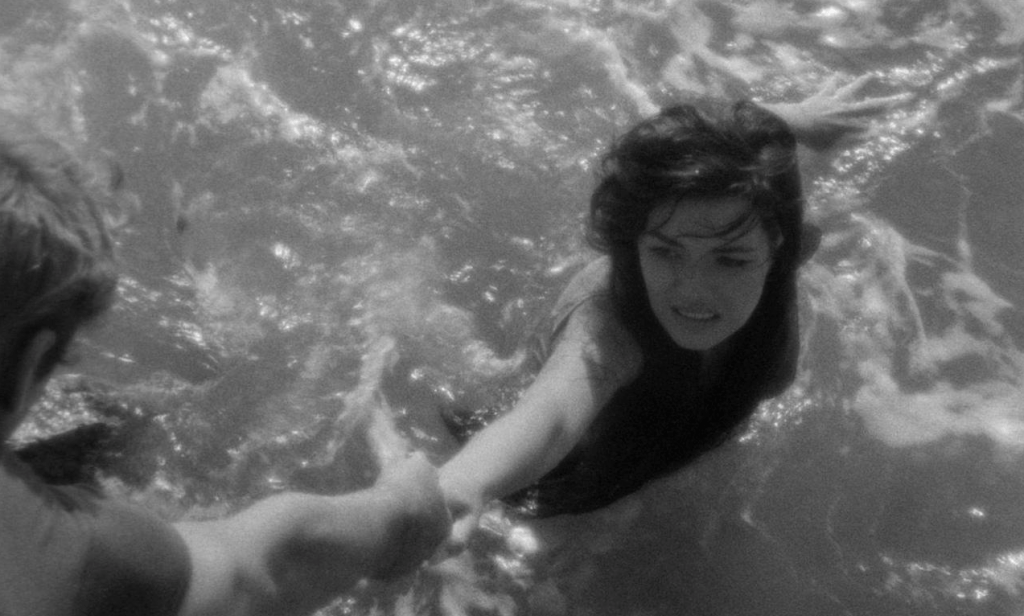
On the beach at night, a woman is invited to dance. Her new lover watches amid a crowd of onlookers. Accompanied by slow, steady drums, she sways and twists her hips, throwing her head back, rocking her torso to and fro in a dance of magnetism: forwards or backwards, towards or away? Curtis Harrington’s fantasy thriller Night Tide (1961)—the first film of our program, named after an Edgar Allan Poe poem—plays with the myth of the siren: the humanoid woman of the sea who sang tantalising songs to lure sailors to their deaths. In the tale of the siren, sexuality is a deceptive form of feminine violence—a trap designed to wreak havoc upon the heterosexual male.
A young woman named Mora (Linda Lawson) is drawn to the ocean whilst dreading this same attachment. She collects seashells and hangs them from the ceiling of her apartment, located above the Santa Monica Pier Carousel.2 Mora makes a living performing as a mermaid on the pier, supported by her adoptive father figure Samuel (Gavin Muir). When earnest and naïve Navy sailor Johnny (Dennis Hopper) begins to fall for Mora, her enigmatic qualities intrigue him even as they begin to incite paranoia. Then, we learn that Mora’s previous two lovers met their fates in the sea. There’s an older woman dressed in black that seems to follow Mora, taunting her in an inscrutable language, perhaps attempting to lure her to a world of otherness. Could Mora be a real-life siren—the embellished fantasy in fact a harmful reality?
Johnny begins to fear Mora, as Mora has long feared herself. In one of the film’s many surrealist sequences, Johnny fantasises about kissing Mora, who progressively morphs into a giant octopus, suffocating him within her/its slimy grip. Harrington, a queer filmmaker whose early experimental work also dealt with themes of sexual anxieties and paranoia, here paints a dreamy romance threatened by the spectre of deviance. Staged against the seaside in umbrous black-and-white, the ocean becomes a simultaneous symbol of alienation, danger, and desire: rough, wild, and beautiful, yet always concealing something else in its dark depths.
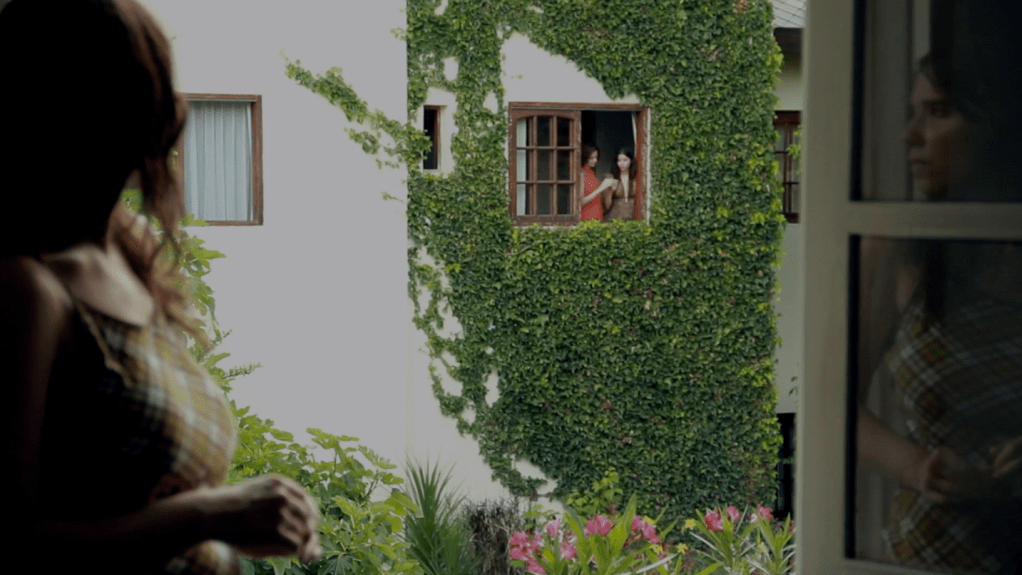
The seaside is also a location of unmoored imaginations and perverse potential in Laura Citarella’s Ostende (2011), the second film featuring in our program. Citarella, a member of the fiercely independent Argentinian film collective El Pampero Cine, who describe their working process as akin to that of a “rock band,”3 is best known for her roguish epic Trenque Lauquen (2022), a giddily indecipherable, atmospheric fable tracing the cyclical pursuit of a missing botanist, Laura (Laura Paredes), which seemingly takes cues from mystery serials, neorealist dramaturgy, and monster movies alike.
Introducing the same protagonist eleven years earlier, Citarella’s slim, sharp precursor is perhaps even more slyly cryptic than its spiritual follow-up. Courtesy of a prize won by her boyfriend on a television quiz show, Laura (Paredes), commences an off-season stay at a drab resort beyond the borders of Buenos Aires, appearing at the reception desk as if excised of all history. Her lukewarm attempts to lounge prior to her boyfriend’s arrival, however, are thwarted by a swelling fixation on a trio of mysteriously linked strangers: a man and two younger women. In Citarella’s shrewd and transportive ode to feminine voyeurism, leisure quickly cedes to obsession, as Laura dedicates her trip to fantasising about her fellow revellers’ seemingly malefic—though perhaps utterly banal—triangle of love, hate, crime, and/or indifference.
Horizons stretch and contract; scenes pulse with unbounded excitement and wretched paranoia. The resort is a wide-open space that is nevertheless choking, rendered in lithe, protracted long shots. Often accompanied by a nagging quietude, Ostende is also striking for its near-blinding, bleached quality of light—a warm effusion that, though initially inviting, quickly grows exhaustive and clinical, accruing an overwhelming air of sordid ennui. Fittingly, cinematographer Agustín Mendilaharzu (who also worked on El Pampero Cine favourites La Flor [2018] and Extraordinary Stories [2008]), bestows the film with his characteristic soft focus. Here, this approach proves both soothing and frustrating. Mendilaharzu cultivates a humanistic regard for faces and gestures, while also suspending them amid an obscure and unsettling haze. For us as for Laura, Ostende creates a unique kind of deranged alertness—everything is at once stingingly visible and wholly out of reach.

Restlessness is also in the air in our program’s third film, The Wolf Knife, artist Laurel Nakadate’s 2010 feature. It’s in the grime and sleaze of its lo-fi, digital aesthetic; in the awkward pauses, charged with frustration, melancholy, and a lingering, unarticulated threat; in characters’ eyes, which either appear totally dead or uneasily wide.
16-year-old Chrissy (Christina Kolozsvary) is disgusted by her family, so she stomps down the street calling for June (Julie Potratz), who we find peacefully submerged in a pool, wearing a shiny pink bikini. They compare the firmness of their asses. They make a game of this. They find a stranger’s empty pool to swim in, and when the owner spots them, the encounter proves both erotic and terrifying. They indulge in elaborately sprinkled ice creams by the beach and hold sparklers up to the sky—rituals of summer leisure so familiar as to be almost hollowed out of pleasure. Chrissy tells an ornate story about her mum’s sex life, sending June into fits of giggles. This seems to be Chrissy’s intention, to make June laugh, until she suddenly hardens: “It’s not that funny,” she insists. “It’s my mum.” Splashing in the ocean, June stops to wipe smudged mascara from Chrissy’s eyes. She swears she will accompany Chrissy to Nashville to find Chrissy’s dad, and so the pair go.
It’s a summer tradition, to spend long nights in hazy places where time turns dull and formless. Motel carparks, empty storefronts, the roadside attraction of a giant fake alligator. Everything can happen but almost nothing does. The girls take pictures anyway. Chrissy has stolen her mum’s engagement ring and a pair of bright pink underwear her soon-to-be step dad bought for her mother; she parades around in them for June, who is less enthusiastic than Chrissy wants her to be. She learns that June has been lying and keeping certain sexual escapades to herself. But it’s okay, Chrissy has been lying too. Doing anything they can for a good bedtime story, they invent and test out new narratives: play-acts that feel deadly serious yet as weightless as a sea breeze. In this way, like Harrington and Citarella, Nakadate illustrates the beach in all its strange paradoxes—as a stage of unknown agonies and pleasures, of autonomy and boundary-staking. Nakadate observes her characters’ innocent attempts at adult sexuality with a sense of inevitability; all of this will be corrupted, if it hasn’t been already.
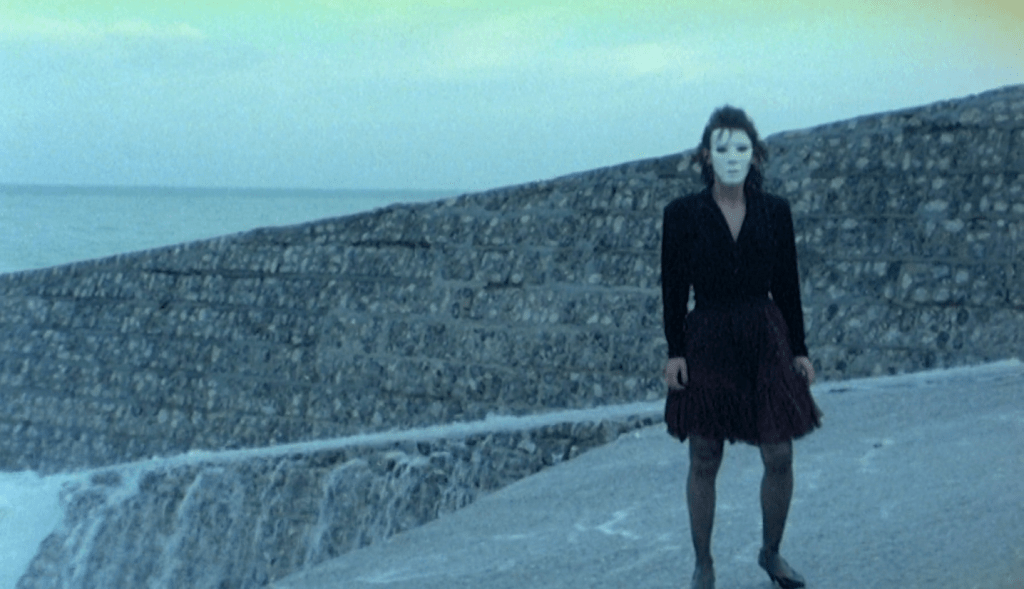
Following a transportive surprise short, we are closing out the evening with a rich, dark dessert: outré horror auteur Jean Rollin’s strangely tender 1989 conjuring, Lost in New York (Perdues dans New York). Beaches are one of the most compulsively repeated images for the director—rivalled only by vampire fangs, ravaged bodies, and nipples exposed by sheer chiffon. In his films, which effortlessly breed pornography with poetry and sensation with sentiment, beaches possess a particular undead quality. Often, they are reanimated by the doggedness of nostalgia. Rollin recalls, in the 1997 diary of his oeuvre, Virgins & Vampires, the beach as the site of his first fantasies and thus as the beginning of all eros. This is a genesis staged, with delicate perversity, in his crooked romantic reverie Lips of Blood (Lèvres de sang, 1975), in which a young boy—played, notably, by Rollin’s son—falls fatally in love with a maternal vampire on a moonlit shore. Here, the two of them later confine themselves to a single coffin, in which they together sink into a waterlogged afterlife. A timeless expanse, for Rollin only the ocean can represent the sublime depths of evil and innocence, doomed to mutate and merge amid its volatile currents.
The same coastline, Rollin’s self-described “fetish beach” at Dieppe on the edge of Normandy,4 features heavily in Lost in New York. An alluringly sulky, 16mm phantasm soundtracked by foreboding caws and scarred by rotting pyres, it plays a pivotal role. With the inexplicable aid of a wooden totem, a stranger’s dance, and a shared obsession with adventure books, the beach becomes a spatiotemporal portal for two parentless little girls, who soon find themselves inexplicably grown-up and separated amid the colourful murk of the faraway city. The flâneuses here commence a nonlinear odyssey; traversing alleyways, bridges, and cemeteries in search of one another’s aged, unfamiliar forms, their movements create a wordless choreography of wanting. As the women are confronted by all kinds of malevolent flotsam, from bizarre rooftop knife-fights to the lurking terror of ruptured adolescence, Rollin’s made-for-TV lyric offers a perfectly opaque last word on the irresistible disorder wrought by the sea.
**********
Ostende will be proceeded by a prerecorded Q&A with director Laura Citarella.
Summer Sacraments will be held at Static Vision HQ on Saturday, the 1st of March. You can explore the program and purchase tickets here. Full-day tickets, as well as single-film passes, are available, both with concession options.
Follow Static Vision on Instagram, Facebook, or X to stay updated about future events.
- 1982, p. 149. ↩︎
- The same carousel would later be featured in George Roy Hill’s The Sting (1973). ↩︎
- See Nicolas Pedrero-Setzer’s interview with Citarella: https://reverseshot.org/interviews/entry/3167/laura_citarella. ↩︎
- Virgins & Vampires, 1997, p. 117. ↩︎
 Rough Cut