


The most marvellous is not
                                       the beauty, deep as that is,
but the classic attempt
                                       at beauty,
at the swamp’s center
—William Carlos Williams, ‘The Hard Core of Beauty’
Brady Corbet’s The Brutalist is an act of construction, a work made out of lines and spaces and emphatic gestures, conceived on a grand scale. At its centre is the story of an architect and a building. In exploring the dimensions of this subject, it is as if Corbet wants us to be aware of the elements exactly as he arranges and deploys them. The VistaVision format he has chosen to use. The opening titles that run sideways. The booming, clashing score. The clear division into named sections: Overture, Part 1, Part 2, Epilogue, with an intermission between 1 and 2. Recurring images and scenes that echo each other. Literary allusions.
Corbet twice borrows the title of William Carlos Williams’ poem ‘The Hard Core of Beauty,’ using it for the name of the penultimate section of the film, then putting it in a speech by a character in the final scene. Indeed, the notion of beauty is invoked in different ways. In the first section, an observation, “They are not beautiful,” conveys a brisk dismissal of design decisions. In the final section, an accusation, “You think you float directly above everyone because you are beautiful,” is part of a shocking act of violence. In-between, beauty or “the beautiful” is a source of contention: desired, resented, shunned, noted by its absence. There is no theory of beauty expressed anywhere in the film, however; there are no characters interested in articulating it. Corbet might have invoked another Williams line, “No ideas but in things.”

The Brutalist deals with the work of an architect and a particular, embattled project, but it is hard to imagine that Corbet—who co-wrote the screenplay with his filmmaker wife, Mona Fastvold—might not have been thinking at times of what it is to make a film. It is, after all, a process involving art, power, and money, a collective endeavour fraught with creative compromises and issues of control. In the particular project that The Brutalist depicts, the stakes are high and the art is being produced in the context of chaos and renewal.
Corbet proceeds with conspicuous intent. Conspicuous does not mean straightforward, however. The Brutalist is an elusive, sometimes slippery work, with ambiguities and ellipses built into it. It engages, in various ways, with history and ideas, with weighty issues and important subjects; it feels heavy with significance, but there is still something curiously non-committal about the way all its elements relate to one another.
For a film with a relatively small budget, it feels ingeniously expansive—a contained epic, lengthy yet distilled, ambitious and economical at the same time. Its length might sound forbidding, but it is compellingly paced, and it rarely loses its sense of purpose. Within these frames and framing devices, two figures bear the burden of the film and embody its contrasts and oppositions. They can be said to stand for many things—including art and commerce, Europe and America—but they are also richly drawn characters, defined by vivid, intensely physical performances that feel utterly central to the film.[1]
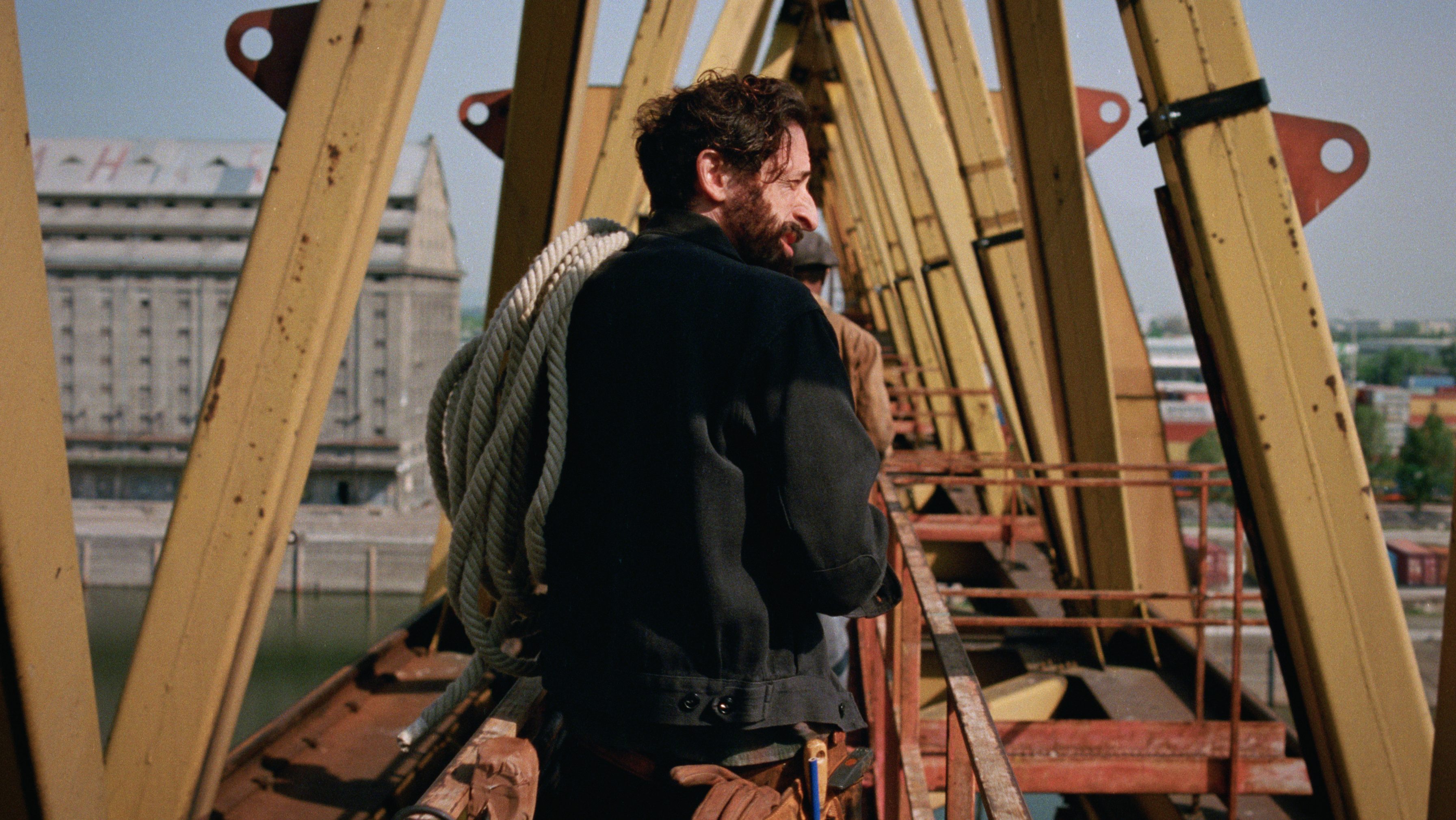
Adrien Brody is László Tóth,[2] a Hungarian Holocaust survivor and a Jewish Bauhaus-trained architect who has survived Buchenwald. He arrives in New York by boat in 1947—exhausted, almost broken. He has travelled alone. He has been separated from his wife and orphaned niece, who are still trapped in Europe, unable to join him. In the early stages of the film, there are times when he seems on the verge of collapse; he buckles, with barely the energy to explain or protest. Brody—spare, angular, fine as a line drawing—gives us a figure who can appear to be hanging by a thread but still summon up a grim, feverish resolve. He resorts, occasionally, to heroin, and will continue to do so; it is suggested that he was first given it for pain from an injury.
Guy Pearce is Harrison Lee van Buren, a self-made, self-centred Pennsylvanian industrialist who becomes László’s patron and tormentor. His instinct is to dominate: he has a demeanour and a voice that fills up available space and an unquestioning assumption of his own importance. His relationship to language is erratic; he likes to tell stories about himself, to give orders, to muse aloud, but in his enthusiasm he can mangle words. Pearce swiftly establishes the confident sheen and rough edges of his character, the authority and abruptness, and a seeming geniality that teeters on the edge of aggression.
The pair meet, inauspiciously, during the first section of the film. Van Buren orders László out of his house, where he had been supervising a radical redesign of the library initiated by van Buren’s son. Corbet calls this section ‘The Enigma of Arrival,’ borrowing the title from V.S. Naipaul’s semi-autobiographical novel about Caribbean immigration to Britain in the 1960s.
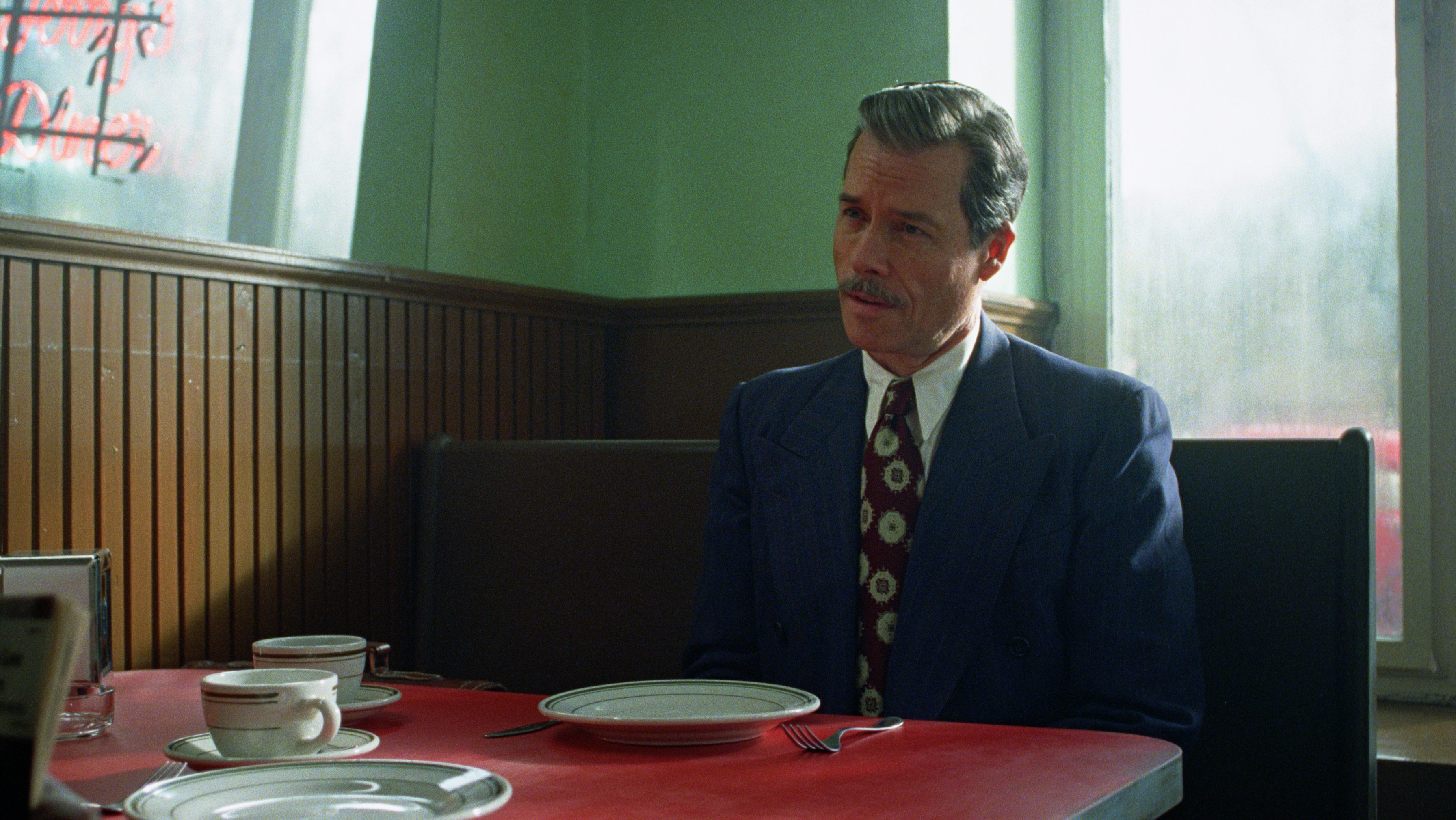
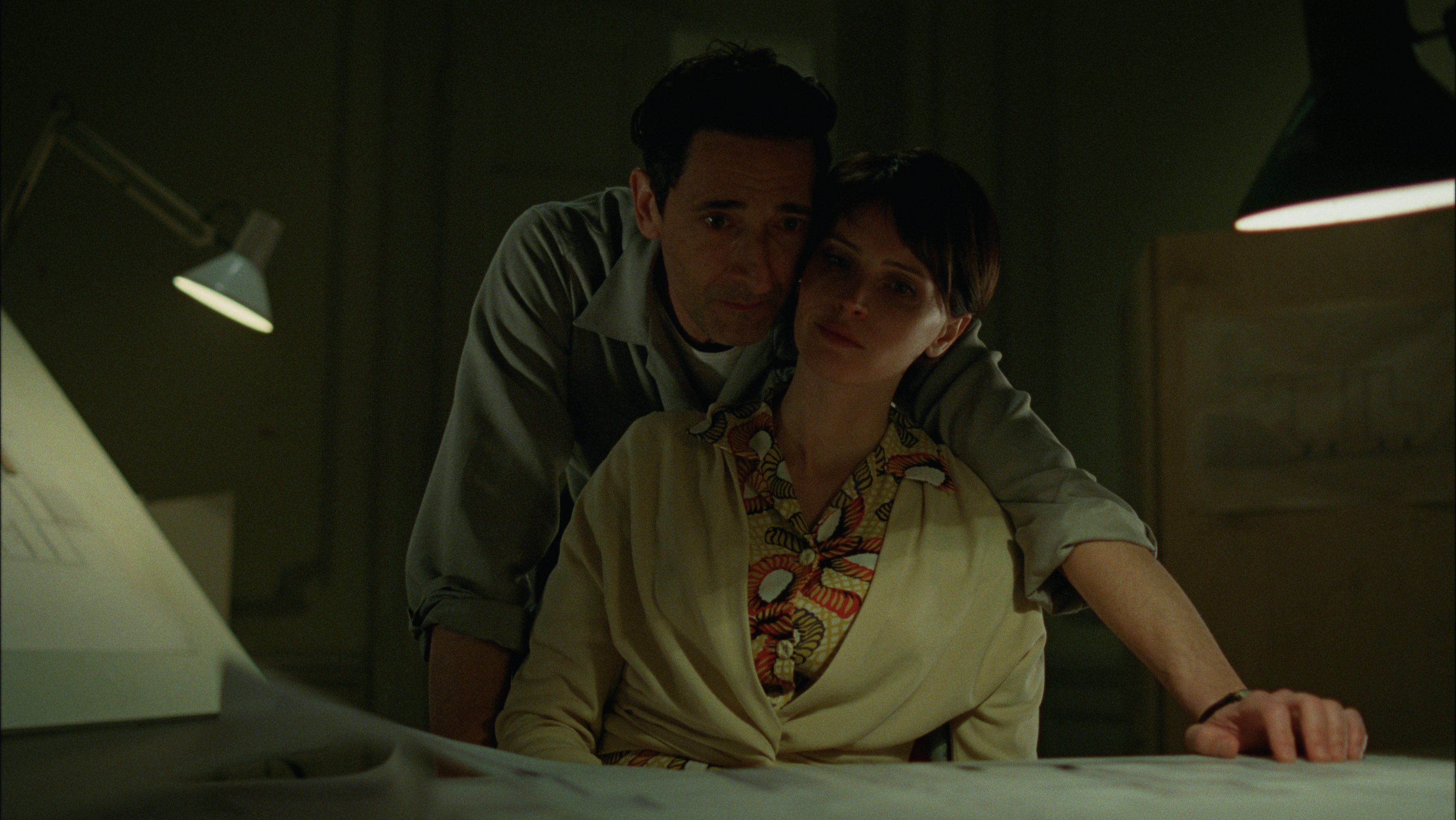
If that section is about the travails of being an outsider, the next section focuses on the challenges of being an outsider permitted on the inside. Part 2, ‘The Hard Core of Beauty,’ reunites László with his wife, Erszébet (Felicity Jones), and his late sister’s daughter, Zsófia (Raffey Cassidy), once their arrival has been facilitated with the help of van Buren’s connections. Their presence changes the balance of the film; they are regarded with a certain suspicion by the van Buren household, either for their eloquence (Erszébet) or their silence (Zsófia). What passes between László and Erszébet is often fraught, their intimacy shadowed by pain, but there is a fierce loyalty that underpins their relationship.
László has received what he describes to Erszébet as a second chance. Van Buren discovered that the man he had earlier ejected from his home is a celebrated architect with an international reputation. He seeks László out, then offers him a lucrative, tantalising commission. He wants to fund a public building that he represents as a social good but which is really a monument to his own vanity. Van Buren’s personal history is tied up with his mother, who raised him on her own. The community centre, to be named for her, reflects his own preoccupations and memories rather than the needs of those for whom it is ostensibly intended: the local residents. He wants a gymnasium (because he was a wrestler in his youth) but dismisses the idea of a swimming pool (he can’t swim). Local authorities try to mandate a church. László comes up with a solution, a design feature with a sleight-of-hand aspect to it, a foreshadowing of what is to come.
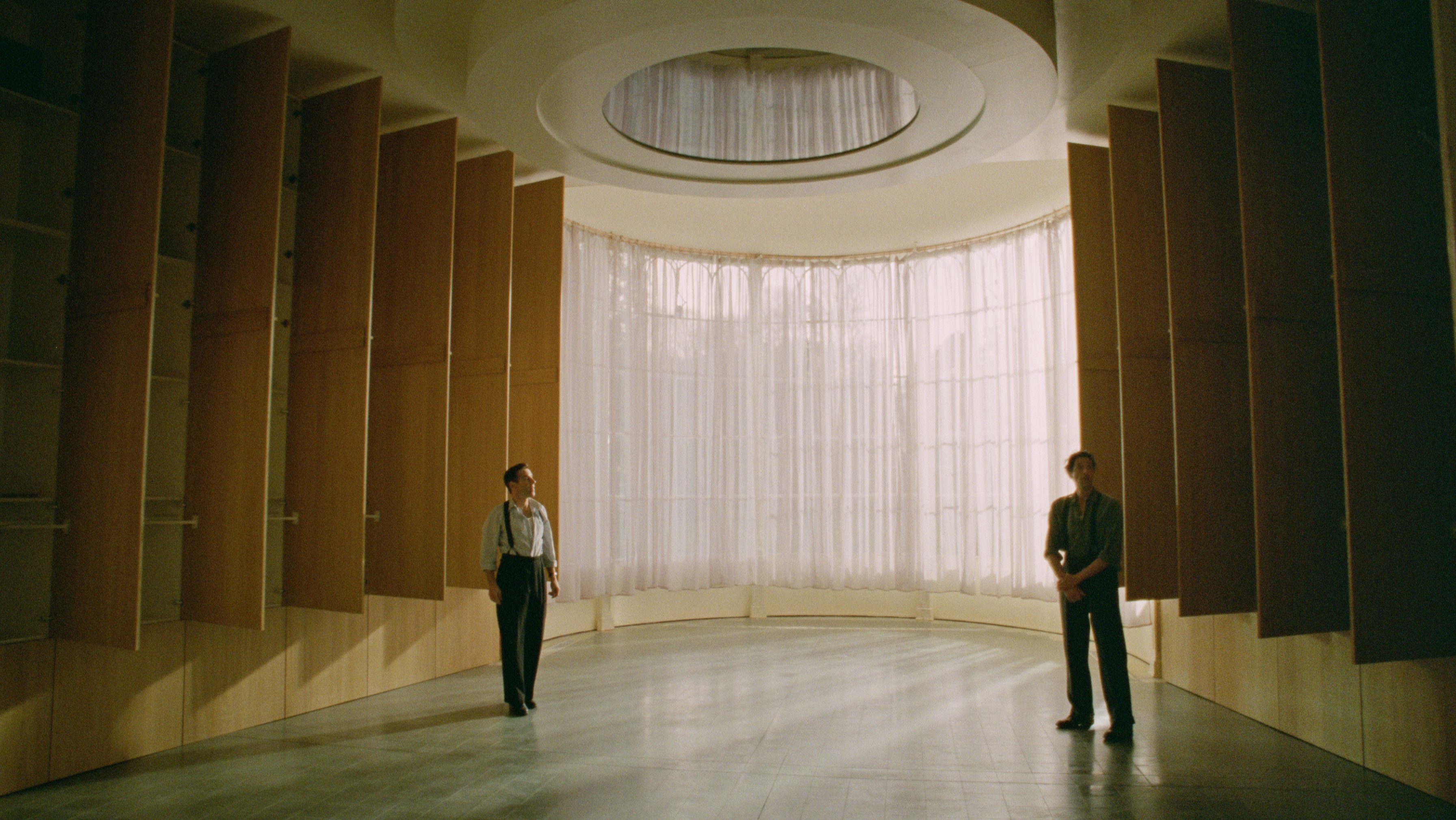
The design and construction of this impossibly hybrid structure—chapel-library-gymnasium-auditorium, to accommodate everyone’s needs and demands—becomes a defining element in the life of László and of the film. The design is both specific and mysterious; the build is consumed with tension. Van Buren has hired a manager and an architect to find economies and efficiencies that will undercut everything that László is trying to do.
What is it that these two men are engaged in? Where do their concerns meet? “Why architecture?” van Buren asks László, in one of the conversations that he initiates and claims to find “intellectually stimulating.” László’s answer suggests that survival—the fact that his buildings still stand, in the wake of all the destruction and devastation that has happened in Europe—is where their significance lies for him. Erszébet asks the same question of van Buren, an industrialist who made his money from the war. “Why this interest in architecture?” she inquires. His airy response appears to indicate that he needed a new hobby, after collecting books and bottles of madeira. It is a comic moment, though it does not bode well for his appreciation of the project he has set in train.

If there is one strong, unambiguous element of The Brutalist, it is its vision of America. There’s a widely cited scene at the beginning of the film, in which László arrives on the boat in New York. Through the hatch, as he scrambles up from below deck, he has his first glimpse of the Statue of Liberty. But he sees it at an angle, oddly askew, as if toppling. It’s a memorably unnerving image, an intimation of a promise already collapsing. Then there is America as an identity to be assumed: this is the case with László’s cousin, Attila (Alessandro Nivola), who has been in the country for some years, and has remade himself with an American wife, a new business, a new name, a new religion.
There is the American boosterism portrayed in upbeat promotional newsreels, footage that Corbet inserts from time to time, with messages proclaiming Pennsylvania as a state of steel, growth, and destiny. And there is the parochial America that folds in on itself, represented by rumblings from the community for which László is creating his work—unwelcoming and insular, teeming with resentment. There is, in fact, resentment everywhere, even from the figure at the apex, the captain of industry—seemingly secure in his own authority, wealth, and power, but actually insecure in the most damaging of ways.
There is a point towards the end at which Corbet and Fastvold throw all this up in the air, with a cascading narrative of pain, revelation, confrontation, and disappearance that brings the second section to an abrupt halt, creating a space of uncertainty that the final passage of The Brutalist does not exactly fill. For László and his family, after all they have gone through, there are reasons to look beyond America. Israel occupies a place in The Brutalist’s structure, though its significance has been much debated. It is also the case with the weight that can be placed on the film’s epilogue. It is set in Venice in 1980, 20 years after the final events of Part 2, at an event celebrating László’s life and work. The authorising figure is Zsófia, played as an older woman by Ariane Lebed: she was the first person to have appeared in the film, in the overture section, and her voice in the epilogue is the last we hear.
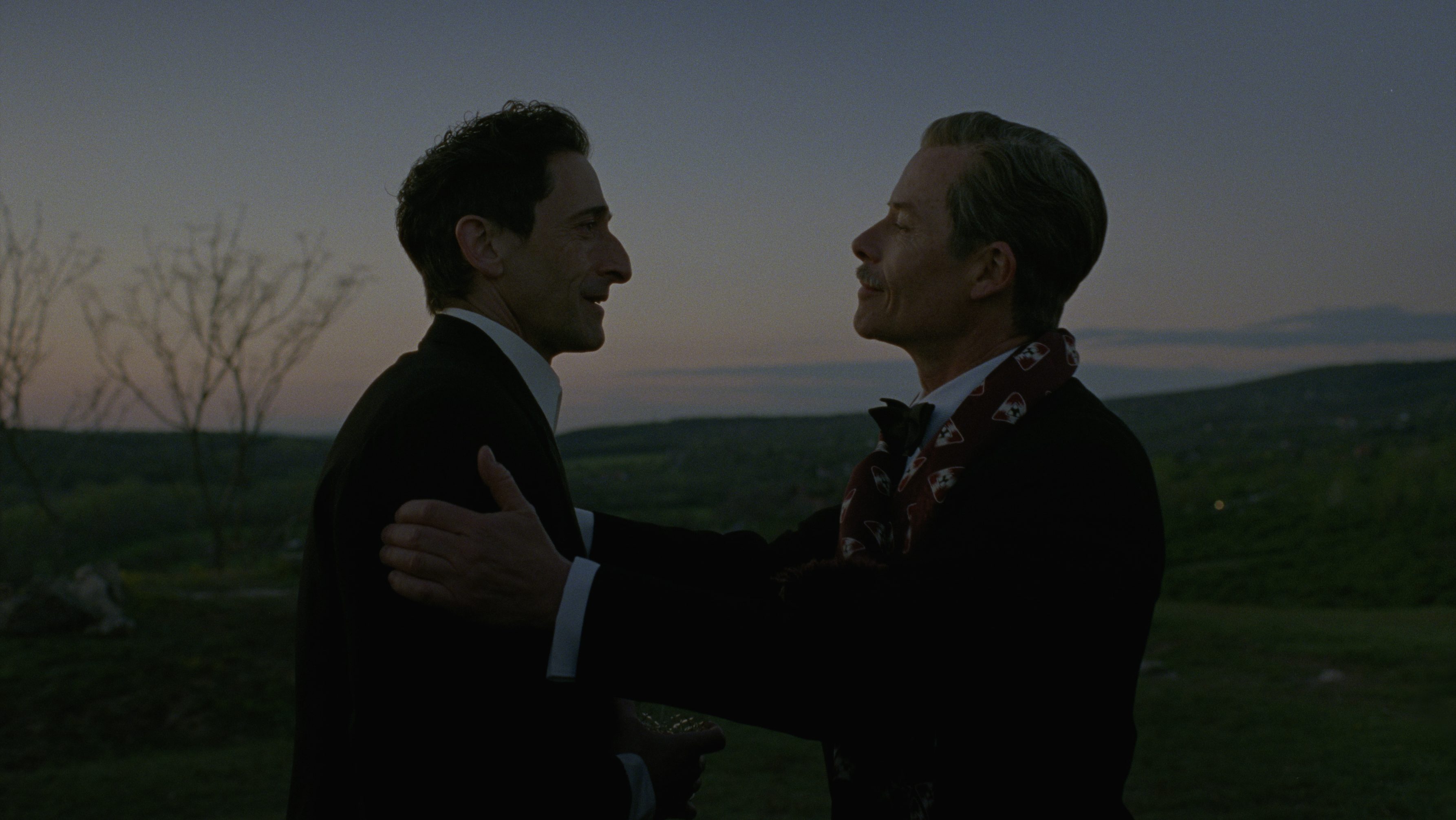
This scene is at a remove from what has gone before, temporally and aesthetically. What it has to tell us—about László, the van Buren project, and the notion of ‘The Hard Core of Beauty’—has the capacity to transform, or at least to put into question, certain assumptions. Fittingly, perhaps, it proposes a new way of understanding the structure—both the film itself and László’s building for van Buren—that we thought we had come to know.
[1] Significantly, there was once an alternative The Brutalist with a very different cast. A Deadline article from September 2020 announced that the film would be shooting in four months time with Joel Edgerton as László, Mark Rylance as van Buren and Marion Cotillard as Erszébet.
[2] As a final note, it is worth acknowledging that the name of László Tóth is associated with a notorious act of destruction. In Rome on 21 May 1972 an Australian-Hungarian geologist of that name attacked Michelangelo’s Pietà with a hammer, breaking off Mary’s arm at the elbow, and damaging her nose and an eyelid.
The Brutalist is in Australian cinemas now.
**********
Philippa Hawker is a film and arts writer. She is working on a book about Jean-Pierre Léaud.
 Rough Cut