


“Dear Dorothy, there’s no place like home!” opens Holly Woodlawn’s biography, A Low Life in High Heels: The Holly Woodlawn Story (1992), a book devoted to her parents and to all “those who have known the struggle of being different, endured the fear of rejection, and mustered the courage to survive.”1 The Puerto Rico-born trans superstar and countercultural icon, known for her scene-stealing performances in Paul Morrissey’s Trash (1970) and Women in Revolt! (1971), shot to prominence in the downtown Warhol Factory scene along with Jackie Curtis and Candy Darling, and has since endured as a captivating mainstay of queer misfit culture of the 1970s New York avant-garde. Known also as Lou Reed’s muse, she features centrally in his 1972 ballad ‘Walk on the Wide Side.’ “Holly came from Miami F-L-A / Hitch-hiked her way across the USA,” he croons, “Plucked her eyebrows on the way / Shaved her legs and then he was a she / She says, ‘Hey babe, take a walk on the wide side…’”

Woodlawn, who adopted her first name from Truman Capote’s novella Breakfast at Tiffany’s (1958) and claimed her last name was taken from the Woodlawn Cemetery in the Bronx (allegedly her inheritance), was well-versed in crafting a mythical persona to match her outré sense of style. With the air of theatrical flapper forebear Tallulah Bankhead, Woodlawn would waft through the Factory with a loud and outrageous campery, marking herself as the psychedelic darling of the underground. An important distinction she always made however, was: “I was not a drag queen. I was an actor.”2 In Robert J. Kaplan’s 1972 camp musical Scarecrow in a Garden of Cucumbers, Woodlawn outshines all in her path as the brightest star this side of Bowery, all sublime comic timing and glamour.
Scarecrow in a Garden of Cucumbers is a film about the trials and tribulations of finding a roommate who actually isn’t insane. Arriving Dorothy-like in the big apple, klutz suburban bumpkin Eve Harrington (Woodlawn) navigates the surreal landscape of 1970s New York City, where foul-mouthed nuns moonlight as taxicab drivers, hotel lobby boys wear gas masks, and movie producers transform into actual werewolves. Yet the police are still pigs who beat up trans people, that much is true in Kaplan’s rendering of a vibrant Manhattan milieu—his send-up of art world intelligentsia and the queer underground in this riotous camp musical once thought lost to history.

Kaplan’s film was only recently found and restored by the Academy Film Archive in 2022. It marked a turning point in trans representation, as it was the first narrative feature to be entirely made around and for a trans actress. Woodlawn reportedly turned down a role in the Merchant Ivory production Savages (1972) to take on this 16mm fever dream for a sizeable payment of $6,500. This sum considerably changed Woodlawn’s life, as despite her fame and acclaim in the Warhol Factory scene, she was rarely paid well. However, due to both a failed distribution campaign and lacklustre advertising, this film quickly faded into obscurity and eventual near-oblivion. The title of Kaplan’s film is taken from the Epistle of Jeremiah: “For as a scarecrow in a garden of cucumbers keeps nothing, so are their gods of wood, overlain with silver and gold.” False idols abound in this hashish-riddled tale of economic precarity.
This film is both a love letter to cinema and a commitment to a bit a minute. Scarecrow in a Garden of Cucumbers chews through all genres—screwball comedy, musical, drama, you name it. Manoeuvred by Woodlawn’s extremely physical performance, it becomes an admixture of a sincere type of vaudeville. It’s both subversive and light; countercultural but unafraid to reference. For instance, all of the characters’ names are taken from popular films and literature, including Robert Stevenson’s Mary Poppins (1964), Ernst Lubitsch’s Ninotchka (1939), James Thurber’s The Secret Life of Walter Mitty (1947), Tennessee Williams’ own Blanche DuBois and Stanley Kowalski, Irving Rapper’s Marjorie Morningstar and Noel Airman, Midnight Cowboy’s (1969) Joe Buck and Ratso Rizzo, and of course All About Eve’s (1950) Margo Channing and Eve Harrington, to name a few. In this oddball cycling of prospective roommates, Warhol regulars Tally Brown and Michael Sklar make an appearance, with the former belting out a blues cabaret number about being a teenage hooker in the vein of Judy Garland’s performance in A Star is Born (1954). Scarecrow in a Garden of Cucumbers is also notable as the cinematic debut of both Lily Tomlin and Bette Midler, albeit as voice actors, with Tomlin as a horny phone operator who gets off on hearing coins dropped into the other end of the line, and Midler providing the musical interludes and voiced cameos.
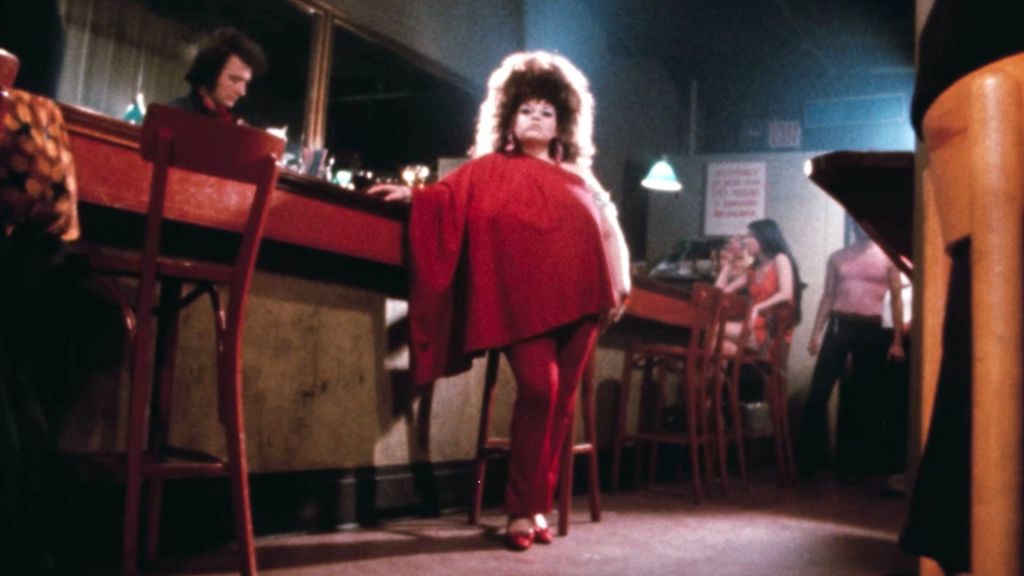
Woodlawn’s Eve bounces across the screen, pure physical comedy and charisma. Her arched, elegant eyebrows are full of neurosis and surprise at the queer characters she meets in her own personal Oz. Woodlawn stumbles about, moving in and out of scenes at wanton abandon, always with a new outrageous costume. Sausages galore, Eve sits in her room, nestled amongst her salami. Eve, like her namesake, is rejected from the garden of Eden—a Sirkian, heterosexual suburbia that is revealed to be a bare-cheeked perversity in and of itself in the naughty opening scene—and into a zany, grimy New York where everyone has a story.
Before we even see Eve, she tumbles out of a bus, bags first. “So, THIS is New York?!” she exclaims. Formally, this fantastic reverie of a film is a series of indica-induced vignettes. There is no plot, really. “RICHARD NIXON IS A LESBIAN” is scrawled across the wall opposite her apartment. “Well, I didn’t know that,” exclaims Eve, innocently taking tongue-in-cheek graffiti at face value. Her naïveté is one of her most endearing qualities; when offered a spliff at some party, Eve replies that, well, she doesn’t eat grass. In one scene, after walking into an experimental theatre group and being forced to inhabit the persona of a vanilla ice-cream, ingénue Eve is heralded as the next Mrs. Fiske, Sarah Bernhardt, Anne Bancroft, or Ann-Margret. Woodlawn—a Dada doll with a Christmas tree ornament adorning her head—wades through a drugged-up dreamland. A blowjob for only $5.95, what a bargain! A contemporary film that resonates with Kaplan’s could be Theda Hammel’s 2024 debut Stress Positions: a comedy marked by a palpable trans sensibility and indebted to the same, distinctive strand of queer chaos.
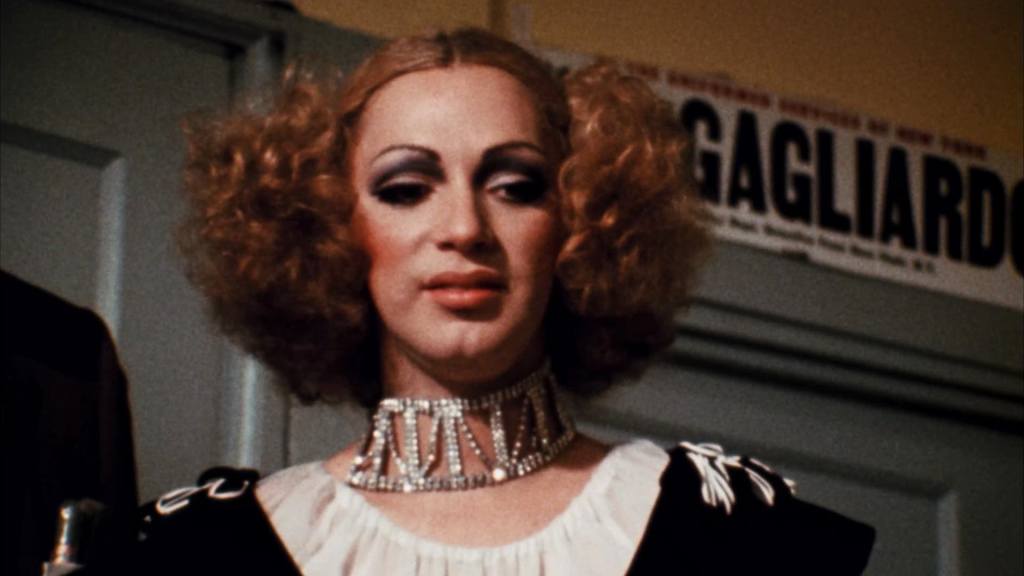
Most succinctly, Scarecrow in a Garden of Cucumbers distils the experience of New York City—what it must have felt like walking through the hoi polloi of Washington Square Park before flâneuring up to Chelsea hotel for a soirée, brushing elbows with high society. In Kaplan’s film, a dirty and down-low aesthetic fertilises those underground boho shenanigans, where bisexual, naked cowboys swathed in American flags flaunt their thighs down Christopher Street pier and free-spirited revolutionaries ki at Bethesda Fountain in Central Park. At the heart of it all is Woodlawn, forever immortalised on the silver screen, now saved from obscurity. “Believe in your dreams,” Woodlawn writes in the epilogue to her bawdy and extravagant memoir, “the dreams of today are the realities of tomorrow. And of course, I always dream in Technicolor!”3
Melbourne Queer Film Festival screened Scarecrow in a Garden of Cucumbers last November. The film will screen again at Cinema Nova on February 1st, 2025.
Find event details here.
**********
Dylan Rowen is a writer and researcher based in Naarm. They are a PhD candidate in Screen and Cultural Studies at the University of Melbourne, where their research focuses on the representation of queens, fairies, and pansies in modernist literature and film.
- Holly Woodlawn and Jeff Copeland, A Low Life in Heels: The Holly Woodlawn Story. New York: Harper Perennial, 1992. ↩︎
- Woodlawn, quoted in Frances Negrón-Muntaner, Boricua Pop: Puerto Ricans and the Latinization of American Culture. New York: NYU Press, 2004, p. 92. ↩︎
- A Low Life in Heels: The Holly Woodlawn Story. New York: Harper Perennial, 1992, p. 305. ↩︎
 Rough Cut