


Barren, windy, and freckled with dry shrubbery across its sweeping sands, on the border of north-eastern China and southern Mongolia lies the Gobi Desert. We comb through the dark dunes and mountains as an oncoming bus arrives from the horizon. It drives comfortably until, suddenly, there is a rupture to the scenic. A herd of animals—scabby dogs of mixed breeds—rush through the rocky terrain, galloping like wild horses through the desert. Within seconds, the vehicle crashes. Confused, passengers emerge and assess the damage in the wilderness. One of them tries to make sense of the mystery: “Where did all the dogs come from?”
The opening to last year’s Un Certain Regard winner, Black Dog (directed by Guan Hu) introduces us to a ghost town overpopulated by stray dogs. Set in the lead-up to the 2008 Beijing Olympics, the locals who live next door to the Gobi Desert barely have time to enthuse about the athletic ceremonies. Rather, their minds are occupied by the swarm of canines that outnumber their human population—roaming creatures treated as pests rather than companions.
This nameless town is home to Lang (Eddie Peng), a mostly mute stunt motorcyclist who returns after his decade-long conviction for manslaughter—the victim being the son of a gang member, ‘Butcher’ Hu (Hu Xiaoguang). The ex-prisoner finds rehabilitation through his new gig as a dog patroller. As part of this operation, led by Uncle Yao (played by the reputable Chinese filmmaker Jia Zhangke), Lang is tasked with seizing stray dogs with his comically oversized net.

Home invasions and wild chases ensue as patrollers of similar criminal histories join in. Amid these desperate pursuits, Lang and his dog patrol colleagues are assigned to capture a whippet with an alleged rabies infection—the titular Black Dog (Xin). A rarely sighted beast, he is near-invisible, endangering the public like a haunted silhouette and mystical legend.
These candid scenes of wandering, seemingly pondering dogs are reminiscent of vignettes gleaned from Tsai Ming-liang’s Stray Dogs (2013), where the stray finds solace in dilapidated habitats within Taiwan’s urban sprawl. Meanwhile, in Black Dog, the strays are hardly tethered to humans. Glimpses of tenderness stand out in the first act, however, such as an elderly resident who speaks through a voice amplifier and depends on his Pomeranian companions for quaint company.
Like Tsai himself, Eddie Peng is also Taiwanese—and like Tsai’s acting muse, Lee Kang-sheng, Peng carries himself with a quiet, deadpan exterior and sparse movements. His loose and lanky manoeuvres across the arid landscapes are more energetic at times, recalling the movements of silent physical comedians à la Charlie Chaplin and Buster Keaton. One moment, he wrangles his net in a chase across crumbling apartment blocks, as both man and dog follow each other’s tails. The next, he flashes his buttocks against the window of a moving car, checking himself for rabies.
This dramaturgy elevates moments of compassion and companionship that emerge to placate the interspecies war between man and dog. And it’s here that Lang redirects his vigilantism to service the unregistered dogs and work against his peers seeking to eradicate them—whether in his lazy attempts at trapping one escape dog or when rescuing a caged puppy for a crying girl.
These gestures further imbue the film with an ethical message that is neither preachy nor didactic. Of course, Lang’s rebellion against the war between man and dog hardly makes him an activist (let alone a peaceful one). Instead, the ex-convict’s tenderness for animals manifests through the quiet love language of care that lends itself to other lost canines, even if it means risking his own life.
Both Lang and his newly appointed companion share a history as societal outcasts: they loom through the halfway plains, in hopes that the public will absolve them of their pasts. Part of this journey towards atonement includes Lang’s passing connections (with both human and non-humankind) in vague spaces, including a travelling circus where he befriends one of the performers, Grape (Tong Liya), and a zoo that cages a tiger passed on from his sick, hospital-ridden father.
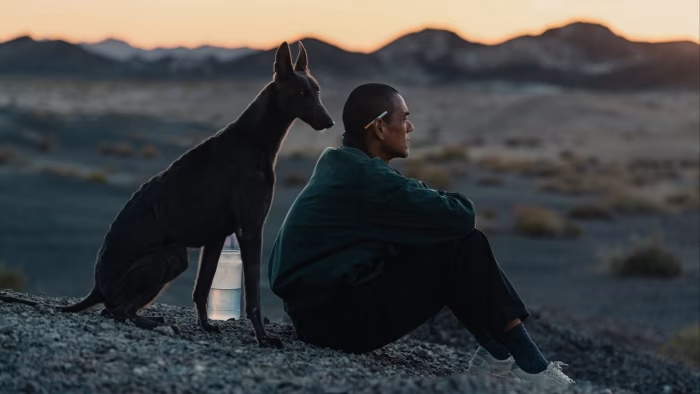
Even for a so-called ‘dog movie,’ any semblance of schmaltz to be found in Black Dog is hardly sugary. Hu manages to offset any traces of Lassie-type sweetness with sun-dried flavours of wild Western grit. Instead of painting the heat-stroked town with scorched palettes, the landscape is caressed by blankets of cooling, cloudy shades of blue. The film’s anamorphic widescreen ratio and slow-moving images—reminiscent of the ambitious New Hollywood era—also add complexity to the man’s-best-friend genre, while providing a window of observation into characters’ animated gestures.
Such observations prompt a further departure from sentimentality, with the language of stillness capturing every punch, whimper, and bark—precisely what makes Black Dog’s glimmers of wholesome camaraderie shine amid its dark and offbeat misadventures. Its final act straps us into the homestretch without bloating us with emotion. We connect to Lang’s desire to resolve the frictions in his life. Beneath his mute façade, we find compassion towards not only the wandering plague of dogs, but also to Butcher Hu, whose own resentment towards Lang eventually dissipates. One wonders if Lang owes this all to his dog sidekick himself, as a bond beyond words thrives in the comfort of motorcycle rides and lulling guitar riffs.
Black Dog is now showing in select Australian cinemas.
**********
Nicole Cadelina is a writer, critic, and text-based artist in Sydney (Darug). With works appearing in The Western, Tharunka, and Kill Your Darlings, Nicole’s writing reflects her diverse interests in diaspora stories and digital media. She was a recipient of MIFF Critics Campus and Varuna WestWords Fellowship. Outside her freelance ventures, Nicole interned and later worked at Sydney Film Festival for their 70th and 71st editions. Her favourite genre of film is SBS World Movies after 9pm.
 Rough Cut