

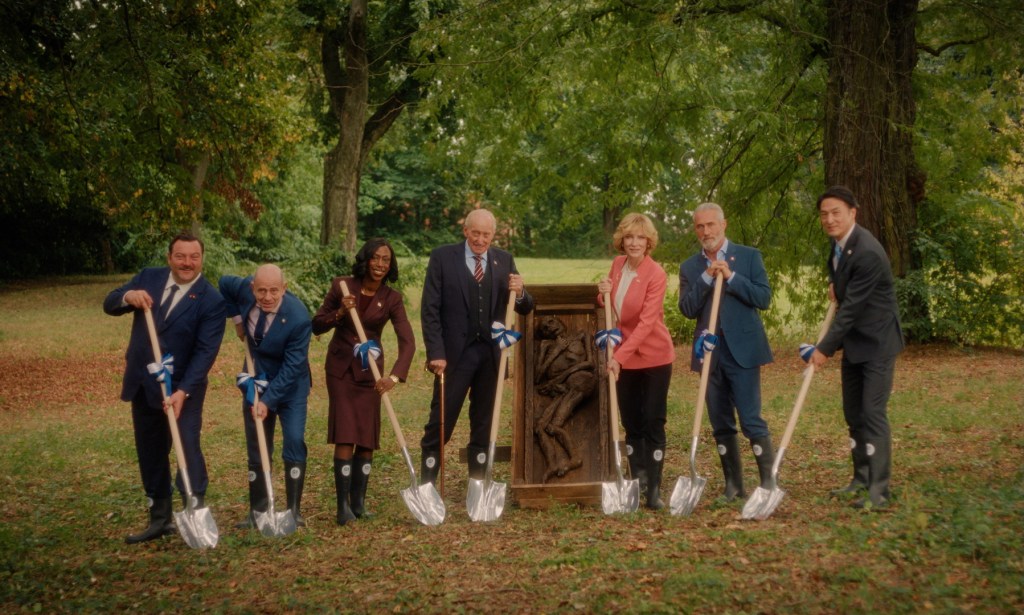
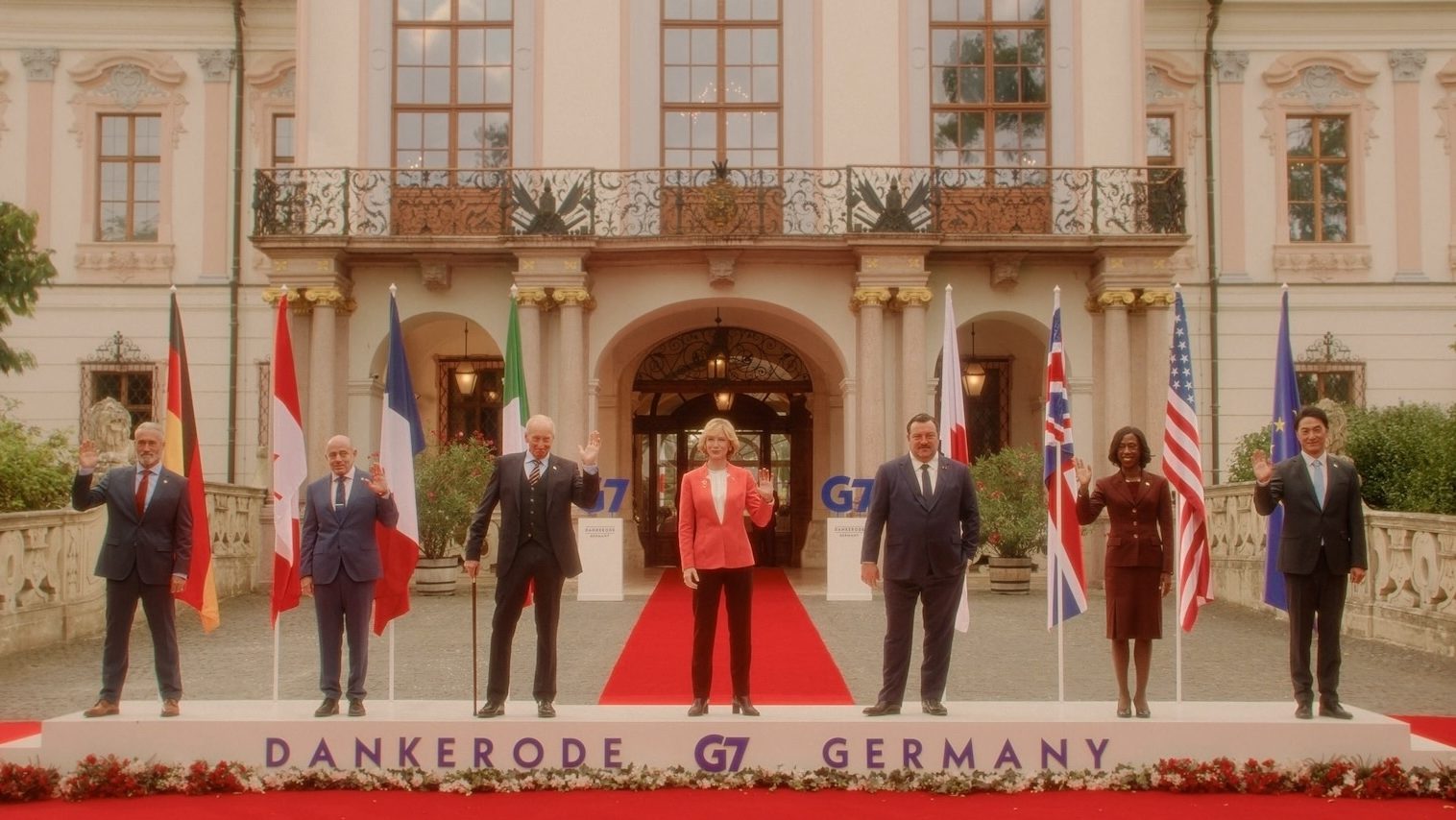
In their latest cinematic brains trust, Rumours, longtime collaborators Guy Maddin, Evan Johnson, and Galen Johnson assemble a team of fictional world leaders to solve an important, albeit unexplained, international crisis. When the world needs them most, the leaders of the free world—including a German Chancellor played by Cate Blanchett—find themselves totally abandoned at a G7 summit in Dankerode, Saxony.
Why is the American President (Charles Dance) British? What is an enormous brain the size of a sedan doing in the forest? Did the Canadian people really vote in a Prime Minister with a man bun? It’s fitting that, in a film about the lives of politicians, such questions are sometimes skilfully deflected, and other times simply ignored. Thankfully, in this interview, the directors tackle many other stimulating topics, such as the emasculating realities of the filmmaking process, the erotic underbelly of politics, and their deepest regrets from the making of Rumours.
Note: the following interview has been edited for length and clarity.
Charles Carrall: Rumours is made up of a cast of seven very powerful people, maybe the most powerful in the world. As directors, do you feel a ‘burden of leadership’ when making a film?
Evan Johnson: That’s a good question. I maybe should, but I haven’t felt the burden of leadership. I don’t feel like a leader on set.
Galen Johnson: Although we do identify with [these characters] in some ways, I don’t think leadership is one of them.
EJ: Yeah, it’s incompetence and failure in the wake of trying to do something really complicated and difficult. That is the way I identify with these leaders. I’m always scrambling against disappointing myself on set. Sometimes there’ll be a day, or an hour, or a scene where you have a really strong vision, and things click into place, and you’re marshalling your troops, or something like that. But I’m sure you’ve had that feeling, Guy.
Guy Maddin: I’m sure Martin Scorsese has it all the time, but at this level, of this budget, I don’t. Back in my microbudget days I was the only person, I had the picture in my head, so I felt like I was actually leading, often running with my camera to a new part of the set, and all the actors would have to follow me and await my instructions. But it’s been a while, and at this level the 1st AD is the boss. And then there’s other people. So it’s more like a parliamentary democracy.
GJ: On a film of this size, most of your decisions get made like 30 to 60 days before you shoot. It’s not like you can just have an idea and decide, “Oh, we’re gonna shoot in that direction. I’m gonna do it this way.” That type of improvisation that happens on a smaller film is a lot harder to do in this context.
GM: It’s extremely frowned upon, as a matter of fact. It’s called ‘audibles,’ which is a reference to American football where a quarterback decides at the last second to change the play and calls out some code. And everything goes into chaos. And so, yeah, we don’t feel like leaders, we feel emasculated.
CC: Emasculated quarterbacks.
GM: That’s right.
CC: Typically we think of directors, or auteurs, as having a singular genius. Your film is about the meeting of minds, genius to genius collaboration. And at the same time, it’s a film where three directors have collaborated as a throuple. What does that process look like for you guys?
EJ: I guess it’s different for every movie. I don’t think there’s been any one movie where the exact breakdown of work and working relationship has been the same as the previous movie. It depends on what we’re doing. Certainly our collaboration looks like the collaboration that you see on screen in Rumours. A group of people sitting there being like, “Is this a good idea?” A lot of that. But I don’t know. We spend all our time together, or a lot of our time, and have watched so many movies together over the years. We write together and take meetings together, so by the time we’re on set I think we’re all pointed in the exact same direction.
GM: We have shorthand, verbal shorthand amongst ourselves, and we can settle things pretty quickly while the shots are going on. We’re basically sitting alone in a tent in front of a monitor watching how it’s going. We get a chance to discuss how it looked and felt then, so that we have a unified front.

CC: Like a control room.
GM: I have always wondered how, say, the Coen Brothers worked because there were two of them, and I was wondering if one did all the directing, or they were just in sync. But with the three of us it’s nothing odd, I think the actors got pretty comfortable with it. And it just works. Somehow, I think it works. You know, I guess it depends on whether the movie is any good or not. But we’re happy enough with our direction.
CC: It’s interesting you mention the Coen brothers, because there are so many siblings working together, [for instance] the Wachowski sisters. I wonder what that phenomenon is.
GJ: Well, I think it’s probably because you grow up together. So you have your own little language, a very specific shorthand that you can speak in to each other.
GM: And I’ve been doing a lot of growing up, too. Yeah. I’ve been very immature most of my life, and I’ve been growing up right along with these guys. Growing up because of these guys.
EJ: You’re 41 or 43 emotionally now.
GM: I think you’re flattering me in front of Charles. But thank you.
CC: I would love to talk about masturbation and the undead bog bodies jerking off. I thought it was so great because it’s kind of a mystery that they can get it up, considering their bones have gone soft after being mummified…What were you guys thinking about when writing that into the text, the circle jerk?
GM: It’s just some sort of iron age parliament. You think of witches’ covens, or warlock covens as midnight parliaments among spirits and things. I’m just riffing now. I don’t know. I think I’m retroactively bullshitting, frankly.
EJ: There was a point when we were writing in the script where it was quite ambiguous whether what we were seeing was a circle jerk or not. We referred to things like onanistic jiggling and maybe we used the word ‘erotic’ or something. But it was more ambiguous. And I’m trying to remember why we felt that. It was a feeling early on that there should be some erotic energy in the air between the leaders, and therefore it made sense to us that this would be mirrored in these menacing figures who are sort of funhouse mirror versions of the leaders. They stand in for voters, terrorists, protesters, anything, and in any of these interpretations I think it felt to us like there should be an erotic dimension. It was a very vague feeling that there’s an erotic dimension to politics, not just because some leaders are sexy.
CC: As Canadians, you guys are one of the last countries to have a really good looking leader.
GM: They’re dropping like flies.
EJ: Sanna Marin from Finland is not there anymore.
GJ: She’s just a think-tanker now.
GM: Well, this isn’t a locker room, boys. This is going to reach the public.

CC: Speaking of, I think I almost expected the protesters in Rumours, the public, to be more of a threat and for them to come closer. Why the distance?
EJ: There were a number of reasons, some practical. We kept them at a distance because we didn’t have a ton of faith in how good they would look up close. Metaphorically, it just seems to make sense also. People are kept at a remove from leaders, and leaders are kept at a remove from their voters. They’re just on TV, there’s a big TV screen between them. So I think it always made sense that they were more an image in the distance than a threat that could actually get physically close.
GM: And there are practical concerns, too. If you get up too close, then it looks too fakey in the wrong way. Same with the leaders. You were starting to say that we had described things more ambiguously when things were getting sexual, this onanistic jiggling. But when it came down to it, it needed to be more explicit what we were actually shooting so that viewers would understand. That’s directing. I guess, you have to decide how clear you want something to be. I know, on the page it was kind of exciting. We even had originally the actual living leaders from the 21st century getting more aroused while watching the circle jerk. They would even be kind of rubbing up against each other. But then, at this point in the script, it felt to us that it wasn’t worth pushing that, and that it would somehow seem to come out of the blue, that we hadn’t earned it somehow.
CC: And neither had they.
GM: Exactly. They hadn’t earned the pleasure.
CC: The theme of the G7 summit in the film was ‘Regret,’ and I wanted to ask if you guys ever have any regrets as filmmakers, after making this movie.
GJ: Absolutely!
EJ: Regret is the main feeling after making a film usually. You spend so long preparing, and then you spend so little time shooting, and then you have an aftermath, and it’s all over so quickly. You just feel like, I should have done more. I could have. We could have done more. We could have done everything better. We could have prepared more. But you can’t live in that kind of regret.
GM: Yeah, you have to have a brief informative autopsy.
GJ: When you’re directing you make probably a billion decisions. And so even if your batting average is like 99, then you’re still gonna have millions of decisions to run.
CC: Emasculated quarterbacks playing baseball.

GM: Sometimes they’re big ones. So yes, of course, there’s regrets. That’s what gets me out of bed in the morning, regrets. What can I regret today? Out of bed I have so many things to regret, and I fall asleep at night with regret warming my burnt out heart. I’m a regretful person. As a matter of fact, when I start thinking of what kind of projects I’d like to do next before I start talking to these guys about it, I just go to what I have regretted most in my life so far. There’s probably serious melodrama there, a mother lode of story ideas. So I just sniff out the most regret-fleece-smelling crack in my personal history.
CC: Pry it open.
GM: I pry it open and see if there’s enough in there for a story.
Rumours is now showing in Australian cinemas.
**********
Charles Carrall is a writer and critic from Sydney, Australia. He makes up one half of the podcast Vanity Project.
 Rough Cut