


With an eclectic oeuvre of hypnotic, heartily whimsical features, shorts, documentaries, and music videos, the one-of-a-kind French director Michel Gondry has contributed countless unforgettable images to pop culture. There’s Björk in a massive dollhouse, or operating a tank, or scaling a mountain. There are the White Stripes pixellated in flashing LEGO squares, or sidestepping along a subway platform, with harsh cuts accompanying every percussive tremor. There are, in the iconic clip for Daft Punk’s ‘Around the World,’ robotic astronauts circling synchronised swimmers circling skeletons circling mummies, all awash in flashes of candy-coloured light.
An animator and drummer whose first love was drawing, Gondry’s visions are transportive in their childish sincerity, as he habitually combines simple concepts with an experimental fervour. Even beyond his innovative mixed-media approaches (cardboard cityscapes, quadruple exposures, perversions of scale), Gondry has long poked at the boundaries imposed on cinema by industry norms and audience expectations, exploding distinctions between the commercial and avant-garde, between classical beauty (see 2013’s Mood Indigo) and total kitsch (also see 2013’s Mood Indigo). This is a sensibility that would endure from his first animated videos (for Gondry’s own band, peppy pop outfit Oui Oui) to his hard-won foray into Hollywood, as he meshed naive, surrealist reverie with an all-too-adult, world-atrophying loneliness in Human Nature (2001) and Eternal Sunshine of the Spotless Mind (2004).
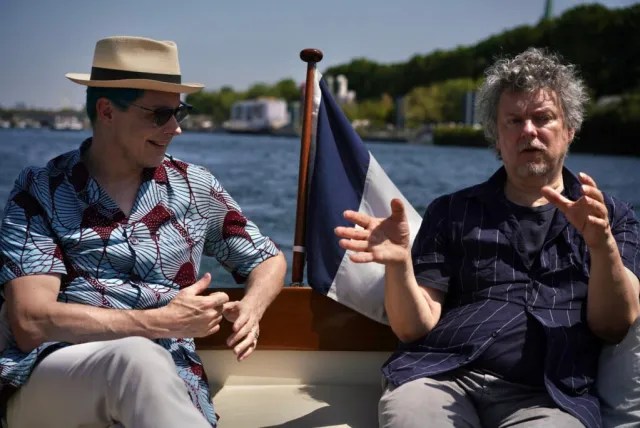
Featuring interviews with Gondry and a number of his collaborators (such as Kylie Minogue, Beck, Jack White, and Charlotte Gainsbourg), François Nemeta’s new documentary Michel Gondry, Do it Yourself is a comprehensive and gently rendered portrait of an unplaceable artist. Framed by Nemeta’s memories as Gondry’s longtime assistant and peer, from his days of recording Oui Oui’s shows (and founding the brilliantly named fanzine Oui Oui Are the World) to helping Gondry sift through scripts with a handheld translator in Los Angeles, it is also a charming document of friendship and admiration. It was fitting that Nemeta appeared over Zoom with house paint streaking his hands to talk about the craftsman-director’s lifelong commitment to DIY magic.

Note: the following interview has been edited for length and clarity.
Indigo Bailey: Your film starts with the beginning of your fascination with Michel’s work, with the animated videos he created for his band Oui Oui, and since then you’ve had a long working relationship with him. At what point did you know you wanted to make this documentary and how did the process start?
François Nemeta: Actually, I worked with one of the producers, who also worked with Michel quite closely at the same time. We spoke about doing a film about Michel quite a long time ago, because we thought that when he was interviewed by journalists, by the press or on TV, he was not the real Michel that we knew. We wanted to do more of an honest portrait—the closest we could do. He talks about many things, many theories about the meaning of life—about everything—and we wanted to catch a little bit of that and put this into a film, because he never says that usually [in press]. We thought that, because of our close relationship, we could aim in this direction. So, we spoke about that—let’s say five years ago—and started the process.

IB: Was it a challenge at first, the idea of making a film about someone who makes films? How do you approach filming a filmmaker?
FN: That was difficult, because of course I have a close relationship with Michel, but at the same time it’s a little bit heavy. It’s like, he’s a mentor, he is a big personality, and when you are close to a big personality like this you are a bit nervous. Like: “Okay, how am I going to film him, is he going to try to interfere in my decisions as a filmmaker?” It’s really difficult because he has an eye, yes, a certain power, and as I had worked with him, I knew this power, and his filmmaking process. So I was a little bit afraid to reveal myself to him. But he was very: “Okay, you know your work, do it and I won’t interfere too much.”
IB: Something that is very visible both in Michel’s work and in your film is this idea of filmmaking as being like a game or a magic trick. What is the role of play in cinema?
FN: Michel uses his magicians’ tricks to do films. It’s something that he saw in various films and in this tradition of French magicians. He told me that he was looking at this program from when we were kids, where a magician explained a magic trick each week. For example, the Kylie Minogue video [‘Come Into My World’] was really influenced by this magician Gérard Majax—a French magician who was on TV and who I met during the process of preparing this documentary, who is a very old man now. Michel always wanted to, really like a magician, show something to the public but do the magic trick behind their eyes, so they don’t see.
When we spoke with Spike Jonze, it was exactly this kind of discussion—about magic and the power of magic in the cinema. Cinema was invented by guys who wanted to do magic tricks, basically. [Georges] Méliès was obviously the most famous one. Everything comes from this fascination for magic, which is really kids’ play, at the beginning. And it’s because [Michel] was experiencing very simple magic tricks with his brothers, with his cousins who were all the same age as him, that he would try to do bigger and bigger magic tricks with filmmaking.
IB: Speaking of Méliès—you show in the film how Michel’s relationship with French cinema is quite complicated. His very first film [the 1986 video for Oui Oui’s ‘Bolide’] included a tribute to Méliès, yet he also talks about feeling distant from the more recent French ‘auteur’ model of filmmaking. How would you describe Michel’s place in the history of French cinema?

FN: In the French tradition of the auteur, everything comes from literature. Those who were able to write literature wrote scenarios, wrote scripts, and then became filmmakers. Basically, it’s very intellectual. The people who did films were romantics, with a very high point of view—for example, guys like Godard or Truffaut, with backgrounds as film critics who went to the Faculté [des Lettres], at the Sorbonne. It’s a very small circle of people who did intellectual filmmaking in a very Parisian style. Michel didn’t recognise—and doesn’t recognise—himself in this category.
Michel was more like the English punks in London, who were coming from art schools. It was exactly the same in Paris when he started. It was musicians, people doing their own stuff—trying to do the opposite, basically, of the previous generation. When he started filmmaking, he was in art school, and was much more into physics and mathematics [than literature]. That’s the big difference between the French auteur and Michel. You cannot categorise him. Actually, I told him, “Yeah, but you are French, or you are American now,” and he said, “I don’t care about that, it’s just frontiers, political frontiers […] it’s just that I feel closer to a guy like Spike Jonze, who does his visual tricks, than to French auteurs.”
IB: That brings us to the period when you were Michel’s assistant as he was seeking his first film project in France after making a name for himself with his music videos. As you say in the film, during this time these doors were very much closed to him. Why do you think the French industry was so reluctant to let him make a movie?
FN: That’s very simple. Michel told me, “I want to do a feature film, so try to find me an agent.” I called a lot trying to get an agent for Michel, but they didn’t know him because he didn’t do the usual film school, short film, then longer film [pathway]; he didn’t have this background at all. Music videos were considered commercials, basically, so film agents didn’t care at all about them. In the U.S., the music video market was so much bigger; the agents were much more aware that artists—directors—were behind those music videos, but this was not the case in France at that time.
The U.S. was much more used to music videos. I remember the music videos of the eighties and nineties, like all those Michael Jackson videos, which were already films, like ‘Thriller,’ for example, by John Landis—or those Madonna videos. They were done by young filmmakers who were growing up and making films. Of course, the productions Michel was working on were music video productions, which only did music videos and commercials; they were not able to finance Michel’s first film, because they were not taken seriously by the banks and the big networks in France. That’s why he went to the U.S., because in the U.S. the cinema industry was already hiring some music video directors who did very cinematographic music videos.
IB: Was there a time when Michel described an idea to you—for a music video, for example—and you didn’t think it would work out, or you were really surprised by the outcome?
FN: With many of his videos, I was trying [hard] to understand, because he was drawing. Basically, he draws his ideas, and that’s not a script, that’s not a usual filmmaker habit. That’s not [even] a piece of art; it really looks like your seven-year-old nephew did a drawing! But the idea is there. Still, sometimes I had difficulties understanding what he wanted to do. He was explaining and explaining, and after that I had to make those ideas understandable to everyone.
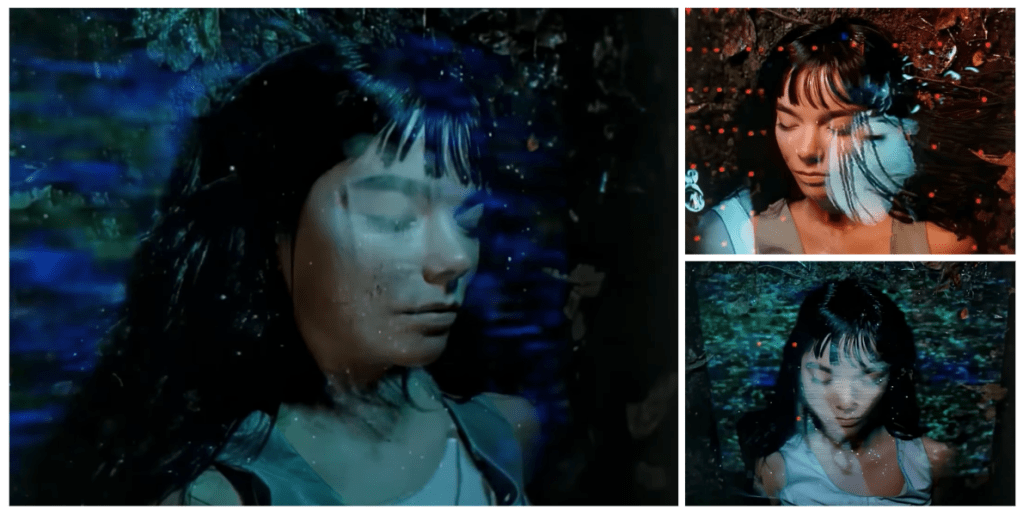
I remember a video which was very complicated technically—well, the most difficult—which was the video for Björk’s song ‘Hyperballad.’ It’s seven long shots printed on the same film. We were rewinding the film in the camera and reshooting on the same piece of film. We did that seven times. We were closing the lens and opening the lens, and we had no idea what it was going to look like. Michel had everything in his mind. He was pushing the machine—this big, computer-controlled crane which was moving very slowly above Björk—and we were looking at it; Michel had programmed everything, and even the guy who was behind the computer couldn’t understand what Michel wanted.
But, when Michel knows something, at some point it’s less efficient for him to try to make himself understandable, so he says “Don’t listen to me, don’t try to understand; I know what I know, I know that it’s going to work, follow me and don’t ask questions because it’s going to slow the whole process. So, just do as I tell you, and you will see, it will work.”
Sometimes the technical [element] is so complicated that you can’t really have the idea, because even if you look in the camera, you don’t see the whole image. But Michel has the final image in his head. If you look in the camera or the monitor while you are filming, you are still missing some little part that’s going to be added next. The Rolling Stones’ video [‘Like a Rolling Stone’] was really like this because we were only taking photos from the left and from the right, and there were these two cameras linked by this process that no one knew at the time: morphing. Michel was using it in a very particular way that nobody had really tried before, so we couldn’t expect what it would be like.

IB: Of all of Michel’s work, do you have a favourite video or film—whether because it connects with you as a viewer or because of your memories behind-the-scenes?
FN: Actually, I would go to the same Björk video, ‘Hyperballad.’ We filmed it in London, on a night of December 1995 or 1996, and we were in this small studio with Björk, with this giant crane above her, filming all day long, in very slow-motion. It was taking so, so much time that at some point the Director of Photography was sleeping; we spent 25 or 26 hours shooting in the studio, so at some point everybody was falling asleep. That was quite magical, because we were inside doing this giant magic trick, and when we finished, we went out and it had snowed. London was covered all in white, and it was five days before Christmas, and we were like: “The magic trick was outside, as well!” I have to say that I have had many good moments on Michel’s films—some nightmares, as well, some bad moments—but this video was quite crazy to do, with the magic trick of the snow which had fallen onto London while we were shooting…
Michel Gondry, Do it Yourself releases on DocPlay in Australia on November 25.
**********
Indigo Bailey is a Tasmanian writer and editor living in Naarm/Melbourne. In 2023, she received the Island Nonfiction Prize for an essay about rain sound. She has written for Island Magazine, The Guardian, Voiceworks, and Kill Your Darlings, among other publications.
 Rough Cut