


Oh—Monica, Monica Vitti! She possessed the “visage of collapse and the visage of triumph,” wrote Gary Indiana.1 The sharp profile, the tousled hair—blonde, red, black—and eyes like the headlights of a beautiful car. That face, like some lovely marble head found in the halls of the Uffizi.
In Rome, she was born Maria Luisa Ceciarelli, and died there at 90. She made her name starring in the films of Michelangelo Antonioni christened the “tetralogy of incommunicability”: as the windswept Claudia in L’avventura (1960), the little flirt in a cocktail dress in La Notte (1961), the mercurial mistress of Alain Delon in L’eclisse (1962). Then Red Desert (1964), Antonioni’s first film in colour, in which Vitti wanders through a sickening fog of industrial development and marital strife. Despondent, aggrieved, put-out, sly, shy, laughing, jaunty—all this, but performed with absolute economy. The twitch of her lips; the way her hand touches her arm, then her cheek, then her throat; a forelock of fringe blinked out of sight. Sucking at a quail egg, consuming a sandwich with terrified, rapid jaws, down to the knuckle. Gestures small as parentheticals seize centre-stage in every scene.
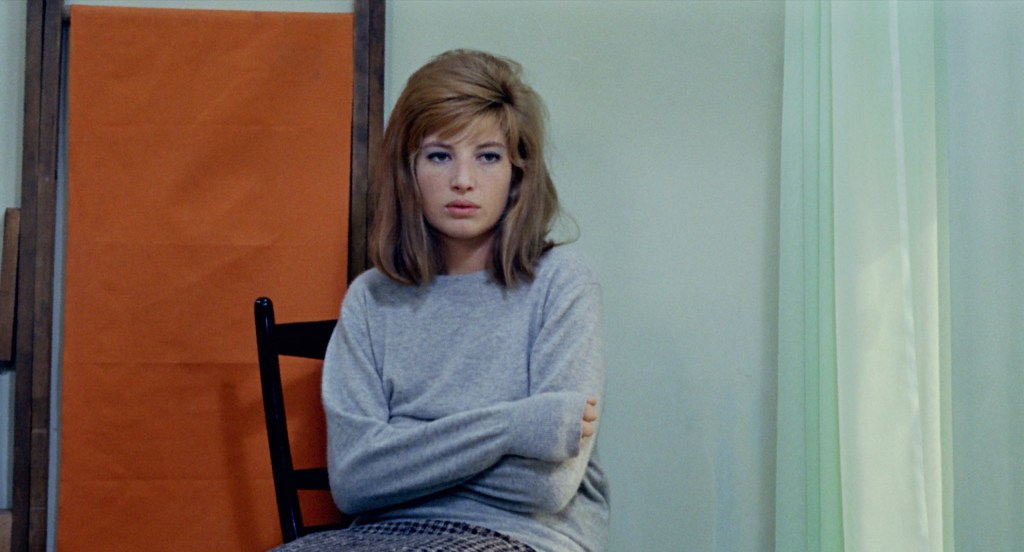
Directed by Roberta Torre, 2023’s In the Mirror (Mi fanno male i capelli) luxuriates in Vitti’s cinematic world. It takes its Italian title from one of her despairing lines in Red Desert: “Mi fanno male i capelli gli occhi, la gola, la bocca”—“My hair hurts, my eyes, my throat, my mouth.” Framed as an incidental homage to the great actress, it is not, in the manner of a biopic, concerned with Vitti’s life off-screen. Rather, Torre’s film is fascinated with the celestial allure of ‘Vitti’ writ large, with her star power and its magnetic draw.
Alba Rohrwacher, another actress with feline eyes, plays a young blonde named Monica. Pale skin dewy under the sun, we first see her sorting grains of sand on the beach, all placid and content in her yellow frock. Suddenly she looks up, stuporous, stumbling around with dirty knees. “Excuse me sir,” Monica says to a man she takes for a stranger, “would you give me a glass of water, I’m lost!” The man leads her into his house and, placing Monica’s hands on his face, asks, “Do you remember it?” It is her husband, and she does not recognise him.
Edoardo, played by a sage Filippo Timi, is Monica’s husband-turned-carer. They live together in a little house by the sea, where they have retreated from Rome. Monica, it becomes clear, is suffering from a profound loss of memory, while Edoardo has some vaguely defined financial troubles. The couple spend their time idly: looking over their garden fence to the ocean, or sitting on their couch. There, they watch old discs loaded with footage: of a holiday in Thailand, of their wedding. “What year is that?” Monica asks. “I don’t know those people,” she says of herself and her groom, pointing. Although there is still tenderness between them, it is clear that those forgotten years were happier. Edoardo organises a dinner party with old friends to celebrate their anniversary. Monica, unzipped and bedraggled, makes her way to the table late in the meal. Shaking hands, she queries her guests—“May I know something about you?”
Monica’s formal diagnosis is Korsakoff syndrome, a neurological disorder that leads with amnesia and confabulation as its primary symptoms. A lack of insight and deficits in memory are compensated with false or imagined memories. This arrangement opens the door for what is the central conceit of In the Mirror. Isolated, adrift (as we are persistently reminded with shots of Monica looking out to sea), she watches more videos to learn about her past with the hope of remembering a future. These move from home tapes to the films of Vitti—first those with Antonioni, then her collaborations with Alberto Sordi and Ettore Scola, when she became the household name of Commedia all’italiana.
Sliding La Notte into the player, Monica exclaims with whispered satisfaction: “It’s one of my movies.” Monica begins to wear a slip dress and black wig, kohl smudged around her eyes. She becomes Vitti’s Valentina, the bored industrialist’s daughter wandering around a party trailed by Marcello Mastroianni. In front of the television, she murmurs the line, “My memory seems to get worse every day.” Rohrwacher, an excellent mimic, perfects Vitti’s wry lip twitch and irreverent head toss. However, these piteous scenes squander some of their potency when followed with more contrived representations. Moving to a sharp black and white, Edoardo and Monica are shown performing as Mastroianni and Vitti. An ascendant score of strings—composed by Wong Kar-Wai collaborator Shigeru Umebayashi—accord these sequences, several in number, with a faint touch of the ridiculous. Like pantomime or terrible foreplay, Monica as Vitti unloads Antonioni’s film of its verve and charm, reducing it to the most meagre of equipment. Once this shift into the world of fantasy has been established, In the Mirror focuses intently on this relationship between Monica and Vitti, the slipperiness between the real and the uncanny. A neurologist insists to Edoardo that “She hasn’t forgotten you, she has involved you in her representation.”
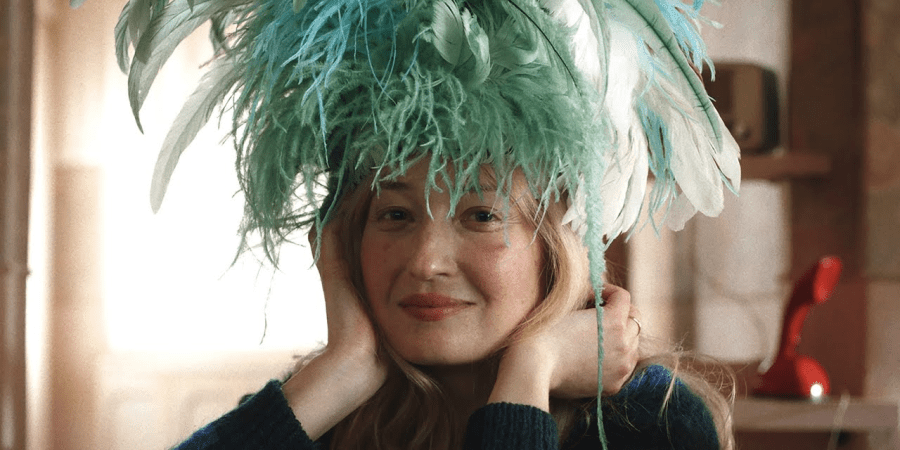
So, in her quest for a character, Rohrwacher’s Monica plays dress-up. In the short black slip she is Valentina in La Notte. In aqua satin with curled blonde tresses, she is Dea Dani in Polvere di stelle (1973). Her clothes are poured out onto the floor; she chooses a green shirt to match the Vitti who appears in her mirror. For indeed, these glimmering images of Vitti are soon transposed to other surfaces: the mirrors in her dressing room. The mirror is both a reflective surface and a portal, an instrument of the desiring, frightened gaze. Efficient edits of existing footage give the impression that Vitti speaks to Monica from the mirror—consoling her, reassuring her; is she a double, or a friend? In one scene, this barrier is punctured as Vitti and Monica appear to try on an array of hats together. A costume screen test of Vitti intersperses with footage of Rohrwacher performing a wry and charming mimicry as feathered headwear is passed back and forth through the front-facing frame. Splicing between these two chatting faces, both are turned into off-duty actresses caught on-screen. Mirrors reflecting into each other, this scenario passes the role of ‘Monica Vitti’ from one actor to the other.
The subject of doppelgängers and doubles has always been fertile ground for cinema—alter egos, body-swapping, projected fantasies both clinical and whimsical, a trigger for alarm and consternation. Think Alfred Hitchcock’s Vertigo (1958), Luis Buñuel’s That Obscure Object of Desire (1977), Krzysztof Kieślowski’s The Double Life of Véronique (1999). Neuroses abound, none more so than those of the actor: think Ingmar Bergman’s Persona (1966). Think dress-ups: Donald Cammell and Nicolas Roeg’s Performance (1970). Think sisters out for blood: Robert Siodmak’s The Dark Mirror (1946), Brian De Palma’s Sisters (1973).
In the Mirror takes up this lineage to a slightly dissatisfying effect. There is the parallel between the character of Monica and Vitti herself: Monica’s condition recalls Vitti’s decades-long struggle with Alzheimer’s disease. Yet a central dimension of Korsakoff syndrome is that it is most frequently associated with severe alcoholism—scarcely explored or touched upon in this depiction, though it can, perhaps, be intuited. Monica’s illness gives the initial push for plot, providing all the shape and scenario for the film. Once she starts to impersonate Vitti, however, this conditional is pushed no further. The tension—along with the sense of possibility for Monica’s character—goes slack. Rohrwacher’s performance of memory loss might hint at someone crushed by life, rather than returned to innocence. Playing Monica with a childlike simplicity, she expresses so much surprise at every turn that it begins to wear. She affects a way of dissolving before our eyes, less Monica, even less Vitti, yet to what end? Half a dozen small plotlines—Edoardo’s money problems, including debts owed to a handful of acquaintances, an old friend who hankers after one of Monica’s expensive necklaces, Edoardo’s flirtation with a woman—seem unfocused, afterthoughts to the central thematic enthusiasms. It is only the Rohrwacher/Vitti fusion which could hope to hold the film together, but even this suffers somewhere between its vision and execution.

Torre’s decision to include scenes from the films of Antonioni, Sordi, and Carlo Di Palma bring some much-needed relief. Vitti’s grit, irony, and complexity offer an irresistible pull towards the great archive of her performances. How great it is to see her be so vibrant, running amok with Sordi. But these clips, so different in pacing and visual manner, sink like stones in the tepid waters of In the Mirror. As a cinematic tribute to Vitti’s performances on-screen, the film collects a number of her most dazzling and enigmatic moments. Yet, In the Mirror does not resist or redefine the great mythification of the star; it takes this for granted. One wonders what the superb Rohrwacher could do with a more innovative template, with a script that did not depend on commonplace tropes to make fantasy more plausible. The spectre of celebrity already invites reverie; Monica responds to Vitti in this mode of imagined intimacy regardless, with an overstated lucidity. “I can’t tell what I dream, and what I experience,” she says. The body of the film star becomes a symbolic instrument. And this is where the true interest of the film lies, in the twofold processes of making the star, of both audience consumption and production, although it neglects to elaborate much further than this.
In the film’s final scene, Monica enters a state of intense confusion. She slinks off from the house and dashes along the beach, under the assumption that she has been asked to open a museum named in honour of Sordi. Instead, she makes her way to the centre of town, and enters an empty cinema where Polvere di stelle is playing. “Are we looking at Monica Vitti?” asks Indiana, in his essay on the actress. “Yes, and no: we’re looking at ‘Monica Vitti.’ Moreover, we’re observing the durée of ‘Monica Vitti,’ the performative enactment of ‘Vitti’ by Vitti.”2 Talking to Vitti, Monica says goodbye to the moving image, immense in proportion, all blue and blonde. A screen goddess with a good hairdresser. A silvery Baci chocolate, ready to be unwrapped and devoured. Here is Monica Vitti, before her audience, frozen into an icon.
In the Mirror screens across Australia as part of this year’s St. Ali Italian Film Festival.
**********
Isabella Gullifer-Laurie is a graduate researcher at the University of Melbourne. Her writing has appeared in The Saturday Paper, Meanjin, Kill Your Darlings, and the Chicago Review.
 Rough Cut