


Close your eyes and you can probably hear a Jiří Menzel movie. It begins with a sweeping full band, evoking the classical scores of an MGM musical, which is cut sharply by a theme with ceremonial pomp, like an RSL performance of a forgotten national anthem or club song. There’s something reminiscent of the live scores traditionally played alongside silent films—or of the synchronised ones of Charlie Chaplin’s resistance to cinema’s international talking revolution. The scores for the majority of Menzel’s films belong to his most frequent collaborator, Jiří Šust. For a director like Menzel who collected an ever-growing coterie of similar-minded artists to populate his films on both sides of the camera, this is a notable distinction. Menzel, who started as part of the Czech New Wave group of filmmakers, directed sixteen features and individual segments in two further features. Of these, six were based on Bohumil Hrabal’s writing; nine featured Rudolf Hrusínský, usually in a starring role; and twelve were scored by Šust.
Nineteen years Menzel’s senior, Šust had been scoring films for 21 years before their first collaboration, on the 1965 anthology film Pearls of the Deep (Perličky na dně), which was based on five short stories by Hrabal and included among its segments one directed by Věra Chytilová. Hrabal and Chytilová would become two of Menzel’s lifelong friends and collaborators. Šust would then score only Menzel’s segment for another anthology film, Crime at the Girls School (Zločin v dívčí škole, 1966), which was released in February, the month production started on their heretofore most significant collaboration, Closely Observed Trains (Ostře sledované vlaky, also 1966).
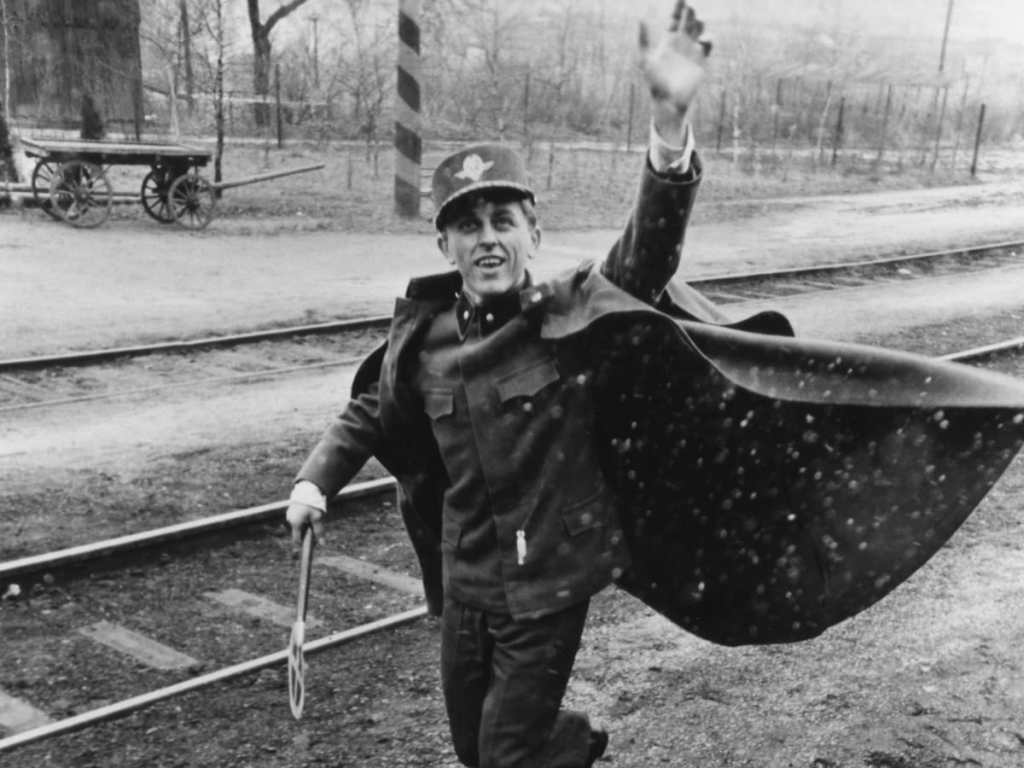
Closely Observed Trains would win the Oscar for Best Foreign Language Picture for the year 1967, when the film had its US release, and propel Menzel’s career. It has been doing laps of honour ever since in cinema programmes the world over, most recently stopping to inaugurate the Melbourne Cinémathèque’s three-week season ‘Jiří Menzel: Making Comedies Is No Fun,’ which was presented in partnership with the Czech and Slovak Film Festival of Australia. The season comprised five films directed by Menzel and a 2016 documentary about him by Swiss director Robert Kolinsky, Jiří Menzel – To Make a Comedy Is No Fun. Of the five features directed by Menzel himself, all but one were scored by Šust, and the single outlier was made long after Šust’s death.
* * * *
With his flat compositions, sight gags, and heightened moments of disorder and anarchy, Menzel draws from the visual tradition of silent comedies, particularly those of Chaplin—though his films do not lack the asperities of post-war commentary. Closely Observed Trains carries both sweetness and futility through a budding love story whose episodes wrestle with tragedy and comedy. The score is mostly made up of a memorable orchestral theme and its variations, which march triumphantly. But the film opens with our dear protagonist, Miloš (Václav Neckár), getting ready for his new job at the railway station while speaking in voiceover about his ancestors’ wartime history—a scene intercut with images depicting such family members and battles. He describes his father’s retirement at 48 thanks to his cushy railway job (though as an engine driver), and his desire since to do nothing but watch time pass as his pension is deposited for years to come; then, he describes his great-grandfather living off his soldier’s pension and taunting workers in his spare time, until they eventually beat him to death; then, at the beginning of the ongoing Second World War, his hypnotist grandfather’s attempt to stop a tank with psychic powers before being quickly dispatched by said tank. Miloš does not want to be like his ancestors—whom he characterises as lazy, mean, or stupid—except to avoid hard work. It is with this declaration that the triumphant score kicks in. Immediately Menzel’s sense of humour is clear, as he and Šust juxtapose descriptions of deep cowardice with a proud and joyful theme.

Šust’s score for Closely Observed Trains is especially reminiscent of that of Chaplin’s pre-talking films, such as 1931’s City Lights, which frequently uses music to set up moments of tonal contrast, with sincerity often transforming into a bumbling naïveté. There is an early physical gag in Closely Observed Trains where Miloš meets Máša (Jitka Bendová), a train conductor, and—as in Chaplin’s Tramp meeting the blind flower girl (Virginia Cherrill) in City Lights—there is an immediate chemistry between the two. In Menzel’s film the two lean in to kiss but, a moment before touching lips, are pulled apart by Máša’s train pulling away. The train’s movement is emphasised by the flat composition, also a hallmark of early cinema; and in Chaplin’s scene, the blind flower girl unknowingly drenches him with a bucket of water. There is an innocence and warmth to each of these thwarted meet cutes, which is a defining characteristic of both directors’ work.
Menzel maintains this warmth despite increasingly dark subject matter, as Czechoslovakia is still occupied by the Nazi Party, and Miloš is drawn into deeper layers of emotional turmoil, including growing political awareness and romantic dilemmas. The score swings mightily throughout the first half of the film but becomes gentler as Miloš grows in maturity. In the final sequence, where Miloš is drawn into a plan to plant a bomb on a Nazi supply train, there is almost no score. During this tense sequence, the soundtrack is sparse, occasionally filled out by phone operator dings, brisk dialogue, and the building whistles of the approaching steam train. Some orchestral twinkling shines hope on Miloš’s role in the plot, but the film closes out to the ringing bells of a clock—a sober trade-in for the jovial title music.

This was followed that same evening at the Cinémathèque by Capricious Summer (Rozmarné léto), which in 1968 was due for its premiere at Cannes Film Festival before the infamous mid-festival cancellation after mounting pressure from filmmakers and citizens in solidarity with the May ‘68 student protests across France. It made its debut shortly after at the Karlovy Vary International Film Festival, where it won the top award, the Crystal Globe. Where the main theme for Closely Observed Trains marches proudly and is rendered oblivious to its narrative pairing, Capricious Summer opens with bright strings in a leisurely, peaceful theme, with shots of a church nestled between verdant hills.
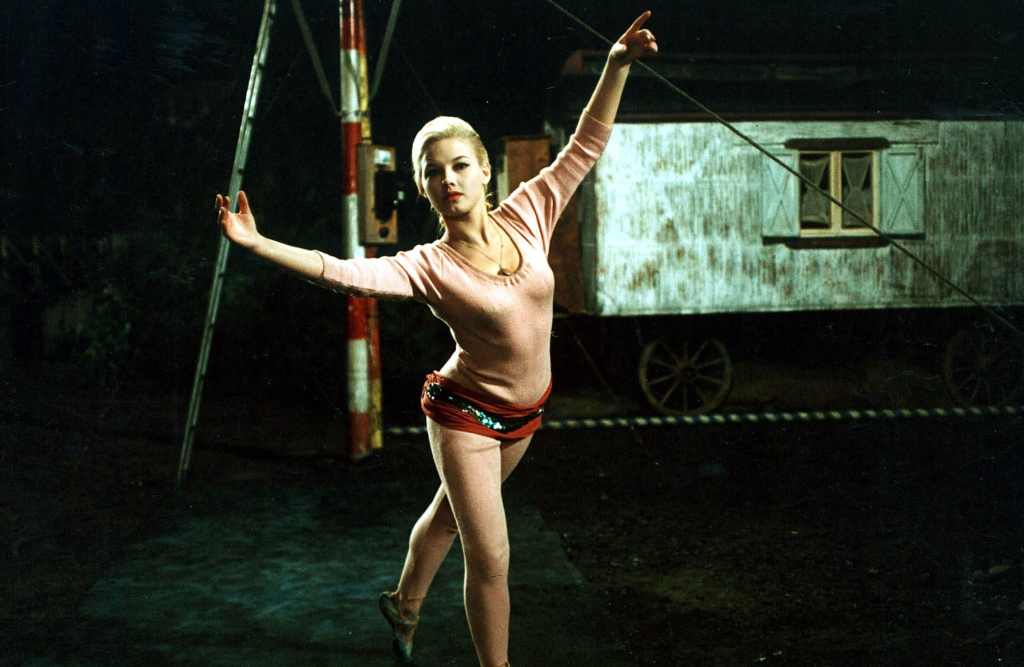
We come to three men—Antonín (Rudolf Hrusínský), Hugo (Vlastimil Brodský), and Roch (Frantisek Rehák)—lounging in swimsuits beside an outdoor pool. They are followed in a single shot by a camera pan and slight tilt as one pranks another in a triangular back-and-forth. Hugo and Roch end up falling into the water, while Antonín smugly lights a cigar and steps in slowly, only to be vigorously splashed by the other two. The group jump and splash and play in the water, before settling into a Three Stooges-style physical comedy routine—Antonín dunks Roch’s head into the water; Hugo takes the cigar from Antonín’s mouth. The romantic style of music softens the scene and the juxtaposition of sound and image is less harsh, less cynical than in Closely Observed Trains. There is a genuine calm about the men, whose world is about to be disrupted by a travelling tightrope walker, Arnoštek, played by Menzel, and his young, attractive assistant, Anna (Jana Preissová).

One by one, the men attempt to seduce Anna and, in doing so, are struck by misfortune. For the next two thirds of the film, the soundtrack is mostly filled with Arnoštek’s carnival-style performance music, with some brief sections of score underlining the bumbling of our three central characters with the comic timing of a slide whistle. The sweeping strings that opened the film return later for Anna to perform a dance after Arnoštek falls and injures himself. It is a simple dance and the increasingly disinterested audience members depart. The beauty of this scene is in the love for performance it shows, underlined by Anna’s inability to reach her audience. Her completion of the dance and the sustained romantic theme take us in and tell us we’re seeing something that almost none of these characters bother to notice. At the end of her dance, the music comes to a close. Anna sees only Antonín left in the audience and bows her head. We, along with Antonín, are the only ones to glimpse this private moment folded into Anna’s performance, akin to the private feeling of communion that art sometimes gives us.
Though moments of bittersweet sincerity and sympathy are hallmarks of Menzel’s work, it is in collaboration with Šust that these complexities are most fully realised. A week after Capricious Summer, the season continued with Menzel’s much later film, I Served the King of England (Obsluhoval jsem anglického krále, 2006), based on the 1983 novel by Hrabal, which Menzel had struggled for many years to get into production. A notable incident occurred in 1998, when Menzel learnt that his then producer had sold the rights to the novel. Accordingly, Menzel approached the producer at the Karlovy Vary Film Festival that year and attacked him with a large stick. (Perhaps the most impressive part of this story is that Menzel later successfully auctioned off the stick.) The film itself is structured between current-day Jan (Oldřich Kaiser), who, having been released from prison three months early from a fifteen-year sentence, is fixing up a ramshackle, abandoned pub; and Jan in his teenage to young adult years (portrayed by Ivan Barnev) as a frankfurter vendor, then a server at a restaurant, and then at a hotel in Prague, all the while fascinated by material wealth and the power it holds over people. Jan’s coming of age also coincides with the coming to power of Hitler, which, combined with his obsession with money, leads Jan to reject his fellow Czechs and ultimately embrace Nazism in Prague. The score’s composer is Aleš Březina, who would also collaborate on Menzel’s next and final film, 2013’s The Don Juans (Donšajni).
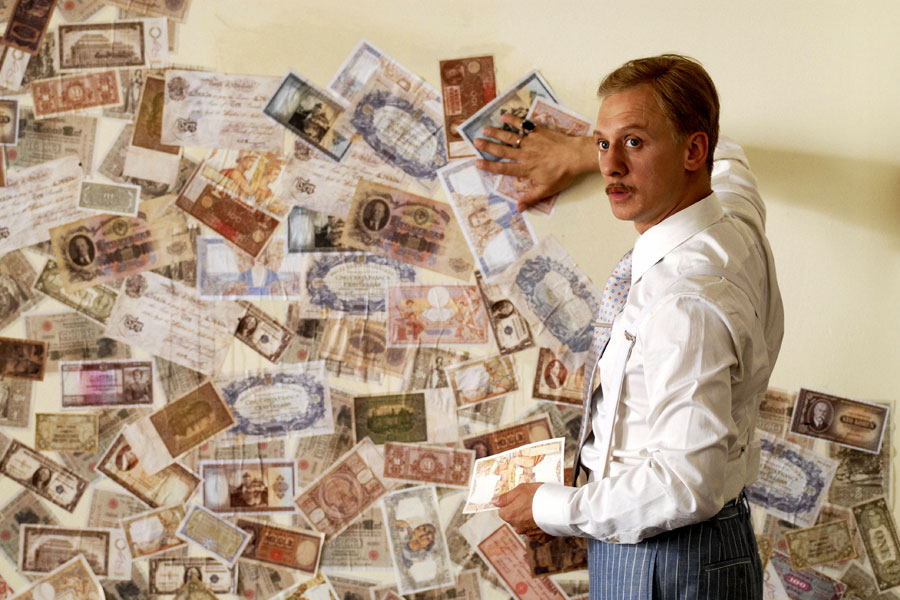
In I Served the King of England, the score is a bouncy homage to silent cinema and synchronised scores, with Joplinesque piano riffs, often during direct recreations of silent-era styled sequences, complete with speeded-up motion, title cards, and colour drained to black and white. For the main theme of the film, the music finds a blissful refrain with deep brass underpinning a climbing strings section, all crowned by soaring woodwind, always to emphasise Jan’s marvelling in amazement, often at money. The music supplements its scenes in a very straightforward manner. The score agrees with its images. It lacks the nuance of a Šust score, which takes on different tones and meanings as the scenes create friction against each other.
* * * *
The final night of the programme began with Larks on a String (Skřivánci na niti), Menzel’s film completed in 1969 and released in 1990, which played at the 39th Melbourne International Film Festival with Menzel as a special guest. The long journey to eventual release was spent mostly dormant, as a ‘vault’ film—a film either removed from circulation, unreleased, or left incomplete due to the 1968 Soviet invasion of then-Czechoslovakia. During this period, filmmaking became increasingly difficult as art was heavily censored; Chyltilová underwent a seven-year ban from filmmaking followed by intense government scrutiny for her later projects, while another fellow New Wave director, Miloš Forman, whose 1967 film The Firemen’s Ball (Hoří, Má Panenko) was mired in political controversy, was forced to leave the country. Menzel’s film, about an ensemble of suspected bourgeois characters exiled to work in a junkyard, hit too close to home for Soviet censors, who saw the anti-communist elements of the film as a political challenge to the current government, rather than the Stalinist-era critique Menzel intended. Menzel atoned for his 1969 transgression in a 1974 interview and was subsequently allowed to continue filmmaking, albeit under strict conditions.
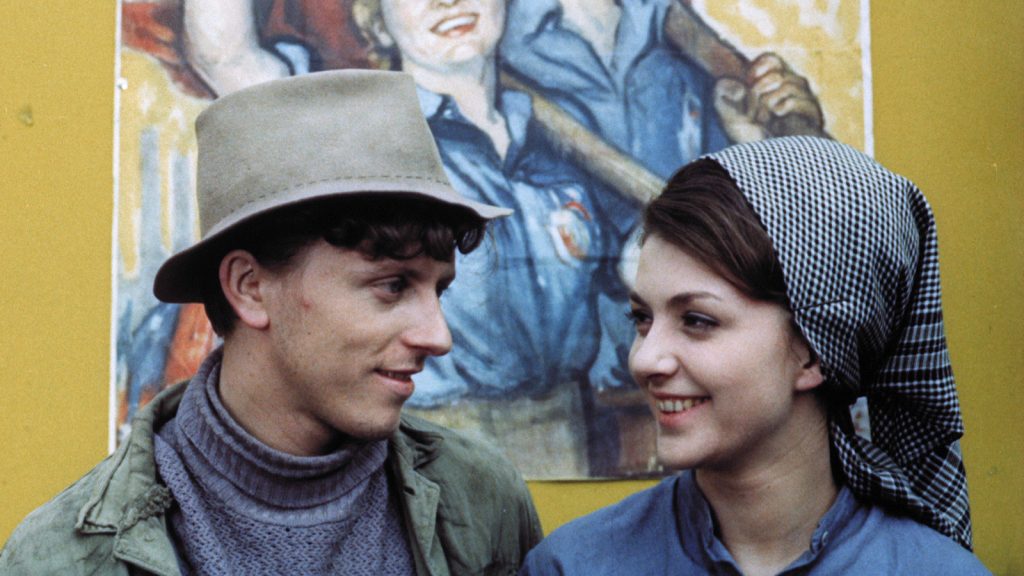
It would come to pass that in late 1989, after the Velvet Revolution, in which the Communist Party of Czechoslovakia was pressured to relinquish power, Larks on a String finally had the possibility of release. After a local premiere in February 1990, the film played at the 40th Berlin International Film Festival, which took place during German Reunification. Menzel’s film shared the top prize, the Golden Bear, with Costa-Gavras’ Music Box (1989), a thriller about an old man accused of war crimes during the Second World War, whose daughter defends him while herself unsure of the truth. Both are a far cry from the previous year’s Golden Bear winner, the cheesy odd-couple variation, Rain Man (1988), and their dual victory carries a note of historical triumph over totalitarianism. It was a celebration for Czechoslovakia—soon to separate into the Czech Republic and the Slovak Republic—which brought great interest to challenging and overtly political art.
As Czech novelist and playwright Ivan Klíma explained in 1994, “In the first months after the revolution there was a surge of interest in everything the former regime had forbidden. There was a huge and immediate interest in both the work of dissidents and Western best-sellers, as well as for pure trash.”1 Indeed, in 1995 Menzel even told an interviewer, “We consume the garbage because it’s available now.”2 While Menzel recaptured his western audience, Klíma decried “the poverty of consumer values” and explained that Czech society “had not had the chance to develop the antibodies which would have protected them against the bacilli carried by the value system of a free-market society and its mass culture.”3 Though Menzel had a renaissance of sorts, Klíma made the salient observation:
The triumph of the market-place, even if only for the time being, will undoubtedly be culture’s loss. Disneyesque megakitsch has elbowed out Czech animation and puppetry, which was once amongst the finest in the world […] Czech cinema, which flourished in the sixties, is barely scraping by and for the most part produces only a kind of mongrel, comprising dumb comedy, pornography and action films.4
Menzel would only make three more films over the next twenty years—a marked and sudden drop in productivity.
The Cinémathèque season finished with 1979’s Those Wonderful Movie Cranks (Báječní muži s klikou). Of the five Menzel films screened at the Cinémathèque, this is the only one that the director was able to release during the period of Soviet rule. The main theme by Šust is his most conventional of the season and glows with a nostalgic warmth. Compare this with his score for Chytilová’s film released in the same year, Panelstory or Birth of a Community (Panelstory aneb Jak se rodí sídliste), an alternating cacophony of chaotic woodwind honking and muddy layers of swirling strings.

Menzel’s filmmaking is never as radical as Chytilová’s, and the vast pole of difference between Šust’s scores demarcates an artistic boundary between the two. Where Chytilová is angry, Menzel often presents a droller dissatisfaction with the status quo. With Those Wonderful Movie Cranks, Menzel has made an ode to another era of filmmaking and, in doing so, crafted a kind of creative manifesto. The film follows travelling magician and projectionist Pasparte (Menzel regular Hrušínský) and his assistant Jakub (played by Menzel). While Pasparte dreams of opening the first permanent Czech cinema, dedicated to showing Czech films, Jakub wishes to make films that capture real life as it is.
Šust’s score is delicate and matches the understated comedy of the film, as well as a sustained sincerity that is hard to come across in Menzel’s work. Despite this uncharacteristic quality, it distils the sense of humour of so many of Menzel’s films with a lucidity afforded by the reflexive subject matter and casting. As Jakub, Menzel plays totally deadpan in his ambition to capture reality, to the point that he becomes ridiculous. It is the slight tonal incongruency between him and the world around him that creates the absurd humour, which is so carefully modulated to ensure a deft weaving of drama and comedy. Strings swell before a simple piano gently repeats a motif. The soundscape is soon taken over by various interchanging woodwinds. It is totally uncomplicated at first, but over time brings in more and more instruments. No matter how elaborate the swooping flute and bassoon become in their dance, the score retains its simple structure. And, as in the dance scene in Capricious Summer, Menzel and Šust show that with a small shift in the image’s relationship to its score, they can refashion the tonal and emotional possibilities of a scene and, by extension, a film.
**********
The Melbourne Cinémathèque screens films on Wednesdays at ACMI in Federation Square. Screenings are presented in partnership with ACMI, and supported by VicScreen. Full program and membership options—including discounted membership options for students—are available at acmi.net.au/cteq.
‘Jiří Menzel: Making Comedies Is No Fun’ was presented in partnership with the Czech and Slovak Film Festival of Australia.
**********
Linus Wolfe Tolliday is a director of films that tend to revolve around chance. They also like to read and follow the cricket.
- From Klíma’s essay ‘Progress in Prague’ in Granta 47: Losers (1994), edited by Bill Buford, p. 254. ↩︎
- From a 1995 interview with Judith Vidal-Hall: ‘Jiři Menzel: The art of laughter and survival,’ p. 122. ↩︎
- Klíma, ‘Progress in Prague,’ p. 252. ↩︎
- Ibid, p. 254. ↩︎
 Rough Cut