


I.
The second film completely financed by Francis Ford Coppola and his studio, American Zoetrope, and the second to baffle both distributors and critics, Megalopolis seemed fated to fade, much as One From the Heart (1982) had done four decades prior. However, one thing is certain about this beautifully messy swan song: you can’t look away.
In the near future of a Romanised America, an innovative architect named Cesar Catilina (Adam Driver) discovers a rare material he believes could mould a better New York. Thwarted at every turn by Mayor Cicero (Giancarlo Esposito), his scheming cousin Clodio (Shia LaBeouf), and the lingering grief over his late wife, it is only through falling in love with Julia (Nathalie Emmanuel) that he finds the strength to move on.

If that plot sounds dry, it’s because it is. That is, if you strip away the surface fantasy and sci-fi elements—like Cesar’s ability to stop time, the meta-material being made from the soul of his deceased wife and the many, many batshit dream sequences that weave their way through the runtime. For better or for worse, Megalopolis has an old-school feel. On the one hand, Coppola brings back his penchant for Expressionist cinema. From its two-tone colour palette and vignette transitions to the use of green screens to form bold, matte backdrops, Megalopolis pops with a vibrant energy. On the other hand, the tired cardboard love interests are dragged out of retirement for Cesar and the other male characters to lust over—a real shame considering Aubrey Plaza could play a fantastically fleshed-out femme fatale. Instead, she’s given a lukewarm craving for money and power and the ridiculously gaudy name of Wow Platinum.
Nevertheless, the film thrives on an absurdity that’s hard not to respect. You find yourself laughing at its sincerity, only to soon question whether it may be a Surrealist masterpiece. Megalopolis becomes a media literacy minefield that you just can’t crack. The film struggles to convey the story of a devoted artist finding the strength to create from a doting wife. Instead, it feels more like an antiquated attempt to bring Ayn Rand’s Atlas Shrugged (1957) into the 21st century. And whether it’s a trainwreck or the magnum opus of a veteran director, it is not one to miss.
—Finn Dall
II.
In the years following the death of Marcus Aurelius—the revered second-century Emperor who’s quoted throughout Megalopolis—ancient Rome would find itself teetering on the brink of collapse. After a period of political unrest and successive civil wars, a once golden civilisation was forced to stare ahead into a dark and unknowable future. New Rome, the urban jungle in which Coppola’s latest film takes place, happens to be at a similarly precarious tipping point when we first meet Driver’s Cesar, the idealist-architect with a vision to rebuild his city into a sustainable utopia—an ambitious dream he’s willing to gamble his entire legacy on.
As evident from its historical contextualisation, Megalopolis is bursting at the seams with ideas—a self-funded, decades-in-the-making passion project from a director who knows all too well the risks that come with forging one’s own destiny. For those familiar with ‘late style’—a term used to describe the output of older auteurs whose recent films tend to burrow deeper into the niche interests that have followed them throughout their careers, often at the risk of alienating casual audiences—Megalopolis, for better or worse, inhabits all of its uniquely jarring qualities. There’s a vulgar, digital sheen to its images, with computer-generated backdrops and set extensions imbuing each scene with an uncanny quality, and the film is left to a gamut of admirably kooky performances (which span from Hollywood elder statesmen to brazen nepotism hires), to make the often rambly dialogue sing.
Despite its rough characteristics, however, there is a beating heart at the centre of Megalopolis. Touchingly dedicated to Coppola’s late spouse, Eleanor, one of the film’s final moments is of a wife beckoning her husband to join her as she drifts towards a bright but mysterious tomorrow. While Marcus Aurelius couldn’t have predicted what would become of Rome, Megalopolis is an unabashed declaration from one of cinema’s great pioneers determined not to make the same mistakes—embrace the future, he urges, even if that can be the scariest thing in the world.
—Kevin Bui
III.

Between the perfection of its opening and closing images, Megalopolis is, at once, an ungainly Trumpian fable and a cosmic ballet. It’s a breathtakingly personal film, preoccupied with creation, ego, grief, and the passage of time. Tonally, it’s quite weird. Sometimes, it’s outrageously funny—the kind of funny that makes you lock eyes in the dark to confirm: You did hear that, right? All of which is to say, Megalopolis is exactly the film that you’d expect from a director whose most recent works are as wonderful and eccentric as Youth Without Youth (2007), Tetro (2009), and Twixt (2011). I liked it a great deal, yet I’ve been struggling to communicate my feelings about it with any real coherence.
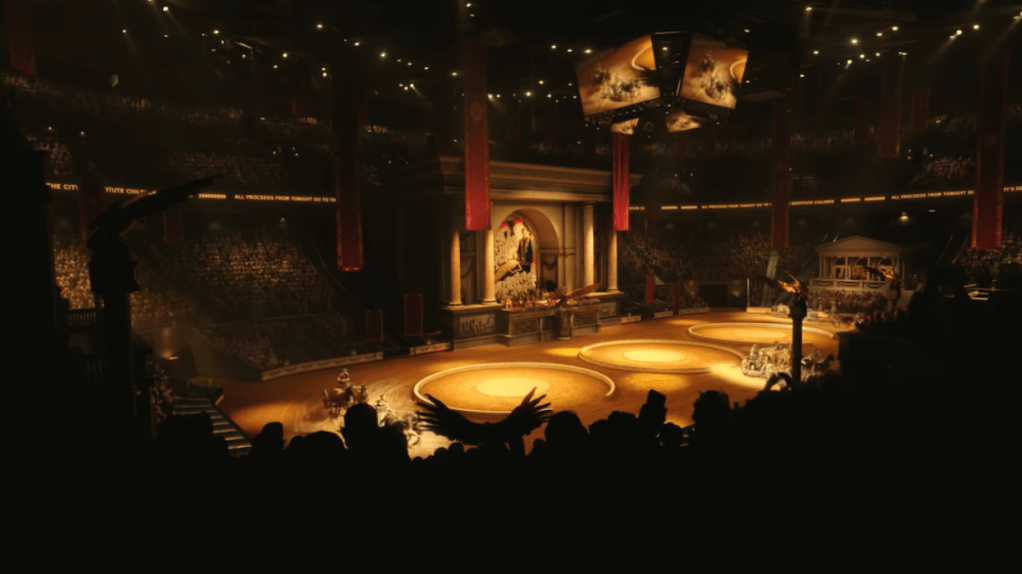
Something I keep coming back to is the film’s incredible, colosseum-set sequence: the musical virginity pledge of budding pop princess Vesta Sweetwater (Grace VanderWaal, who rose to mega virality for her precocious, ukulele-backed songs on America’s Got Talent). Vesta’s performance is, hilariously, met with an eye-watering surge of donations from the city’s geriatric elite. That is, until it is interrupted by the broadcast of a sex tape the singer has apparently made with the brooding and brilliant Cesar (Driver, perfect in this role). The latter is arrested for statutory rape, a charge that his colleague and love interest Julia (Emmanuel, Megalopolis’ beating heart) must disprove.
This is a plot point that would be boggling even without the context of Coppola’s heavily publicised decision to cast multiple actors with allegations of abuse and misconduct against them, not to mention the disturbing reports of his own on-set behaviour. Viewed through this lens, it’s sort of disastrous. For better or for worse, Megalopolis is, like Cesar’s logic-defying city, a reflection of its maker, and thus intrinsically bonded to his image. As in all of human history, with beauty comes monstrosity; with brilliance, fallibility. Megalopolis feels like a triumph. Perhaps it is only an illusory one—entirely a product of hubris—but I choose to believe otherwise.
—Grace Boschetti
Megalopolis is now screening in select Australian cinemas.
**********
Finn Dall is a writer and critic interested in weird and wonderful stories. His work has been featured by ACMI, Writers Victoria, and the Melbourne University Film Inquirer. You can follow him over on Letterboxd @finnwritesdall.
Kevin Bui is a writer and critic from Melbourne. His work has been published in The Guardian, Little White Lies, and The Big Issue.
Grace Boschetti is a Melbourne-based freelance film critic. She has written for Metro, Senses of Cinema, and ScreenHub, among other publications.
 Rough Cut