


It begins in the dark. In white lettering, the opening credits slowly fade in and out of the patient black screen. Suddenly, thunder rumbles.
Except, it is not thunder at all. Once the image appears, we learn that it is the sound of a basketball being dribbled in a school gym. But for 40-something housewife Cai (Yu Aier), perhaps it is thunder after all, because this school gym is the eye of the storm she’ll soon be swept up in. When she accidentally hits an old woman with a basketball, Cai’s life begins to spiral out of control. Her husband, her daughter, her mother-in-law, and her past all seem to be pulling her life apart.
Some Rain Must Fall is the debut feature from Chinese writer-director Qiu Yang, whose short films have captured festival audiences and racked up several prestigious awards. His final film project at the Victorian College of the Arts in Melbourne, Under the Sun (2015), was selected for the Cannes Film Festival’s La Cinéfondation (now La Cinef) competition; his first short film out of film school, A Gentle Night, won the 2017 Short Film Palme d’Or; and in 2019, Yang received the Leitz Cine Discovery Prize for She Runs, which also screened at Cannes. Considering the director’s track record, to say his debut feature was highly anticipated would be an understatement. “I finally started writing the feature in 2020 during the COVID outbreak. There was nothing to do, really, so I thought I might as well start writing the script,” laughs Yang.
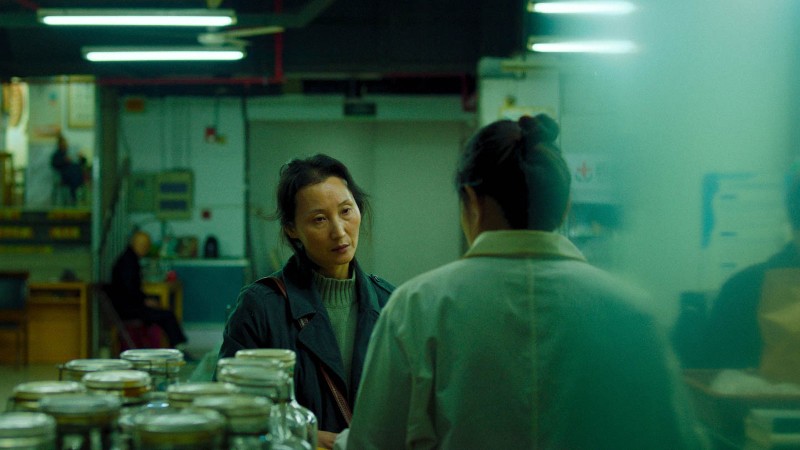
Yang’s writing process was free-flowing, as he allowed his intuition to decide the shape of the film, including the point of view from which the story would be told. Some Rain Must Fall shifts between Cai’s perspective and that of an invisible observer, juxtaposing visions from Cai’s knotted mind with peeks into the lives of those she interacts with, like the housekeeper with whom she shares intimate moments or her daughter’s classmate whose grandmother she injured. “When you think about it, that [invisible observer] is me. Growing up, I would see parts of the relationship my mother had with the housekeeper. As a kid, you only see a little and understand even less. Only later in life can you piece those moments together, but their meanings are still elusive. I want to depict those moments honestly from that unique perspective.” Yang chose not to describe in detail the classmate’s and the housekeeper’s lives because he does not share their backgrounds. “I think sincerity is a must.” Much like Some Rain Must Fall, Yang’s previous works are also social-realist family dramas that centre on mother-child relationships, inspired by his own experiences. “I believe that at the core of what I do are these stories that I can tell with total honesty, stories that explore the vulnerabilities and weaknesses of humanity. They are all that I can offer to the world.”
Aside from inspirations from his personal life, as an avid reader Yang also sought to experiment with translating the structures of some of his favourite novels and short stories into film. “I know some people might not like it, but I am happy that I got to experiment with it. I was very lucky to have that chance,” he says. In particular, he notes that the short stories by Canadian writer Alice Munro have guided his writing process, specifically as influences for his character-driven writing style. Yang would build a character first and then ask himself what the character would do, following them from scene to scene. The second half of Some Rain Must Fall takes its characters away from established settings like the school and Cai’s apartment, pursuing plot threads that were only vaguely alluded to throughout its first half. Here, Cai is confronted by a past that has long haunted her and chooses to confide in her daughter parts of it.
While Some Rain Must Fall is an intimate character study of Cai, in the background are subtle commentaries on social issues such as classism. Cai has groceries thrown at her and dirt flung on her car’s windshield, seemingly because she is rich, while her husband refers to those who are less affluent as “peasants.” Yang affirms that “When [someone makes] a social-realist film honestly and sincerely, the social issues will come up, no matter what.” Many details pertaining to the social issues brought up in Some Rain Must Fall actually come from what Yang observes in everyday life, even within his family. The challenge for Yang was to keep those issues in the background rather than letting them take up the spotlights of his characters—especially Cai’s.
I don’t think seeing is believing. Hearing is.
—Qiu Yang
The soundscape, which Yang paid acute attention to, amplifies the focus on Cai’s struggles as a middle-aged housewife. Instead of a score, Yang wanted the soundscape to touch the audience. “I don’t think seeing is believing. Hearing is.” For Yang, sound expands the scope of a story and provides the audience with a world beyond what is encased by the frames. “Sound goes into your heart while the image goes to your brain,” says Yang, quoting an acquaintance whose theory on the affective implications of sound he finds fascinating.
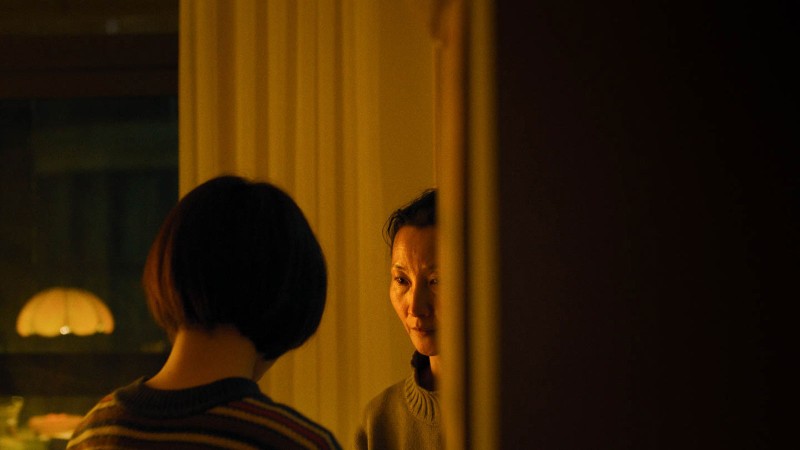
Despite Yang’s belief that “Seeing is not believing,” he and cinematographer Constanze Schmitt also crafted a unique visual language. The trademarks include framing the characters within vertical lines, shooting them side-on, and a combination of static and long, wide tracking shots. Yang and Schmitt also worked together on Yang’s shorts A Gentle Night and She Runs. Speaking on their collaboration, Yang says that they share “eerily” similar tastes when it comes to visuals and a mutual understanding when it comes to finding the right frame for an image. Yang and Schmitt prefer working with little external lighting, using what the locations can offer to their advantage. He cites works by alumni of his alma mater, Adam Arkapaw and Ari Wegner, as well as Melburnian filmmakers Garth Davis and Greig Fraser, as inspirations for this naturalistic philosophy, in which the discovery of a visual language coincides with a careful location scouting process.
Now residing in Paris, Yang still reminisces about Melbourne, where he first learnt filmmaking. Yang likens the process of making his debut feature to that of creating his first short film as a student, recalling unforeseen challenges that he is now happy to have learnt to overcome. While it took him a long time to find the urge to make his first feature, now that Some Rain has fallen, Yang has quickly gathered the motivation to cook up his next storm.
Some Rain Must Fall screened at this year’s Melbourne International Film Festival.
**********
Đăng Tùng Bạch is a Naarm-based filmmaker from Hanoi, Vietnam. Short films he directed have been screened in Vietnam and Australia, as well as in Europe. He writes about films to understand the stories they hold, hoping he can tell stories of his own one day.
 Rough Cut