


Shula (Susan Chardy)—adorned in a headpiece and costume lifted directly from Missy Elliott’s ‘The Rain (Supa Dupa Fly)’ music video—stares down at a body that lies static in the middle of a moonlit road. It belongs to her much beloved Uncle Fred, yet Shula seems unmoved by the shocking discovery of her relative’s untimely (and absurd) death. She takes the necessary steps: calling the authorities, informing family members, and staying with the body until the morning. Yet her muted response to this unnerving event is the first of many warnings that more is amiss here than just the unexpected revelation of a family member’s passing.
The uncovering of familial trauma and the complexities of generational and cultural divides are at the core of writer-director Rungano Nyoni’s sophomore feature On Becoming a Guinea Fowl. The film—at once ethereal and aggressive, mysterious yet forthright—builds upon the gently surreal vision of the Zambian-Welsh filmmaker’s excellent 2017 debut, I Am Not a Witch (which also follows the journey of a protagonist named Shula). Nyoni’s latest film is another tale of women who seek to defy tradition by carving a new path despite the resistance of their conservative communities.
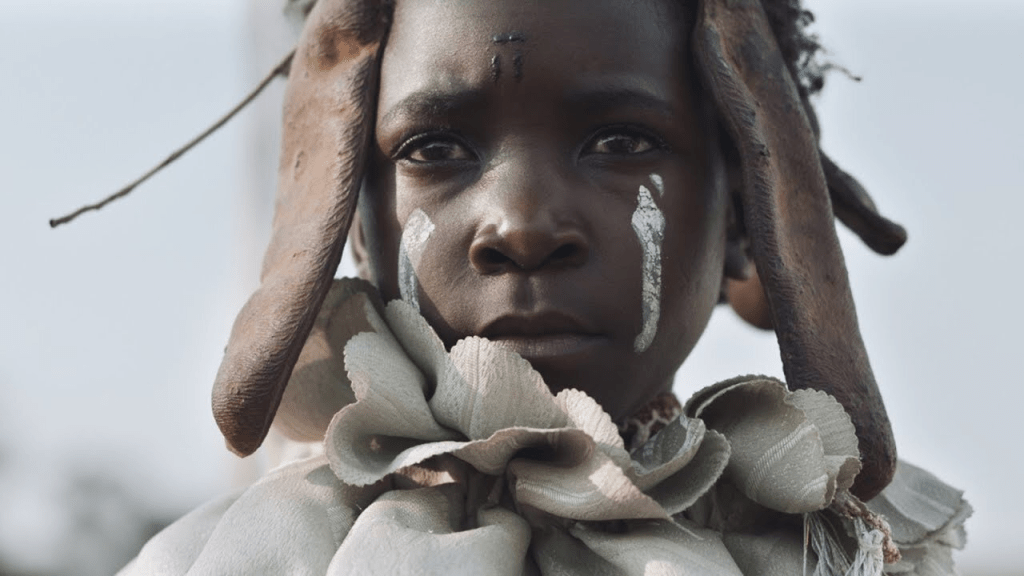
On Becoming a Guinea Fowl’s Shula is clearly at odds with her Zambian upbringing. We quickly deduce that she is a single, ambitious career woman living overseas, and her embrace of Western attitudes prompts the ire of her Bemba relatives. Following Uncle Fred’s death, Shula must participate in a period of mourning within her family home, vacated to be used as a temporary funeral parlour of sorts. According to tradition, the women of the extended family crawl through the house on their hands and knees, and sleep together in the communal spaces. Throughout the day, they prepare food for the men, who sit and socialise outside while the women collectively mourn.
Battle lines are immediately drawn between the older and younger family members, most notably Fred’s sisters, who exile their brother’s much younger widow (Norah Mwansa, in a devastating turn) as punishment for her supposed role in her husband’s death. Meanwhile, Shula finds a compatriot in her bombastic cousin Nsansa (Elizabeth Chisela), and the pair routinely evade their aunties’ scolding eyes to drink and to speak freely. Nsansa, despite her often uncouth demeanour, becomes a powerful ally for Shula, expressing her equally disparaging feelings for their late uncle and the spectacle held in his name. Nsansa discloses the abuse she endured in Fred’s hands as a child, confirming Shula’s suspicions that her own traumatic experience with him was not in isolation. Quickly, it becomes clear that many of the young family members have survived the horrific actions of their uncle, a realisation which reaches a fever pitch when Shula’s younger cousin Bupe (Esther Singini) attempts suicide, leaving a video that recounts her painful encounters with Fred.
As Shula, Chardy’s stoic performance is riveting; her work is imbued with sly humour and deep feeling that gently leads us to the inevitable heartbreak felt in the face of her family’s desire to protect a predator, rather than his prey. Equally engrossing is Chisela as Nsansa, who explodes onto the screen in the film’s opening scene and remains captivating in both her comic and dramatic moments. The ensemble cast are uniformly excellent and Nyoni elegantly calibrates the large group scenes, gifting her actors with long takes that allows them to inhabit the situations fully and deliver surprising, volcanic performances.
What unfolds is an arresting, spirited, and darkly comic critique of the oppressive power of silence and the struggle to break relentless cycles of abuse. On Becoming a Guinea Fowl examines the ways in which denial is implemented as a survival mechanism—to live a lie is frequently easier than acknowledging an uncomfortable truth. Shula embodies the complexities of addressing one’s own trauma, and the dark secrets that both bind and unravel families are finely drawn by Nyoni. The exquisitely icy framing by cinematographer David Gallego, paired with Nyoni’s direction, have us repeatedly questioning the reality of a scene; the film exists on a more psychological plane of grief and anger, embracing a hypnotic quality akin to the daze one can feel in the wake of death. The film’s sound design is also noteworthy, as looping audio recordings and the echoing call of distant music contribute to building an off-kilter world.
Nyoni’s instinct for the uncanny can be most felt in the presence of the titular guinea fowl, a bird that lives amongst other animals and loudly caws at the sign of any danger, which comes to Shula in memories of a childhood television show that reoccur throughout the film. The metaphor is explicitly stated—but it is a finely calibrated choice by Nyoni to embrace a fiercely direct (and at times almost didactic) voice to honour the delicacy of her subject, leaving no doubt on where she stands on the contentious issues at the core of the film.
The turn of phrase “Do not speak ill of the dead” has much to answer for, Nyoni posits. On Becoming a Guinea Fowl is both a scathing critique of those who defend abusers in the name of tradition, and a deeply cathartic battle cry to clear the path ahead, so that those who follow you will never have to suffer in silence.
On Becoming a Guinea Fowl screened at this year’s Melbourne International Film Festival.
**********
Andrew Fraser is a writer, performer, and filmmaker based in Sydney, Australia. He holds a Bachelor of Fine Arts (Acting) from the National Institute of Dramatic Art and is an alumni of the MIFF Critics Campus. He has worked on multiple film and television projects including Heartbreak High, Birdeater, Three Thousand Years of Longing, Bump, and Mr. Inbetween. His writing has been featured in the MIFF Revue, Kinotopia, and The Big Issue, and he is a regular guest critic on ABC Drive Radio.
 Rough Cut