


Warning: minor spoilers ahead.
Kelly Link’s ‘Magic for Beginners’ is a short story about a fifteen-year-old boy named Jeremy who, along with his group of friends, obsess over a TV show called The Library. The show is a cult object: too lore-heavy and low budget for most people to follow, but appealing to the kind of person who enjoys trawling fan forums and trading theories. Jeremy and his friends’ shared obsession is the stable constant in their rapidly evolving lives, and provides a mechanism for them to mediate their adolescent feelings, changing friendships and growing sexual desires. “They imagine that life will always be like this—like a television show in eternal syndication—that they will always have each other. They use the same vocabulary.” I first read ‘Magic for Beginners’ in 2020 and was immediately struck by a desire to see it adapted to film. I Saw the TV Glow is an original film, the sophomore effort of writer-director Jane Schoenbrun, but there are so many overlaps between it and Link’s story that my wish seems to have been granted—at least, in spirit.
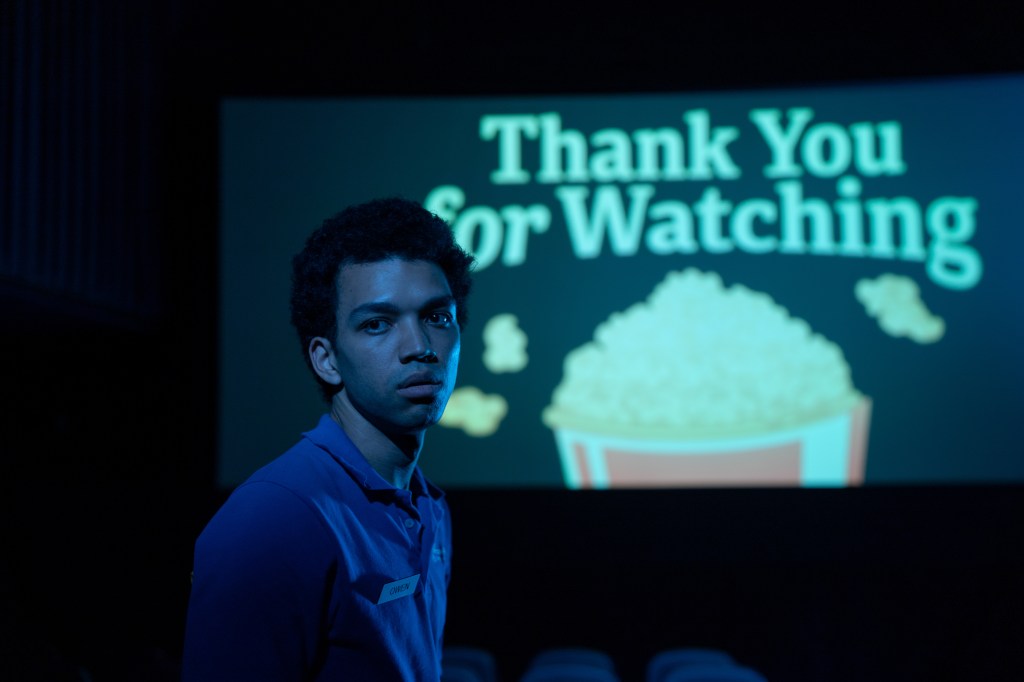
From the outset, Schoenbrun displays a Link-like capacity for identifying and poking at spots where the barrier between the fiction we love and the reality we live in is thinnest. “It was raining last night, and I couldn’t sleep,” declares the film’s protagonist, Owen (Justice Smith), “so I started my favourite TV show again.” This dialogue is initially presented as voiceover narration but is later revealed to be a fourth wall break, delivered directly to camera. It’s almost as if Owen is cognizant that he is not real, that he is a narrative object with a preordained arc and destination. It’s almost as if he believes that by speaking to the audience, offering his own interpretation of events, he might wrest back some semblance of control. But the content of the admission undercuts the intent. He’s resorting to a comfort watch, talking about it the way someone might talk about medicine: a treatment for sleeplessness, a serotonin hit to combat the melancholy. This is the language of dependency—yet he wants us to believe he is in command?
This behaviour is pathologised in flashback. Young Owen (played by Ian Foreman) is left no room to breathe by his parents: his mother Brenda (Danielle Deadwyler) is protective to the point of coddling, maintaining a strict bedtime well into adolescence; his father (Fred Durst) is exacting to the point of judgement, unhappy when he acts in a way that could be perceived as abnormal or not suitably masculine. But, as Owen later observes, this is just their way of coping with the fact that there is something not-quite-right about him. His peers are all developing ‘normally,’ but somewhere along the road he thinks he made a wrong turn. “It feels like someone took a shovel and dug out all my insides,” Owen explains. And while he knows there is “nothing in there,” he is still too nervous to open himself up and check.
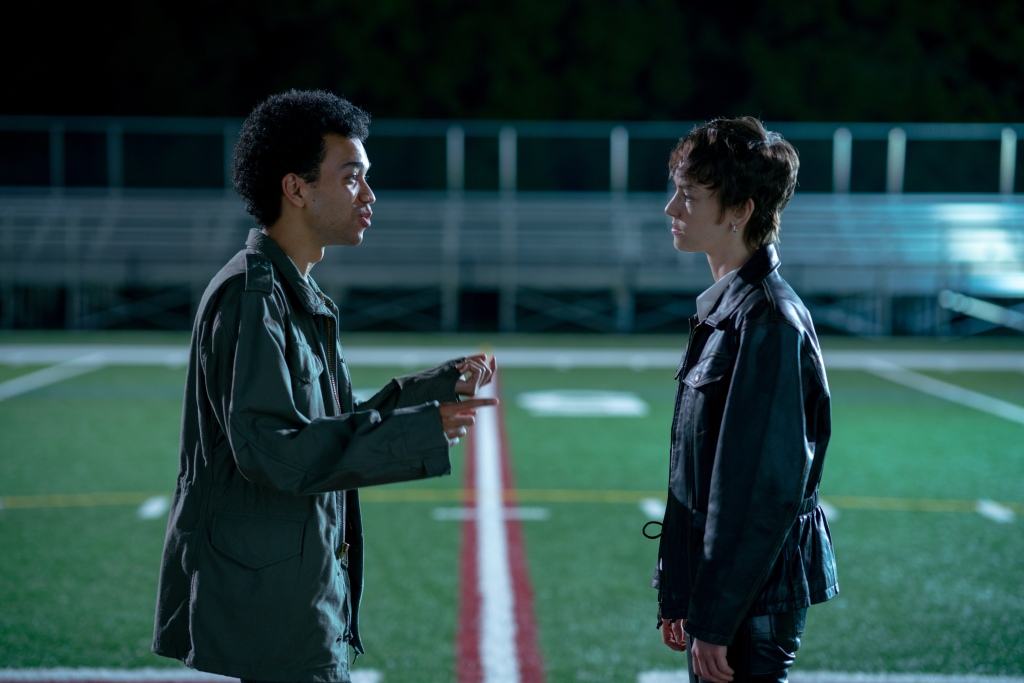
The only time he feels at all right in the world is when he is watching The Pink Opaque, a monster-of-the-week show in the vein of Buffy that follows two telepathically linked girls (played by Lindsey Jordan and Helena Howard) who do battle with a moon-based evil called Mr. Melancholy and the minions he sets upon the Earth. The program airs past his bedtime but Owen’s on-again off-again friend, Maddy (Brigette Lundy-Paine), makes VHS recordings of each episode for him. Their fandom stems from an escapist impulse; the show’s imagery and subtext are a sword and shield with which they can battle through the day-to-day of their assimilative suburban reality.
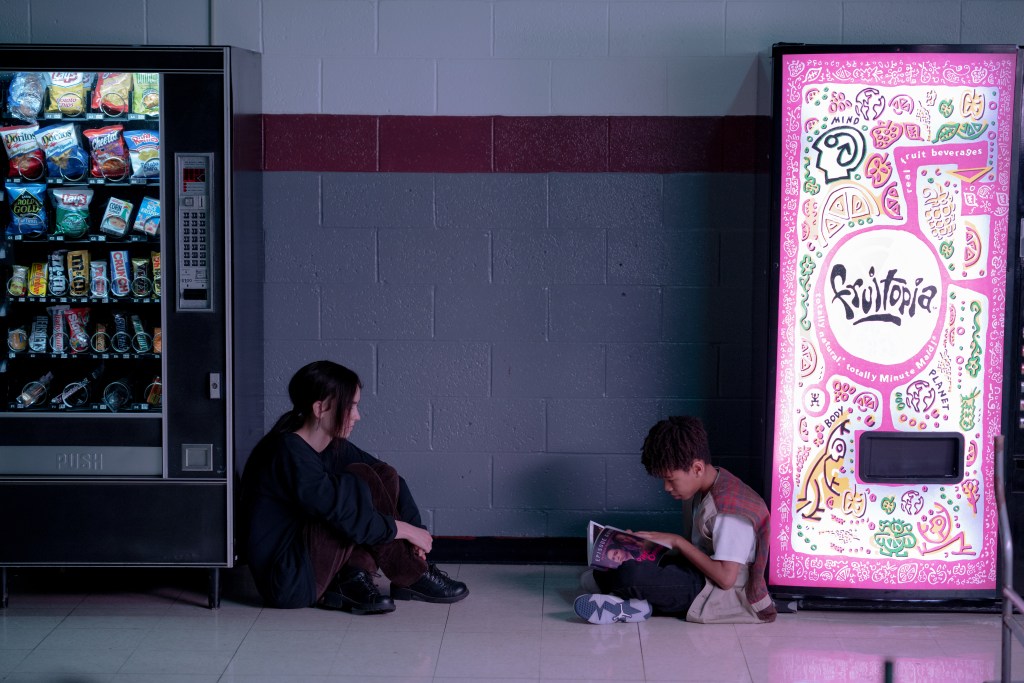
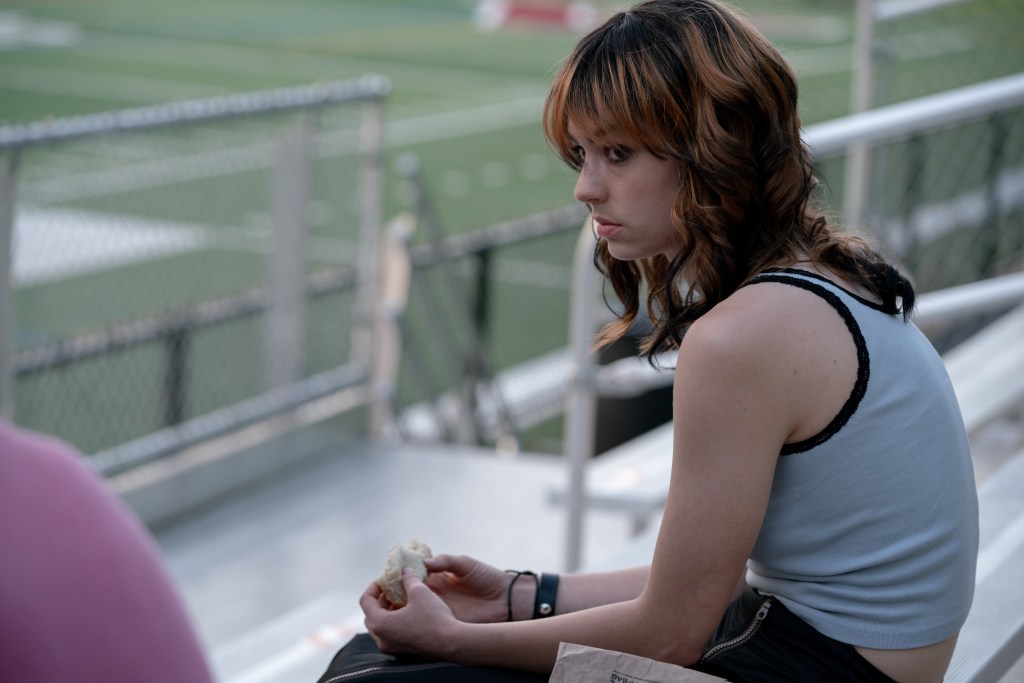
What Maddy sees in the program is almost instantly clear. She is into girls during the peak of ‘Don’t Ask, Don’t Tell’ politics. It’s not hard to guess why her most cherished media object is a show about two girls with a bond that, if you tilt your head just so and squint the right amount, is obviously sapphic. What Owen sees in The Pink Opaque is not immediately evident, though his relationship to it hums with an unrealised desire; via the show, he subconsciously accesses a different world, bringing him closer to another self—an implicitly trans one. “What if I really was someone else,” Owen allows himself to question at one point, “someone beautiful and powerful?”
Because she is further along on her journey of self-discovery, Maddy has come to a clarifying realisation: they will never fit into the world they currently inhabit, and it will eventually suffocate them, so their only choice is to escape. She begs Owen to come with her. At first he agrees, but then he panics—hesitates—and she ultimately leaves without him.
Eight years later, a 20-something Owen is working at a movie theatre when Maddy re-enters his life and suggests that their reality is a lot less real than it seems, and The Pink Opaque may be more than just a TV show. This development—which is almost impossible to adequately describe—is akin to something that happens halfway through ‘Magic for Beginners,’ wherein characters’ identities begin to blur. Talis, a girl Jeremy has a crush on in real life, becomes Fox, a character from The Library that Jeremy fantasises about, forming an entity known as Fox-Talis. Owen and Maddy’s identities are similarly tethered to the TV characters they identified with as teenagers, though the specifics of these relationships are far more frightening.

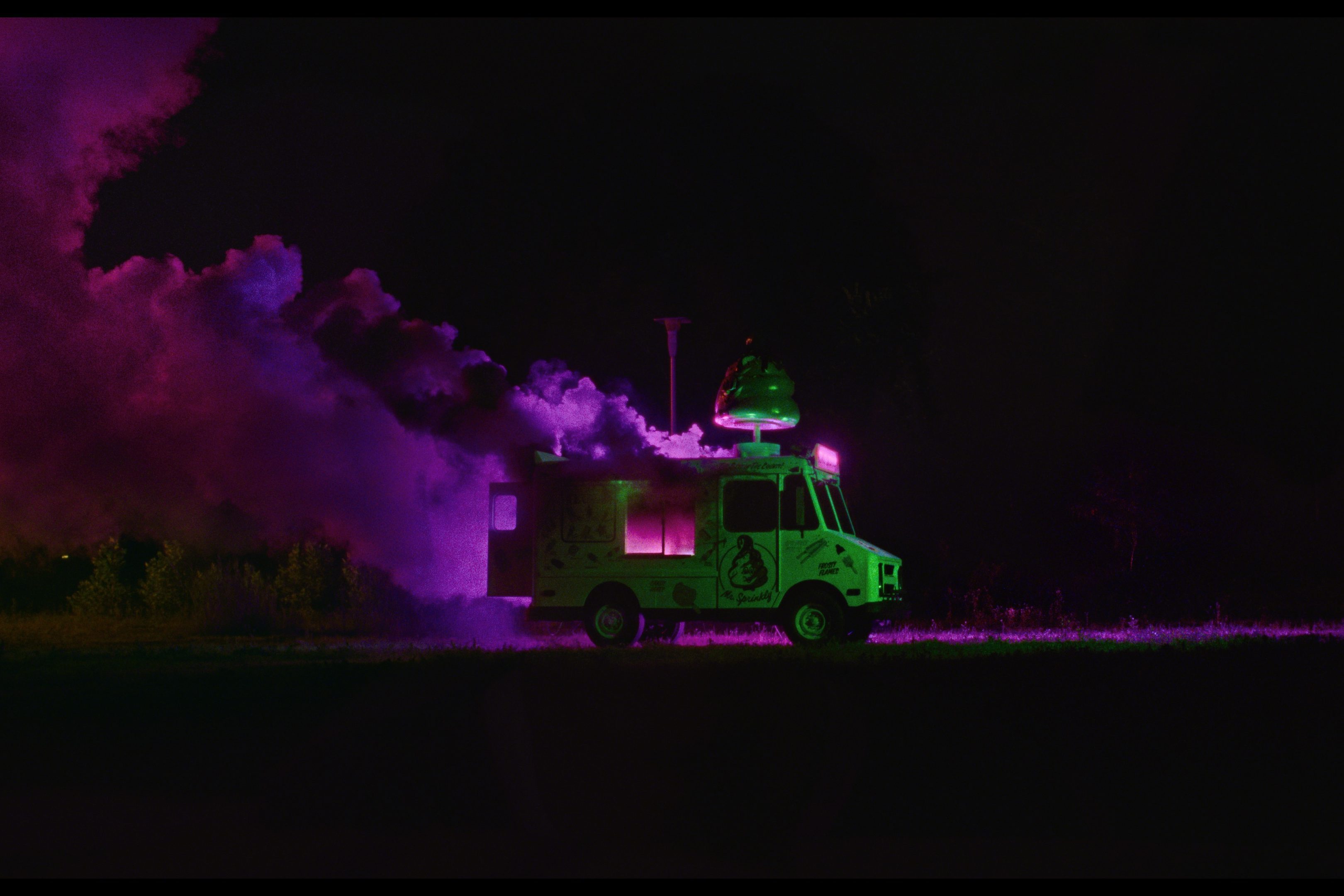
This is a lot of concept, but Schoenbrun never lets it become overwhelming, deploying a bevy of narrative tricks and details—some showy, some understated. For every cameo by a major sad-girl indie singer-songwriter, there’s also the blink-and-you’ll-miss it porcelain decorations at a travelling fair—designed to look eerily like B-movie creatures—or the enigmatic name of Maddy and Owen’s high school, Void High. These moves position the film on the edge of realism, so that when it asks its questions—about how the media we consume and our passion for it shapes our perception of reality—we’re responding empathically, because we are experiencing the world the way Owen and Maddy are: just clinging on.
This is formally impressive, but what elevates the film from good to great is how it triangulates the three aspects of the experience it’s depicting—fandom, adolescence, and repressed queerness—into a single point. Schoenbrun is transfeminine and non-binary, and the film reflects their own experience of media as emotional processing—what they’ve called the “coping mechanisms” of their teenage years. Or, as they said in an interview with Bright Wall/Dark Room: “TV Glow is a film about nostalgia, as much as it’s a nostalgic film, or perhaps more than it’s an aesthetic film. The film’s interaction with nostalgia as a feeling and a concept is complicated—or my feelings about it are complicated.”
Complicated is right. Those who come to I Saw the TV Glow looking for a narrative of queer affirmation will be met with something far more bittersweet. Trawling the internet in the days after watching the film, I’ve seen some claims that the film is a work of outright queer misery. I don’t know if I agree. It is bleak, yes, at times almost unbearable. The first text I sent after seeing the film was to a friend who had seen it earlier that week: tv glow made me feel so sad that I wanted to die lol. But despite all this, I would still describe the film as hopeful.
There are plenty of films that feature queer misery. There are even more fandoms that feature it. These works, whether they intend to or not, can betray our desire for affirmation and lead us to despair, but they are still valuable. In recalling them, we learn the limitations of searching for oneself in media. The difference is that I Saw the TV Glow doesn’t just feature queer misery, it’s specifically about it—the brutality is a feature, not a bug. It’s playing with the same tropes as bad faith queer films and fandom media, often with a bit of a wicked grin, but it’s a controlled environment. This is an exploration of what a ‘darkest timeline’ version of adolescent development might have looked like for a trans kid in the 90s. A timeline where development was stymied constantly, and in the place where identity and relationships were supposed to form, a dependency on a TV show emerged instead. It walks you right up to the brink of despair, but never forces you over it.
Initially, I’d planned to draw parallels between ‘Magic for Beginners’ and I Saw the TV Glow, with their shared setting, preoccupations, and formal techniques. What I realised, however, is this thesis would ultimately diminish both texts, especially Schoenbrun’s. Similarity in content does not automatically mean similarity of purpose. ‘Magic for Beginners’ is a classic cautionary tale: its final page finds Jeremy stranded in the middle of nowhere in a telephone booth, calling into the receiver, believing that Talis-Fox is on the other end of the line, his obsession with The Library foreclosing his connection to reality. A full stop ending. I Saw the TV Glow is cautionary in its own way, but radically open too, and that combination results in something far more provocative, and perhaps even invaluable: an ellipsis.
One shot in the film features a road marked up with text, written in swirling neon-pink chalk: ‘There is still time.’ In the days since watching the film, I have found that phrase coming to me, seemingly at random, bleeding into my reality, just as The Pink Opaque bleeds into Owen and Maddy’s. As queer people, the media we love can have an outsized influence on our conception of self; sometimes we can hold onto something too tight, clinging to it even once we’ve outgrown the lessons it can impart, even when it begins to hurt us. This is a film about confronting those limitations, acknowledging that a narrative doesn’t owe us anything beyond a window onto a new world. If you want to see a certain life actualised, you might have to go do it yourself.
I Saw the TV Glow is now screening in select Australian cinemas.
**********
Joshua Sorensen is a writer, bookseller, and committee member for #LoveOzYA based in Naarm. Movies starring Holly Hunter are to him what lamps are to David Byrne.
 Rough Cut