


TEXTURES AND SCAPES
A seasonal vibration—maybe a low buzz, maybe a whine, maybe even a call of courtship. There are two small legs gunning it down a hill. Think about the time it takes to reach the bottom, the time it takes to dial your mother’s number, the time it takes for her to answer the phone, to come to you. Faster or slower than you thought? Your New Age mother in linen; in denim; in a long, sheer skirt. The steady rhythms of a fan whirring in every room. A dangling charm. Moonlit surfaces yield to warm, dappled patterns. Wet hair clumped on the shower wall: part of you now beyond you, a persistent claim. Think about the time it takes first to form a bond, then to break it. Think about the time it takes to play a song on the piano from beginning to end. Grass brushing ankles. Legs folded underneath. Ice cream now staining a bright T-shirt.
TRANSIT AND ORBITS
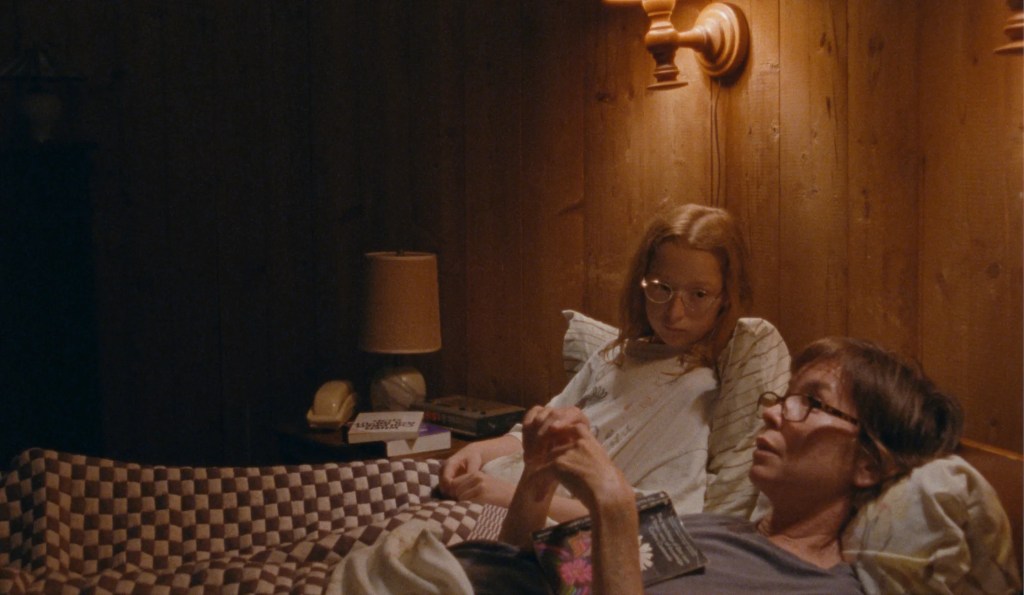
Lacy walks with Janet but runs with Sequoia. On the drive back from camp, the frame cannot hold Lacy entirely; she is off to one side, wind tousling her hair. On the drive back from the mall, the frame holds Lacy and Sequoia equally, almost symmetrically. A fleeting rightness to it. Loose unions shape the weeks as they roll into each other. There’s Wayne and Regina and Avi, sitting at Janet’s table, telling stories, shutting up. Lacy watches furiously from the side, in a crouch. Adult dialogue is thick with its own knowing significance, riddles people create for themselves and pretend (not) to understand. Child dialogue burns with exaggeration for fear of being misunderstood. A game is made of coming and going, but only Lacy is keeping the score. Matter rushes and pools and settles in the same spot; a flow that smoothes out the edges.
ONENESS AND SEPARATION
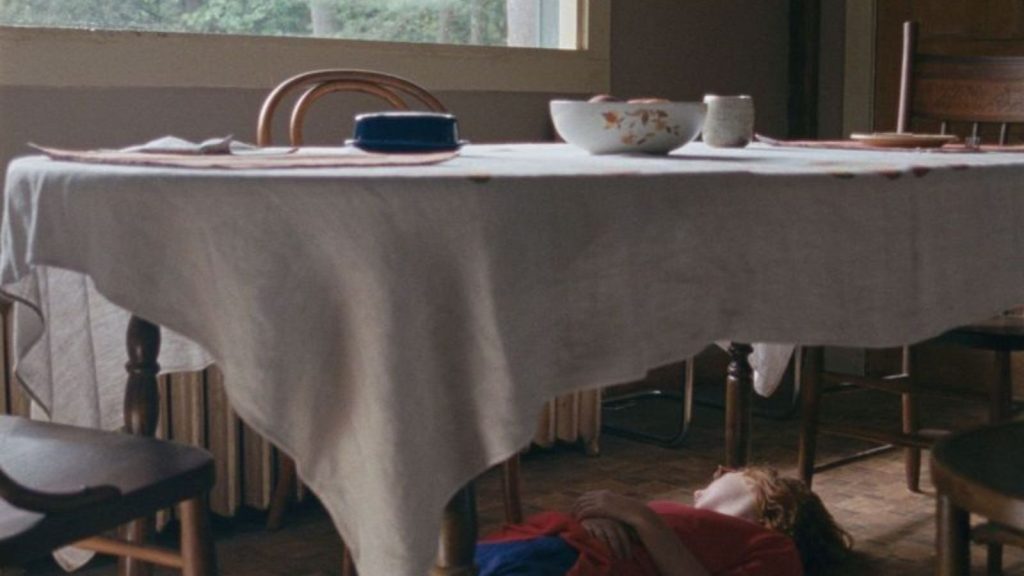
A doll is transformed with play. One character mutates into another—an attachment, a threat, an astounding unity. There’s Lacy in the mirror, cut off again, even to herself. Janet in full view. There’s a tick: a parasite feeding on Lacy’s blood that they set alight in a violent separation ritual. The irony isn’t lost, though it is momentarily put away. A mother is a private thing, which always ends up shared. You approximate your environment through a lock of her hair, her cupped cheek. Regina longs for the womb, but we all long for the womb, where the boundary used to form itself. Now what once felt vital and eternal suddenly feels out of time, repulsively so. You’re eleven and your body isn’t whole in the way you thought it was; you lie down because you can’t take it. The bus comes and goes and one day you decide to get on it.
PERFORMANCE AND WORLDMAKING
Janet tests the truth of herself: affirmations willing the ego into something solid, something coherent, something that needn’t be reflected to be real. There is a pulling away, but to where? Speak or don’t speak, rationalise it or don’t. Feel the small universe of your past closing up. Drive home alone. Lacy tests the space she take up—what’s there and what’s not, what’s a mask, what’s a trick of the light. Your mind is a world. Every relationship is a world. You’re God and/but so is everyone else. Tend to your private theatre, where everything exists for you; dress your figurines in chocolate wrappers, sustain them with juice. The scene feels like it could catch fire at any moment, but it doesn’t. You don’t know how it doesn’t. The puppets play at meaning, play at the moment before inhabiting it, play it over. The actors are waiting for instruction. Are you having a breakthrough or are you deluding yourself? Will you join the dance anyway?
Janet Planet screened as part of this year’s Melbourne International Film Festival.
**********
Tiia Kelly is a film and culture critic, essayist, and the Commissioning Editor for Rough Cut. She is based in Naarm/Melbourne.
 Rough Cut