


A six-year-old boy attacks his classmate, threatens sexual violence, and possibly follows through. Parents gather to talk the matter out, although it’s not clear whether resolution will actually be achievable. In the words of Julia Kristeva, “Any crime, because it draws attention to the fragility of the law, is abject, but premeditated crime, cunning murder, hypocritical revenge are even more so because they heighten the display of such fragility.”
This is not Franz Kranz’s Mass (2021). Nor is it Michael Bentham’s Disclosure (2020), an underrated Australian indie that got lost in the shuffle of pandemic-era, straight-to-streaming releases. Nor again is it Roman Polanski’s Carnage (2011). This is Armand, the debut feature from writer-director Halfdan Ullmann Tøndel (grandson of Ingmar Bergman and Liv Ullmann). And while this film starts out on similar terrain—as a chamber play and a morality tale—it quickly reveals itself to be a darker, stranger, altogether more wrangling kind of affair.
The meeting is happening at the boys’ school. Although, judging by the walls covered in photos of bygone cohorts, ‘establishment’ would perhaps be the more appropriate term. The principal, Jarle (Øystein Røger), has served for decades. He remembers every person who has studied there, including Sarah (Ellen Dorrit Petersen), who is the mother of the victimised boy. Representing the accused, the titular Armand, is actress, widow, and all-around hot mess Elisabeth (Renate Reinsve). The boys themselves remain absent—spoken only to, about, and around. Upon arrival, the parents—including Sarah’s emotionally detached husband, Anders (Endre Hellestveit)—are ushered into a classroom by well-meaning but inexperienced teacher Sunna (Thea Lambrechts Vaulen). She has been directed by Jarle to represent the school in the matter, but to keep her opinions to herself and allow the situation to “blow over” without alerting the police or child protective services.
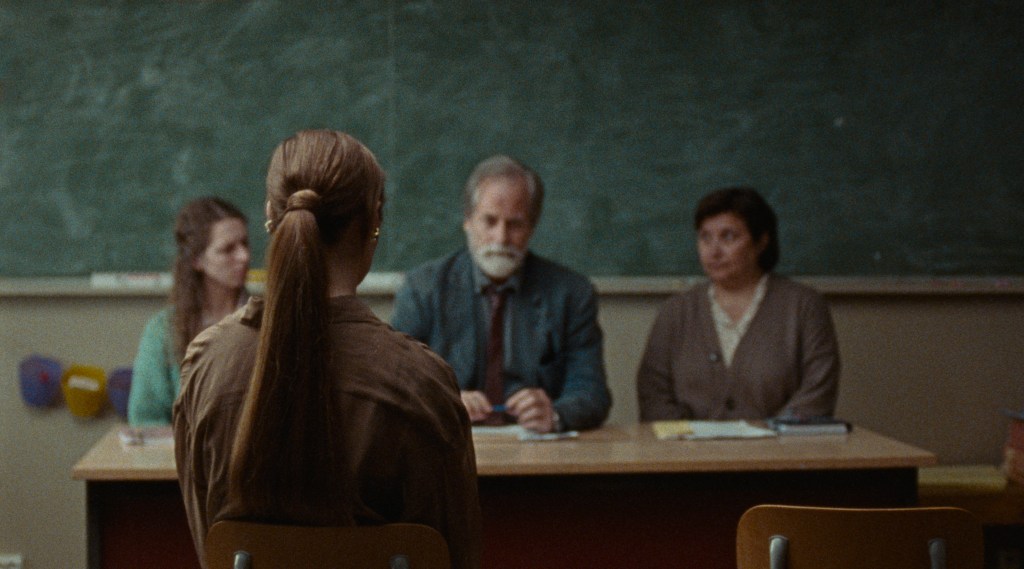
Elisabeth and Sarah have a complex relationship, marked by long simmering wounds and traumas. The meeting quickly turns into a more tangled negotiation, as they attempt to resolve crimes both past and present. The screenplay paces its discoveries well throughout its front half, peeling the narrative back layer by layer, every reveal containing another reveal, another reversal. The more you learn about Elisabeth and Sarah’s bond—that the former was with the latter’s brother, perhaps drove him to suicide, perhaps deferred her pain onto Armand, perhaps caused him to defer it again onto Jon—the more your stomach turns. This structure, of truths within lies within truths within lies, signals the ultimate focus here: a Kristevan interest in how glossy surfaces hide abject centres.
There’s a particular attentiveness here to bodies; cinematographer Pål Ulvik Rokseth finds unsettling ways of framing close-ups, either a little too close or ever so slightly off-kilter. Within this proximity, we witness flecks of spit fly, or a long string of snot run from someone’s nose. Shots lingers on characters as they use hand gestures to mimic the sexual acts Armand is alleged to have threatened Jon with, capturing the moments when onlookers’ eyelids flutter into a cringe of disgust.
Of course, ‘bodies’ has a double meaning, also referring to organisational bodies: institutional, governmental, disciplinary. Tøndel is equally attentive to their degradation. When the meeting spins out of control, Jarle steps in to course-correct, but his presence only exacerbates matters. Sarah demands to know why the situation hasn’t been taken more seriously up until now, and is a hairpin away from calling the police. Elisabeth, meanwhile, questions the legitimacy of the incident report, noting that its language doesn’t seem like the kind a child would use: too clinical, too precise. Jarle’s attempts to appease both women without upsetting the other underlines his fundamentally servile nature: he’s not interested in justice or rightness, only in preserving the school’s image.
It’s easy to see how this might all come together to form a greater point, about how failing to address the roots of violence for fear of engaging with something revolting will ultimately reproduce them, but it never does. At the halfway mark, Jarle, realising that the meeting is growing tense, suggests that everyone take a breather and regroup. Here the film tributaries, scattering its players across the school, where they bumble through hermetically sealed narrative episodes.
Structurally, this move makes sense. Where Mass and Disclosure—and to a lesser extent, Carnage—falter is in their unflinching adherence to traditional narrative arcs. As Kristeva notes, once the abject has been exposed, “nothing is familiar, not even the shadow of a memory.” It’s impossible, then, to return to normalcy, to have a conventional arc, without flattening the moral complexities. Instead, the narrative entropy that occurs in Armand’s middle is a perfect expression of Kristevan ideas, pulling apart the very structure of the film and laying the various threads out like stringy bits of entrail. The problem is that Tøndel doesn’t have a handle on how to make this deconstructed approach work.
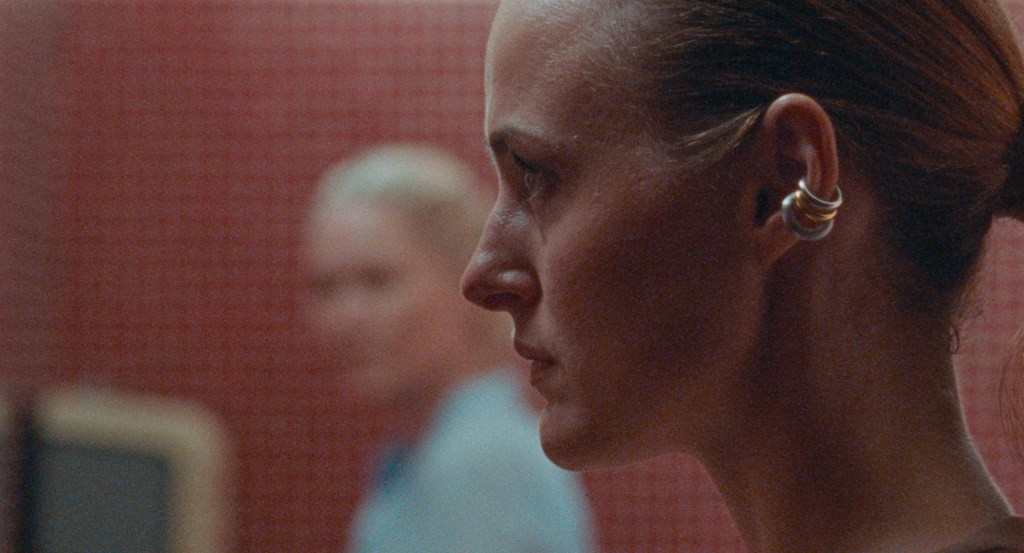
Elisabeth experiences a series of Discreet Charm of the Bourgeoisie-style breaks with reality in the form of dance sequences: a pas de deux with a janitor, followed by a claustrophobic group number full of limbs and groping hands. Reinsve is game—throwing herself about, selling full-blown mania—but these numbers are oblique. It’s never quite clear what they suggest about Elisabeth’s thorny reality, or how their larger gestures—regarding performance and relationships—fold into the film’s larger schema.
These numbers are intercut with two conversations, between Sarah and Anders, Jarle and Sunna. Although the specifics of these conversations are different, their substance is the same: taking stock of the meeting thus far, they come to the realisation that the other person has been misconstruing facts to their own end, and we see their personal and professional relationships fracture in real time. These conversations might feel seismic, introducing snares upon which ideas and themes could catch, if the dialogue wasn’t so evasive. While this style serves the opening scenes—capturing the particular way people talk around uncomfortable topics, and how they use jargon to obfuscate meaning—it proves fatal in these later ones. Just when more clarity and depth are needed, the narrative becomes sheer surface, and it’s impossible to regain your purchase on it once lost.
What we’re left with is a film that makes superficial observations about corruption, power, and the seedy underside of human nature. Everything it says is true: yes, children are capable of harm; yes, parents can enable it through their unresolved trauma; yes, institutions regularly fail those they are designed to protect. So what?
I don’t ask this question to be glib, nor do I ask it because I believe that filmmakers are duty-bound to extol a certain set of ethical values in their work. There are plenty of works that deal with similar subject matter while refusing easy moralisation: Jennifer Fox’s The Tale (2018), Sean Baker’s The Florida Project (2017), and Destin Daniel Cretton’s Short Term 12 (2013), to name a few. But what distinguishes these films from Armand is that they always treat the characters and their experiences with decency and care, by following through on their arcs whether Pyrrhic, self-destructive, or redemptive.
Tøndel positions Armand in opposition to the easy answers provided by Mass and its ilk, but opposition is not in itself a worldview. The form works—it’s very clever—but that rigour isn’t applied evenly. By prioritising narrative shape over thematic coherence, the film repeats the very cycle it is (seemingly) trying to critique, wielding abuse without interrogating it. Yes, the film can admit that these things happen, which is more than its characters can do, but by failing to say anything more it becomes a work of sensationalism. Armand proves itself as abject as its characters, and—drawing from Kristeva one more time, paraphrasing now—sickened, you reject.
Armand screens again at the Melbourne International Film Festival on the 24th of August.
**********
Joshua Sorensen is a writer, bookseller, and committee member for #LoveOzYA based in Naarm. Movies starring Holly Hunter are to him what lamps are to David Byrne.
 Rough Cut