


Payal Kapadia’s All We Imagine as Light is about the dreams of millions of invisible migrants who come to Mumbai with the hope of improving their lives, yet struggle to belong to a place that refuses to fully embrace them. It’s about people who have become used to the loneliness and alienation of moving from a small town to a big city, such that they’ve retreated within themselves. It’s about how systems of othering directed towards individuals based on language, gender, religion, caste, and class differences come to bear in an India where everything—from cultural practices, food choices, and social norms to dressing sensibilities, spoken dialects, and senses of humour—changes within practically every twenty kilometres.
It’s also about how women remain invisible in India, because their personhood continues to be filtered through a patriarchal mindset which fails to acknowledge them as individuals who are free to choose what they desire. They must fiercely contest for space in a society preoccupied with socially and morally policing their right to self-determination. Kapadia traces the lives of three female nurses—Anu (Divya Prabha), Prabha (Kani Kusruti), and Parvathy (Chhaya Kadam)—who must define what intimacy means for them in a city that dims any possibility of genuine connection. This journey of self-discovery for our three protagonists, though initially unassuming, takes on a more subversive meaning as the film moves forward; Kapadia wants us to pay attention to the lives of those that contemporary India has conveniently forgotten.
When described this way, you may expect All We Imagine as Light to be an angry film—an indictment of the country from the eyes of those who have been marginalised. After all, Kapadia has a right to be angry. She is currently battling a police case that’s dragged on for the better part of the last decade, for participating in protests against the appointment of the actor-turned-politician Gajendra Chauhan as the president of the Film and Television Institute of India (FTII), where she was a directing student from 2015–2018. The protests against the appointment of Chauhan were part of a larger movement of resistance led by students against an attempt by the Bharatiya Janata Party (BJP)—the Hindu right-wing party—to curb the independence of educational and creative institutions by appointing compliant ‘yes men’ in positions of power when it came into office in 2014.
After she was charged with rioting, Kapadia’s scholarship as a student was suspended. In her first full-length documentary film, A Night of Knowing Nothing (2021), she relayed the truth of the protest movement at FTII and the brutality with which the State cracked down on students. Premiering in the Directors’ Fortnight section at the Cannes Film Festival in 2021, the film won the Golden Eye award. It still hasn’t seen a release in India. And while her alma mater FTII and the Indian Prime Minister Narendra Modi jumped at the opportunity to congratulate Kapadia on winning the Grand Prix this year for All We Imagine as Light, it’s highly unlikely that even this film will see a wide release in her home country, due to her history of dissent against this government.
But there’s none of that justified anger here. This is a deceptively quiet film, to the extent that you’re lulled into expecting the stillness is building toward a dramatic final act. It’s not. And perhaps, due to the inherent languidness of how the film is put together (which reminded me, in moments, of Tsai Ming-liang’s later work, such as Days [2020] and Abiding Nowhere [2024]), it may not overwhelm you in the first instance. This is also its strength, however, and where Kapadia’s radical streak comes to the fore.

Kapadia has made a quiet film at a time when mainstream Indian cinema is becoming unbearably loud, embodying a level of maximalism and excess that would make Michael Bay blush. She’s made a film centering three women and their interpersonal dynamics in an Indian film landscape that is deeply patriarchal and revolves around male stardom. She’s made a film exploring the need for female intimacy in a country that struggles to comprehend the nuances of female desire, both on and off-screen. She’s made a ‘Bombay film’ but, in doing so, has reimagined Mumbai in a wholly original manner that doesn’t have a celluloid reference thus far. This isn’t the noir-tinted Mumbai of Guru Dutt, where protagonists down on their luck look for a way to change their fortunes. It isn’t Mira Nair’s chaotic, harsh Mumbai wrapped in a cocoon of Kore-eda-like humanism. And it’s definitely not the seedy underbelly of crime that you would see Mumbai cosplay as in a Ram Gopal Varma film.
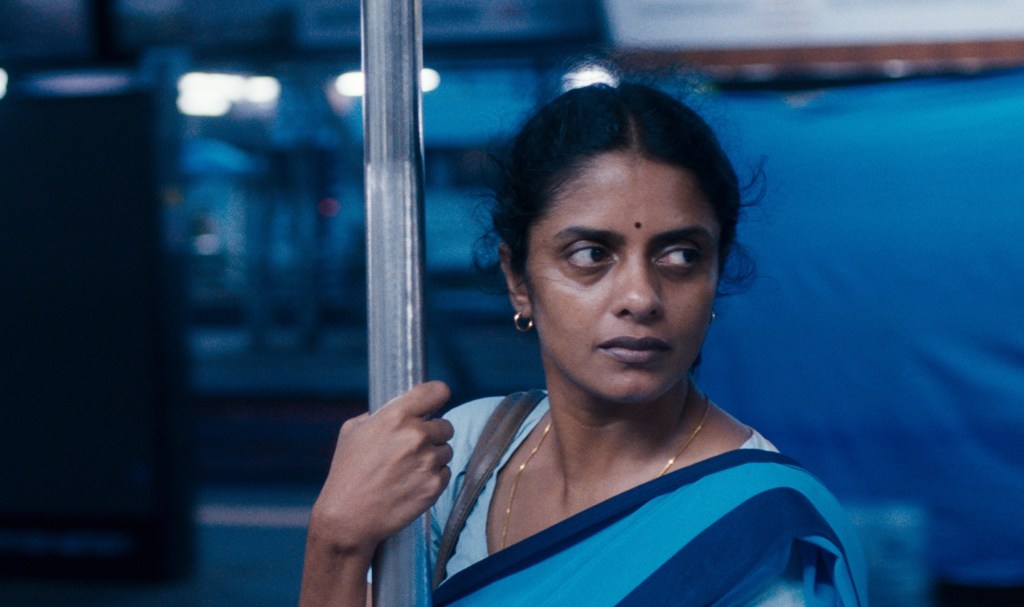
Kapadia’s Mumbai is a slow poison of monotony and apathy—it’s filled with people, yet there is little sign of fondness or intimacy amongst them. Before you know it, this loneliness becomes internalised. The section of the film set in the city is filmed largely at night and presented in cool tones, with different shades of pale blue dominating the frame, conveying its lifeless melancholy. Even the uniforms of the nurses are blue. By the time they finish their shifts and it’s time to go home, it’s so late that the city and its otherwise bustling local trains are barren. It’s not a coincidence that the first time we see a warm splash of yellow is midway through the film, when our three protagonists leave Mumbai to travel to a coastal village, which sows the seeds of hope once more into their lives.
The film’s approach to sound design also does away with any semblance of realism by transforming Mumbai into a ghost town. Bereft of its cacophony of street ambience, the soundscape is instead infused with an artificial sense of quiet. Drawing from her documentary roots, however, Kapadia’s screenplay sparsely punctuates this sense of eerie calm with voiceovers detailing the stories of anonymous migrants who continue to feel like outsiders in Mumbai. The vignette-like structure of the film, scored by TOPSHE (Dhritiman Das), is loosely threaded together by a recurring piano interlude, which creates a sense of wistful coherence amidst the city’s alienating maze.

And yet, even in a place that feels like a dead body slowly turning blue, signs of life seep in. One of the few ambient sound motifs is that of waves crashing against the shore—even when the sea isn’t visible. The sea breeze is an ever-present companion, too, giving our protagonists much needed reprieve from a hot and humid climate. There’s a gorgeous shot of the blue saris of Anu and Prabha, who live together as housemates, swaying by the open window of their apartment while Anu tries to find out more about Prabha’s past marriage. In a cosmopolitan locale like Mumbai, these natural elements can’t do much more than peek through a keyhole. But when we shift towards the coastal village, nature takes over in helping the characters to find the closure they’re seeking and to reclaim their lives.
In a cosmopolitan locale like Mumbai, these natural elements can’t do much more than peek through a keyhole. But when we shift towards the coastal village, nature takes over in helping the characters to find the closure they’re seeking and to reclaim their lives.
—Virat Nehru
The biggest triumph of All We Imagine as Light is how it frames the search for intimacy, particularly for women, as an act of dissent in contemporary India. Prabha needs closure after her husband abandoned her and left for Germany shortly after their arranged marriage. There are hints of a blossoming romance with a doctor at the hospital, but she’s so unsure of herself and her needs that even the possibility of exploring her own desires terrifies her. She’s also touch-starved, to the point that when a rice cooker arrives on her doorstep, presumably sent by her estranged husband, she finds a private corner and engulfs it in a tight embrace, imagining it as a hug from him. This moment closely resembles a scene in Sandhya Suri’s film Santosh (2024)—another Indian feature at this year’s MIFF—where a widow hugs the police uniform of her husband slain in action, craving his presence when he’s no longer around. Both films—Kapadia’s and Suri’s—explore how women carry unrealised, repressed anger by virtue of having to operate in a world that doesn’t understand their needs and desires.
In the final thirty minutes, the film takes a delightful, magical realist twist, when a stranger washes ashore and the villagers presume him to be Prabha’s estranged husband. This stretch of the film has a similar premise to The Stranger and the Fog (1974, dir. Bahrām Beyzāêi), which also appeared at MIFF as part of the Iranian New Wave retrospective. However, Beyzāêi’s film is more externally focused—he wants to investigate the impact this stranger has on the attitudes and behaviours of the village-folk and how this new arrival stokes existing fears of the ‘other.’ Kapadia, on the other hand, takes a more internal approach. The stranger becomes a catalyst for Prabha to find the closure within herself that she’s been seeking from her husband for too long.
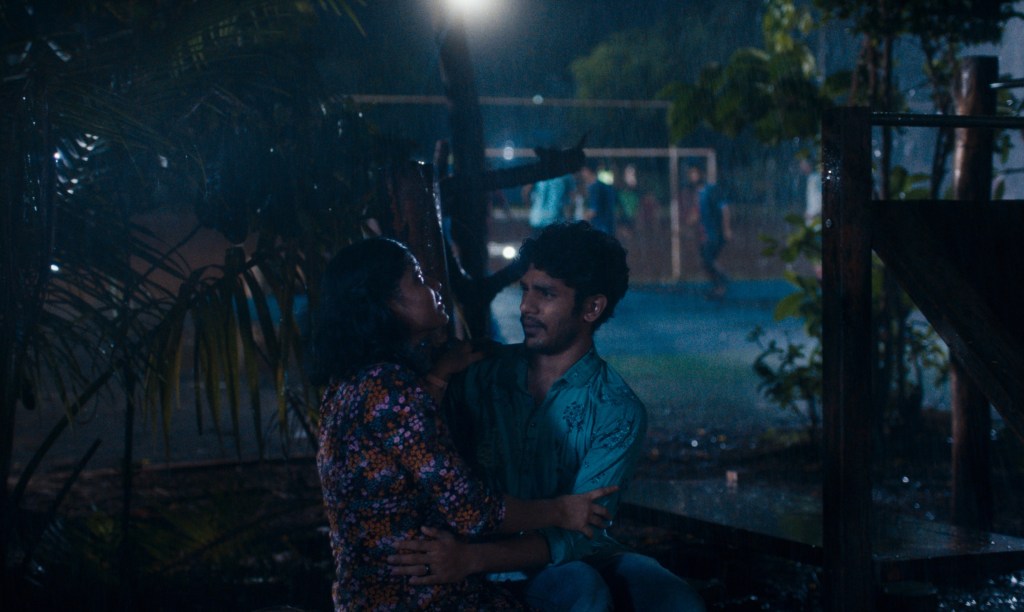
Meanwhile, Anu is in love with a Muslim boy named Shiaz (Hridu Haroon), and must go to extreme lengths to keep this relationship a secret—even wearing a burqa to covertly enter a Muslim neighbourhood. Anu doesn’t know who she can trust with her secret, especially as questions around her moral character are already doing the gossip rounds in her workplace. The young lovers struggle to find moments to be alone, away from the prying and inquisitive eyes of the world around them. Anu has her own soul-searching to do regarding her future as the three women leave for Parvathy’s ancestral village.
The eldest of the three, Parvathy is struggling to establish her own identity and existence since the death of her husband. She has been strong-armed out of her family home so a new block of high-rise apartments can be constructed on the land where she currently lives. With all paperwork in her deceased husband’s name, Parvathy has no legal way to prove that the house she’s currently living in actually belongs to her, and is on the verge of becoming homeless. “Class is a privilege reserved for the privileged,” boasts the tagline of the builders ready to demolish Parvathy’s home. Kapadia articulates an uncomfortable truth: that the economic success story of Modi’s India—with industrialists Adani and Ambani as its self-proclaimed poster boys—is built upon the displacement and disenfranchisement of thousands of underprivileged, routinely exploited undocumented migrant workers like Parvathy.
Three different women, each with their own longings and tribulations. All We Imagine as Light stands apart as a dissenting voice; not only does it lyrically explore ideas of female intimacy and friendship, it also intricately conveys their intersection with religious differences, linguistic barriers, and class and caste divides, as migrants struggle for survival away from home. The fact that this film and its original canvas exists, given everything that Kapadia has been through, is nothing short of a miracle. Its beating heart—soft, but firm and resilient—is a louder clarion call to affirming life in all its forms than anything we’ve seen from Indian cinema in recent memory.
All We Imagine as Light screens again at the Melbourne International Film Festival on the 23rd and 25th of August.
**********
Virat Nehru is an Indian-Australian film critic and programmer. His words have appeared in SBS, Screenhub, The Curb, and Indian Link, among other publications and booklet essays for home entertainment releases. He is the Founding Committee Member of the Sydney Science Fiction Film Festival.
 Rough Cut