

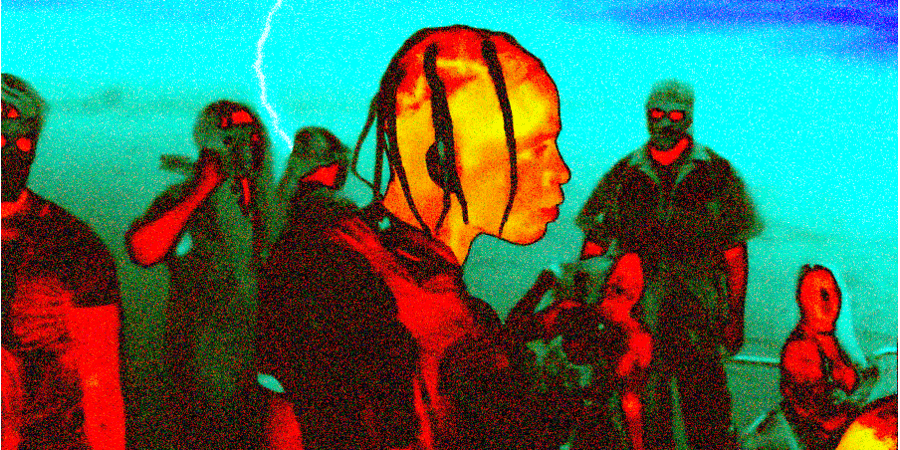
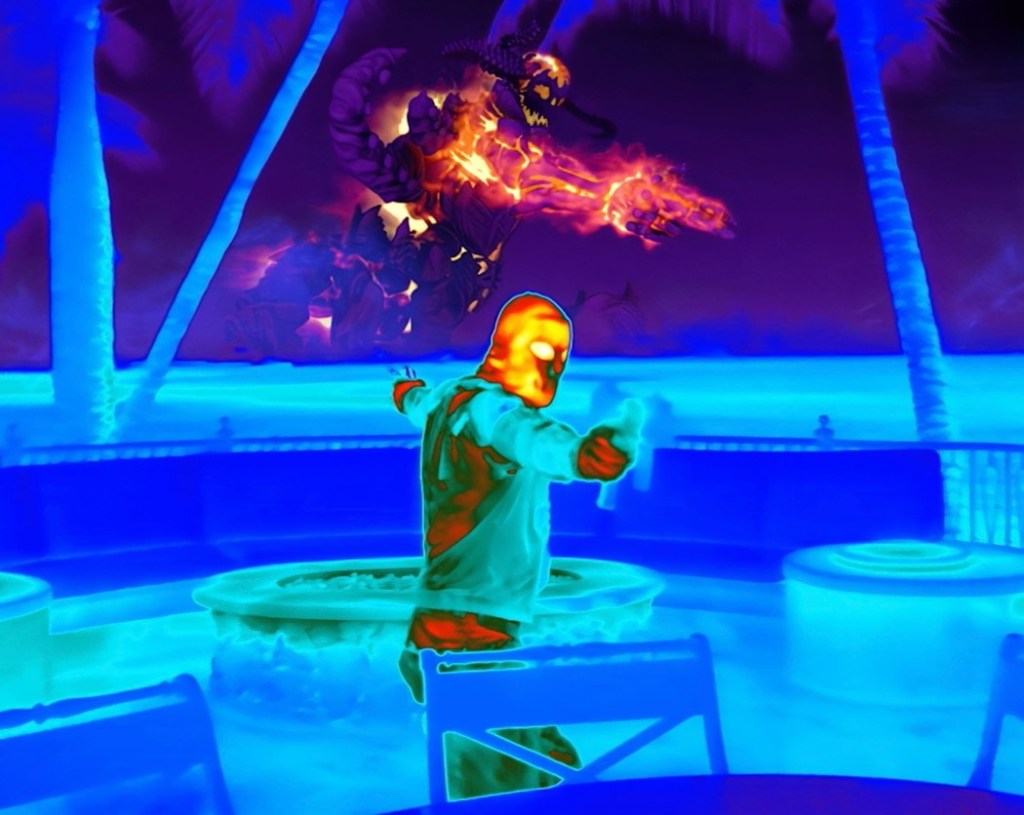
Harmony Korine begins the provocations of Aggro Dr1ft early—right from the surreal opening shots of neon palm trees lining a lava-hued Miami pier under a purplish sky, the visual style carries a forceful first impression. The film is shot entirely through a thermal lens, which renders its tale of a hitman, BO (Jordi Mollà), at odds with his world in intense and psychedelic tones, often as unpleasant as its characters are. BO’s life is bifurcated between the roles of inconsistent family man and jaded professional killer—a funny tension that features often in the worlds of heightened crime narratives. The cliché produces an initial disingenuity that is soon unsettled by the deep sincerity of BO’s anguish and the dizzying whirligig of colours. The harshness of this visual style is augured by the notable typographical effrontery of the film’s title. It’s all very bold and at times hard to take, with layered animations of skull patterns or lightning breaking across the screen. But it offers a compelling insight into one of the more divisive filmmakers of recent years.
This is not the first time that watching a film by Korine has felt like completing a dare. His notorious 2009 film, Trash Humpers, follows three people in masks meeting a variety of strange characters, including a child who instructs them on how to kill a baby doll, and two men in hospital gowns, whom they force feed pancakes doused in dish soap. The group’s violent tendencies are met with little redemption. Ever since his first youthful shuffle into the limelight, in an interview with David Letterman following the release of 1995’s Kids (which he co-wrote at nineteen with Larry Clark), Korine has never been one to pander, kowtow, or self-censor. His directorial career began at age 24 with the narrative blips of Gummo (1997), a film told through vignettes that revolve around a teenager, Solomon (Jacob Reynolds), and his friends and family, living amongst the debris of a recent tornado. When Korine talks about the film, he dwells on evocative images rather than narrative—in his second Letterman interview, he took the time to describe the opening shot of a dog impaled on a satellite. The film debuted at Telluride Film Festival and, while for the most part panned, amassed great praise from a number of influential filmmakers and critics.

Korine’s work is designed to challenge, and even in his least controversial works, such as 2019’s The Beach Bum, he refuses convention with a barely discernible narrative, instead prioritising a gradual cultivation of tone. Though a mellower achievement, Korine’s focus in interviews avoided the usual journalistic undulations; in a GQ profile published around the film’s release, he opted instead to tap dance at random and discuss the possibility of our world being a simulation. It appeared that The Beach Bum reflected Korine’s lifestyle and personality; though perhaps this logic can be reversed to suggest Korine’s having adopted the stoner attitude of the film. This certainly tracks with his commitment to tone over narrative.
There’s a section in Ingmar Bergman’s memoir The Magic Lantern (1987) in which he talks about Igor Stravinsky and the figurative volcano living inside the great composer. He says that for Stravinsky, the art was in taming the volcano inside of him. His followers mimicked this and used restraint despite not having even “the vestige of a volcano,” as Bergman put it. Korine’s expression is clearly not understated and may well be the irrepressible manifestation of his own internally raging volcano, though there is an element of quietude to the saturated sexuality and violence of Aggro Dr1ft that comes through retroactively. That is, Korine’s work operates at such a high level of intensity that it could be framed as a kind of initiation ritual, where one becomes inured to the inflammatory style, which gives way to the emergence of subtleties over time.
As we follow BO, he repeats trite mantras such as, “To live by the knife, to die by the sword,” and, “I am a solitary hero,” which have the bass-heavy sonic texture of a Wu-Tang sample. He only truly finds happiness in escaping his job, his family, and the world as he knows it by sailing his boat to a place where all he can see is water. There is an interplay here of opposites. Until now, all we have seen is hedonism performed by one gender or another, ruled by a strict binary line—that is, the men display violence and violent performances (flashing guns, posing severely), while the women exhibit aggressive sexuality (twerking, dancing desirously or ravenously). BO’s world is loud, much emphasised by the stark heat map visuals and the ominous, crackly synth score. But he represents the search for something other than earthly pleasures. Specifically, he yearns for inner peace. It is this contrast in philosophy that creates an impression of, ironically, confinement in the sensuous ways of those around him.
In Spring Breakers (2012), Korine plays with a similar, gender binary-obsessed hedonism, with James Franco on the guns (and grills), and a cadre of bikini-clad women, including Rachel Korine, the wife of the director, seductively weaving their way through a series of armed robberies. The fact that they are armed, though, and that they force Franco’s character to fellate a gun, erodes the boundary and indeed challenges the binary conditions of gender. The men and women in Aggro Dr1ft, on the other hand, are confined to the tenets of a conventional gender binary turned up to an extreme. Korine populates these films with vulgar, off-putting material, where the female characters are predominantly strippers or faithful stay-at-home wives, whose bodies we see more than their faces. But the camera ogles in infrared, which adds a layer of strangeness to the lecherous imagery and in turn allows it to develop from sexual objectification into abstract fantasy.
Korine tells us Aggro Dr1ft is not really a movie, arranging the conditions of its viewing to follow suit. It has played at venues with simultaneous chat screens appearing alongside the film, and he has also recommended it be viewed in strip clubs, where the film has toured in the United States as part of events curated by EDGLRD, Korine’s multimedia design company. In these environments, the film has been noted to play on multiple screens, including on the ceiling and covering the walls, as though pressure testing the threshold between intense immersion and overstimulation, which serves as its own spectacle, magnified by the novel look of the film.
Korine has asked a number of times recently what comes next, after cinema. He challenges conventional shooting by using thermal recording; he challenges conventional viewing with screenings in unconventional environments. Perhaps Korine’s volcano, to put it crudely, is a thoroughly buried lede. That is, by telling audiences that he has not made a film and that he prefers browsing TikTok to watching movies, the conditions for viewing become a carnival of competing philosophies. Should one be excited by Korine pushing the cinematic form, or are these distractions designed to induce a passive audience experience? Or, should we cynically reject its offerings as edgy but ultimately empty provocations? To take it seriously might be letting the bully get the better of your guilelessness. There is no definitive answer, and Korine’s work thrives on this uncertainty.

Earlier in the year, in an interview about his latest work, Evil Does Not Exist (2023), Ryûsuke Hamaguchi said that “hesitation is cinema.” Whether in the staticky, handycam violence of Trash Humpers or the casual cruelty among friends in Spring Breakers, Korine offers hesitation in droves. It would be easy to dismiss his output as the work of an inveterate online troll, who uses interviews and outrageous pull quotes to hide his insecurities and fortify his work against criticism. But there is something tempting about the work, something inscrutable that compels questions of its layers and meanings. Korine has engineered a persona that is inseparable from and defining of the work he makes. In some interviews for the film, he has worn the ‘demon skull’ helmet that BO’s main target, the crime lord, wears throughout the film. Korine himself appears in Trash Humpers, though mostly heard from behind the camera. For The Beach Bum, behind-the-scenes stills captured him and Matthew McConaughey in matching Hawaiian shirts. In the time of Aggro Dr1ft, Korine’s strict alignment with his project makes a lot of sense, down to interview style.
Under the EDGLRD moniker, his next phase appears to be selling skateboards and the aforementioned demon skull helmets, as an extension of Aggro Dr1ft. The difference to most other film merchandising is the prohibitively high prices and limited runs of items on offer. Korine’s adjunct visual art exhibition, AGGRESSIVE DR1FTER, which opened in Downtown Los Angeles at Hauser & Wirth in September 2023, feels of a piece with his merchandising approach as a possibly self-satirising step into the ‘high art’ world. Though the film itself feeds on excess and pleasure, a queasy impression emerges in bas-relief; the reputation of the ‘high art’ world as vapid, superficial, and cruel, then, would be a perfect setting for an exhibition based on Aggro Dr1ft. Korine may not give us a clear wink and a nod, but it’s this ambiguity that keeps audiences—some, at least—coming back for a little more aggravation.
Aggro Dr1ft can be streamed worldwide via the EDGLRD website.
**********
Linus Wolfe Tolliday is a director of films that tend to revolve around chance. They also like to read and follow the cricket.
 Rough Cut