


The jolting synths of Eurythmics’ nihilistic pop masterpiece ‘Sweet Dreams (Are Made of This)’ are our entry into the world of Kinds of Kindness, a triptych of fables directed by Greek auteur Yorgos Lanthimos. “Some of them want to abuse you / Some of them want to be abused,” taunts singer Annie Lennox over the opening credits, revealing the film’s modus operandi before the first scene has even begun.
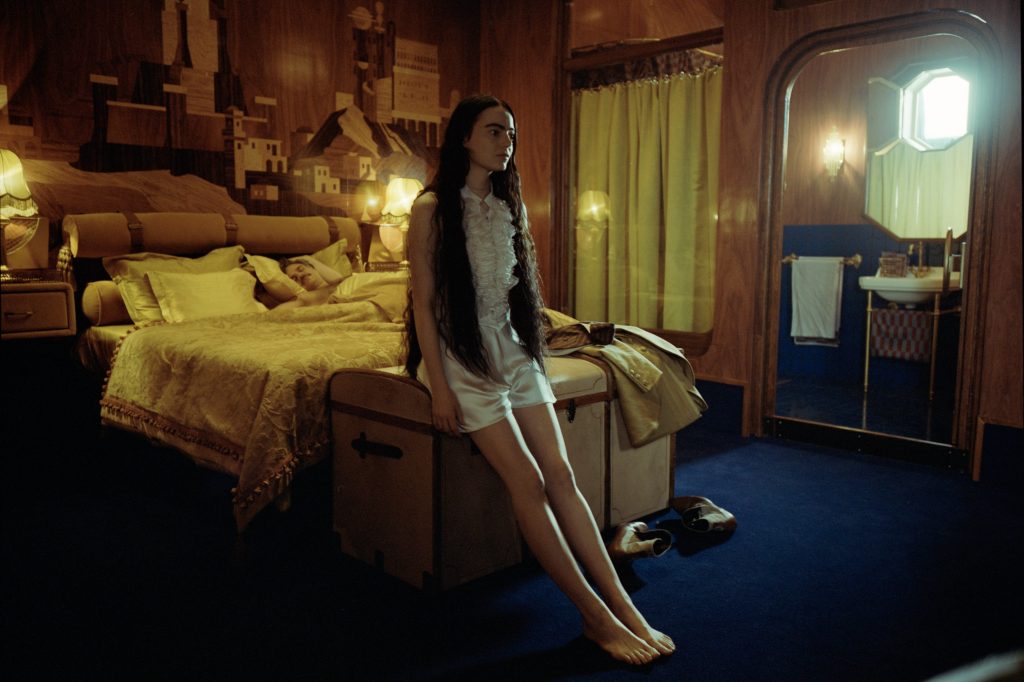
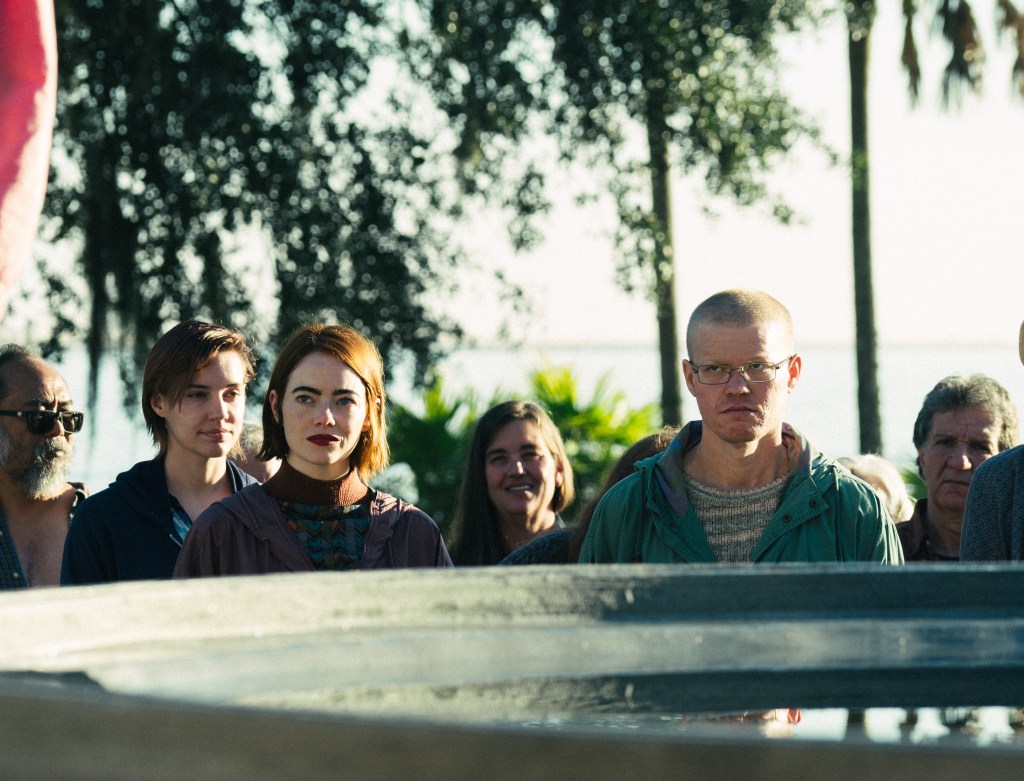
Lanthimos’ compulsive fascination with methods of control is on full display across the bleakly comic anthology film. Kinds of Kindness follows an assortment of isolated upper-middle class freaks, all in various states of peril, with the same cast of seven actors performing as different characters across each story. In the first act, ‘The Death of R.M.F.,’ a superb Jesse Plemons plays Robert, a man desperate to win back the trust of his boss Raymond (Willem Dafoe), who plans every element of Robert’s life with fanatical authority. In ‘R.M.F. is Flying,’ the film’s second parable, Plemons plays police officer David, who is married to marine researcher Liz (Emma Stone). After disappearing on a work trip, Liz returns home only to be met with reticence from David, who suspects she is a false version of his real wife. In the final segment of the film, ‘R.M.F. Eats a Sandwich,’ Stone takes centre stage as Emily, a cult member on the hunt for an enigmatic Messiah figure while she adjusts to a new life away from the family she has seemingly abandoned.

The director, with the assistance of longtime writing partner Efthimis Filippou, triples down on his pet themes of domination, alienation, and humiliation. Lanthimos is famous for placing his characters in situations where the absurdity of human behaviour is turned up to eleven. In Kinds of Kindness, new relationships begin with self-inflicted injury, a body part is offered as proof of companionship, and a character’s worthiness is assessed based on the purity of their sweat. The most mundane of actions are rendered as excruciating or life-threatening tasks, the body is always in a state of duress, and his performer’s stylised affectations amplify the ludicrous ways people sabotage even the most vital of human needs: connection. While his previous two films, Poor Things (2023) and The Favourite (2018), pursued a heightened theatricality within period (or period-like) settings, Lanthimos’ latest returns to the contemporary comic stylings of The Killing of a Sacred Deer (2017) and Alps (2011). Many of the actors assume an atonal manner of speaking, verbose outbursts of emotion are replaced with careful choreographies of physical expression, and acts of violence are performed with a deadpan resign.
As the latest entry into the director’s oeuvre of ostracization, Kinds of Kindness distinguishes itself from other Lanthimos works not only with an anthological form of storytelling, but with an anthological style of acting. Armed with a company of performers taking on (at minimum) three roles within the film, the suggestion that the self is merely a performance is magnified threefold. Though the actors play new characters in each segment, their repeated appearances and recurrent behaviours mean that audiences are likely to draw their own connections between the three stories. Aesthetically, changes between characters are also minimal, limited to hairstyling and clothing as opposed to the use of accents or prosthetics.

This casting mechanism, while heightening the film’s questions of how one assembles their sense of identity, is also just a lot of fun. Lanthimos’ ensemble (rounded out by Margaret Qualley, Hong Chau, Joe Alwyn, and Mamoudou Athie, with a third-act cameo from Hunter Schafer) throw themselves into the project with a total embrace of the director’s acerbic humour. Though rarely described as such, the auteur is first and foremost an actor’s director; despite his reluctance to go on the record about any notion of style, the specific quality of the comic performances across all nine of Lanthimos’ features has become the defining element of his filmography.
Notorious for his theatre-based rehearsal processes, Lanthimos cites early experiences with the Greek stage as the basis of his method for directing actors. Using drama games and tasks of improvisation, the rehearsal period is intended to move actors out of their heads and into their bodies. Influenced by the likes of the legendary expressionistic choreographer Pina Bausch and the surrealist works of Luis Buñuel, Lanthimos requests his actors see their memorised dialogue as an extension of a kinaesthetic language. Bodies in motion are not only an aesthetic pleasure, but an opportunity to witness ourselves as instruments of both personal autonomy and destruction. Like Bausch and Buñuel, Lanthimos draws out the repressed or subconscious desires of his characters through physical actions that reject unspoken social codes. Lanthimos routinely finds somatic inspiration in animals, as his actors are forced to submit to their most base desires: licking, fighting, fucking, sucking. The sense of abandon he demands from his actors is akin to that of a dog off-leash, running headlong into freedom.
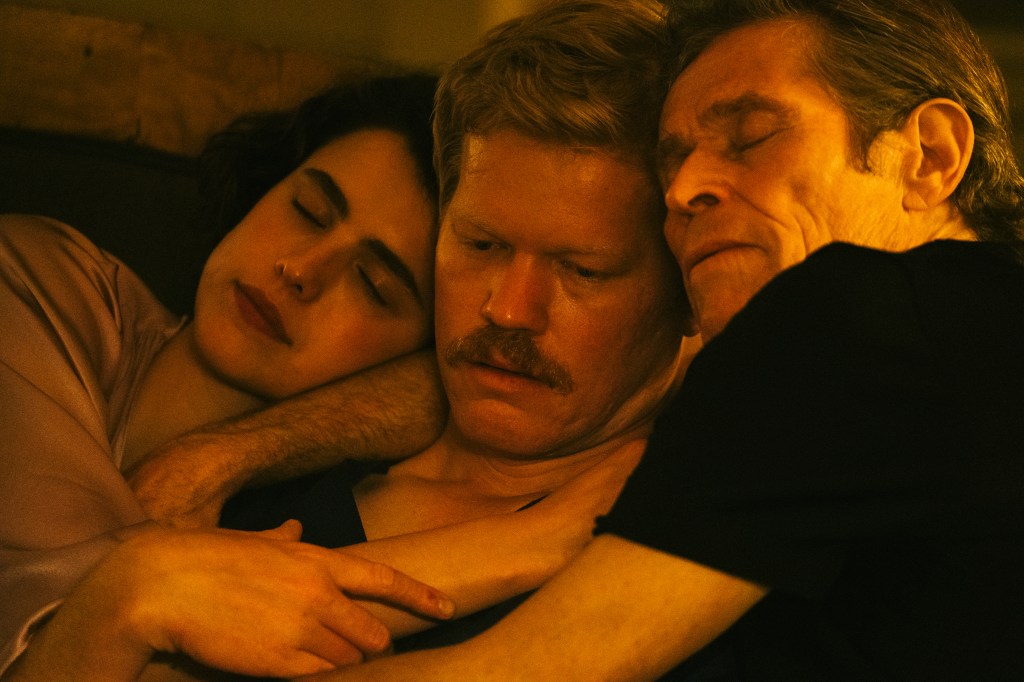
As most actors will attest, the severity of the rules with which Lanthimos constructs his worlds provides the greatest creative freedom. While the characters of Kinds of Kindness endure numerous embarrassments, Lanthimos’ actors seem to revel in the liberties these twisted tales allow them. In particular, the film marks the fourth collaboration between Lanthimos and Stone, who has become his most frequent acting co-conspirator (a fifth collaboration has already been announced). Her agile, alien-like appearance and nimble comic timing accord perfectly with Lanthimos’ strange stylings, and her willingness to ‘go there’ resulted in an Academy Award for her performance as the batshit, baby-brained Bella Baxter in Lanthimos’ Poor Things (which she also produced). It is understandable why Stone would relish her Alice-like role within Lanthimos’ wonderland. The women in his films, despite often enduring significant suffering and subjugation, are unburdened by the constraints of oppressive ‘real world’ niceties.
Enjoying an increasingly rare combination of critical and commercial success, Stone has thrown her star power behind Lanthimos. The pair’s creative bond, and her desire to push her dexterous comic talent to new extremes, has allowed her to subvert audience expectations as an actor who got her start in teen comedies. Armed with lethal levels of charisma, Stone elicits a winning sympathy that helps viewers weather even the harshest of terrain. Even when she is playing the viperous Abigail in The Favourite, her first film with Lanthimos, you can’t help but root for Stone—she’s the spoonful of sugar that helps the cyanide go down. An ecstatic dance near the final moments of Kinds of Kindness captures the many facets of the actress’ gifts—viciously comic, rigorously full-bodied, and feverishly tip-toeing the tightrope of pleasure and pain.

While popularised by Stone’s work, the striking, non-naturalistic style of acting in Lanthimos’ films has been embraced by several reoccurring collaborators, most notably the two performers who round out the director’s Holy Trinity—Angeliki Papoulia and Colin Farrell. As the only performer to appear in both Lanthimos’ Greek and English language features, Papoulia’s fearless performance in the director’s 2009 breakthrough Dogtooth introduced the cruel physicality that has become a motif across his work. As an infantilised daughter who has never been permitted to leave home, the actress is both frightening and hilarious, setting the standard of commitment required to survive a Lanthimosian nightmare. The DNA of Papoulia’s performance in Dogtooth—from her unnervingly deadpan comic flourishes to her skin-crawling, signature dance scene—is visible in much of the work from the Kinds of Kindness cast.

Colin Farrell’s position as the lead of Lanthimos’ first two English language films also welcomed new elements to the director’s output. The Lobster (2015) marked Lanthimos’ first time working with an international movie star, which allowed the director to play with subversions of Farrell’s star persona as Ireland’s favourite bad boy. Farrell the star disappears into a character so transparently vulnerable that the actor is almost invisible. His performance displays a level of empathy and soulfulness somewhat absent in Lanthimos’ earliest works, tapping into a morbidly funny sadness which counters the filmmaker’s more gleefully sadistic tendencies. Farrell’s performance in The Lobster feels in direct conversation with Plemons’ spin on the hapless ‘everyman’ in Kinds of Kindness, with both actors deploying a world-weary quality that warms the chilled air of Lanthimos’ atmospheres.
The work of Farrell, Papoulia, and Stone also highlights the ways in which Lanthimos engages with binary performance of gender in his work. Typically, Lanthimos men are softer and weaker, or more prone to enact behaviour that subordinates them to a higher power. Conversely, his female characters are often feral, cunning, and explosive—women who seek to dominate their environments or act as willing agents of chaos, even when their attempts are thwarted (usually by men). Kinds of Kindness doesn’t break new ground in its analysis of gender, yet the film’s queries into the constraints of gendered power structures are conveyed with greater subtlety than the gothic girl-bossing of Poor Things. The filmmaker is acutely aware of the ways in which our grappling with domination and submission—in the workplace, in the bedroom, or on an island ruled by dogs—are informed by our experiences of gender, as they play out within the unrelenting gaze of others and the storms of our self-perception. This builds upon Lanthimos’ fascination with the self as a flexible entity—one that can be moulded or repurposed.
Cultural critic Wayne Koestenbaum argued in his 2011 book, Humiliation, that “identity germinates from humiliation’s soil.” Lanthimos would likely agree, as his characters endure abasement after abasement out of the desire to fulfil an unmet need. It is the absence of love, affection, or companionship that defiles our humanity, and we attempt to fill this void with arbitrary notions of power and success. Lanthimos grapples with this side of human nature by suggesting that it is borne from an instinct to survive, no matter the precarity of one’s circumstance. This survival is achieved through the accumulation or relinquishing of power, maintained through the infliction of pain and suffering—either to another or to oneself.
Kinds of Kindness implies that we all face the same problem. Whether you are a corporate chump, a cop, or a cult member, pain is inevitable and sometimes necessary to make sense of your own reality. It is not what makes us different, Lanthimos and his cast emphasise, but rather what makes us the same, that leads us to act in desperate and depraved ways. As Lennox reminds us in the chorus for ‘Sweet Dreams (Are Made of This)’: “Everybody’s looking for something.”
Kinds of Kindness is now screening in Australian cinemas.
**********
Andrew Fraser is a writer, performer, and filmmaker based in Sydney, Australia. He holds a Bachelor of Fine Arts (Acting) from the National Institute of Dramatic Art and is an alumni of the MIFF Critics Campus. He has worked on multiple film and television projects including Heartbreak High, Birdeater, Three Thousand Years of Longing, Bump, and Mr. Inbetween. His writing has been featured in the MIFF Revue, Kinotopia, and The Big Issue, and he is a regular guest critic on ABC Drive Radio.
 Rough Cut