


Watching Maxine Minx (Mia Goth)—the now begrudgingly prolific porn performer at the centre of Ti West’s MaXXXine—saunter out of a Hollywood audition, all blue jeans and rabid self-confidence, it’s hard not to think of Showgirls (1995). In that film’s opening, Elizabeth Berkley’s Nomi Malone (who, like Maxine, has rechristened and uprooted herself in trauma’s wake) is traipsing a Vegas-bound highway, yearning to be carried into seamless stardom. From here arises a surreal arc that involves pain, betrayal, and debasement, but also lust, ecstasy, and genuine connection, all pursued by Nomi with a near-superhuman sincerity. Despite their parallels, however, West’s latest—in which the promise of an energetic thrust is quickly snuffed by cynical sangfroid and suspenseless schlock—has no future in the annals of camp.
MaXXXine marks the third film in the director’s A24-produced horror trilogy, which began with X (whose story MaXXXine resumes, a decade after the ‘Texas Porn Star Massacre’ of which Maxine was the sole survivor), and proceeded with crowd favourite prequel Pearl, which saw Goth’s X villain as an embittered wannabe actress, awaiting her husband’s return from World War I. When Maxine lands a role in The Puritan II, the sequel to a controversial horror film directed by Elizabeth Bender (Elizabeth Debicki, whose icy Britishness could be compelling, were it surrounded by enough relative warmth), Maxine’s past threatens to re-engulf her. A VHS copy of the flick she made with her now long-dead porn troupe appears in her living room, a Private Investigator is shamelessly trailing her (Kevin Bacon, too cartoonish to be cruel), and a killer specialising in femicides (the Night Stalker, whose creaking leather gloves precede him) haunts the Hollywood boulevard, where Maxine moonlights as a blasé burlesque dancer.
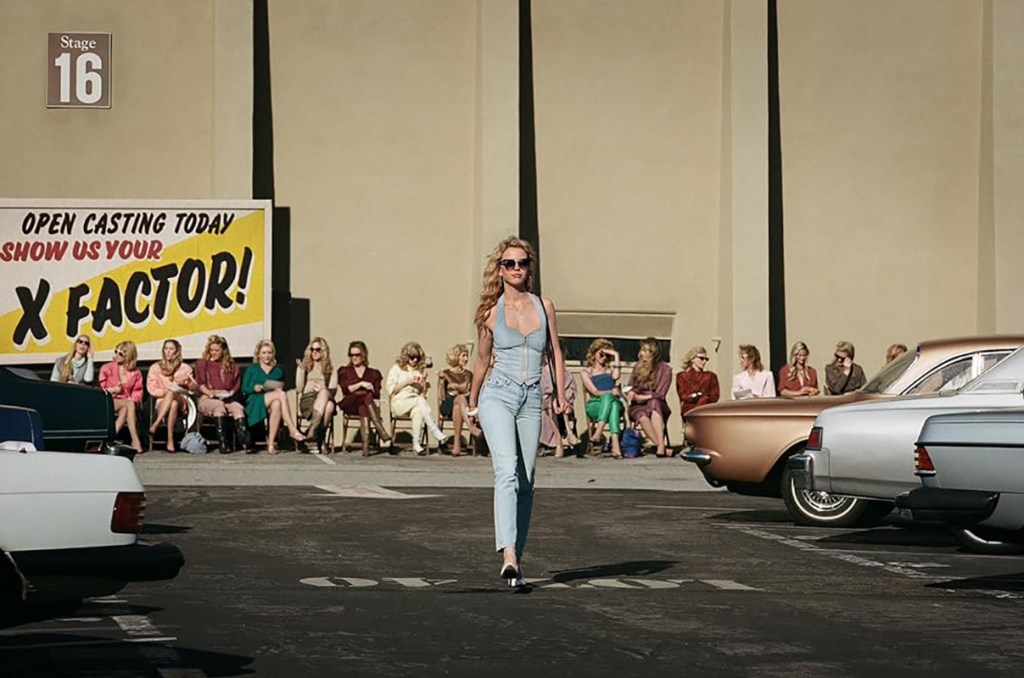
Maxine is desperate to ascend from pornography into a sphere of respectability and glamour, immediately flaunting the realness of her latest gig to her sex industry colleagues. West strives, confusingly and inconsistently, to satirise this division between the real and the false, between high and low culture. “They don’t want you to be in the movie,” Elizabeth will tell Maxine during a buggy tour of the set, “because it’s too controversial for a porn star to be in a satanic horror movie.” But the director’s decision to vacuum-pack MaXXXine with unsubtle homages to his own auteurist canon means that the film, like its protagonist, seems desperate to justify its worth. Most hammy are its allusions to Psycho (1960); the lot The Puritan II is being filmed on also happens to house the infamous Bates Motel set. As Maxine foresees her future self in its attic window, West hones in on the stories’ superficial similarities; in particular, Psycho‘s spectre of aged and infirm femininity, here transmuted into crystal-clear images of Goth in weighty prosthetics. While Psycho hinges upon the gravitas of the nested and unseen—of the enclosed room, the disembodied voice, the potential for violence to be exerted by a vulnerable body—MaXXXine is compulsive in its slashing of ambiguity. Body bags are peeled away to verify every mutilated face, already pathetic villains are dealt with in efficient flashes of action, and slippery conversations are swapped for snarky one-liners.
While X and Pearl, both set on a Texas farm and filmed at different stages of the pandemic, share the charged, claustrophobic doom of a (near) chamber piece, MaXXXine’s version of Los Angeles is abstracted into a bland sprawl, presenting an edgeless expanse with scant definition beyond the clichés of sidewalk stars and the Hollywood sign. Shorn of any intimate detail, even Maxine’s apartment looks like a half-emptied studio, evoking questions that go unanswered: How, for instance, has she been living for the past ten years? What does she do for pleasure? With predictable plotting that relies heavily on retreading the lore of its previous chapters, and a wavering attention to its stock, NPC-like side characters, MaXXXine’s world unfurls like that of a video game still undergoing beta testing.
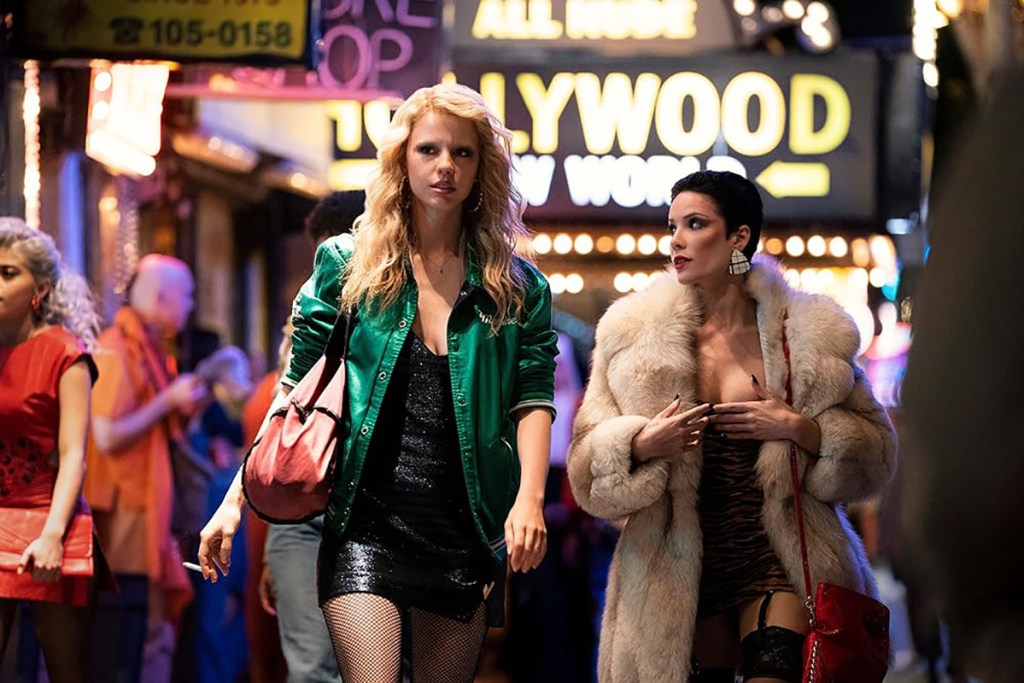
Where the close quarters of X’s outhouse caused identities to blur and anxieties to congeal, in MaXXXine, intimacy and psychology give way to an overwhelming sense of detachment. A notable exception to this chill lies within Moses Sumney, who appears as Maxine’s only friend, video-store clerk Leon, and whose ease exists in sharp relief to the abrasive quality of other bit roles. These include Lily Collins as a Yorkshire-born Hollywood up-and-comer and Halsey as a peppy sex worker—half-drawn cautionary tales comprising two sides of the same, flat coin. While Sumney exudes an otherwise rare suppleness, the pair’s relationship is glossed over (they bonded, we learn, simply because Leon was never interested in fucking Maxine) and soon discarded.
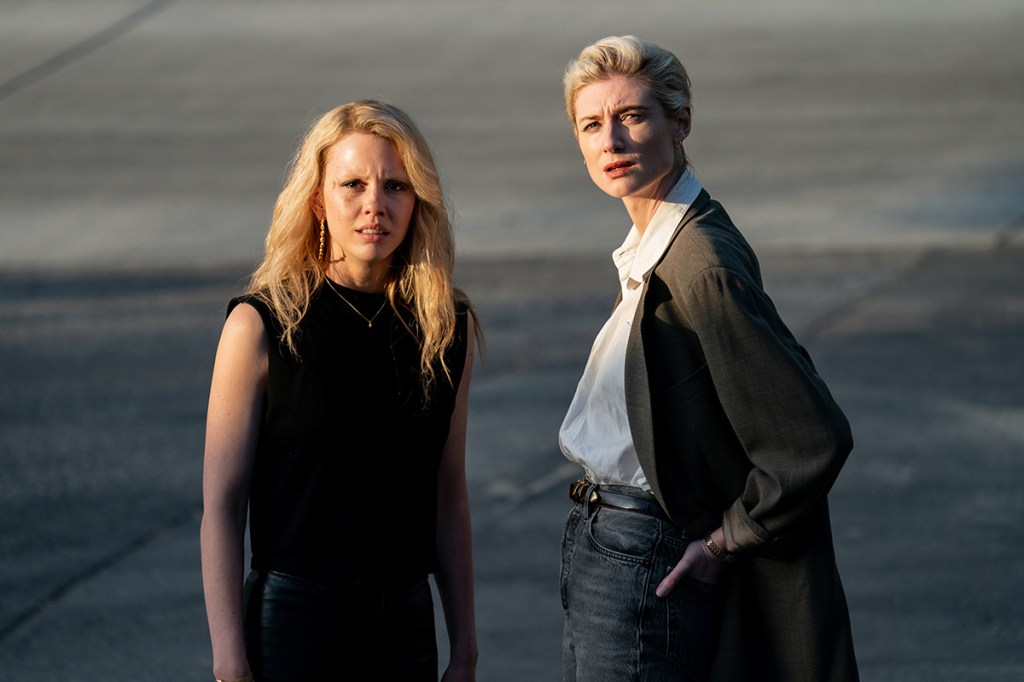
As an aggressively stylised eighties period piece that swings for psychosexual thrills, allusions also abound to the work of glam noir auteur Brian de Palma (Body Double [1984], Blow Out [1981]). There are lush women nightwalking in satin and furs, and ceaseless attempts to craft a paranoid ambiance from rebounding neon and echoey synths. Yet MaXXXine’s efforts feel stagnant, inflected as they are by a social media-era perfectionism and flattened by a digital clarity which excises all grit and grain. Nothing is awkward or mussed, and the jewel-toned mise-en-scene more closely resembles the belaboured nostalgia of Riverdale or Euphoria (the creator of the latter, Sam Levinson, was also a producer on the film). Failing to cohere into a compelling mood, or to deepen the film’s feeble emotional stakes, West’s references signify little more than cinephilic know-how (or know-of), giving the impression of a Letterboxd log adapted for the screen.
Breadcrumbs of more thrilling films also contribute to making MaXXXine’s absence of erotics all the more jarring. In contrast to its bolder precursor, X, sexuality is here relegated to cheap jokes and meagre shocks, rather than being taken seriously as a destabilising force. Parking attendants’ faces jolt into leering recognition when Maxine enters The Puritan II‘s set; a Buster Keaton lookalike’s balls are busted. When Maxine returns to a familiar, cavernous porn studio after her triumphant audition, she passes her colleague, Amber (Chloe Farnworth), who, during a shift of mechanical sex, bemoans how long it is taking for her scene partner to come. As the story continues, and its plot settles on a duel between cultish puritanism and Hollywood’s alleged hypersexuality, it’s ironic that West lands on his own brand of the former, choosing to sublimate the vivid fervour of his cinematic touchstones with a limp, narcotic ennui. The only kind of desire that the film seems interested in is Maxine’s ambition itself, affirming a feedback loop of ambition for ambition’s sake (captured by her preacher-father’s vague, oft-repeated mantra, “I will not accept a life I do not deserve”), which feels contrived, above all, to sell more costumes in an era of rampant girlbossery.
Perhaps the film’s greatest loss, however, lies in its treatment of its own star, who is waylaid as Maxine takes centre stage. In recent years, Goth has garnered a strong reputation for her agile performances of passion and perversion—nearly always imbued with a troubling excess of innocence that is prone to being bent out of shape, but never simply effaced, by evil. This was true of her first film role, in Lars von Trier’s Nymphomaniac: Vol. II (2013), in which she played a neglected teenager taken under the wing of Joe (Charlotte Gainsbourg), whose allegiance to her sexual guardian unfolds, in uneasily organic motions, through stages of tenderness, obsession, and destructive rage. More recently, Goth’s tormenting multiplicity featured in Brandon Cronenberg’s Infinity Pool (2023), where she appears as Gabi, the lead of a gang of droll elites who uses her needling charms to engineer sadistic games of death and rebirth.
Goth has always been both a muse and orchestrator behind the trilogy, co-producing Pearl (whose script she also co-wrote) and MaXXXine alongside the director. Nevertheless, beyond Maxine’s opening audition—where her expressive face, snugly framed, is transfixing—altogether Goth conjures little more than an idle aplomb, mimicked by the camera’s own, disinterested attitude towards her, as it crawls half-heartedly up her sleeping body or flits passively between mid-shots. As we scurry towards a soporific, albeit frantic, climax, there proves no time to linger on Maxine’s reactions to the world around her. Rather, these are sliced away in favour of visions and flashforwards whose contents could’ve been expressed far more potently in gestures and glances. Near the film’s end, Elizabeth tells Maxine that she looks like a “Hitchcock blonde,” but this is where the comparisons stop.
MaXXXine is now screening in Australian cinemas.
**********
Indigo Bailey is a Tasmanian writer and editor living in Naarm/Melbourne. In 2023, she received the Island Nonfiction Prize for an essay about rain sound. She has written for Island Magazine, The Guardian, Voiceworks, and Kill Your Darlings, among other publications.
 Rough Cut