


There’s a remarkably visceral quality to Timothy Despina Marshall’s feature directorial debut, the queer psychological horror In the Room Where He Waits. Watching up-and-coming theatre actor Tobin Wade (an outstanding Daniel Monks) while away his two weeks of COVID isolation in a Brisbane hotel room, there’s a sense of needing to hold your breath for fear of what you may be just about to find out.
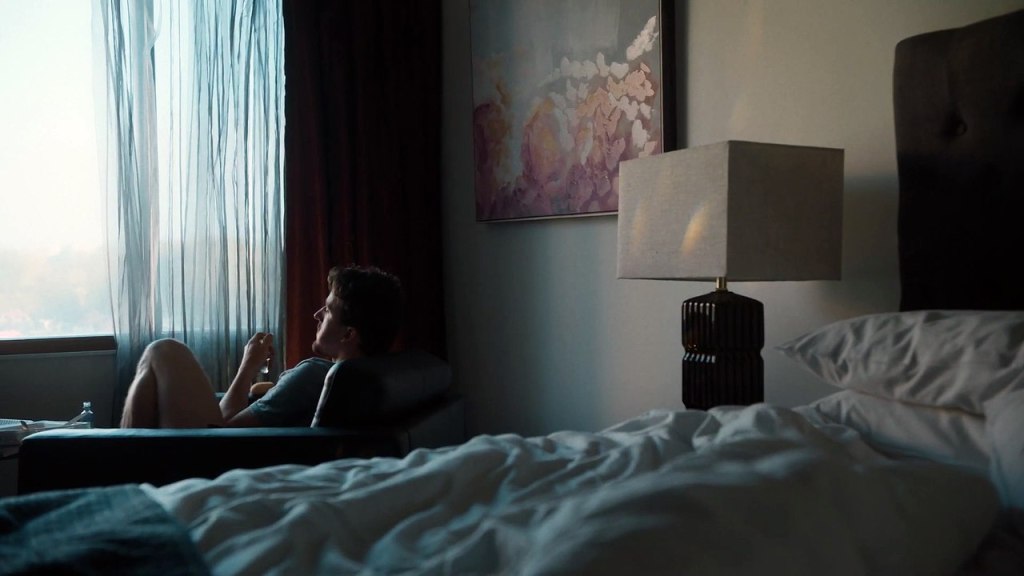
Set for a major break in The Glass Menagerie on Broadway, Tobin is forced to return to the city he once ran from to deal with his father’s passing. Brushing off the advice of his friend and scene partner Sienna (Annabel Marshall-Roth), Tobin avoids communicating his situation during Zoom rehearsals. Likewise, he withholds from his concerned mother (Susie Porter in a voice-only role) the news of his recent romantic separation. Trying and failing to compartmentalise his grief, Tobin begins to notice traces of another person in the room of his confinement. The daylight that filters through the room’s sheer curtains has a cold, blueish tinge, but at night the lamps cast a muted yellow glow. It could be inviting, but as the strange occurrences become increasingly difficult to parse, it begins to feel sickly.
In the Room Where He Waits has garnered significant praise over its past few weeks of screenings. In a review for The Curb, Nadine Whitney called it “one of the best Australian debut features around.” As a former screenwriting student of Marshall’s, I’m really pleased to see him having this well-deserved success. After catching the film at a recent Q&A screening in Melbourne, I had the chance to speak with him.
Reflecting on the highs and lows of releasing an independent film, Marshall has a generous outlook to “share and be open […] so that there’s a learning for people that come after you.” He doesn’t want to discourage anyone, but he’s conscious “to not beat around the bush about how hard it is.” The distribution process has been “a tough slog,” he says. “It’s a really hard time at the moment in general for film sales,” he explains, acknowledging that In the Room Where He Waits’ hotel quarantine setting may make it a particularly difficult sell given a general aversion to COVID-adjacent stories. Even with the partnership of a small distribution company, “you have to really be all hands on deck. There’s not really a marketing budget,” he continues. “It’s an ongoing conversation, finding ways to get Australians to watch Australian cinema and to get past the cultural cringe.”
It’s an ongoing conversation, finding ways to get Australians to watch Australian cinema and to get past the cultural cringe.
—Timothy Despina Marshall
Production took place during, and came about partly as a result of, nationwide lockdowns. “Funnily enough, In the Room Where He Waits wasn’t actually meant to be my first feature,” Marshall notes. “I’m still developing, in a different way now, another feature that was meant to be shot [earlier]. With the pandemic, everything shifted. It’s funny how things work out. This did come about quite quickly.” Marshall developed the idea with collaborators Dimple Rajyaguru and Paradox Delilah. He reasons that having this writers’ room meant the story “was able to incubate perhaps a little bit quicker than normal.” The extended shutdown also contributed to the availability of an ideal filming location. “We had a window, I guess, during the pandemic, that meant filming at this particular hotel was very accessible, very affordable, and obviously a very rare occasion because no one was at the hotel.”
Hotel rooms are transitory and perhaps innately haunted spaces. There’s a certain incongruity in being tethered to a place that exists to be passed through. Marshall and cinematographer Ben Cotgrove make full use of their limited location, and especially of its ever-present mirrored surfaces. As Tobin leans his head against the window, his reflection is multiplied, a clear double with a fainter one behind it. At other times, he is physically boxed in by dark shadows. At every turn, he is stifled and forced to confront what he wants desperately to escape. On Triple R’s Primal Screen, host Dr. Flick Ford eloquently spoke to how “this liminality, this fixedness, has a really powerful parallel in Tobin’s disability, in his queerness and also his grief.”
As Tobin, Monks (Pulse [2016]) is unguarded and never less than compelling. Marshall expresses how critical it was for the actor, who is hemiplegic, to feel “equal as a creator.” “I don’t have a disabled experience, so it was really important to me that it was a deep collaboration,” he says, noting that it was Monks’ request that the role not be changed to include his disability once he was cast. While the film is by no means autobiographical, it is clear that both Monks and Marshall have in some way drawn from their individual experiences and desires for authentic representation. “Being someone who grew up in the 90s and the 2000s, it was like, you sort of took what you could get with gay cinema,” Marshall remarks. “It was always the beautiful young bodies.”
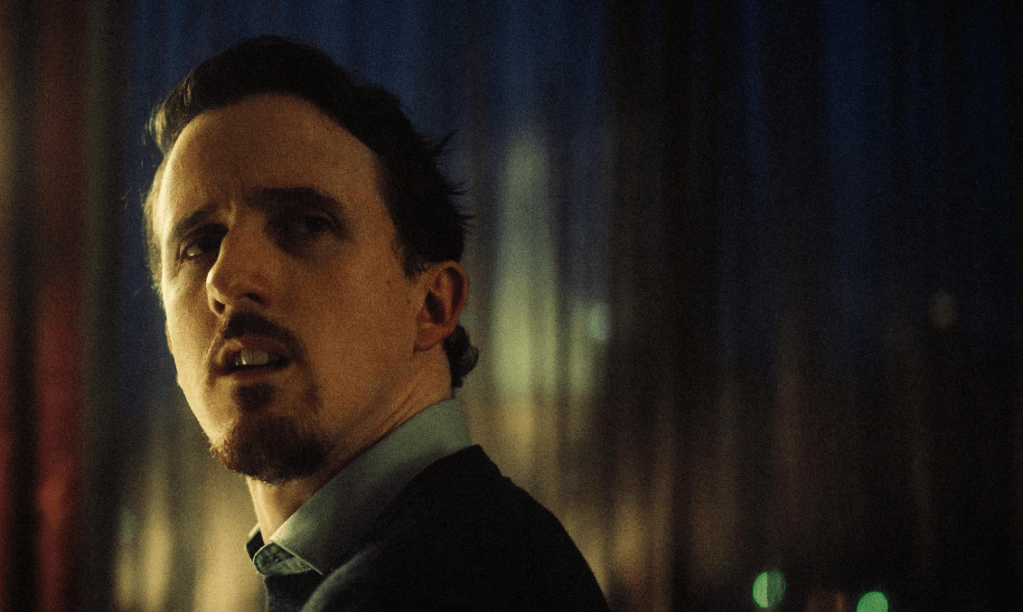
He explains how he “wanted to be really vulnerable” in interrogating some of his own feelings surrounding the desire for validation through his writing. “There’s something about the experience of being single, being a little bit older as a gay man,” he shares; “not feeling like you fit into certain categories [or] beauty standards and being in that online space that’s kind of like this meat market where you’re being judged solely on what you look like.” Early in the film, having left a forlorn voicemail for his ex-boyfriend Adrian, Tobin downloads Grindr (“it’s like a video game with hot guys,” he tells Sienna). He takes some posed photos and solemnly awaits a response that never arrives. Later, in a moment where he’s had to drop his defences, he opens up about how Adrian once told him he was beautiful. “I feel like I’ve waited my whole life to hear a man say that to me,” he says.
In many ways, In the Room Where He Waits serves as an exploration of queer loneliness. Some have already pointed out the parallels to Andrew Haigh’s beautifully tender All of Us Strangers (2023). Marshall calls Haigh “an incredible filmmaker.” “I feel very connected to him because when he released Weekend (2011), I released Battlefield (2012), one of my earlier short films, and it was about this one night stand connection, and it had similar themes,” he explains. “When I saw All of Us Strangers, I was like, ‘Oh my god, wow; I’m releasing a feature that is again exploring such similar themes to this, around the same time.’” Another of Marshall’s shorts, the atmospheric Gorilla (2013), was awarded the Iris Prize, the largest LGBTQ+ short film award in the world. This facilitated the production of Followers (2015), which had its premiere at the Sundance Film Festival. Marshall speaks to how the lessons from each of these productions helped form “the kind of filmmaker [he] wanted to be.” “I think with every short that I’ve made, you learn something that you never thought you would,” he reflects. “It was always really important that whatever project I did was something that really deeply resonated with me.”
In the context of queer representation, Marshall believes strongly in the significance of hope, which ultimately comes across through the film’s arc in a way viewers might not expect. “I just think we’ve seen […] the sad narrative, the hopeless ending narrative. We’ve grown up with that, we’ve had to live with that for a very long time. Young people are still living with that. So, I think there’s a deeper conversation of what role queer cinema should be playing,” he says. “Hope is really important in queer narratives.”
I just think we’ve seen […] the sad narrative, the hopeless ending narrative. We’ve grown up with that, we’ve had to live with that for a very long time.
—Timothy Despina Marshall
In the Room Where He Waits will screen in Brisbane on the 30th of June, and in Sydney and Canberra on the 7th of July.
**********
Grace Boschetti is a Melbourne-based freelance film critic. She has written for Metro, Senses of Cinema, and ScreenHub, among other publications.
 Rough Cut