


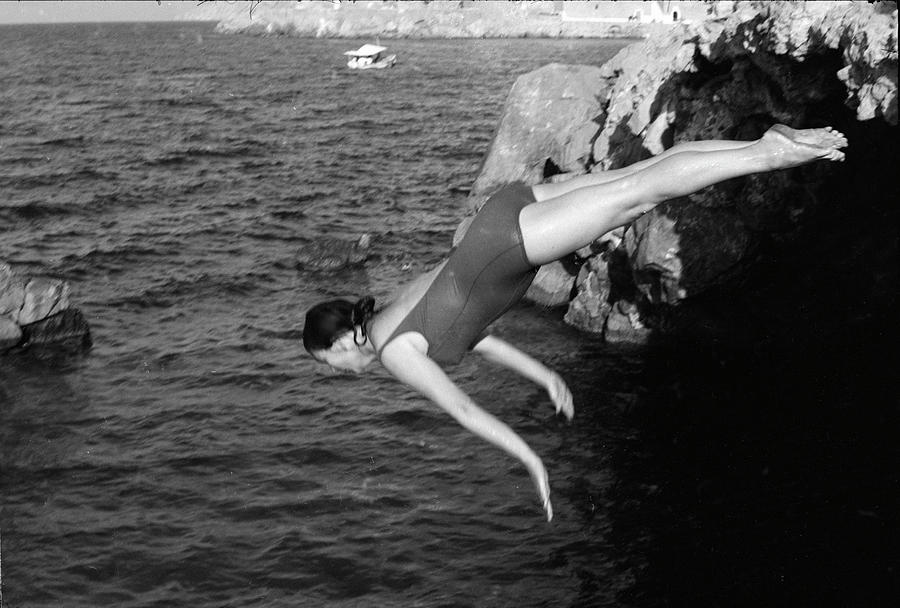
Early on in Life Burns High, the new documentary about the trailblazing Australian writer Charmian Clift, we learn about her early love of being photographed and watched, posing and swimming on the jagged periphery of her seaside village, Kiama, in New South Wales. She took joy in being exposed to others and to the elements; in one of the film’s interviews, her biographer Nadia Wheatley describes her tendency to lie naked in rockpools as a child during the evenings, ‘star-baking’ in hopes of turning silver. Clift was fascinated by glamour, the epitome of which she envisioned as owning “a white car with red upholstery,” and yearned to be a “film star” (“not an actress,” she clarifies). She was reborn in adulthood when she submitted a photo of herself in a swimsuit—back arched, balanced on curled toes like a dancer—to a magazine contest, which secured her a modelling contract in Sydney. In rare snatches of live-action footage of Clift, her voice has a theatrical timbre and an unplaceable accent; her eyes convey a serene self-assurance.
As an unusual kind of writer who rejoices at being seen—and whose archive therefore abounds with not only numerous novels, diaries, essays, memoirs, and magazine columns, but also with ceaseless images of herself and her family (especially of her husband, fellow writer and author George Johnston, whose celebrity has too long threatened to eclipse Clift’s own)—Clift’s life feels as if it were invented for the screen. As Life Burns High attests, this was the case even before Clift and Johnston settled to raise their children on Hydra, the sun-bleached Greek Island on which they were at the centre of a lively artistic community which included, for a time, Leonard Cohen. (In one chiaroscuro photograph from this period, Clift grins from behind the neck of a clean-shaven Cohen’s guitar, as he sits across from his lover, Marianne Ihlen.)
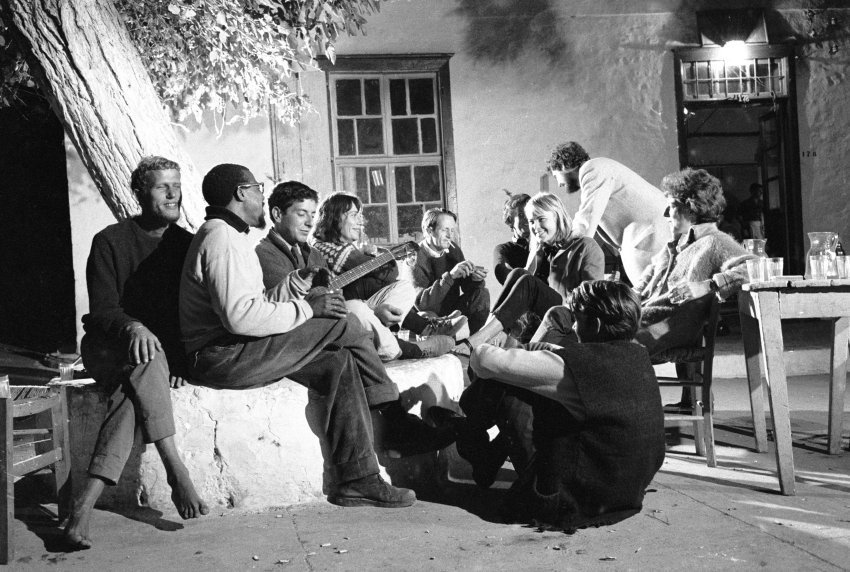
Director-writer-producer Rachel Lane had the same impression of Clift’s cinematic fate as soon as she finished reading Wheatley’s biography, The Life and Myth of Charmian Clift (2001), in 2002. “I’m always fascinated by women who break out of the norm,” says Lane; “I was immediately captivated by her courage, her bravery in living what would’ve been considered quite an unorthodox life, at the time.” “Charmian’s story has all the hallmarks of a feature film where life imitates art,” she continues. “She was just stunning, and she led this creative life, with the bohemian life on Hydra, her creative relationship with George (even though it was obviously tumultuous at times) and then this amazing writing career […] If you sat down to write a story: there it is.”
Resourcing the project, however, was far less straightforward; a producer already had the rights to Wheatley’s book, and even when Lane took them on after their death, raising funding for the film—which she initially pitched as a feature-length drama—seemed impossible. Switching gears to documentary (a form Lane is more familiar with, having produced and directed half a dozen of them, most recently ABC’s Faithfully Me [2020]) and teaming up with co-producer Sue Milliken, who “had worked with Charmian and George, back in the sixties, at the ABC,” Lane pursued funding with the Documentary Australia Foundation. “Well, I had to put an ad in the paper to entice people to donate to the Documentary Australia Foundation website,” she says, “because at that stage we didn’t have any government backing, so I was like ‘How am I going to find these other people that share this passion for Charmian Clift’s story?’ So, I put an ad in the Sydney Morning Herald and I put an ad in The Australian, and that was, I think, 2020, and out of that we garnered most of our funds.”
Unlike the many documentarians battling against erased or hidden histories, Lane’s next challenge was the sheer immensity of Clift’s archive, which demanded meticulous selectiveness. “There were three-hundred odd; I read all of them,” says Lane of Clift’s essays, “then I would painstakingly go through and underline things that I felt would help drive the narrative. It was like a consantina […] then I got it down to the essays that you now see in the film, and then I plotted it out on my wall.” “So that was a lot of my pre-production,” she continues, “then, obviously, gathering all the archive through my amazing archive producer Jen Fulton, physically going down to the National Library in Canberra and the State Library of New South Wales, actually touching the photos and going through them […] It was very much a hands-on editing process.”
Commanded by the voice of Marta Dusseldorp reading passages of Clift’s writing, the film moves briskly through the arc of her life, first chronicling Clift’s childhood days on the coast. While Lane anticipates critiques of the film’s chronological structure, she believes that this “is the perfect place to start, because you need to show Charmian as this pagan girl that grows up on these wild, beautiful beach landscapes of Kiama, and […] they absolutely just loved living by the sea.” According to Wheatley and Lane, an attraction to the ocean anchored Clift’s personal and creative lives. Recurring throughout her work, its omnipresence evokes her blissful relationship to travel, while also foiling the repetitions of domestic routines and a broader social context of machinic, post-war mundanity. Lane sees Clift’s relocation to Hydra as a full-circle return to her past: “When she did get to Kalymnos first and then again on Hydra, I think that felt totally natural to her because, growing up with that, I think she gravitated towards it as an adult.”
Lane was always aware that to witness Clift’s life was also to witness Johnston’s, with whom Clift shared three children and co-authored three novels. The first of them, High Valley (1949), was inspired by Johnston’s stories as a war correspondent in Tibet, yet was in large part structured and written by Clift, who Johnston described as “the artist.” Regardless, when the book won acclaim in the form of the Sydney Morning Herald literary prize, its headlines shrugged her off: “Journalist, wife win novel prize.” While Johnston would later go on to receive the Miles Franklin for My Brother Jack (1964), Clift remained under-recognised throughout her career.
Lane never expected to be able to simply extract Clift from Johnston’s shadow, however. Life Burns High opens with a fragment of a TV interview with Clift, Johnston, and their children, where she is asked whether her upcoming projects will also be in collaboration with her husband. Their styles have diverged so much, she tells the interviewer, as to make writing together inconceivable. But, the pair are quick to elaborate, they remain collaborators in living, in caring, in housekeeping, in enabling the other to work at all. “From the moment I read the biography, I always knew making the film that it was going to be from Charmian’s perspective,” Lane says. “But you can’t tell Charmian’s story without telling George’s story, and vice versa, because they’re just intertwined.”
Lane is inspired not just by the “bravery” of Clift’s persona, but by the everyday bonds that sustain creativity amidst otherwise unsparing precarity. On Hydra, the couple’s “creative life was kept buoyant by this otherwise unknown grocer on this island in Greece, [and the shop] that he ran called Katsikas. Their life revolved around Katsikas. As Nadia mentioned, no matter how much they drank the night before, they’d be up at their typewriters by the morning, and then by, you know, eleven or twelve, they were down by Katsikas drinking their Retsina. And it sounds very romantic and lovely, but, you know, obviously the financial side of their life was very precarious.”
There was also a more sinister aspect to the couple’s entanglement, which Lane also sought to capture. “In the film it says they had an inscrutable bond; they couldn’t live without each other, and they couldn’t live with each other.” After Johnston was hospitalised for tuberculosis, he began work on Clean Straw for Nothing (1969), in which he hijacked the alter ego, Cressida Morley, that Clift had long ago created as her own fictional conduit. In Johnston’s final book, Morley is married to his own cipher, David Meredith, whose illness she’s accused of causing due to her affair—a situation that clearly (and publicly) harkened back to Clift’s alleged infidelity on Hydra. “As Susan Johnson points out,” adds Lane, “that’s a double betrayal. Not only has he betrayed Charmian, but he’s betrayed her by using the alter ego that she came up with.”
The crisis of Clift’s life, then, was the stripping-back of her choice of protective artifice, here twisted into a weapon of paratextual psychodrama—an event that closely preceded Clift’s death by suicide at the age of 45. As its title implies, however, Life Burns High is conscious not to let Clift’s story become absorbed by an impression of tragedy. “I always knew that the suicide was going to be part of the film,” says Lane, “and when I secured the rights for the book, way back in our very first talks with Nadia, she said to me one of the terms and conditions were that we needed to include the suicide; don’t brush over it because this is what happened.” At the same time, the impetus of the documentary was to illustrate the boundless energy behind Clift’s life and work: “to be true and authentic to her character, [to] this innate person that she was, that lived this extraordinary, charismatic, unorthodox life—making sure that you absolutely feel that up until that point.”
It’s Clift’s energy—her sensuousness and “wildness” —that continues in the many strands of her legacy today. Clift’s first child, Suzanne Chick—who she gave birth to at nineteen and was compelled by her disapproving family to put up for adoption—is the mother of Gina Chick, the rewilding facilitator and writer who last year won the survival reality series Alone Australia. Chick outlasted the other contenders on a stretch of wintry Tasmanian bushland with her patient approach, informed by Indigenous practices of living with, rather than against, country. “Gina, in her various interviews that she does, I go: ‘There’s Charmian.’ You can see that wild sort of gene.”
**********
Indigo Bailey is a Tasmanian writer and editor living in Naarm/Melbourne. In 2023, she received the Island Nonfiction Prize for an essay about rain sound. She has written for Island Magazine, The Guardian, Voiceworks, and Kill Your Darlings, among other publications.
 Rough Cut