


Last year I released a book, which was ostensibly a group biography of four Australian actors. The last subject of the book was Nicole Kidman. Before it hit the shelves at home, news broke that Kidman was to be a recipient of the lofty-sounding Life Achievement Award, bestowed upon her by the American Film Institute (AFI). She would be the first actor with Australian citizenship to receive the honour. The roll call of previous recipients was made up of icons only: John Ford, Orson Welles, Lillian Gish, James Stewart, Gene Kelly, Bette Davis, Sidney Poitier, De Niro, Streep, Pacino, Beatty, Fonda (Henry and Jane), and so on. The timing was serendipitous with the release of my (admittedly partial) biography of her and so, on a sunny day in Redfern, the book’s publicist and I ordered puffy pink finger buns from a hipster bakery, and, sugar-rushed, brainstormed ways of getting me to cover the event while, at the same time, promoting my book.
Such is the demeaning dance that a certain kind of writer—Australian, obscure—needs to perform for people to hopefully read, or at least buy, their work. If you wish to publish a book, get ready to crawl on your knees to any number of doors and weakly knock, asking for entrance so that you can talk about yourself at length. At least, as a biographer, I am most often found talking about others. Still, even for that, an entrance is required, and so knock, knock: would ABC Radio—or TV—have me on to talk about the award and what it might mean for Kidman’s legacy?1 Could I write another piece, expanding on aspects of Kidman’s career that weren’t already covered by material in the book? Was there a way to get me to Los Angeles to go to the event and sell a piece to an American magazine, the kind of masthead that might impress people at home and so, again, push the book?

It all seemed like a good idea at the time, but then, in the end, the timing was not right, and with good reason. In May 2023—a month before the AFI event, and two months before my book would be out—the Writers Guild of America called a strike (the Screen Actors Guild would soon follow suit). The AFI, acting properly, postponed the event, pushing it into 2024 with no exact date. As a result, my publicist and I gave up on the idea of being able to connect the book with the award.
* * * *
After a summer of post-publication burnout, I booked a trip to Los Angeles—partly as a holiday, partly as a research trip, and mostly as a chance to watch a bunch of movies in a city steeped in film culture. I trawled the extremely useful retrospective screening listing page www.revivalhouses.com and locked in various films at a load of cinemas I hadn’t been to before. I also soon discovered that Kidman’s rescheduled AFI ceremony was now within the exact period that I would be in Los Angeles, and, perhaps, there was a point to reviving the push to cover the event in some capacity. Pitches would need to be readied. Publications approached. Another door to knock on: I sent a tentative email to the general publicity contact for the AFI, seeking media accreditation of some kind.
Over the course of close to five months, I liaised back and forth with a contract publicist, trying to worm my way into the event. I felt low to the ground; snakish. Meanwhile, dispatched pitches came close to acceptance, but only ever close. One masthead said they would send their own reporter (the bane of the freelancer: pitching ideas that then get passed on to staff writers). Most claimed an overexposure of Kidman in the lead-up to the event. The story would simply be too close to a raft of scheduled coverage of Kidman’s miniseries Expats, which, when finally released, no one seemed to watch, or, certainly, talk about. This was despite the fact that Expats was the follow-up directorial effort from Lulu Wang after her critical success with The Farewell (2019).

It was understandable if Expats—despite all that press—went unwatched, given the fact that it was a late entry into a seemingly unending era of streaming glut, to which Kidman has been a key polluter (Big Little Lies, The Undoing, Big Little Lies Season 2, Nine Perfect Strangers, Roar, Special Ops: Lioness; the list will, alas, go on). No one can keep up. I try to watch it and it feels ‘unwatchable’—stilted, unnecessary—but then maybe I’m biased by the fact that it tanked my story. Perhaps the most interesting thing about Expats is the fact that it can’t be watched in Hong Kong, where it is set and was (mostly) filmed. Wang and Kidman filmed politically charged scenes in Los Angeles, making reference to the Umbrella Movement of 2014, which has been rumoured to have caused the series to be blocked by Hong Kong’s Office for Film. This was the sort of film-culture-as-political-culture story that interested me most, and here I was bumming about instead trying to cover a frivolous award ceremony. Still, I was at a ‘sunk cost’ impasse and needed to push on.
* * * *
A major newspaper had said yes to taking the piece, but in the week before the ceremony they claimed they were out of space. The piece was killed. I was now liaising with a publicist about writing up an event without a publication locked in—the freelancer’s version of preparing for a skydive without the guarantee of a plane or a parachute. I didn’t entirely give up pleading my case for the story with local publications. My conceptualisation of what I wanted to write was already not just about Kidman, but also the award she was given, and to try and explain the AFI to an Australian reader. I reworked the pitch and proposed interviewing the head of the AFI, film-historian-turned-executive Bob Gazzale, who began writing and producing the tribute shows before taking over the CEO and President role in 2007, and continued to do so after, he says, “because I believe they are imperative to our image in and around the world.”
There was no interest in this pivot on behalf of Australian media outlets—until I approached the publication you are reading, a familiar home for some of my weird thought experiments about stardom. Film culture—as compared to celebrity culture, surface culture—has not been greatly supported by mainstream Australian media. In some cases, it hasn’t even been aided by its own instruments. By ‘own instruments’ I mean cinemas, galleries, museums, and festivals; these institutions too can be romanced by international efforts, leading them to ignore what is right in front of them at home. At a memorial conference for the late Australian filmmaker, essayist, artist, cultural historian, researcher, and poet Ross Gibson held last year, Adrian Martin rightly raged against the Sydney Film Festival for making no effort to note Gibson’s death. The festival did not offer to host a memorial retrospective of Gibson’s work, nor did they even make mention of his passing (Martin also criticised US-based Criterion Collection and MUBI Notebook for the same omission). Martin boiled down the snub of Gibson down to the fact that he was a) an academic, b) a multi-hyphenate creative, and c) Australian. Any nuance in your life and career and you’re seemingly worthless to those who can—and should—amplify your work.

This does not mean, however, that film culture cannot be rotten in the City-State of Los Angeles. In January this year, the LA Times laid off 115 workers. Subsequently, its insightful film critic, Justin Chang, moved across to the New Yorker (Chang was awarded the Pulitzer Prize for Criticism for his tenure at the LA Times this month). In March this year, the Highland Theatre closed after 100 years of operating, following the expiry of a 99-year lease. This followed the collapse of the LA Film Festival, which started in 1995, but was over by 2018. With their rusted-on audiences and strong governmental support, it’s impossible to think of the major Sydney or Melbourne Film Festivals ever teetering towards ruin. Los Angeles might not need a film festival, though, given the fact that the American Cinematheque, founded 40 years ago, holds over 1500 screenings across the city each year and itself hosts a number of mini-festivals. A recently founded documentary festival, This Is Not a Fiction, ran during my stay, and included retrospective screenings of wildly diverse films, from Chris Marker’s Sans Soleil (1983) to Jeff Tremaine’s Jackass: The Movie (2002). Los Angeles’ retrospective film programming has a better sense of humour about itself, and a broader palette, than you might imagine.
Los Angeles has also proven it is still possible to revive old acts and forge entirely new ones. The Academy Museum of Motion Pictures had opened since I was last in town, a gleaming building with two new theatres. The historic Egyptian Theatre, sitting on Hollywood Boulevard, is now owned and operated by Netflix, and often houses American Cinematheque screenings. Quentin Tarantino has similarly wrested control of the Vista Theatre, adding it to his growing cinema empire, which already included the New Beverly Cinema. Vidiots, a not-for-profit video store, found a new home in Eagle Rock, after significant crowdfunding efforts. I’d just missed out on attending the potential successor to LA Film Festival, the inaugural Los Angeles Festival of Movies, co-presented by film distributor and streamer Mubi and the not-for-profit film programming organisation and publisher Mezzanine. The festival used venues including Now Instant Image Hall and 2220 Arts + Archives, which also houses events by the LA Filmforum.2 These multi-use venues also hold arts and music events, in addition to operating as micro-cinemas. It’s something Sydney could think about. Brain Dead Studios—the buzziest of the single-screen cinemas in LA—started as a clothing line, and still sell their various knits out of their Fairfax Avenue address.
The American Film Institute seemed to me to be the least accessible, in the immediate sense, out of all these landmarks. The AFI’s public cinema isn’t even in Los Angeles; it’s on the other side of the country, in Maryland. Australians would be forgiven for not knowing it existed. The Life Achievement Award, their biggest focal point, is broadcast in America on the basic cable channel TNT—Kidman’s ceremony will be aired in June—but it doesn’t play at home, reaching us only as YouTube and social media clips of individual speeches or meme-worthy moments. Still, its mandate and import are significant. The AFI was inaugurated by Presidential decree when Lyndon B. Johnson announced a suite of national arts endeavours at the White House Rose Garden in 1965, outlining the intention to bring together “leading artists of the film industry, outstanding educators, and young men and women who wish to pursue the 20th-century art form as their life’s work.”3 As Gazzale told me, in our (then) publication-less interview, one of Johnson’s key tenants was to preserve film:
“It was a time in our country and our world where film was produced on nitrate stock and it was rapidly deteriorating. And so the AFI sent out the clarion call early on to say that film must be preserved, and through those efforts of those early days—this is the late 1960s—there are 35,000 feature films in the AFI archive in the Library of Congress. So, in other words, the AFI saved those films.”

Gazzale stressed that “the other tenant [is] to honour the artist and their work,” which brought us back around to the AFI Life Achievement Award and to Kidman. Gazzale’s design of the ceremony itself interested me, as it involves a sort of proxy autobiography of the star, told from their perspective. With Gazzale, the recipient submits to a career-spanning interview, covering key films and collaborators. Gazzale told me that they had initiated this approach in 2001, when Barbara Streisand was the award’s recipient, and Gazzale asked her to record a reflective interview so that “she could provide the narrative—she could lead us to scenes of her films that perhaps we wouldn’t have thought of.” Until then—from “John Ford to Dustin Hoffman,” according to Gazzale—the only time you heard from the recipient was when they went up to accept the award.
For Gazzale that meant a fundamental change to the nature of the show, a Streisand Effect of a different kind: “From that moment on—now over 20 years—it’s the recipient who is driving the evening, and that is certainly true of Nicole’s tribute.” So, then a crux: how would Kidman tell her own story?
* * * *
I wanted to look respectable for the telling; but, more importantly, I was also required to look respectable for the telling. The invitation read ‘black tie.’ It was a big ask for someone who was travelling around the city with a backpack filled with t-shirts and slacks, and so I found myself in Los Angeles in need of a suit, running around Silver Lake like a fucking lunatic trying to find a store that would sell me something presentable, and texting friends with a modicum of fashion sense back home to offer advice on what to buy (at the low end of the low-budget range). At some point that week, the need for a suit became an even higher priority, because there was an email from the publicist informing me that I had been bumped from the mezzanine to a table seat downstairs. This also required travelling to the AFI campus in Los Feliz and picking up a newly printed ticket, which I was handed by an extremely kindly gentleman who had spent a decade living in Leichhardt, and with whom I exchanged unexpected pleasantries about Sydney’s Inner West.
What was semi-expected was who I would be sitting with at that designated table. I thought it likely that I would be sat with other Australian journalists, and as I made my way into the Dolby Theatre, I was, indeed, designated the same table as two Australian entertainment journalists, faces familiar to free-to-air television viewers. One of them brought his semi-famous son along, a real-life showing of nepotism’s gears grinding (I was thankful the other journo didn’t bring along her mother, a woman who is spending her twilight years defaming people on a channel dedicated to right-wing fantasia). Defrocked of their fame from home, the pair, from rival channels, appeared to team up to go looking for other ways to exert power. I watched on with horror as they made stroppy complaints that they had failed to receive access to the red carpet. Australians are terminally embarrassing.4
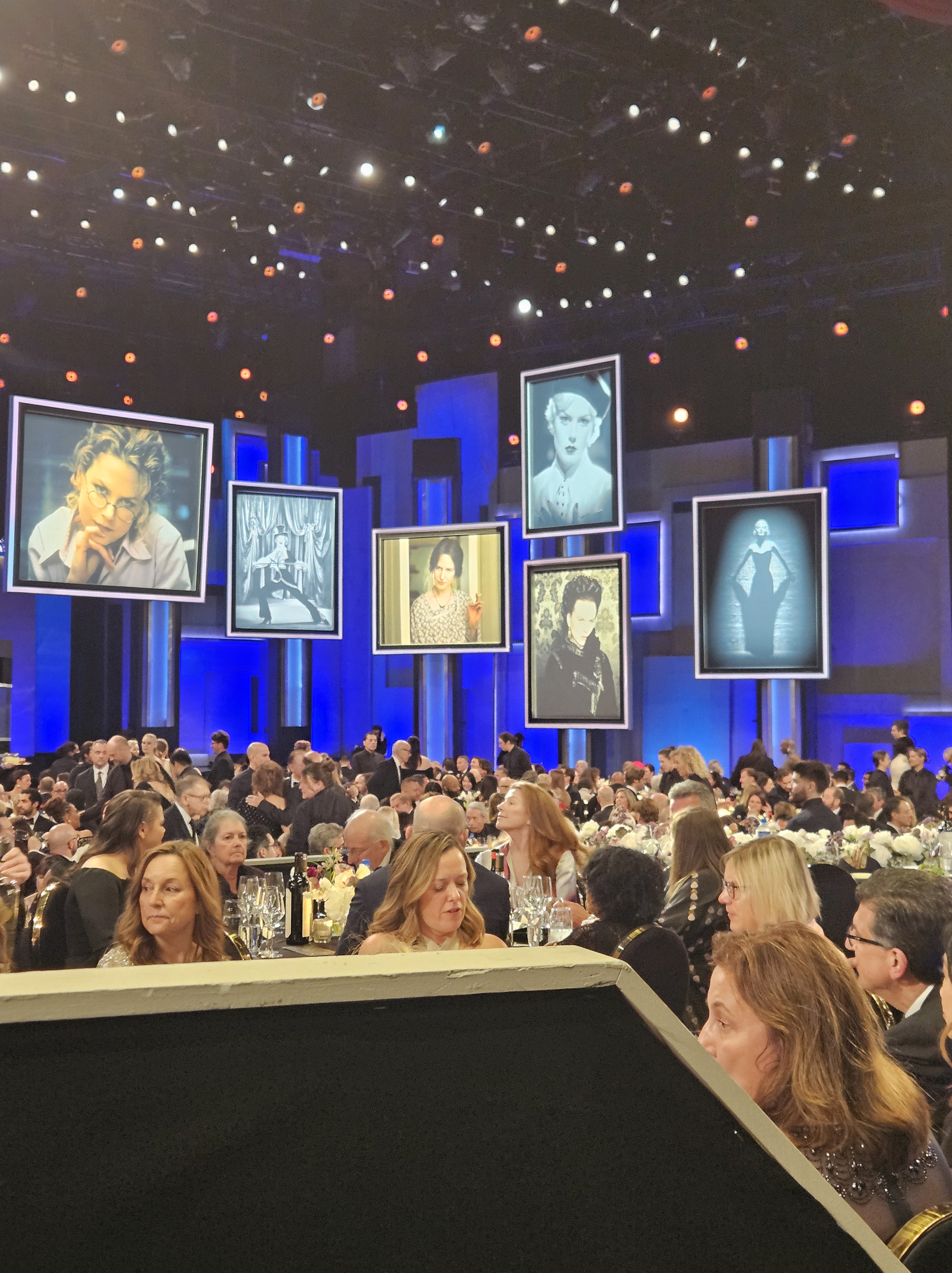
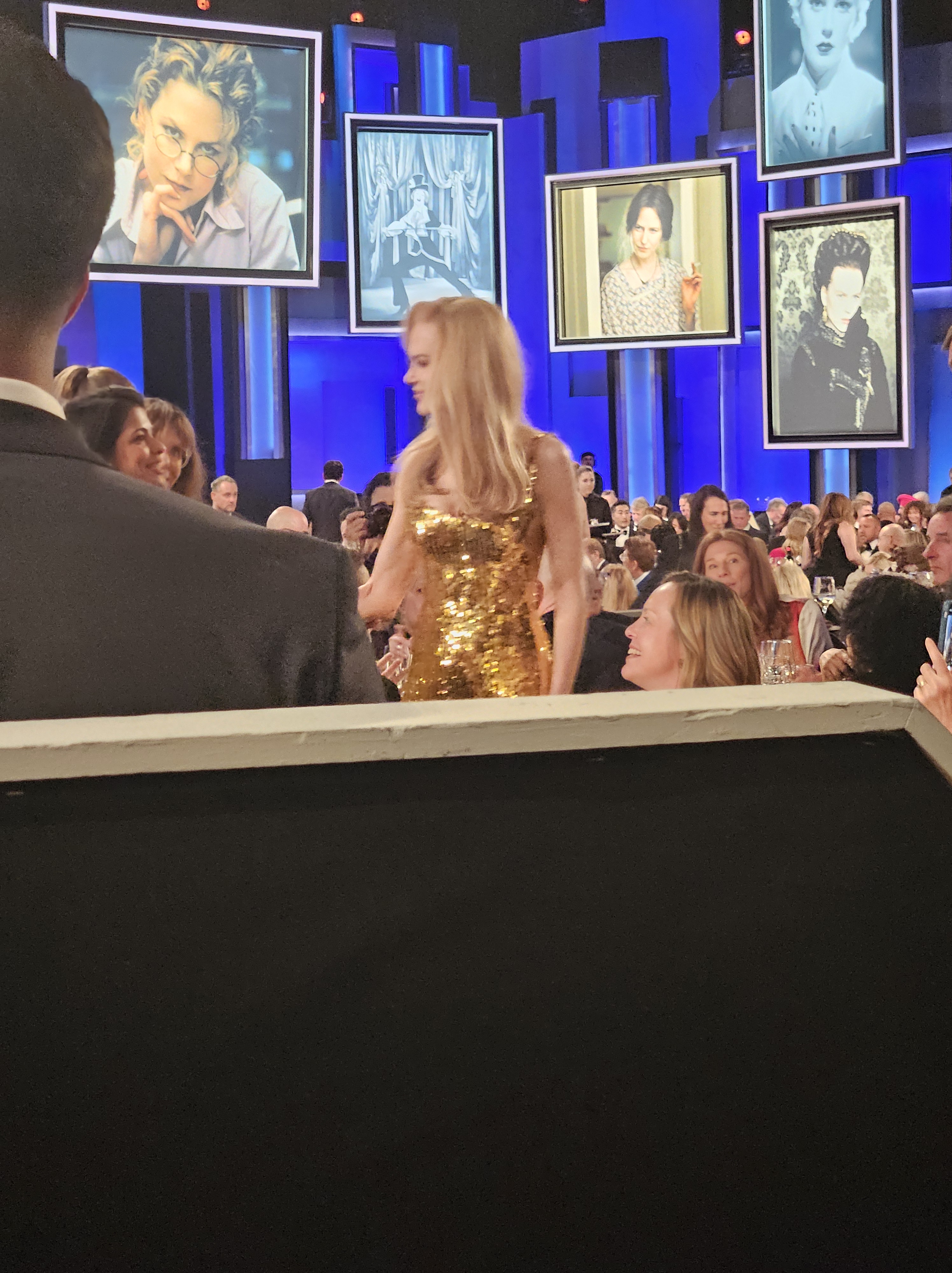
Still, the sense of ceremony wasn’t lost on them, and from across the table I heard: “This is kind of a big deal. Not every day you have dinner in the Dolby.” Sitting in front of my television at home, I had watched this room host the Oscars less than two months before. The cavernous space had a high-tech sheen to it, which was hard to take in—were the oversized pictures of Kidman decorating the room physical printouts or digital projections? One thing I knew was that Gazzale had made the same discovery I had in writing my book: an early 90s photoshoot from Australian Vogue, guest edited by Baz Luhrmann and Catherine Martin, in which—pre-Moulin Rouge (2001)—they had collaborated with Kidman on a series of photos evoking old Hollywood icons. Blown up, I was taking them in, and the history they represented, right as Kidman was announced as having arrived in the room.
* * * *
She was supposed to be there. It was her night. What was I doing there, though? Was it just to get this close to Kidman, to encounter this level of fame, up close? To take a few bad photographs on my camera (while trying to be inconspicuous, tasteful, about it)?
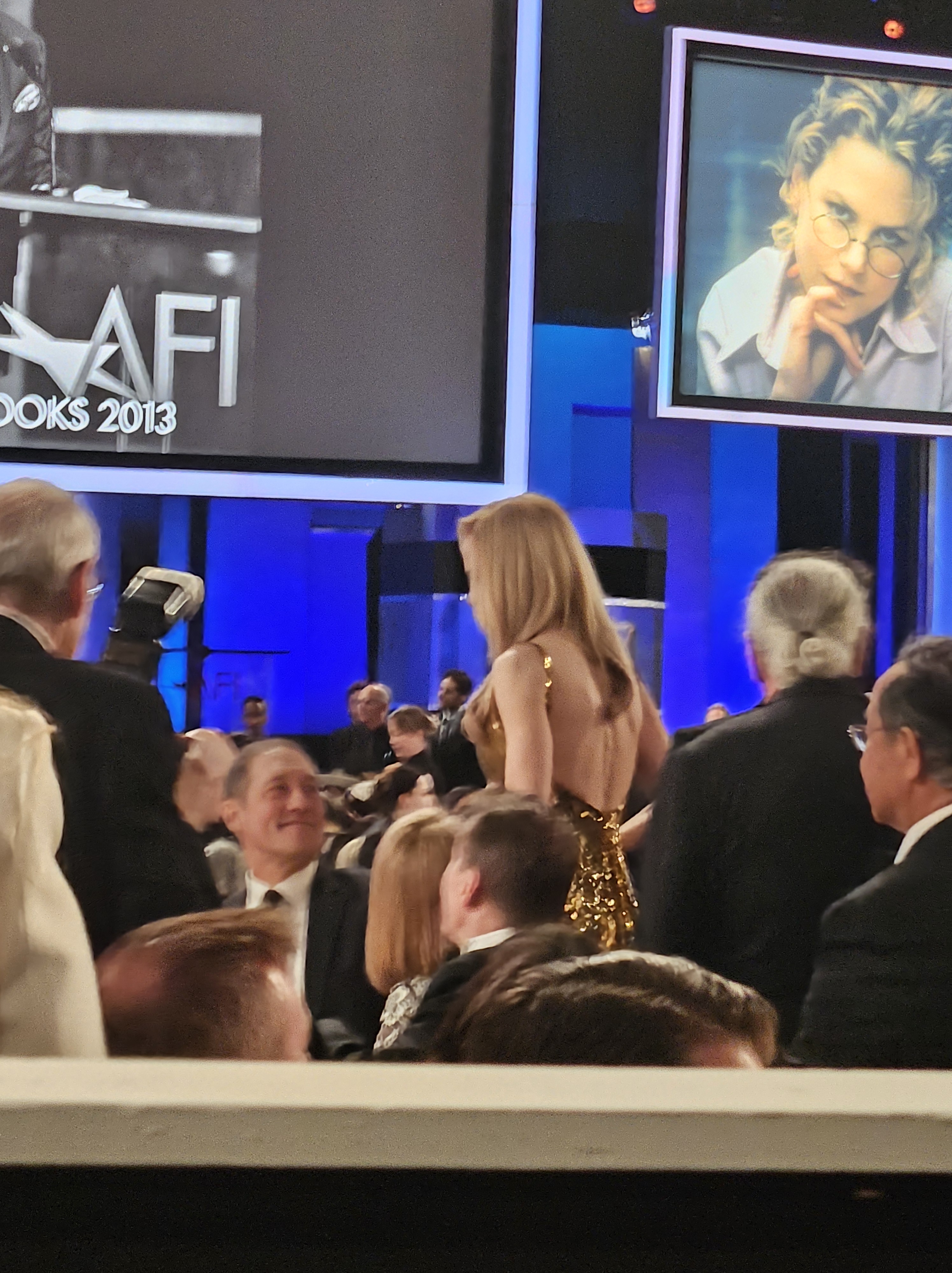
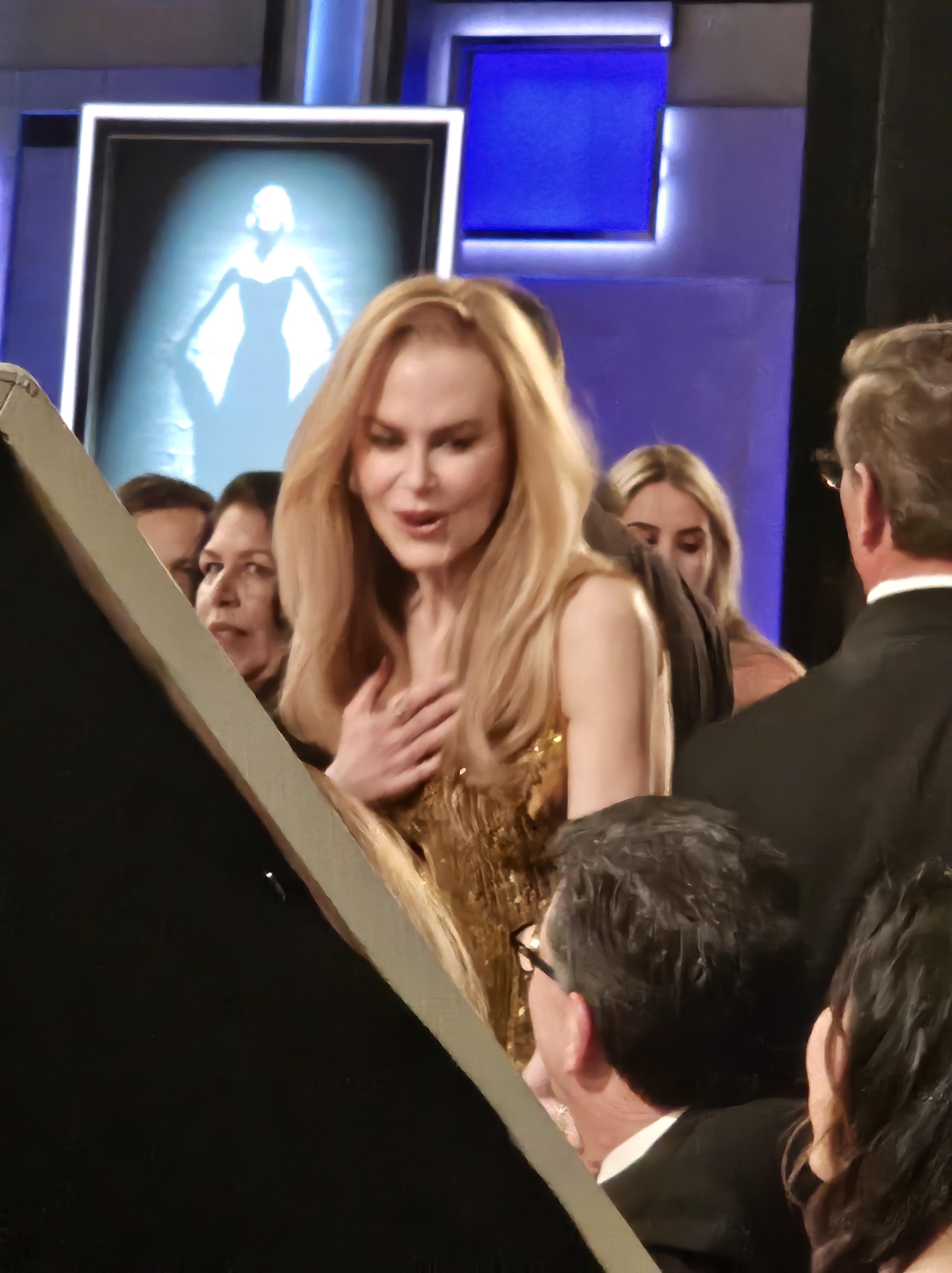
The act, in the moment, feels not entirely without merit. Celebrity culture—surface culture—does have something to do with film culture. Star studies is an important facet of film history. Most films don’t exist without actors; most film economies certainly don’t exist without celebrities. An industrial history of cinema cannot be approached without looking at how actors exist outside of films—their roles in marketing, sales, slippages into the non-film mainstream. The film critic, the film historian, the film essayist needs to decide the degree to which they wish to be in proximity to the actor as an actual, living person. The biographer too.
I never wanted to interview Nicole Kidman. People often ask whether she has a copy of my book. I don’t know. I never wanted to give her one. Gazzale doubly stressed to me that his show was “Never about a personal life, but more about their impact on the culture.” I thought I had taken a similar approach by looking at my subjects within film culture—both in Australia and America, exploring the connect and disconnect between them. That’s what has brought me back to Los Angeles again. I’m still interested in that story, which can often feel like driving against the traffic of a one-way street. It goes on: three movies were dominating billboard space across Los Angeles while I was there, and all three were filmed in and around Sydney: The Fall Guy, Kingdom of the Planet of the Apes, and Furiosa: A Mad Max Saga. The billboards of the American productions, at least, signalled nothing of their Australian landscapes. I come to think this might be for the best after witnessing The Fall Guy’s incoherent geographic knowledge of Sydney and seeing Kingdom of the Planet of the Apes’ flashes of bush scenery washed out by digital fuss.
Australianness weaves its way through the ceremony. Gazzale was in proud possession of some early home movies, and the Kennedy Miller mini-series production Vietnam (1987) was focussed on at length as a turning point in Kidman’s career. In person, on the night, Australian actors were represented by Naomi Watts—serving up a nostalgic speech about catching a cab through North Sydney streets at a fifteen-year-old Nicole’s expense. Keith Urban gave a twangy, loving speech about his wife, with a particularly moving note about her standing by him during his attempts to put his addictions to an end. The rest were phoned in, as such, in pre-recorded tributes (Russell Crowe waves a half-hearted hello; a slightly forced bit involves Cate Blanchett and Hugh Jackman on a Zoom call with Jimmy Fallon, thinking he was calling from the Australian Film Institute, and awarding them instead of Kidman). Pre-recorded doesn’t mean throwaway, though; included in these to-camera videos were the holy trinity of Baz Luhrmann, George Miller, and Jane Campion—directors Kidman had worked with more than once and who provided pivotal moments in her career—who, despite not being there in person, managed to run the most context-rich commentary of Kidman’s career on the night. Trust the directors to be able to step back and deliver the big picture.
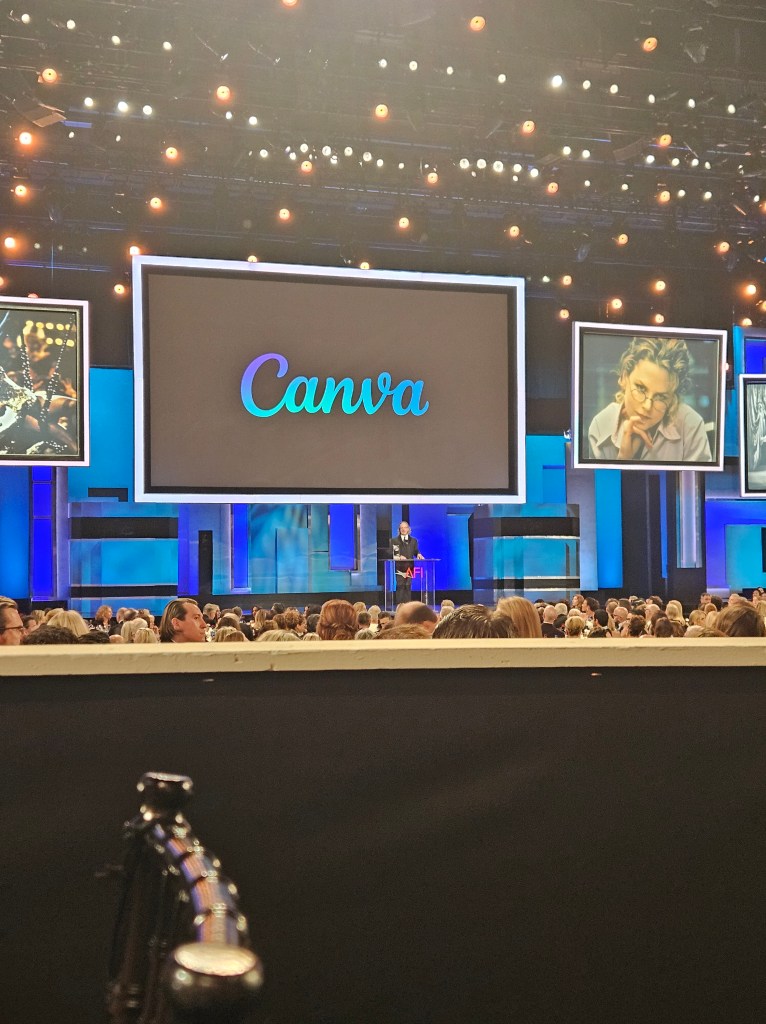
The most surprising Australian cameo on the night, however, was the luminescent logo of Canva being blared throughout the Dolby. The free-to-use design platform, which has created any number of unnecessarily prettified PowerPoint presentations, had sponsored the dinner service and a tribute book. Canva has, apparently, used its start-up capital to sponsor many American film culture activities.5 Money has flowed into Robert De Niro’s Tribeca Enterprises, a series of fellowships with the American Film Institute, Issa Rae’s Hoorae, and the American Cinematheque’s PROOF, a new short film festival. No similar investments have, to the best of my knowledge, been made out to Australian organisations in the name of developing Australian film talent.
Kidman gets it, though. In the weeks after the AFI award, Kidman is announced as the Ambassador for a new gender equality initiative at the Sydney Film Festival—the somewhat folksy sounding, though hopefully effective, Women’s Giving Collective. Kidman has been canny at balancing her film and celebrity identities (whoever manages her day-to-day schedule must have training in quantum theory). The real reason to be in the room was, in fact, to witness her perceive this star persona: her own.
* * * *
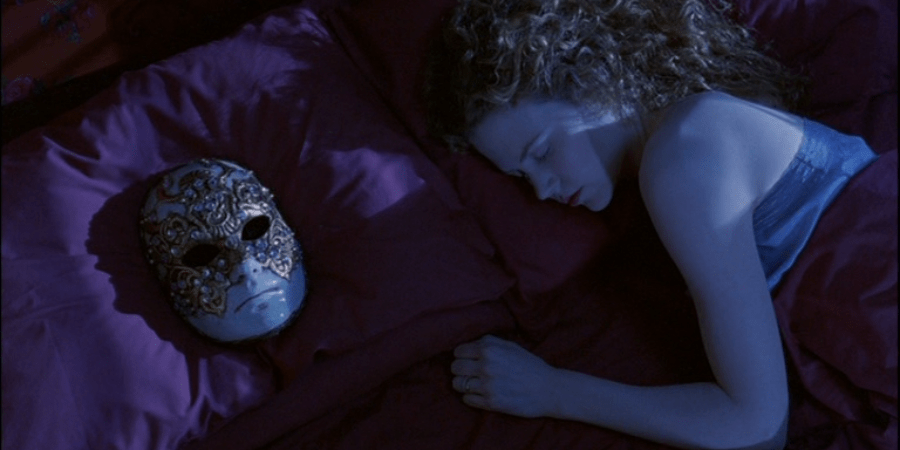
During the ceremony, the camera cuts to Kidman’s reactions to the speeches delivered about her. But the audience doesn’t get to see her face as she watches the three scenes Gazzale lets play at length—the stoned, accusatory speech from Eyes Wide Shut (1999), the depressed pleas of Virginia Woolf at the Richmond train station in The Hours (2002), and the impeccable, long reaction shot captured in a concert scene in Jonathon Glazer’s Birth (2004). Sitting back from the fray, in a not-so-cheap seat, even getting to entertain the thoughts that might be going through her mind while watching that work back is a moment of revery. It is hard not to imagine it energising her eventual acceptance speech.
When she rises to accept the award—from previous recipient, and sometimes co-star, Meryl Streep—Kidman understands the true remit of being there and the fact that it derives from an institution like the AFI. It is, perhaps, something an actor understands implicitly as they get toward the latter half of their life: that the preservation of film culture and history means the preservation and longevity of one’s work.
“Film is forever,” she says.
Kidman lists every director she has worked with in a breathy rush. When she gets to Jonathan Glazer, the utterance seems to usher a particular quiet. I might be projecting my own internal hush, but it is true that Glazer has become persona non grata for some in the industry, some of whom may well be present here. Two months earlier, Glazer had taken to the very same stage at the Dolby Theatre to accept the Academy Award for Best International Feature Film for his loose adaptation of Martin Amis’ novel The Zone of Interest. Glazer nervously unfolded a piece of paper and delivered a short but powerful statement denouncing the atrocities that had occurred on October 7 led by Hamas and the ongoing genocide being committed by the State of Israel in occupied Palestine. Speaking on behalf of his fellow recipients, Glazer read: “Right now, we stand here as men who refute their Jewishness and the Holocaust being hijacked by an occupation which has led to conflict for so many innocent people.”
The speech was denounced by some in the industry, including via a cringe-inducing open letter followed from a group of Hollywood creatives, who decried Glazer’s clear-eyed moral stance. This was later countered by cooler heads, co-signed by Kidman’s To Die For co-star Joaquin Phoenix, who backed Glazer’s statement and noted the “silencing effect” of the open letter. We know that Silence = Death from other campaigns against ignoring atrocities and although Kidman was pointedly keeping Glazer in the fold, she has so far said nothing publicly about the war (compare this to Cate Blanchett, who called for a ceasefire in Gaza as early as October 20, and again on November 9 in an address to the European Parliament).
When the ceremony ends, I walk out of the Dolby theatre with a slight empty feeling—passing a red carpet where fans are still lined up waiting for the event to finish and for the celebrities to exit out the front—and order an Uber. I wait for it out the back, beside the parking garage where big black SUVs are driving the talent to their next location (an after-party somewhere high in the Hills, I imagine). I suddenly find myself in the middle of a pack of autograph chasers, trying to get the celebrities to wind down their windows and sign a photograph. Not knowing who all the speakers would be on the evening, they’ve brought portable boxes, filled with unmarked headshots, ready to be signed.
What difference is there between them and me? What is the distance between the autograph hound and the celebrity biographer? If I felt truly dejected, it was because I could have been at Now Instant, Brain Dead Studios, 2220 Arts + Archives, or at blessed Vidiots, watching a film instead of simply witnessing spectacle. But then, film culture is a matter of scales, and sometimes it’s good to be reminded of its top end, its extremes, even if it is to decide it doesn’t really hold a seat at the table for you. Save those seats for the Sydney-based digital start-ups with a multibillion-dollar worth, instead.
**********
Sam Twyford-Moore is the author of The Rapids: Ways of Looking at Mania (2018) and Cast Mates: Australian Actors in Hollywood and at Home (2023). He is currently working on an intellectual biography of film critic, researcher, historian, poet and novelist Sylvia Lawson, as part of a PhD at the Australian Centre for Public History at the University of Technology, Sydney.
- A producer from the ABC did end up DMing me on Instagram, after I put up photographs on the social media site of how close I got to Kidman, to see if I could talk about the event on NewsRadio, but I’m in a movie at Vidiots—watching Bertrand Bonello’s The Beast—and by the time I’m out the spot has already been taken by someone else. A further debasement? Perhaps, but at least it felt in tune with Léa Seydoux’s character in the movie I’d just seen, trying to make it in LA as a model-slash-actor, but being out of rhythm with everything around her. In a further echo of that film, both Seydoux’s character and I had to naively ask someone in Los Angeles what 2C-B is. ↩︎
- During our stay, my wife and I travelled to Now Instant—in an eerily empty part of Chinatown—to attend the launch of Fireflies Press’ small monograph on Chantal Akerman’s La Captive (2000). Now Instant was the spitting image of the Golden Age in Sydney, except, instead of being gilded here and there, it was draped entirely in a velvety green. The monograph’s author, Christine Smallwood, was not present—nor was the Fireflies’ powerhouse publisher Annabel Brady-Brown—and, though there was a short launch speech by the translator of Akerman’s My Mother Laughs, Corina Copp, without any real presence from those behind the book, the event felt a little disembodied, which was actually surprisingly apt, given the pointed listlessness of Akerman’s quasi-adaptation of Proust’s fifth part of À la Recherche du Temps Perdu. ↩︎
- Despite there being practically no national film industry to speak of, the Australian Film Institute actually predates the American Film Institute, having been formed in 1958. Without a local film industry to celebrate or preserve, it didn’t have a great deal to do, and went unfunded until 1970. ↩︎
- We’re so less likable than we think we are. We don’t want to hear it, but, in many ways, Americans—or at least those who hug the West Coast—have the far more polite society. It all comes down, as most things do in Los Angeles, to driving. You’re here and you rarely hear a car horn blasting. Road rage is kept at a minimum. Even on the busiest highways, I don’t experience tail gaiting to the level I do daily in Sydney. There’s a huge amount of respect for pedestrians (perhaps, given there are so few of them). The whole idea of the four-way stop sign approach is much more deferential—drivers giving way to the first person to arrive at an intersection—than the Australian equivalent, the roundabout, whose rules are often ignored. Trusting drivers to do the right thing and letting them turn right (i.e. our left) on a red light is part of the reward. We can only ever dream. ↩︎
- Following them up, out of personal interest, Canva’s Head of Corporate and Internal Communications briefly replied: “While most of our focus is in the US, we’ve supported the Sydney Film Festival in the past both as a partner and in-kind through providing our product and design training.” It is unclear in this statement how product design training in Canva supported the development of film in Australia, or if there are any future plans to instate programs that could be beneficial to such aims.
↩︎
 Rough Cut