


Earlier this year, writer-director Bertrand Bonello had a retrospective at the Cinémathèque Française ahead of the French release of his new film, The Beast, starring Léa Seydoux and George MacKay. As part of the program, he was asked to pick four favourite films to screen and talk about afterwards.1 Somehow, he notes, he found himself gravitating towards works about solitude. One of them was Fred Walton’s 1979 horror classic When a Stranger Calls, best known for its ominous warning: “The call is coming from inside the house!”
“It’s a B movie but it’s a heartbreaking film,” Bonello says. In a discussion after the Cinémathèque screening, he talked about the impact it had on him, and the intensity of its performances. It also happened to be one of two movies that he watched while preparing The Beast, a work primarily inspired by Henry James’ 1903 novella, The Beast in the Jungle—the tale of a man with a debilitating sense of foreboding that overwhelms his life.

The connections between The Beast and When a Stranger Calls are intriguing. Walton’s film is a bold extension of the initial premise, in which a student babysitter (Carol Kane) is menaced by an anonymous voice on the phone. It then morphs into an unusual study of the hunter and the hunted, of male trauma, obsession, and isolation. These are elements that Bonello also chooses to investigate. And there is something about Kane’s face—a silent-movie expressiveness—reminiscent of Seydoux in The Beast.
We are made aware from the outset how important Seydoux’s face and presence will be. The film begins with a green screen sequence in which she is an actor following off-camera directions—it’s Bonello’s voice we hear—for a horror movie. “It’s the first scene I wrote,” Bonello says. “And it’s there for two reasons. The first is that [a] green screen means for the audience that there’s going to be something virtual. It’s a way to enter the film, to say, ‘We’re not always going to be in reality.’ And the second reason is that you have Léa, alone in this green space, totally lost. And it’s a way to say to the spectator, ‘My subject, it’s her. Her, Gabrielle, and her, Léa Seydoux.’”
… you have Léa, alone in this green space, totally lost. And it’s a way to say to the spectator, ‘My subject, it’s her. Her, Gabrielle, and her, Léa Seydoux.’
—Bertrand Bonello

Moving between Paris and Los Angeles, we follow the character of Gabrielle across three time periods—signified by the years 1910, 2014, and 2044—whose stories are interwoven rather than in chronological order. Watching Seydoux as Gabrielle, we witness an eloquent, subtle actor whose face conveys nothing and everything at the same time, a performer who suggests or implies but also fully embodies—whether in movement, carried away while dancing, or in stillness, in a fleeting moment when she imitates the expression of a doll. She has a timeless quality: Bonello says he can’t imagine another actor who could have played Gabrielle over three eras yet belonged so effortlessly in each one.
This is his third film with her, after On War (2008) and Saint Laurent (2014). He wrote The Beast, he says, because he wanted to create a female lead. He hasn’t done this before, although he has made films with multiple female characters: the women of the Belle Époque brothel in House of Tolerance (2011), for example, or the schoolgirls of Zombi Child (2019), or even the teenager of Coma (2022), an unusual COVID-era project inspired by his daughter. He also wanted to explore melodrama. And The Beast in the Jungle, he says, “for me is a masterpiece of melodrama, and [James] is the master in terms of looking at the human soul.”
There have been several adaptations of The Beast in the Jungle for stage and screen over the years, including two recent movies: Clara van Gool’s 2019 English-language period piece and Patric Chiha’s 2023 version set in a Paris nightclub over the course of 25 years. Bonello takes many more liberties with the story than they do, beginning with the change of the central character from male to female.
He shifts to a thoroughly Jamesian location, however, straight after the green screen sequence. It is a Parisian salon in which the elegant Gabrielle Monnier (Seydoux) has an unexpected encounter with a young man, Louis (George MacKay), whom she met years earlier, and to whom she confided a secret. Bonello borrows dialogue and a few details from James’ novella for this scene, but adds several new elements. Not only has he made the central character a woman, he has also given her achievements and attachments, including a career as an artist—she is a celebrated pianist—and a husband. Later scenes introduce more additions and variations.
He prefers not to watch other movies to prepare for his own—“I try to take influences from pictures or paintings”—but the other film he looked at, apart from When a Stranger Calls, was Martin Scorsese’s The Age Of Innocence (1993), an adaptation of Edith Wharton’s 1920 novel of society, love, inhibition, and denial. He wanted, he says, to understand how Scorsese managed to convey simultaneous passion and restraint, a contradiction that plays out in various ways throughout The Beast.

When it came to setting a specific date for the earliest part of the story, Bonello chose 1910, a significant year in the life of Paris. Between January and March of that year the Seine burst its banks; many of the streets were underwater, buildings were flooded, tens of thousands were evacuated, and the city ground to a halt. It is a natural disaster he incorporates dramatically into the story of Gabrielle and Louis—one of multiple catastrophes, depicted or referenced, that weigh on the characters and the narrative.
The Beast is dedicated to Gaspard Ulliel, the actor originally cast as Louis. He played the title role in Saint Laurent (2014), Bonello’s languorous portrait of couturier Yves Saint Laurent, and he provided one of the voices in Coma. Ulliel died in a skiing accident in January 2022, shortly before The Beast was due to start shooting. In the aftermath of mourning, Bonello says, “there also was the big question of what to do with the film. We decided to postpone it, and to replace Gaspard with a non-French actor, so you don’t have any comparison.”
“I did a basic casting process with American and English actors and the last one I met was George. I went to London and in five minutes I knew I had found my actor”—the best he’s ever worked with, Bonello says. MacKay played Ned Kelly in Justin Kurzel’s unorthodox account of the bushranger’s life, True History of the Kelly Gang (2019), and he was a soldier on a behind-the-lines mission in Sam Mendes’ ‘one-take’ World War I drama, 1917 (2019). What made him the right choice “is not only that he is a good actor; it’s not only that the test scenes are good. It’s a behaviour, a face, a way of walking, talking. It’s very mysterious but very obvious. Then I brought him back to France, to see him with Léa, as a couple.”
MacKay spoke no French but threw himself into the task of mastering French dialogue for the 1910 and 2044 sequences. There were no real changes to the script. “But the fact that he was not French put the film somewhere else. And he made the film possible again. He and Gaspard have very similar human qualities, and they are both actors that like to prepare a lot, to ask many questions. They want to arrive on the set very ready, which is the opposite of Léa. She likes to arrive on the set not knowing a lot, and discover the scene while she’s doing it. The very opposite.”
* * * *
When it came to the section that takes place in 2044, Bonello says he had no specific cinematic influences. People sometimes ask him about time-travel films, but that is not what The Beast is. He simply wanted to imagine a future not too distant from the present, and to think about what might happen to the notions of love and fear that he was exploring. It was a difficult part of the process, “because inventing the future is difficult.” Right now, in 2024, he says, “We live in a world where we fill up everything, everyone wants something more, another application. [For 2044] I took the opposite view.” He chose neither technological excess nor a dystopian wasteland, but a place in which much has been removed, an environment that has been minimalised, streamlined, and supposedly made safe. “I said, okay, it’s tomorrow, the world will be as we know it, but we’re going to take away stuff—cars in the streets, computers, commercials, social media, you take away all that, and you make something very empty. We will live in a kind of nudity.”
We will live in a kind of nudity.
—Bertrand Bonello
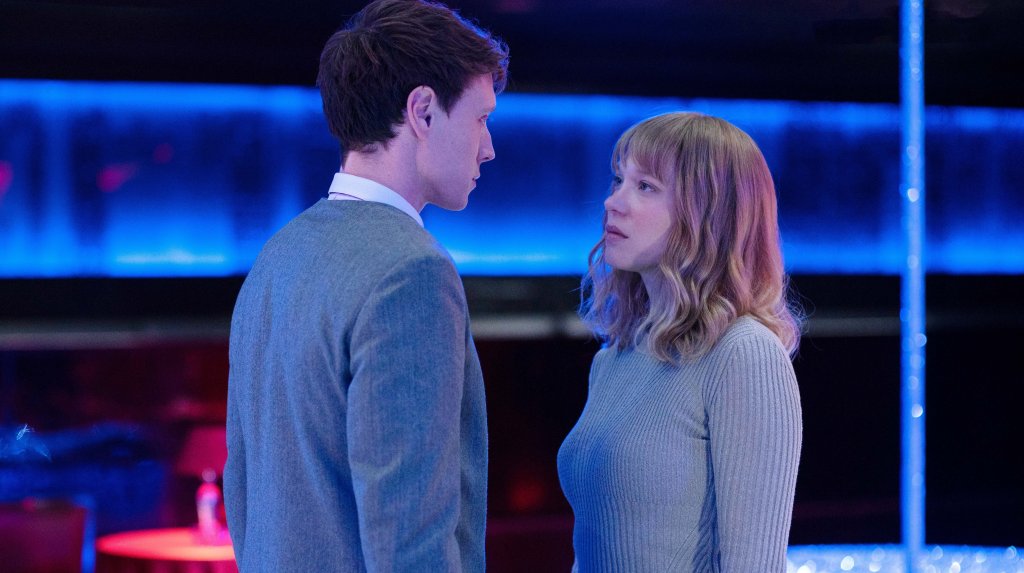
It is a society in which Artificial Intelligence has replaced many human activities, and where emotions and memories of trauma can be removed through the action of “purifying” DNA. Human frailty has been erased, although the cost of this is not entirely clear. To Bonello, however, there is no doubt about one aspect of it. In this situation, “there are no more problems, and no more catastrophe—but you are no one.” For the likes of Gabrielle and Louis, “it’s a terrible dilemma. Being a human is also feeling fear, which is one of the most beautiful feelings. It makes you really awake and aware of the world.”
Being a human is also feeling fear, which is one of the most beautiful feelings.
—Bertrand Bonello
He has been taken aback, he says, by the way events seem to have overtaken his imagined scenario. “When I started writing four or five years ago, I worked with researchers in AI and I knew a lot about it and its dangers. But for me it was like, in 20 years this could happen. Then when we showed the film in Venice last year, AI was at the heart of so many subjects and worries and such a part of the Hollywood writers’ strike. It made the film much more contemporary than I thought it would be.”
When it comes to the classic horror story element of the film, Bonello sets it up early, then saves the tension of it until the second half. The Gabrielle of 2014 is an aspiring, somewhat despondent actor doing commercials and casting calls, house-sitting a large, modern, two-storey residence that has CCTV, floor-to-ceiling windows, a red Mustang convertible in the driveway, and a Ming vase on a side table. She is also starting to fall down an internet rabbit hole, in which her laptop becomes a portal to all kinds of unexpected and uncanny things.
Louis has undergone a more dramatic change, becoming an unnerving, threatening figure. He expresses himself through increasingly violent rants that he records on his phone and posts online. Feelings of isolation and self-pity—“A beautiful environment can be the darkest hell if you have to experience it all alone”—turn into rage, hatred, and a desire to take revenge on women for his feelings of rejection. There are also moments when he seems to fear what he knows he is capable of. Both Louis and Gabrielle are caught up in a contemporary conundrum, Bonello says. “You think you’re very connected but you’re more and more alone.”
* * * *
In his films, Bonello has often used interwoven narratives or moved between different time frames: in the multiple, converging stories of the young revolutionaries in Nocturama (2016), for example, or in the linked chapters of Zombi Child, set 20 years apart. In The Beast, this was tricky to sort out, he says. “I did maybe 15 drafts because of the structure. I would say it was more complex than complicated, but I think it has to be simple for the spectator. So how do you put something here that rings a bell there, something in 1910 that rings a bell in 2014?” Part of the solution was pure pragmatism. “I worked a lot with coloured Post-it notes, putting them on the wall.” But the most challenging aspect was making sure that there was an overall coherence, that it did not feel like three separate films or seem to be about three different sets of characters.
There are many elements that “ring a bell” from one episode to another, whether it is the unsettling presence of a bird, the kinetic energy of dance, the predictions of a clairvoyant, or the snark of a trio of young women. The figure of the doll, with all its imagery and implications, has a significant role in every era. There are phrases that are carried from one period to another, or ideas that take very different forms. Sometimes the characters themselves recognise these echoes; sometimes they do not seem to.
Bonello, as always, composed the score for the film. He began as a musician, studied piano, played guitar, formed bands, and did session work before he made his first film. He regards being a composer and filmmaker as part of the same process. “They’re very much connected. If I write a scene and I think it needs some music, I stop writing and go into my studio. The two things feed off each other, in fact.”
He occasionally composes for other people. “I just did the music for a friend, Aude Léa Rapin, something very electronic.” And in January this year he was involved in a large-scale collaboration with the Philharmonie de Paris to celebrate the work of Arnold Schönberg. The project involved music, video, projections, dramatic performances, twelve Schönberg compositions, and an evocation of his life. “He’s a composer I really know well,” Bonello says. “I have a very intimate relationship with his music.” So too does Gabrielle; when we see her at the piano in The Beast, she is practising a Schönberg piece.

In 2014, music means something very different to Gabrielle, but she is repeatedly drawn to the same warehouse dance club and a karaoke TV program she watches. A karaoke favourite, Roy Orbison’s ‘Evergreen,’ a song of enduring love, haunts the final half of the film. In the stripped-back future of 2044, there is still, perhaps surprisingly, a place where people go to dance: it’s a club that functions as a kind of free zone, in which the music comes from a different year each time and those who attend dress accordingly.
There might be dance clubs in his vision of 2044, but there are no movie theatres, Bonello says. And he is not even sure what their immediate future is. “We are in the centre of mutation, and it’s impossible, no one can tell what the world of cinema will be in five years. Will it be expensive like going to the opera, or just Marvel movies? The platforms, maybe they will eat everyone. Or maybe they will fall apart.” In the meantime, he is preparing a new film—“very different”—that he hopes to shoot in Rome. “In today’s world, which is full of images, trying to think of what an image of cinema is becomes more and more interesting and more and more difficult.”
We are in the centre of mutation, and it’s impossible, no one can tell what the world of cinema will be in five years.
—Bertrand Bonello
There is at least one way in which he is sympathetic towards the idea of “taking away stuff.” Sometimes, he feels, it’s better not to be connected. On the table next to him is his no-frills, calls-only mobile phone. “It’s so I don’t get internet when I go out of my house. When I go into the streets, everyone is walking like that”—he picks up his phone, then looks down at it intently—“and it’s a little weird.” He understands the impulse, he adds. “I’m not stronger than everyone, I would look at my emails. So I like to go out free. I look at people, I daydream. Daydreaming away, trying to catch an idea—that’s why I need to be far from my computer and the internet, just to let the mind go.”
The Beast releases in Australian cinemas on the 30th of May.
**********
Philippa Hawker is a film and arts writer. She is working on a book about Jean-Pierre Léaud.
Philippa Hawker travelled to Paris with the assistance of Unifrance.
- The complete lineup of the Cinémathèque program curated by Bonello was as follows:
Features:
1. Un flic, Jean-Pierre Melville, 1972.
2. Birth, Jonathan Glazer, 2004.
3. When a Stranger Calls, Fred Walton, 1979.
Shorts package:
1. ‘Scorpio Rising,’ Kenneth Anger, 1963.
2. ‘Voodoo in my Blood,’ Ringan Ledwige, 2016.
3. ‘Dancing in the Rain (Turf Feinz),’ Yoram Savion, 2014.
4. ‘Brumes d’automne,’ Dimitri Kirsanoff, 1929.
5. ‘Clean with Me (After Dark),’ Gabrielle Stemmer, 2019.
6. ‘De l’origine du XXIe siècle,’ Jean-Luc Godard, 2000. ↩︎
 Rough Cut