


In their apartment at Northcote’s Walker Street public housing estate, three children twirl, play, and speculate about what their next home might be like, after this one has been disappeared. Will there be enough space for them to live comfortably? Will their street be lined with the houses of school friends, or will they end up far afield from everyone they know? At this point in Lucie McMahon’s graciously revelatory documentary Things Will Be Different, these children, their elder sibling, and their mother, Najat, are the estate’s last remaining tenants after it has been condemned to demolition as part of the Victorian government’s Public Housing Renewal Program. Despite its oblique title, this program would instate the demolition of eleven of Melbourne’s public housing estates, to be reconstructed by private developers (in the case of Walker Street, alongside a swathe of luxury, river-facing apartments), with the diaphanous promise that their inhabitants could someday return—even though the plans for the new buildings include a slashed quantity of bedrooms.
Things Will Be Different is told through attentive observation of, and conversations with, Najat and her neighbour William Gwynne (Will), the latter of whom had lived at Walker Street for five years at the time of filming in 2019-2020. Will’s humour, near-Shakespearean oration, and passion for Walker Street’s community act as the film’s captivating emotional foothold. From its first scene, in which he tours a cluster of visitors around the estate’s grassy periphery, leading them to its river, we are reminded that a place is never stagnant; it’s something assembled and reassembled by encounters, walks, and memories, and it is this Walker Street that is also being threatened. Things Will Be Different is an acutely melancholic film, recording the loss of the estate as a window into what Will describes as “a global destructive process that marks governments all around the world abandoning public housing.” In the limbo of Walker Street’s “death sentence,” the film is suffused by an overwhelming atmosphere of loss, which is only further clouded by the government’s protracted failure to assure its residents a future. When housing is precarious, documents McMahon, it feels dangerous even to imagine a tomorrow. “I don’t have dreams about… anything,” divulges Will in the dark, outside of his replacement house in Fitzroy.
Things Will Be Different is a call to action—“We actually all need to imagine and actively work towards a better future,” as Will says toward the film’s end—but it is a soulful and elegiac one, a still-tender record of the pain of prematurely committing the home one loves to the past. The documentary, which was produced by researchers Libby Porter and David Kelly from RMIT’s Centre for Urban Research, has a cadence far more akin to a poised montage of home video footage than to a public service announcement. There are countless glowing moments: Najat’s youngest daughter, Nada, singing The Rocky Horror Show’s ‘Time Warp’ (as time is splayed and contracted in the mind of her mother, who anxiously awaits intel as her eviction date looms), or Will crafting something from a broken chandelier, never ceasing to be engaged in the process of making and sustaining a home, as if dispersing seeds even as one’s garden is about to be razed.
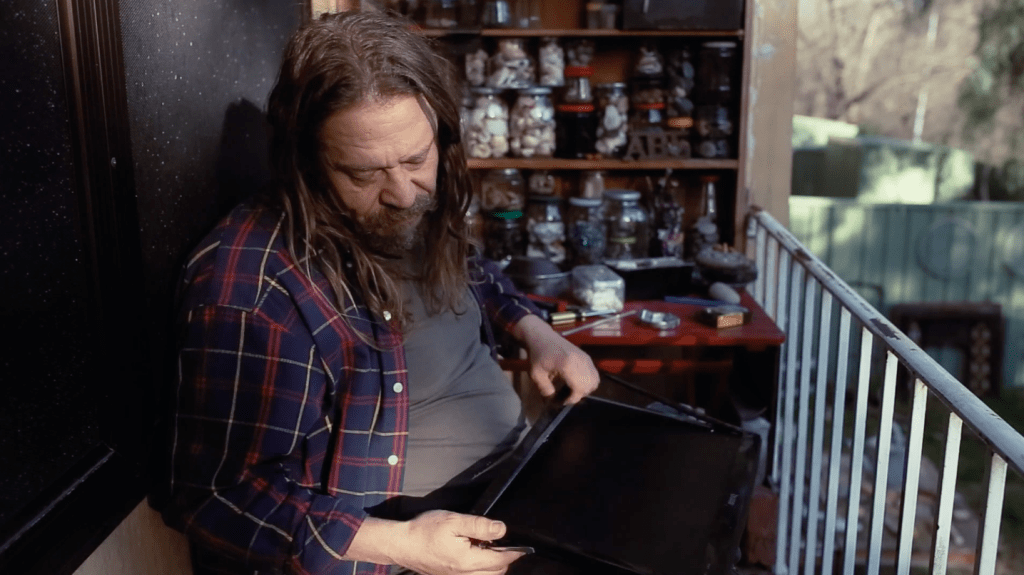
Cinematographer Celeste de Clario Davis—herself a former Walker Street resident, committed public housing advocate, and Will’s stepdaughter—for the most part shoots the estate in gentle daylight, so that it feels like we are waking up there. She savours its details: webbed silhouettes dancing on plaster, cresting pink flowers, a tousled, pinstriped duvet dappled with sun. These images, often scored by light-footed piano and supple strings, shimmer with a beautiful, fragile familiarity. De Clario Davis’ handheld camera doesn’t feign passivity; instead, it is a responsive eye, wandering and noticing, peering from stairwells and panning rooms with a lyrical, serene idleness. Inching closer to Will and Najat’s respective moving days, every close-up—like the one roving Najat’s children’s graffiti, blue hearts with smiling faces, on a wall—feels like another goodbye. Similarly, while McMahon (who also grew up in public housing and met de Clario Davis at a Save Public Housing Collective meeting) rarely draws attention to her own presence, she occasionally lets her voice drift into the film, asking her subjects questions and conveying her hopes for them. In doing so, she dispenses with any expected veneer of an outsider-documentarian’s non-involvement, instead evoking the intimacy of a visitation and echoing the history of Walker Street as a supportive meeting place, where neighbours carpooled and Najat conducted a homework club for the local children.
Throughout the documentary, ‘haunting’ figures as its own kind of resistance—and a way of seeing that refuses the Renewal Program’s unexamined valorisation of ‘the new,’ which is unable to recognise social ties as an infrastructure of their own, worthy of protection and preservation. As Mark Fisher points out in Ghosts of My Life, a haunt “signifies both the dwelling-place, the domestic scene and that which invades or disturbs it. The OED lists one of the earliest meanings of the word ‘haunt’ as ‘to provide with a home, house’” (125). In the form of the eviction letter received by Najat, or the blurred face of her Department of Health and Services Relocation Officer, the Renewal Program figures as an unnervingly disembodied spectre—‘haunting’ the possibility of domestic peace and security. However, it also forces Will and Najat to haunt the estate in turn. While Najat resists the pressure placed on her to ‘choose’ a house that is deemed good enough (one in which her four children share two rooms), Will refuses for as long as possible to fully vacate his own home, hesitant to leave Najat and her family alone.
I am reminded of an essay by Ann Boyer, simply titled ‘No.’ “Sometimes our refusal is in our staying put,” Boyer writes. “We perfect the loiter before we perfect the hustle. Like every toddler, each of us once let all adult commotion move around our small bodies as we inspected clover or floor tile” (10). Dwelling and loitering are often practical modes of refusal. For Boyer, they are also a poetic animus—a way to linger with words, ideas, or moments, beyond what might feel appropriate according to consumer-capitalist scheduling. As an art form, cinema bears the magical ability to create illusions of time stilled and reserved, but it also enacts many literal refusals through processes of editing and elision, through which it can avoid reiterating the same, already overexposed stories. Things Will Be Different is never frantic in its ‘messaging,’ instead sustaining a watchful devotion towards its subjects that subtly erodes the noise of stigma surrounding public housing. We watch Will’s possessions become achily inert in the ordeal of moving, as de Clario Davis films still lives of ballooned Aldi bags, shakily stacked boxes, and identical black shoes crowded in a dim corner. The film’s molasses-like pacing is doom-laden, but it also feels, at times, unapologetically leisurely, as in its time lapses, where we watch the sky above Walker Street, stroked silver with power lines, being carried from dusk to dawn.
The film’s molasses-like pacing is doom-laden, but it also feels, at times, unapologetically leisurely, as in its time lapses, where we watch the sky above Walker Street, stroked silver with power lines, being carried from dusk to dawn.
—Indigo Bailey
The naturalistic intimacy and warmth of McMahon’s film make the estate’s destruction feel like a far-off impossibility, although this is also its unforgettable premise. It is only when the crane has arrived to demolish it that we truly see the boarded-up building in its entirety. After growing so accustomed to its interiors—and to the stirring inner and outer lives of its people—the abruptness of this zoom outwards feels like a surreal torment. From here, we watch as the crane’s monstrous, outsized beak begins dismantling the outer walls, nudging its plasterboard into streams of dust. It’s a sublime tableau—reminiscent of Shaun Tan’s illustrations of strange beasts towering over industrial wastelands, or of J.M.W. Turner’s propulsive, mournful landscapes. On the border of the fenced-off rubble, Najat still lingers, however. Wearing all black, she tells McMahon that she left some of her furniture inside and, recently, dreamt of being allowed in to retrieve it. In the dream, her lost items were still miraculously intact.
Things Will Be Different is now showing across Australia.
**********
Indigo Bailey is a Tasmanian writer and editor living in Naarm/Melbourne. In 2023, she received the Island Nonfiction Prize for an essay about rain sound. She has written for Island Magazine, The Guardian, Voiceworks, and Kill Your Darlings, among other publications.
 Rough Cut