Everything moved. The island was never still; everything that grew moved. […] The grass was about 2ft, 3ft high, and it was waving like the waves of the sea.
—Wendy Hiller on the Isle of Mull in I Know Where I’m Going! Revisited (1994)
A young woman stands in the doorway of a grand old house, the foggy evening light filtering in behind her. Leaves from the windswept path accumulate just inside the entrance. Hearing no response to her knock, she picks up her suitcases and wanders in, glimpsing three chickens mooching in the hall just before a door opens. Unbeknownst to her, she is, in more than one sense, crossing a threshold into another world. In British filmmakers Michael Powell and Emeric Pressburger’s 1945 film I Know Where I’m Going!, the far-flung highlands of the Hebrides in which the protagonist finds herself are much more than a backdrop for narrative activity; they are some of the most powerfully evocative landscapes on film. Its rolling hills are revealed to be a cradle for community, while its unyielding weather acts as both an agent of personal transformation and an embodiment of the uncontrollable and serendipitous forces—human and non-human—composing our lives.
The overconfident exclamation of the film’s title is embodied in Joan Webster (Wendy Hiller), a young woman who knows where she’s going and what she wants—until she doesn’t. I Know Where I’m Going! opens with a compact voyage through Joan’s biography, cycling through her unwavering determination for personal advancement at the ages of one, five (specifying in a letter to Father Christmas that she would like silk stockings, not artificial), twelve (hitching a ride home from school on the milkman’s cart instead of waiting for the bus), and eighteen, before arriving at 25.
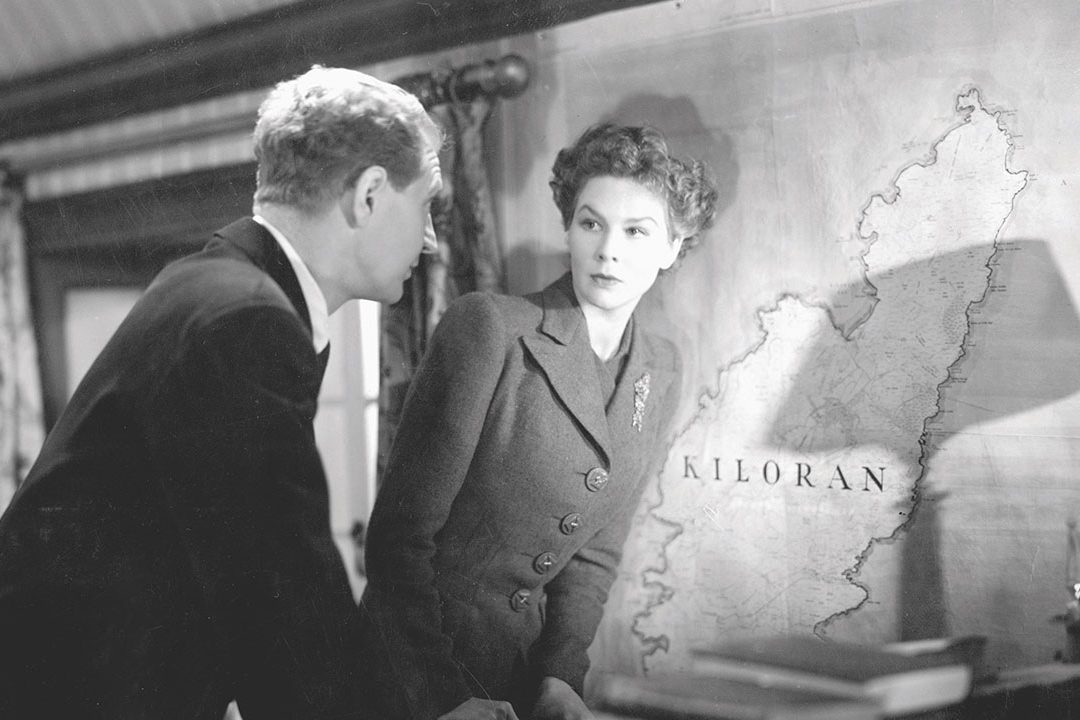
In the present day, as Europe moves closer to the end of World War II, Joan meets her bank manager father in a bustling, high-end Manchester restaurant. Her greeting is interrupted mid-sentence by her impatient request for some money they had agreed on. She announces that she is going to marry Sir Robert Bellinger, the head of Consolidated Chemical Industries and “one of the wealthiest men in England.” The marriage is to take place on “his” Isle of Kiloran, located in the Hebrides, an archipelago off the west coast of the Scottish mainland. Her words and gestures tremble with enthusiasm as she describes the natural wonders of Kiloran, only to admit that she has only ever visited the island in her dreams.
* * * *
On the overnight train journey to Glasgow, Joan’s impatience to meld her fantasies with reality boil over into a delirious visual and aural dream-collage. Her wedding, the spoils of her future spouse’s wealth, and the travel arrangements congeal and crash into each other in an increasingly frenetic expression of her ambitions. Images of Joan in a veil, descending bank notes and the train’s smoke and wheels jostle with disembodied voices preoccupied with finances and the future (“everything’s arranged,” “we’ll send it tomorrow,” “five-hundred guineas”), repeating rhythmically in tandem with the chugging of the train as she sleeps. The sequence is superimposed with the shiny surface of the plastic cover for her wedding dress hanging from the luggage rack—as though the attraction of the whole prospect lies in its packaging as a glossy, consumable fantasy of upward mobility.
In her BFI Film Classics study of the film, Pam Cook explains how Joan’s careening aspirations reflect the occurrence of a broader cultural re-orientation, brought on by the imminent conclusion of the war, away from the resourcefulness necessitated by austerity conditions and toward the “material abundance” and “upward social mobility” of consumer capitalism. Indeed, the materialistic motivations undergirding Joan’s marriage are exposed in her dream’s central event: a priest asking if she will take Consolidated Chemical Industries to be her lawful wedded husband. The dream ends with a miniature train travelling through a landscape of tartan-patterned hills, an amusing evocation of Joan’s clichéd perception of Scotland, which for her is merely an exotic destination in which to wed. But when Joan arrives on the Isle of Mull, the last stop before her final passage, she enters a landscape far removed from the ornate English interiors she left behind, and steeped in far deeper mysteries than the superficiality of tartan hills.
At Port Erraig, from which Joan is to sail to Kiloran, the film’s entire sensory environment shifts. There are sights of a vast sky with clouds casting shadows onto the hills, darkening their higher-most tips. The cigarette smoke that earlier filled the Manchester restaurant is replaced with swirling fog. There are the sounds of the Gaelic language and seals singing, the smell of ocean salt. This all arises from the land itself, its inhabitants, and its weather. The chasm between Joan’s lofty assertions and dearth of real experience is exposed by her unfamiliarity with the mellow sound of the seals’ song—asking sharply what “that noise” is—despite having eagerly described it to her father.
From the moment Joan sets foot in this land of constant flux, she is no longer on firm ground.
—Alex Williams
In sequences such as this one, cinematographer Erwin Hillier favoured shooting against the light, producing strong contrasts which cast the human figures as near-silhouettes against the ethereal glow of the overcast sky. The landscape’s stylised rendering takes on a gothic ambience of uncertainty and obfuscation, making it suddenly harder to see where one is going—in ironic contrast to the film’s title. I Know Where I’m Going! is considered a central film in inaugurating the neo-romantic sensibility of the Archers (the collective name for Powell and Pressburger, after their production company). The film’s pictorial rendering of Mull is likened by scholar Stella Hockenhull to the sublime aspects of nature and expressive use of light in the work of neo-romantic painters such as John Piper and Alan Sorrell. Indeed, the Archers’ distinct anti-realist sensibility placed them at odds with the modest, restrained national style of filmmaking praised by British critics at the time. The lustrous atmospheres of I Know Where I’m Going! and its following Technicolor wonders A Matter of Life and Death (1946), Black Narcissus (1947), and Gone to Earth (1950) invite sensory engagement, taking on metamorphic agency within the narrative.
The Isle of Mull is the product of transformative elemental forces; the island came into existence between 55 and 60 million years ago when it arose from the ocean as a volcano, and has since been twisted into new shapes by subsequent eruptions, the grinding of glaciers, the push and pull of the tides and turbulent weather systems. From the moment Joan sets foot in this land of constant flux, she is no longer on firm ground.
* * * *
No words feel quite capable of capturing an affect so purely cinematic in origin as what is evoked by Joan’s arrival on Mull. Yet the responses of those the film’s landscapes have enchanted speak for themselves. In a letter written in 1950, Raymond Chandler declared of its olfactory allure that he’d “never seen a picture which smelled of the wind and rain in quite this way.” Nancy Franklin, an editor of the New Yorker magazine, felt so overwhelmed after seeing I Know Where I’m Going! on television that she travelled by ship to the Isle of Mull (recounted in Mark Cousins’ 1994 documentary I Know Where I’m Going! Revisited).
When I watched the film for the first time in late 2020, the impression its beautiful yet elusive world left on me was so strong that the feeling of being enveloped inside its landscapes persisted for days afterward. Powell himself harboured a lifelong affection for the Scottish Isles and an investment in the restorative effects of its landscape; he would often return there after completing a film to clear his mind, or when his spirits needed lifting. I Know Where I’m Going! continues in the vein of what Powell called his first truly personal film, The Edge of the World (1937), which was also set in the Scottish Isles and contained a similar reverence for its rugged scenery, as dangerous as it is beautiful.
For Joan, the island’s enigmatic surroundings remain—at least for now—secondary to reaching her destination; she checks her hair and powders her face in a portable mirror, only half listening while her driver recounts the curse on the family whose castle looms through the fog and branches behind them. She makes her way down to the water’s edge, only to be told by a man in naval uniform and fellow passenger to Kiloran, Torquil (Roger Livesey), that there’ll be no crossing on account of the weather. This is the first delay induced by the island’s natural rhythms, which will soon become a longer postponement and, eventually, a complete change of direction. As Joan waits stubbornly for a boat that never comes, the wind snatches the paper itinerary from her hand and it is claimed by the sea.
* * * *
No matter how much we try to design a direction or project an outcome, most things never quite go exactly the way we plan, expect, or think. I Know Where I’m Going! foregrounds the importance of ruined plans and subverted expectations in determining the character of our lives. The temporal interruptions structuringthe filmwere also present behind the scenes, through an abundance of postponements and detours. Just as Joan finds herself stuck waiting for the fog to clear, the film’s production was the result of a similar disruption. The Archers’ next planned feature had been A Matter of Life and Death, but a shortage of Technicolor stock necessitated its deferral and a new film materialised out of this unexpected gap. The experience of being stranded in an unacquainted environment would also have been familiar to many of the film’s crew—including Pressburger—who had emigrated to Britain to flee Nazi ascension.
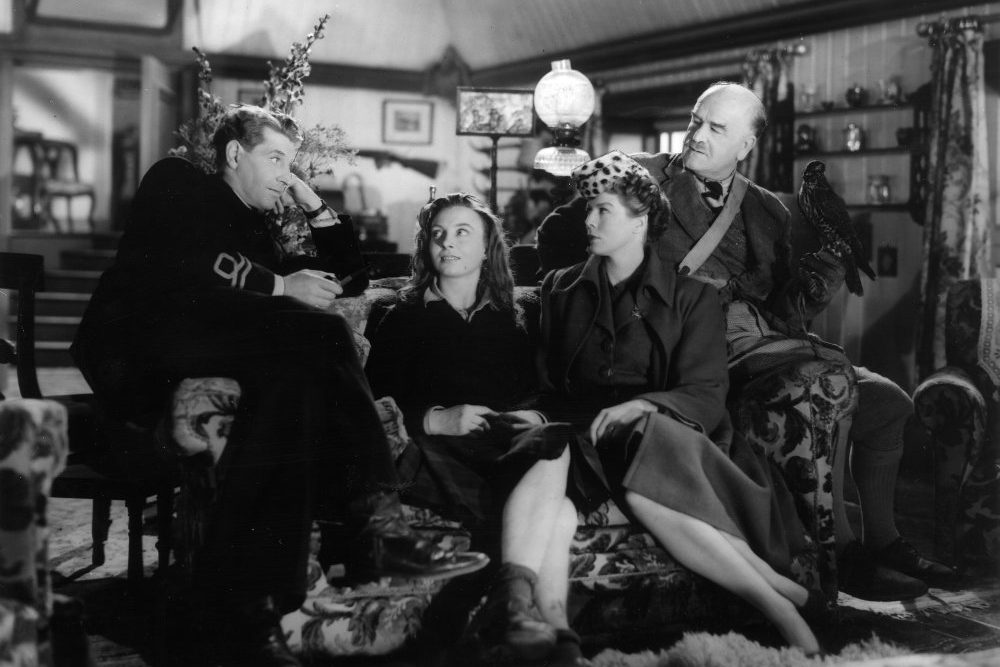
Joan’s suspended existence continues when a meteorological hindrance of another kind is encountered: a gale warning is issued, “blowing from every point of the compass at once” and chopping up the sea to an untraversable degree. The lengthening of the delay allows Joan to see more of Mull and its people; eclectic inhabitants include a falconer who has been training a golden eagle for seven months, and a childhood friend of Torquil’s who breeds Irish wolfhounds and hunts wild animals for food to survive austerity conditions. Progressively, the residents’ ‘old-fashioned’ collectivist values begin to undermine her closely held individualism and ambitions. The private gives way to the public: Joan’s request to travel by car to the town of Tobermory, from which she will contact Robert, is overridden by Torquil’s insistence that there is no need; they can take the bus.
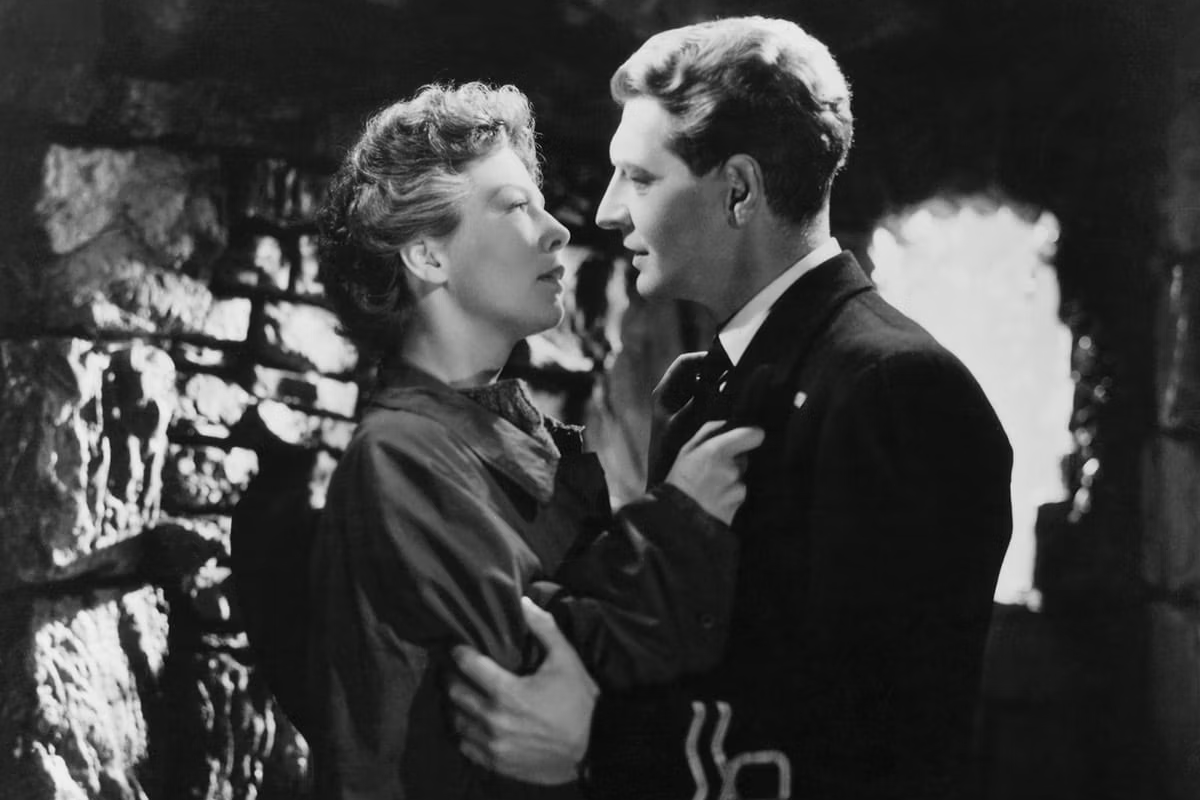
What’s more, Joan discovers that Torquil is the true Laird of Kiloran, from whom her fiancé is merely renting it for the duration of the war (Torquil’s modest living is not enough to live there himself). Her restlessness is contrasted with his patience: when his crossing is also delayed, he simply accepts the weather as it comes, accustomed to its often unpredictable behaviour. Despite her best efforts, Joan finds herself attracted to the handsome naval officer, whose intense gaze seems, disarmingly, to see right through her. Equally, Torquil’s enchantment with her seemingly unflappable determination fans the embers of a growing physical and romantic desire, which reaches fever pitch at a cèilidh—an informal yet traditional gathering for singing, dancing, food, and drink. The event is a tapestry of human community and connection: the wooden floorboards shake with feet dancing to music performed by the pipers meant for Joan’s wedding but who have also been stranded by the gale. Dance partners are gained and exchanged (sometimes unwillingly), smiling faces fill the frame as they sing merry Gaelic harmonies, and love is confessed. Translating the lyrics to the Gaelic song ‘Nut-Brown Maiden,’ Torquil skewers Joan with his gaze as he ends on the phrase “you’re the maid for me.”
No longer just an obstacle blocking her destination, the weather’s ungovernable elemental force begins to mirror Joan’s tempestuous emotions, which are similarly capricious and unpredictable, frightening in their power to change and control her in ways beyond her comprehension.
—Alex Williams
Threatening as it does to further fray her tightly-wound plans, the magnetic pull of her newfound attraction begins to scare Joan, and her eager pursuit of Kiloran tips over into a desperate flight from both Mull and Torquil. No longer just an obstacle blocking her destination, the weather’s ungovernable elemental force begins to mirror Joan’s tempestuous emotions, which are similarly capricious and unpredictable, frightening in their power to change and control her in ways beyond her comprehension.
Mull’s geographical position also lies at a volatile intersection between polar and temperate zones, with humid air originating from the vast ocean to the west and dry air from the land to the east. This situates it within a tumultuous pocket of storm activity, producing varied and unpredictable weather patterns. Film scholar Tom Gunning pinpoints how, contrary to its traditional position as that which “regulate[s] and order[s]” the classical Hollywood film, heterosexual romance here functions as a destabilising and transformative force. The world-shattering sensation of unversed desire disturbs and dismantles Joan’s aspirations and, with it, who she believed herself to be.
* * * *
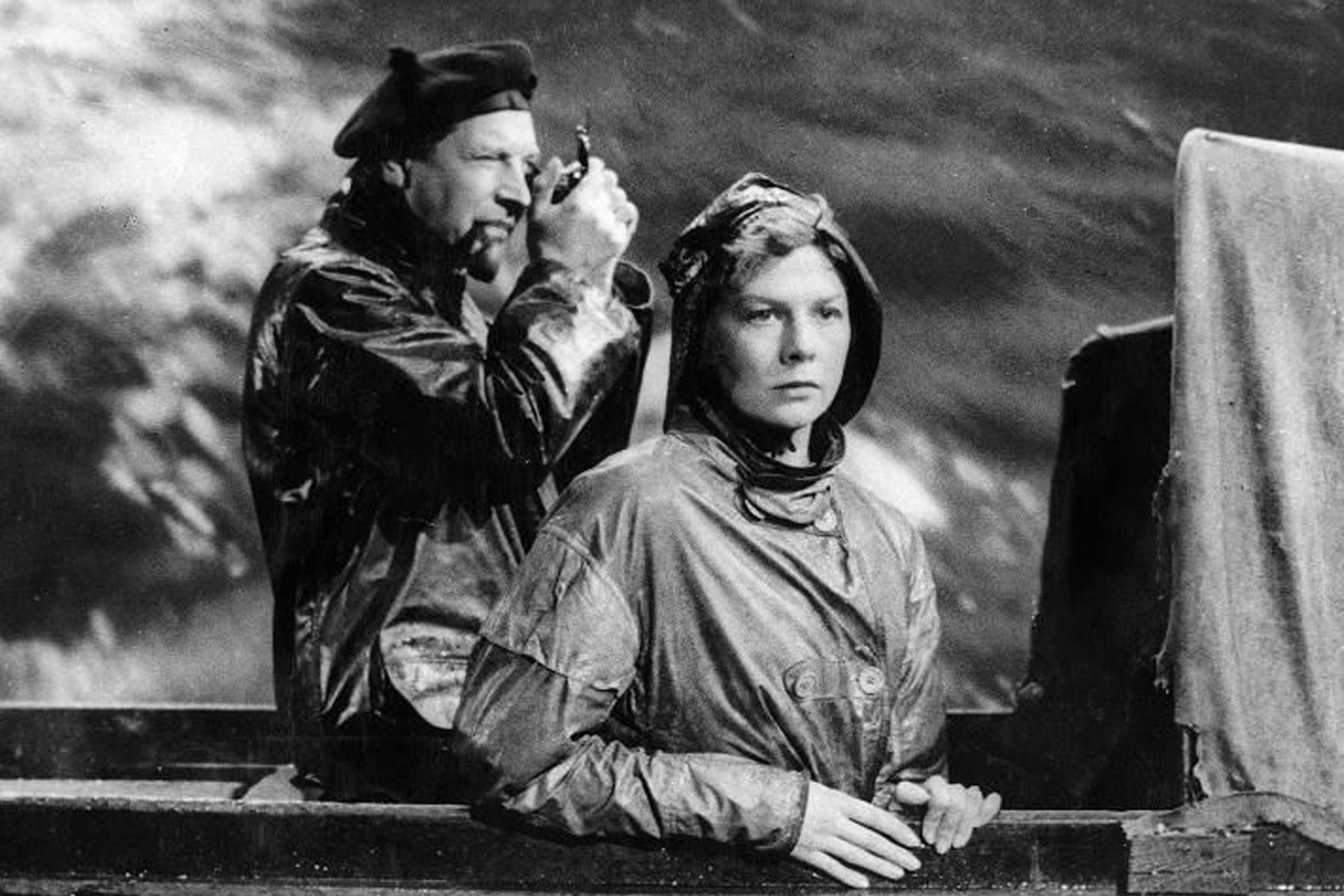
The wind, rain, and sea are finally unleashed in their violent and untameable glory in the climactic whirlpool sequence, which finds Joan selfishly bribing the young Kenny (Murdo Morrison) to ferry her across the dangerously wild seas to Kiloran in a desperate bid to escape her attraction to Torquil. Prior to this, Joan hears of the Corryvreckan whirlpool, the second largest in Europe, which is infused with mythological associations and lies between her and Kiloran. The scene—which was constructed by intricately combining footage of the actual whirlpool, rear projection, exchanges shot in a giant tank at Denham studios, and miniatures—was directly inspired by the formidable whirlpool at the centre of Powell’s favourite short story, Edgar Allan Poe’s ‘A Descent into the Maelström’ (1841). Poe’s portrayal of the whirlpool as a monstrous entity that swallows humans, trees, boats, whales, and even bears evokes the powerful emotions arising from a confrontation with the awe and terror of nature. Joan’s volatile feelings resemble the whirlpool itself; both voids of unknowability threatening to destroy her whole identity and re-configure her perceived purpose, should she yield to them.
A near-death experience with the whirlpool is narrowly averted by Torquil’s last-minute repair of the boat’s faulty engine, and Joan returns to Mull rudderless. The embodiment of her carefully designed future, her silken wedding dress, has been lost to the sea. When the weather finally settles, Joan changes direction one final time: from Kiloran back to Mull, where she treads arm-in-arm with Torquil down a modest highland path.
While some commentators define Joan’s inner conflict as one between the head and the heart, between the unambiguity of logic and the heady pull of desire, to me it’s really between two different kinds of desire: aspirations of wealth and upward mobility, and those which develop out of direct experiences and encounters. Mull’s landscape and the people it sustains affect an end to Joan’s hunger for material wealth, giving way to the feeling of wind in her hair and the splash of ice-cold water on her face. The shift is one from materialistic fantasy and individual advancement to elemental, communal, and romantic experience. I Know Where I’m Going! rejects fantasies of upward mobility—a cultural aspiration which has steadily deepened since the film’s making—as a glittering yet perpetually unfulfilling endeavour. Instead, we are called to openly see, hear, and feel the world that is directly in front of us.
I Know Where I’m Going! screened in Melbourne and Sydney in May as part of Cinema Reborn.
**********
Alex Williams is a PhD student, writer, and editor living on Wurundjeri Country. Their doctoral research investigates corporeal vulnerability in contemporary slow cinema. They are co-coordinator of the community engagement program Screening Ideas and a committee member of the Melbourne Cinémathèque.



 Rough Cut