


A favourite action film of mine, Martin Campbell’s Casino Royale (2006), boasts a handful of fast-paced, spectacular set pieces that are the product of expert direction, precise technical expertise, committed performances, and unthinkable coordination. The Taste of Things, meanwhile, is a beguiling romantic drama, but it also contains three or four sequences that promise to thrill in equal measure. Instead of a breathlessly-cut foot chase through Miami Airport, these lingering sequences parade vol-au-vent, velouté de petit pois, and pot-au-feu—decadent French dishes that, like Daniel Craig dangling from a speeding truck, you could enjoy watching entirely bereft of a narrative.
This is a new classic Food Film, with culinary spectacle to rival the titular meal in Babette’s Feast (1987). Vietnamese-born French writer-director Trân Anh Hùng even plays the same card as Ang Lee in Eat Drink Man Woman (1994) by opening the film with a heady sequence depicting the preparation of a multiple-dish feast that stuns as much as any cinematic fistfight. It’s all butter, sizzling fat, vegetables caramelizing, perfectly browned meat, velvety-smooth sauces, thick lardons, exquisite bouquets garnis, and celeriac freshly harvested from the earth. The film’s food, cooked under three-Michelin-star chef Pierre Gagnaire, who also appears in a cameo, is all real (promotion of the film uniformly highlights this, creating another easy parallel with action filmmaking and contemporary ‘we did it for real’ anti-CGI rhetoric).

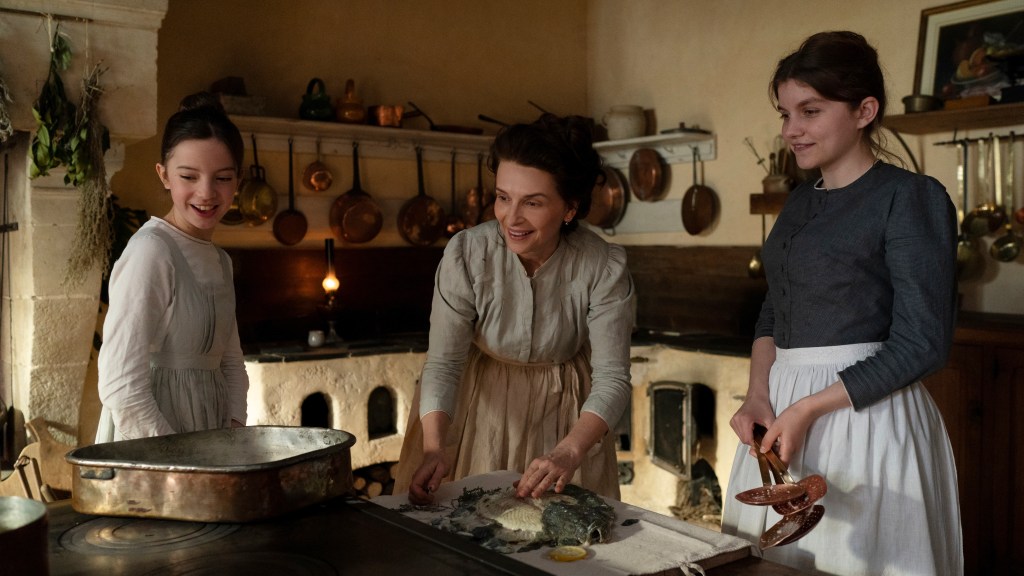
Equally ‘for real’ are the lead actors, who can’t fake the cooking in the film’s long takes. Benoît Magimel plays the epicurean Dodin Bouffant, while Juliette Binoche exudes elegance, calm, and self-assurance as his long-time chef Eugénie Chatagne. It’s 1889, and with housemaid Violette (Galatéa Bellugi), Dodin and Eugénie’s picturesque life in the French countryside revolves around the culinary arts. In their perfect larder kitchen replete with beautiful copper cookware—Toma Baquéni’s production design is as sumptuous as the food—the self-identifying gourmands prepare meals together not as servant and master, but as equals. With gastronomy as their bond, they bear a romance which could turn from implicit to explicit were Eugénie to accept one of Dodin’s regular proposals (she prefers their blissful status quo).
The film, titled La Passion de Dodin Bouffant in French, is very loosely based on Swiss author Marcel Rouff’s 1920 novel La Vie et la Passion de Dodin-Bouffant, Gourmet (commonly translated as The Passionate Epicure). Similarities to the book are limited to outline, including key elements like Dodin answering a profligate feast served to him by a “Eurasian” Prince with a simple pot-au-feu, or his desire to marry his cook, who is far less developed than Binoche’s character in the film. What is added in transporting the story to film is the medium’s intoxicating capacity to effect sensory euphoria. The processes of gourmet cooking are a visual treat, as revealed by editor Mario Battistel’s virtuosic juxtaposition of images (one match cut involving a pear made my friend and I gasp). There’s also the immersive allure of sound—sizzles and pats and clinks of cutlery provide the film’s chorus in lieu of a score.
It’s the cinematic embodiment of that near-mythical state of ‘flow’ associated with skilled craftspeople: practice, focus, and passion allowing one to move instinctively, making complex tasks look easy.
—Oscar Ragg
The beauty of cooking is also that of pressure, heat, and motion—the latter of which cinematographer Jonathan Ricquebourg delivers with profound fluidity. In the hypnotic opening sequence, the handheld camera is rarely if ever still; we pan to follow Dodin and Eugénie striding quickly (but never hurriedly) around the kitchen. They are stirring pots, pouring stocks through colanders, lifting huge trays in and out of the oven, checking the progress of a sear, fetching ingredients. It’s the cinematic embodiment of that near-mythical state of ‘flow’ associated with skilled craftspeople: practice, focus, and passion allowing one to move instinctively, making complex tasks look easy. The phrase ‘a well-oiled machine’ feels too mechanical to capture what Dodin, Eugénie, and Violette do—they’re more akin to ballet dancers. Perhaps the story’s most satisfying moment plays out as a visual reveal: something is brought into the frame through a pan to the side, an exciting and fresh development, yet according completely with the established cinematic vocabulary.

At the end of the extended opening—that day spent in the kitchen—Dodin and Eugénie retire to smoke and converse in the moonlit garden, clearly a ritual. Here still, Ricquebourg’s camera is in motion, moving lazily between the two in a long, unbroken take. Their conversation is well-worn and lovingly familiar. Indeed, Magimel and Binoche were lovers over 20 years ago, and have a daughter together (a more archetypally French history for the two stars could scarcely be imagined). As the camera swings between them, still charmed by each other, we come to understand that Trân’s most moving subject is the implication of years of shared passion and collaboration—both on and off-screen.
Dodin and Eugénie’s love is intimate and generous. The food they make together is shared with a dining club, and even though Violette clearly works hard, Trân is sure to highlight her satisfaction at the marvels she helps Dodin and Eugénie create. The emotion in Bellugi’s eyes in these moments floored me. But it’s Violette’s younger cousin Pauline (Bonnie Chagneau-Ravoire) that bears the most meaningful generosity of all—mentorship. When she joins Violette on a visit to the kitchen, Dodin and Eugénie quickly realise she has a gift. This is a film about cooking for someone you love but it’s also, perhaps most of all, a film about learning from others. Trân clearly has a zealous belief in the broader philosophy behind his characters’ relationship to their food: its seasonality, the pursuit of perfection, and the imperative of its knowledge and craft.
To wit, it would be hard to argue this isn’t a fundamentally conservative film: traditional French culture is ubiquitously lionised, from the constant name-checks of Gallic culinary pioneers to the exhaustive depictions of ‘the right way’ to do things (your mileage may vary on Dodin’s assertion that eating an omelette with a spoon makes “all the difference”). However, its reverence for old-world sensibilities doesn’t read as dogma—although one might accuse Trân of romanticism, given Dodin’s uglier tendencies toward the pretensions and impatience of entitlement, the film comes out relatively clear-eyed about the wealthy 19th century bourgeoisie that lived in countryside manors with cooks and maids preparing six-course meals. The little dining club of four well-dressed Frenchmen who form Dodin’s entourage are charmingly archetypal, quoting famous maxims about food and wine as they salivate over their feasts.
Given the depictions of both culture and cuisine, I’m much quicker to see The Taste of Things as winningly romantic, rather than objectionably so. Eugénie and Dodin’s story lands in a place of emotional resonance that’s only intensified by the substratum of the actors’ own romantic history, and the cinematic depictions of cooking are a masterclass in engrossing, tactile filmmaking. In the end, The Taste of Things combines culinary spectacle with heartfelt storytelling. As the saying might go, Trân is having his six-course French dinner and eating it too.
The Taste of Things is now showing across Australia.
**********
Oscar Ragg is a film enthusiast living on Boonwurrung land in Melbourne. His writing has appeared in In Review and The Big Issue.
 Rough Cut