


The question of what, if anything, distinguishes robots from humans—whether they have agency, inner lives, desires, hopes, or wishes of their own—is a perennial concern in science fiction. Whether it’s Ridley Scott’s Blade Runner (1982) with a bleached blond Rutger Hauer as a murderous replicant searching for his creator, or Mamoru Oshii’s equally existential cyberpunk classic Ghost in the Shell (1995), the genre is full of robots questioning the limits of their existence, desperate to break free of their machinic shackles. Director Jérémie Périn’s feature debut Mars Express, which screens as part of this year’s Fantastic Film Festival Australia, is an accomplished animated mystery that addresses these questions with a light touch, drawing upon much of the best sci-fi that came before it.
In Périn and co-writer Laurent Sarfati’s vision of the future, humanity has largely relocated to Mars, while Earth is described at one point as nothing more than a “slum for the unemployed.” Androids are widespread but ultimately subservient, jailbroken models are quickly destroyed by police, and human beings are free to augment their bodies with cybernetic upgrades.
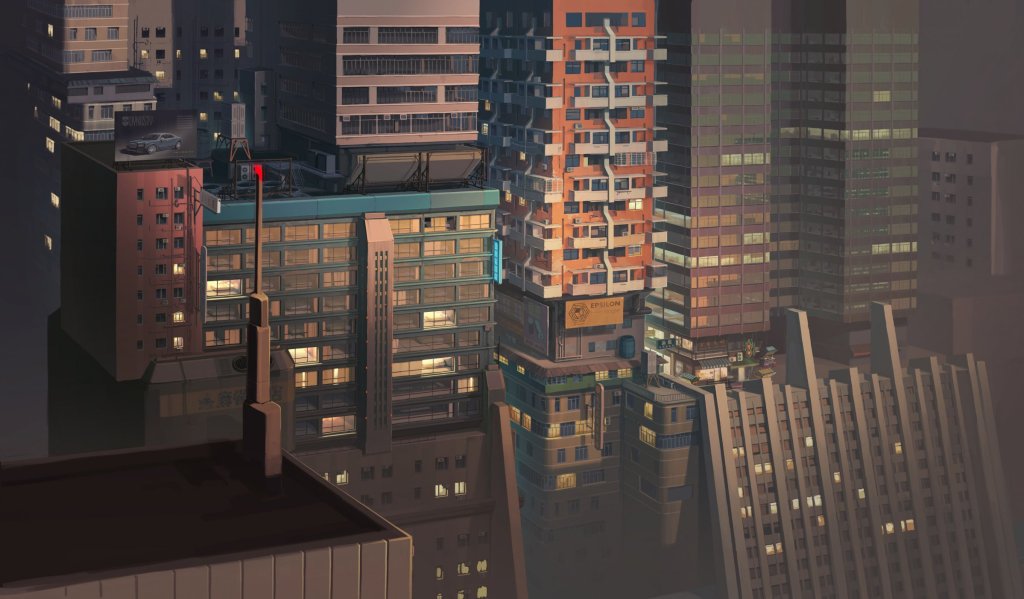
A pair of engaging, violent sequences launch us headfirst into the film’s richly conceived world, animated by French studio Je Suis Bien Content (who previously worked on TV series Lastman with Périn), which evokes everything from the kinetics of anime to the expressive economy of Mœbius/Jean Giraud’s faces in graphic novel The Incal. We open in a student dorm as Jun (Geneviève Doang) relaxes in the bath and her roommate Dominique (Angéline Henneguelle) lounges on the couch. As her cat jumps up to greet her, Dominique notices a streak of purple fluid on the creature’s fur. She runs her index finger down the cat’s coat, which quickly detaches itself from a green robotic body sitting underneath. It’s an elegant moment that signals to the viewer that we’re dealing with a vision of the future: androids are integrated into the domestic sphere, replacing their corporeal counterparts with shiny, perfect replicas. Soon, there’s a police officer at the door. Dominique lets him in, and it’s only a matter of seconds before he expeditiously assassinates her while Jun is able to escape detection. It’s a shocking opening that instantly sparks the questions: who could be looking for these young women, and why?
We’re then introduced to the film’s central duo. Aline Ruby (Léa Drucker) is a brash, headstrong PI. She’s on a sting operation with Carlos Rivera (Daniel Njo Lobé), an android copy of her partner who died years ago in a conflict called the Novigrad Insurrection. The pair served together in this conflict—the details of which are kept vague—alongside Chris Royjacker (Mathieu Amalric) who’s become a tech magnate in the intervening years and plays a key role in the film’s complex narrative.
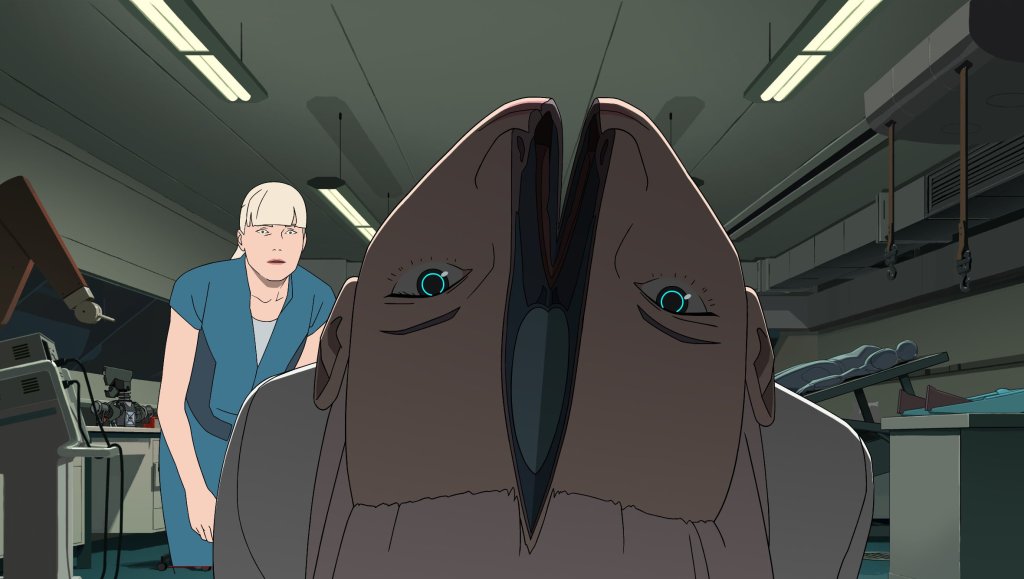
Royjacker has employed the pair to catch a hacker by the name of Roberta (Marie Bouvet). In an early scene, Aline and Carlos arrive at a hotel room and are greeted by Roberta’s android partner in cybercrime, Lem (Thomas Roditi). To catch the duo in the act, Carlos agrees to be illegally jailbroken—a procedure that will free him from the constraints of his programming, so that he will be able to kill humans at will. Yet he and Aline’s cover is quickly broken. A fluidly animated chase ensues, in which Aline follows Roberta out onto the exterior of the hotel and in through the window of the apartment building opposite her (a sequence that would be right at home in Ghost in the Shell). The pair succeed in capturing Roberta, but when the time comes to hand her in to the authorities, she’s managed to make the warrant for her arrest disappear. This is not, however, the last of her: before the film’s end, Lem and Roberta will become entangled in the mystery driving Aline and Carlos’s work.
This mystery begins to take shape once the pair are hired by Jun’s father to track down his daughter who’s now missing and wanted by the police for jailbreaking an android belonging to her university. The robot is found dead not long after, and when they visit the scene of his murder they discover a rocket he was in the process of building. Was his desire to escape to the stars always his own, or has it somehow come about because of Jun’s tampering? If it is his own, why would a robot ever want such a thing? The pair’s pursuit of Jun leads them through an array of vivid and sometimes seedy locales, such as a sex club staffed entirely by robots, and a furniture store which is a front for a ‘brain farming’ operation where people can sell their memories for profit.

For his part, Carlos’ android body is just about the only thing robotic about him, and his close, supportive friendship with Aline is the emotional anchor of the film. They are also remarkably flawed characters. Particularly Carlos, who struggles to contain his violence, and who we see in the film’s first act fruitlessly attempting to convince his ex-wife, towards whom he’s been violent in the past, to let him see their daughter again. These flaws add depth to the film’s characters as we watch them try to uncover the truth of Jun’s situation with one another’s help.
As Mars Express progresses, in true noir fashion, the missing persons case is proven to be merely an entryway into a labyrinthine conspiracy. The truths that Aline and Carlos uncover challenge many of their assumptions about the world they live in, where humans and androids exist side-by-side in supposed harmony. Featuring delightfully grotesque creature design, the film’s action-packed climax builds to a sombre, subdued ending that shifts its focus toward the cosmic. It’s an assured and memorable debut from Périn that will delight animation and sci-fi fans alike.
Mars Express is screening on the 8th and 9th of May, in Melbourne and Sydney respectively, as part of this year’s Fantastic Film Festival Australia.
**********
Jack Rowland is a writer from regional Victoria.
 Rough Cut