


Monday night, a half-full Melbourne screening of Jonathan Glazer’s The Zone of Interest. The room is already dark, quiet. The film has started: it opens with ambient sound over the production credits, followed by three minutes of a black screen and an overture by composer Mica Levi, one of the only fragments of music in the film. It’s a string elegy bent out of shape, its pitch descending atonally, taking us down.
A patron in the third row, retirement-age, there alone, turns around to the rest of the audience and makes an announcement: “I’d really appreciate it if people didn’t rustle their food wrappers during this film,” she says. “Please be considerate.”
There’s a ripple of stifled laughter in the room. “This is a cinema,” someone protests. “I’d appreciate it if you didn’t talk,” says someone else.
The woman looks defiant but embarrassed. “This is an important film,” she says quietly, turning around to face the screen. A wave of communal annoyance fizzes around the theatre. We’ve been rudely jolted into confrontation.
The screen is still black. This blind opening is designed, I’d read, to allow viewers the space to prepare ourselves to fully focus in on the film’s complex and violent soundscape, starkly at odds with its pace and action. But I’m now overly aware of the soundscape in the theatre around me. The isolating spell of the dark room has been broken.
* * * *
The Zone of Interest is a brutally efficient film, direct in its evasions. It’s free of the usual trappings of Holocaust films. There are no emaciated victims, faces stricken by poverty and horror. In their places are the Höss family—Rudolf (played by Christian Friedel), the dedicated and ambitious commandant of the Auschwitz-Birkenau concentration camp, his wife Hedwig (Sandra Hüller), and their four children. They live in an idyllic, riverside setting in southern Poland. Hedwig cares for an extensive garden. The children play. Rudolf gets a boat for his birthday and promises to take the family out on the weekend.
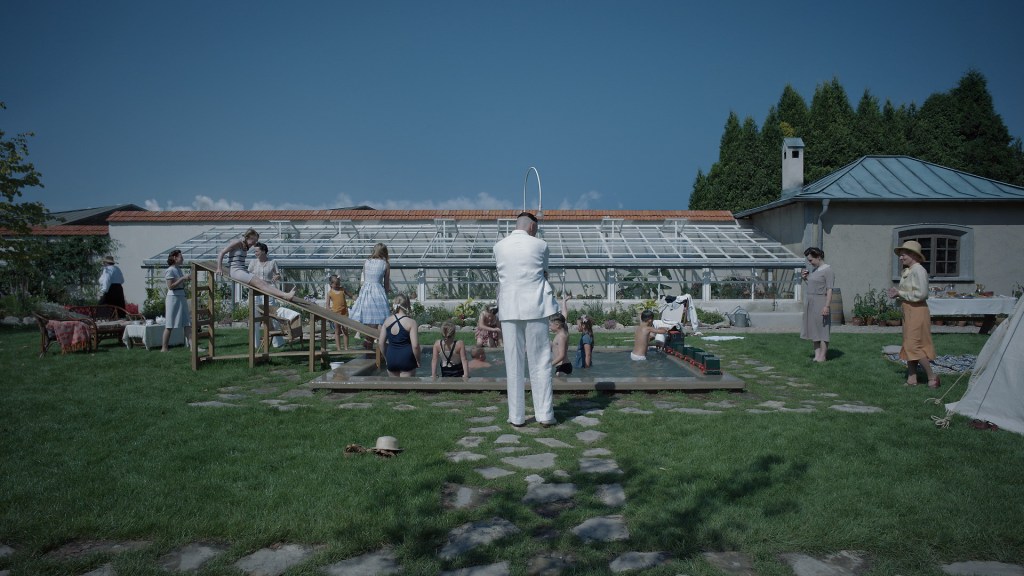
Hedwig’s mother, Linna, comes to visit. She is impressed by the garden, and by Rudolf’s ambition and success in his job. “It’s huge!” Says Linna. The space is dominated by a wall, topped with barbed wire. We can see the chimneys on the other side, hear the cries. “And that’s the camp wall?” She asks. “Yes, that’s the camp wall,” Hedwig confirms. “We planted more vines at the back to grow and cover it.”
“Maybe Esther Silberman is over there,” Linna wonders idly. “I got outbid on her curtains at the street auction.”
Hedwig turns her to the azaleas. They cross through a row of sunflowers seven feet tall, into the vegetable garden, where a table of food awaits them. A gunshot cracks in the background. “This will grow and cover everything,” says Hedwig, pointing to the vines overhead. A montage of flowers is scored with the buzzing of bees—and an indistinct scream.
Someone rumples a choc-top wrapper to my left. Behind me, someone digs into a popcorn box. A whisper. My own plastic water bottle crinkles, and I shuffle in my seat, too loudly. The screen fades deep red, and a synthesised drone finds its way into our bones.
Their home is metres from the camp, but we never see over the wall. Instead, we stay with the Höss family and their life—domestic, bucolic. Inside the house, it’s procedural and stifling in the vein of Chantal Akerman’s Jeanne Dielman, 23 quai du Commerce, 1080 Bruxelles (1975). Outside, it’s an uncanny nightmare à la Andrei Tarkovsky’s Stalker (1979).
Aesthetically, the film aims for realism and naturalism, verging on nostalgia. The actors were encouraged to improvise in long takes, while the lighting is natural and practical. This approach has proven controversial for some reviewers, like Professor Peter Rutland, writing for CNN, for whom it’s “a film about the Holocaust in which we never see any Jews,” “tedious,” and “Nazi pastoral.” Perhaps he watched it on mute.
What we see and hear are at odds. Throughout the film, the detailed soundscape created by Johnnie Burn (who also worked on the sound design for Glazer’s previous two features, Under the Skin [2013] and Birth [2004]) is an extraordinarily controlled symphony of screaming voices and machinery. Despite its incongruity, it sits beneath the picture, drawing attention to itself only rarely, surfacing at key points to emphasise the horror. It’s chilling how easy it is to tune it out.
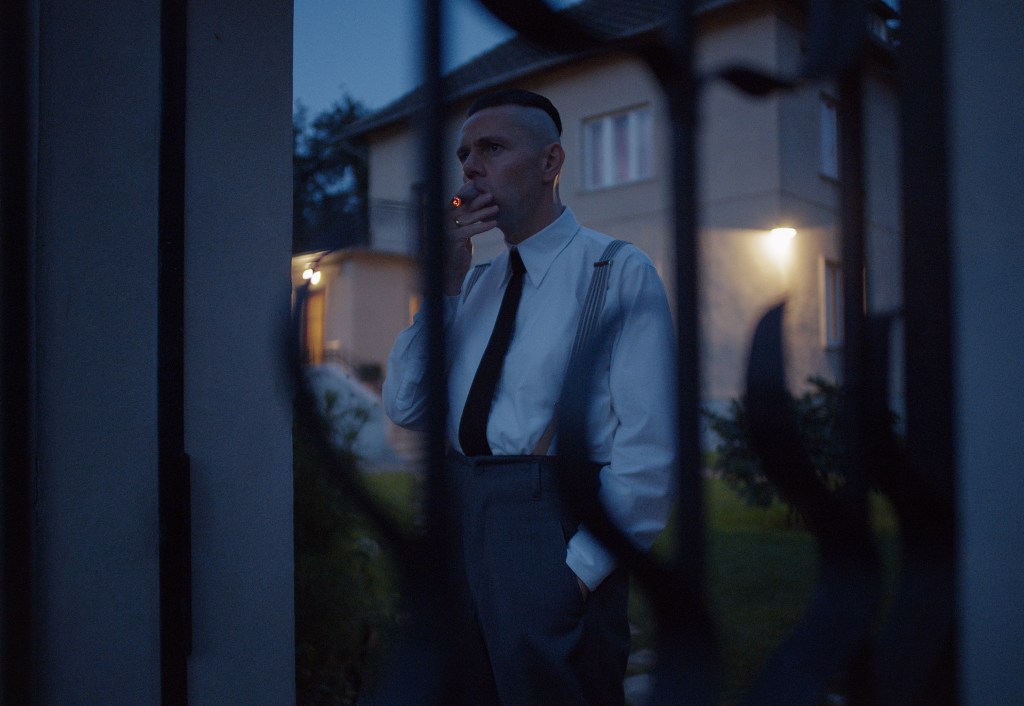
The immediacy of the screams, gunshots, and machine sounds audible from the Höss home isn’t just a matter of mixing. These sounds aren’t dramatised; there are no staged recreations of Nazi atrocities here. Burn’s process involved travelling around Europe and recording shouting—in urban centres late at night, at football matches, at street riots in Paris—which would then be interspersed with the mechanical noises of train arrivals, factories, and crematoria.
“To get actors to pretend that they’re in a gas chamber or whatever is not a good thing to do,” Burn told Hannah Rosin at the Radio Atlantic podcast recently. “So it was really about trying to find sound in the real world that is accurate and credible because it happened for real, and trying to repurpose that.”
He continued:
“So it was a long process of my team and I travelling around Europe to different places where people shout—you know, late-night city centres, things like that, and football matches, soccer matches in amateur league without big crowds, you know, those sort of things are just going to capture sounds that sounded right, and in the context of the film could be repurposed to trick you into believing you were hearing something horrific.
“It just sounds so much more credible to go out and record people shouting in a street where the acoustics are all correct and people are full of actual adrenaline than it is to stand in a booth and try to recreate an atrocity.”
Burn also discussed the scene in the garden with Hedwig’s mother in relation to the collage nature of the soundscape:
“Jon [Glazer] and I went to the library of sounds that I’d spent a year recording and we carefully placed in the sound of people over the wall. It was the sound of a hundred clogged feet, and then as you move further up the garden, there’s a quiet moment and you become aware of the electric fence. And then you hear some kind of metal barrels being moved.
“And Hedwig says a line, ‘Rudolf calls me the “Queen of Auschwitz”’ and then you hear some German shouting that I think came from a recording of, you know, late at night in Berlin. And then what we hear over the fence—further away, somewhat in the distance—is something going wrong within the camp and a random act of killing.”
Far from simulations created in a foley studio, these are sound collages built from contemporary sources. The sounds we hear didn’t need to be recreated because they exist all around us. The film, as Glazer has made clear since its release, is about now. The voices we are hearing, trying to tune out, are calling now. It is designed to bring present-day viewers upsettingly close to these atrocities, and to those committing them. This is the power of the film, and indeed the whole point of it.
As Hannah Arendt wrote of Nazi war criminal Adolf Eichmann in 1963, “the trouble with Eichmann was precisely that so many were like him, and that many were neither perverted nor sadistic, that they were, and still are, terribly and terrifyingly normal” (Eichmann in Jerusalem: A Report on the Banality of Evil).
In the theatre, audiences abide by a set of rules—we switch off our phones and keep noise to a minimum, to ensure the spell is not broken, that the world of the film is kept unblemished by our own. My fellow audience member on that Monday night hasn’t been the only one concerned with the way the communal cinemagoing experience sits uncomfortably with the film’s content. Across its theatrical release, commentators on social media have pointed out the dissonance—should we really be eating an ice cream to this?
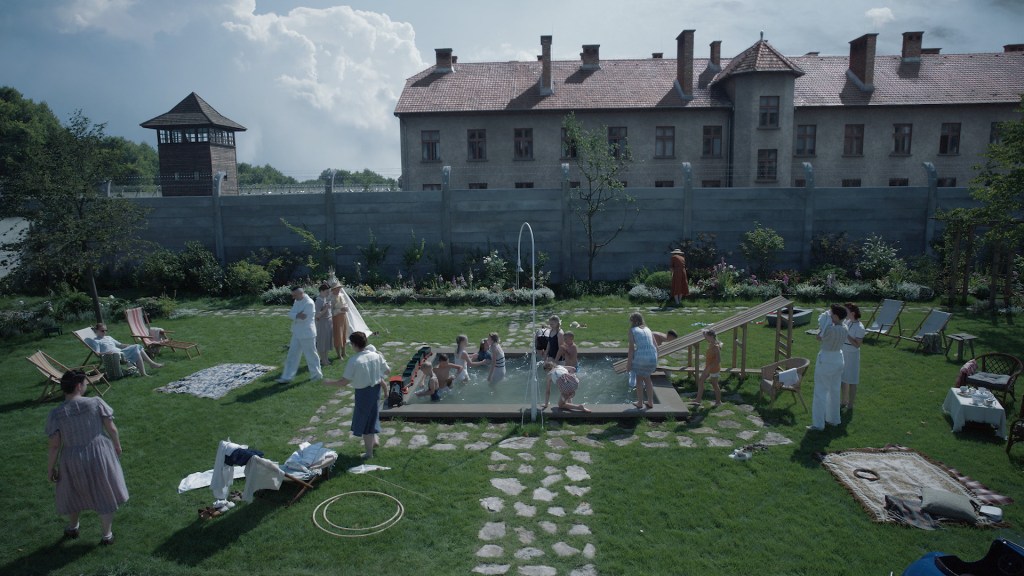
But ambient sound is inevitable. A theatre is not hermetically sealed. Cinema food, of course, is frivolous, and not in line with a film about such atrocities. The Zone of Interest, however, is about these contradictions. The table of food that awaits Hedwig and her mother upon her arrival, as the screams and gunshots echo; a huge cake on the dining table on Rudolf’s birthday; Hedwig and her friends enjoying cups of coffee over a discussion about commandeering Jews’ clothing and diamonds; Rudolf and his staff discussing crematorium efficiencies in the next room while the maid prepares him an aperitif. Teapots. Breakfasts. Adding popcorn and choc-tops to this is uncomfortable, but not entirely out of place.
Towards the end of the film, we lurch discomfortingly to the present day, as staff at the Auschwitz-Birkenau State Museum sweep the floors, vacuum, and polish the glass displaying thousands of child victims’ shoes. The film ends. Cinema staff enter to sweep up the popcorn, and we return to the 21st century. The screen is torn. This is our world, but it is also still the Höss’ world.
* * * *
The Zone of Interest released in Australia in February, more than four months after the events that catalysed the Israeli State’s most recent acts of genocide against Palestinians. Since last October’s Hamas attacks and Israel’s ensuing assault on Gaza, mainstream media coverage in Australia and abroad has been grossly selective, qualified by the notion that it’s all too complicated to discuss.
But the reality that, with this recent barrage of terror, Israel has already killed more than 33,000 Palestinians, frequently breaks into seemingly distant, comfortable lives in surreal ways. “Well, I hope by the end of the weekend,” President Biden said to news outlets in late February, a mint-chip ice cream cone in hand, “my hope is by next Monday we’ll have a ceasefire.”
People haven’t been blind to this bizarre spectacle. “Considered in the context of the worsening food shortage in Gaza, and juxtaposed against pictures of desperate children begging for aid, [the ice cream cone image] intensified anger towards a president who remains supportive of Israel even while bemoaning its ‘over the top’ military campaign,” wrote ABC Australia’s Washington correspondent Brad Ryan.
Invited onto Sky News UK in January to discuss the Houthi attacks on shipping lines—a retaliation against the genocide in Gaza—journalist and filmmaker Dr Myriam François articulated the disconnect: ‘I’m so sorry your Amazon packages are delayed, I really am,” she said. “But you know, genocide, guys. Genocide.”
In March 2024, The Zone of Interest was nominated for Best Picture at the 96th Academy Awards. The Oscars have long been partial to a certain kind of historical film. At this year’s Academy Awards alone, World War II featured multiple times, from thirteen nominations for Oppenheimer, one each for The Boy and the Heron and Godzilla Minus One, and five for The Zone of Interest. Historical epics provide fertile ground for production design and costumes, but they also allow the Academy (and audiences) a safe space to consider contentious topics like racism, prejudice, and genocide with an easy out at the end as the credits roll, safely quarantining them within the screen and the past. World War II is a prime ground for this path to awards glory.
During the ceremony, the present was to be kept resolutely outside the theatre. Protestors outside calling for a ceasefire in Gaza disrupted the schedule for only a few minutes. Jonathan Glazer, accepting an Oscar for Best International Feature, broke this rule: “All our choices were made to reflect and confront us in the present, not to say look what they did then, but rather look what we do now,” Glazer said, his hands shaking.
It’s a sentiment that has drawn ire from the press and industry figures. Some 80 years after the events depicted in the film, polite society still hinges on our perceived right to ignorance. How dare he make this, the past, about now? But like any artwork, a film doesn’t exist in a vacuum. The Zone of Interest doesn’t live in the 1940s; it lives today, just as Oppenheimer and Godzilla Minus One live today, and are about today. Whereas the latter two are mainly concerned with today’s burning need to package and commodify the past—to comfort audiences with an understanding that we are beyond it, smarter than it—The Zone of Interest doesn’t let us off the hook. It is an indictment of ambivalence, of the willingness to immerse ourselves in a pretty lie, despite the screaming.
**********
Will Cox is a lutruwita-born, Naarm-based writer and critic. He’s a regular arts writer for The Age and he can be heard on RRR’s Primal Screen. His short fiction has appeared in various journals, and his novella Hyacinth—an experimental gothic rewrite of sitcom Keeping Up Appearances—came out in early 2023 to acclaim.
 Rough Cut