


The title credits of Sudanese director Mohamed Kordofani’s Goodbye Julia—set in Sudan’s capital, Khartoum, at the knife’s edge of South Sudan’s democratic secession—appear with the cocking of a neighbour’s gun. Before this, we meet Mona (Eiman Yousif), a married woman preparing breakfast for her husband, Akram (Nazar Goma). There’s a cramped close-up of an onion being sliced, the distant crinkle of burnt food scraped into a bin, and the disapproval of Akram, who mumbles about the absence of protein. Off-screen havoc ensues, slashing the paper-thin harmony of the couple’s domestic routine. A group of Southerners—who Akram calls “slaves” with breezy indignation—are rioting in the street, protesting decades of racial and religious oppression in the sprawled wake of British colonial boundary policing and extensive civil war.
The neighbour’s cocked gun doesn’t eventuate, instead foreshadowing a future blow. Mona, who was a well-loved singer before Akram asked her to quit, is doing vocal exercises—portentously rising scales—as she drives. Distracted, she strikes a child with her car. She flees. When the boy’s father follows her on his motorcycle, Mona calls Akram, blustering about a Southern man’s crazed pursuit. Upon arrival, Akram shoots to kill. While the law hurries to absolve a grimly triumphant Akram, Mona’s guilt churns; we see her curled in a thin blanket, pulled taut around her like a cocoon. Seeking salvation, she finds Julia (Siran Riak), the deceased man’s newly houseless wife who hasn’t been told she’s a widow, and invites her (alongside her son, Daniel, who survived the accident) to live with her as a maid.
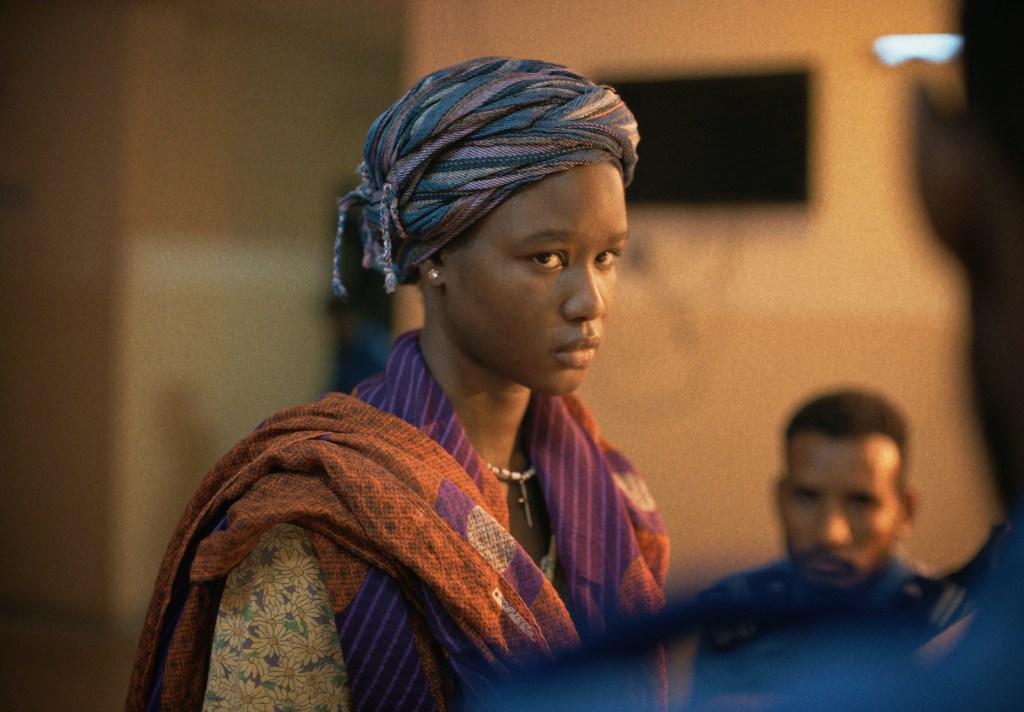
For Kordofani—who grew up as a Northern citizen of Khartoum—writing the film meant making the prejudices of his own childhood visible, to himself and to the public. “I can only talk about myself and to me I had some of that social injustice passed onto me from previous generations, from my ancestors,” he shares. “Some of it is this masculinity and some of it is this ingrained racism that they pass onto us. I think I’ve changed quite a lot over the last 20 years, and I wanted to explore that. I wanted to portray how this change happened and take glimpses of my own personal experience and put it in the film.”
In Goodbye Julia, the ‘moment’ of brutality is dislodged from the film’s climax, instead becoming a wound from which meticulously ritualised violence unfurls. When Julia moves in, Mona paints crimson circles on the base of a set of tableware with nail polish, delineating which ones Julia and Daniel can use. Kordofani remembers similar markings from his childhood, as his mother also employed a domestic worker from the South. A Northern Sudanese friend of Kordofani’s, reading the script’s first draft, exclaimed: “Oh my God, we had the same in our house; my mother used to also paint drinking glasses with nail polish.”
“The film talks about separation on so many levels,” says the director: “the separation of man and wife, the separation of two friends, the separation of mother and child. It’s always separation and it’s always due to social injustice or differences.” Separation doesn’t only fragment the relationships in the film; space is literally spliced and contracted, as Kordofani and cinematographer Pierre de Villiers fixate on the home as an architecture of secrecy and control.
When asked about the film’s interiors, Kordofani responds: “The personal is always intertwined with the political and I wanted to portray the macro through the micro,” to “look inside a home and see the bigger picture of Sudan.” Julia’s emergency dwelling is forcibly disassembled into a mound of bright sheets while, in Mona’s house, cruel truths are nestled in cabinets and vessels. The wallet of Julia’s husband, which Mona bribes a policeman to obtain as a way to find Julia while further anonymising Akram’s victim, is stashed in a teapot, which looms over Mona and Julia’s growing bond. “The first draft I wrote was entirely inside a house. We don’t even go to the street; it was all inside this claustrophobic home of Mona.” The decision to move beyond it came from one of the film’s producers, who urged Kordofani to showcase Sudan’s beauty due to the country’s sparse cinematic history. “We don’t have a lot of films from Sudan,” Kordofani recalls his producer protesting; “we have like eight or nine feature films from the history of Sudan, and this is an opportunity for us to show the audience some of Khartoum.”
Still, Kordofani and de Villiers worked together to forge an enclosing sensation that endures throughout the film, which echoes the impact of a single-location thriller like Hitchcock’s Rope (1948). This relies upon a 4:3 aspect ratio which, Kordofani points out, is “more like a box than the CinemaScope, rectangular shape that people are used to in cinemas nowadays.” Within this frame, Mona’s house “felt like a prison and at other times it felt like a cave, where you’d see the sun—the light outside of the house—shining so bright, but still the house is very dark.” A box, a cave: appropriate metaphors for a site (a house, a nation) that simultaneously ensconces and entraps, provoking closeness while feeding suspicion.
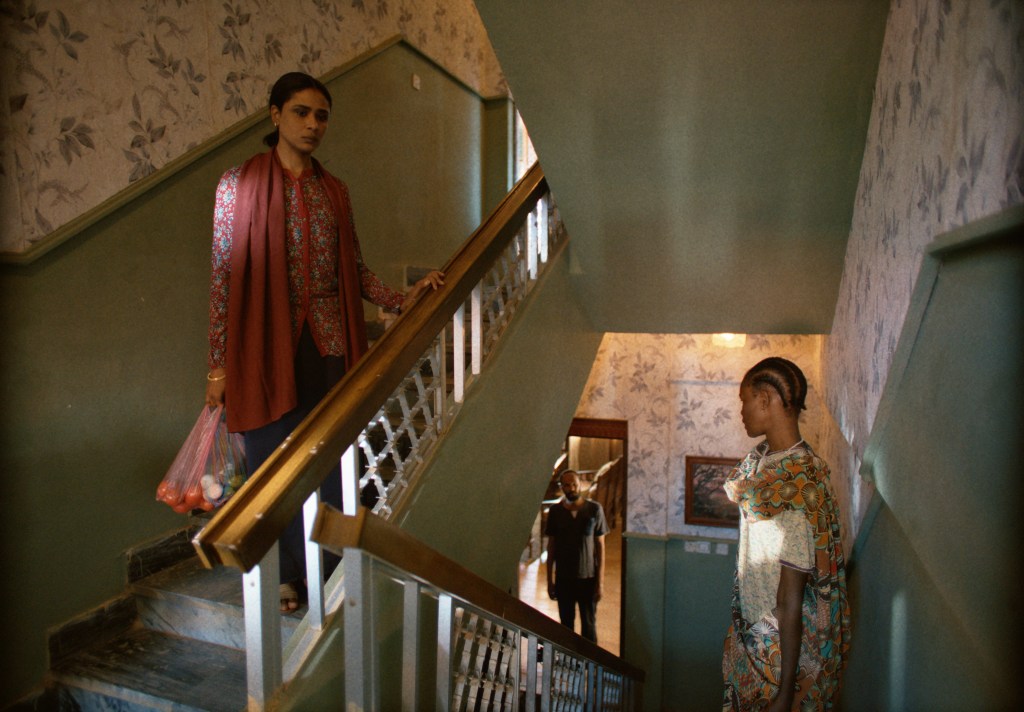
Meanwhile, with the outside scenes, Kordofani and de Villiers intended to capture the light and colour palette of Sudan. “It has a distinct look—this earthy tone,” Kordofani observes. There are mists of umber dust; there are vivid, patterned textiles. At times, rainbows refract on the glass, as de Villiers’ lens strains to stare into the sun. The desire to negotiate Sudan’s vibrancy with the muffled captivity of his characters’ lives reflects Kordofani’s abiding optimism. “The relationship between Mona and Julia in the film […] to me is a representation, a symbolic relationship of the North and the South of Sudan,” says the director. “We have a lot of love for one another, but also a lot of heritage of differences, to say the least. There is a long history of a slave trade, actually the longest history of civil war in Africa. There’s a lot of complication, but we did live together in the same place, in the same country, so I wanted the relationship between the two characters to portray that.”
Graceful despite the sharp pain of deferred grief, Julia’s constant presence both soothes and torments Mona, as their relationship begets a waxing intimacy charged by dependency, deceit, and—most surprisingly—genuine curiosity. As the story stretches over years, Mona becomes the benefactor of Daniel and Julia’s education; Julia brings Mona to listen to the choir in a vast church, trying to reignite Mona’s passion for music. A semblance of blissful familiarity, however shadowed, enters, as Kordofani poses the question: can the corkscrew of Mona’s complicity ever be loosened?
There are numerous “happy scenes” within the film, Kordofani stresses (“four, five, six”). Many of them involve song and dance. For the director, these expose a “real love” between the two characters, underpinned by the pair’s real-life chemistry and collaboration as first-time on-screen actors. “There is always something very authentic about non-actors acting,” he says of Yousif, a singer he cast based on a video of a live performance he saw on Facebook, and Dubai-based model Riak, who had grown up in Khartoum but left about 15 years prior.
Kordofani took care to bring Riak to Khartoum two months before shooting, asking Yousif to take her under her wing. “[Yousif] received Siran at the airport, I think, and ever since then they really became friends.” The subtlety of the duo’s performances, which rest more so on gestures and glances than on dialogue, is only augmented by what Kordofani describes as the camera’s “observational stance.” “You often feel like you are only observing. You’re not very close to the characters; you’re not sympathising with the characters or the camera.” There are few close-ups of Mona and Julia’s faces, propelling the audience to instead perceive the supple vicissitudes of gratitude and distrust in their movements, and to witness the exhaustive repetitions of labour.
Goodbye Julia ends at the dawn of South Sudan’s secession in 2011, when almost 99% of South Sudanese citizens voted for the right to self-determination, officially separating Sudan into two nations: the Republic of Sudan and the Republic of South Sudan. With this event, the boundaries created and maintained by British colonial government during the period between 1899 and 1956, which sought to divide Sudan across linguistic and religious difference, were enshrined. Yet the formation of South Sudan also implied newfound security and economic independence for its people—promising to prevent the North from appropriating Southern resources.
In the film, this shift is met with a tone at once exultant and melancholic. It corresponds with greater freedom for Kordofani’s characters, but it also prompts painful recognition of the past and creates fresh lesions of displacement, reflecting the reality for the many South Sudanese people living in Sudan who could now be punished with illegal immigration charges. Kordofani’s film is inflected by the complex feelings of empowerment and disempowerment wrought by the division, but also by the rapidity of political and cultural momentum in the years following. The script was written in the wake of the Sudanese revolution that began in 2018 and led to the toppling of the country’s long running dictatorship in the hands of Omar al-Bashir in 2019, giving “people hope for a better future,” as Kordofani recounts it. “Despite this heavy topic that the film discusses,” Kordofani says, “you can still see, I think, the hope [that] comes not only from me, but from the energy of the people in the film, the individuals that you see, and this came to all of us from the Sudanese revolution.”
In making the film, Kordofani was afraid of how it would be received in his home region—anxieties tied to both its political substance and its form. “I expected backlash, because the film is talking about a very sensitive topic, and it’s portraying Sudanese people who are not used to cinema. They are used to TV. Television usually, you know, is national. Through the years it always spread positive messages and positive portrayals of the community as any other TV would do, but because we’re not used to cinema […] we assume that the cinema would do the same.”

These concerns crumbled when, three months after the film wrapped, in April 2023, war borne from competing claims over the seat of power post-revolution fractured Sudan anew. “I’m still hopeful to this day,” Kordofani continues, “though I don’t know when the war will stop. But I think of war as the last obstacle in the face of the revolution because I’ve walked the streets with these protestors, with these people, and I know that the resilience that they have and the amount of hope that they hold in their hearts is not something that can be broken easily.” This hope bursts forth in the film, as solidarity blooms between Julia and a Southern activist, Ager (the charismatic Ger Duany), who together look out at the sea. Kordofani’s frame is box-like, but a box always implies an outside, and Goodbye Julia’s broad margins feel full.
Upon its premiere at Cannes, where it was nominated for three awards, Goodbye Julia was celebrated by critics and took out the Un Certain Regard Freedom Prize. When Kordofani is asked what surprised him most about the film’s reception, however, this prestige pales in comparison to the overwhelming response of Sudanese and South Sudanese audiences, and the extraordinary context through which they encountered the film. At first, the war placed another barrier on Kordofani’s dream to screen Goodbye Julia in Sudan. It forced many Sudanese people to take refuge in Egypt, however, where Kordofani’s team managed to find a few screening halls for the film. “On the very first day, we went up from seven theatres to the next day thirteen, and the day after it was 23, then it went to 35, and this is because there were queues and lines and the theatres could not take this amount of people, and more theatres wanted to have the film.” After the war broke out, he says, “it really softened and humbled the Sudanese audiences, and they received the film with open hearts—a lot of tears, you know, and a lot of regret maybe.” “So yes,” he goes on, “I was surprised, and I really thank the Sudanese and the South Sudanese community for this love.”
Goodbye Julia will release in Australian cinemas from the 4th of April.
**********
Indigo Bailey is a Tasmanian writer and editor living in Naarm/Melbourne. In 2023, she received the Island Nonfiction Prize for an essay about rain sound. She has written for Island Magazine, The Guardian, Voiceworks, and Kill Your Darlings, among other publications.
 Rough Cut