


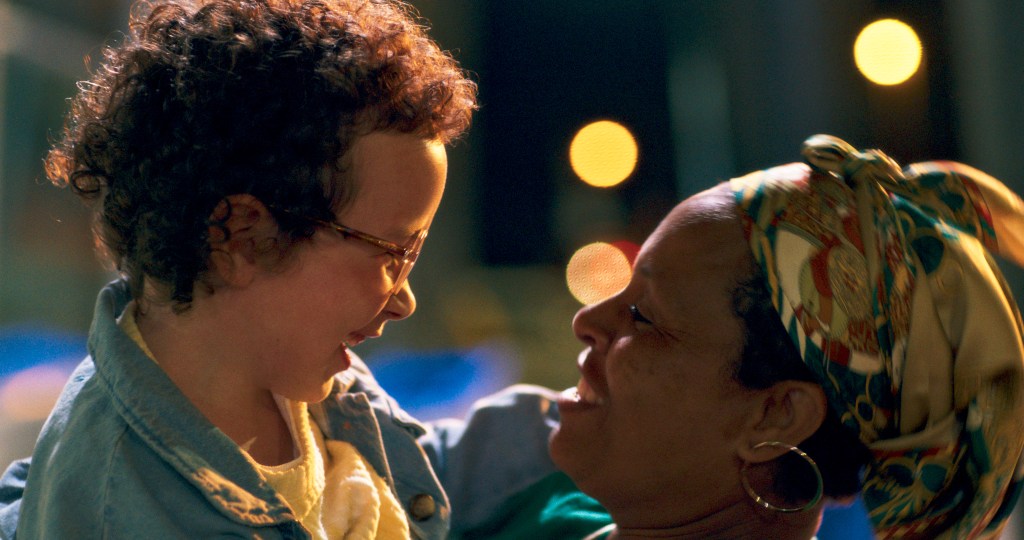
We’ve all encountered girls like Cléo (Louise Mauroy-Panzani). She has tumbleweed hair; she wears thick-framed glasses; her two front teeth, which recently fell out, are growing back in. She has an immense sense of fun, which tips over into brattiness when she doesn’t get what she wants. She lives with her father (Arnaud Rebotini) but because he is often at work—and her mother passed away when she was a baby—much of the raising is done by Gloria (Ilça Moreno Zego), the family’s live-in nanny. While the configuration of her family unit is unusual, Cléo’s relationship to her guardians—Gloria, especially—is anything but: they are the objects around which her life orbits. But at six years old, Cléo is of an age where her small, interior world is about to expand rapidly with the revelation that people have lives outside of her.
Àma Gloria is the first solo outing for director Marie Amachoukeli (who made her debut co-directing 2014’s Party Girl) and here she establishes herself as a meticulous observer of human behaviour, capturing Cléo’s emotional variations with an almost striking clarity. Early scenes particularly showcase this ability. Look at the way Cléo and Gloria’s expressions firework when they see each other at school pickup. Look at the way they hug, with such pressure and intensity it’s a shock diamonds don’t form between their bodies. Look at the way they play, freewheeling and giggly. You can’t imagine them apart, and neither can Cléo. So, when Gloria’s family in Cape Verde call with the news that her mother has passed away, prompting her to return home, Cléo is beside herself.
To ease the process of separation, Gloria suggests that Cléo come visit during the summer. At first, the trip seems like something out of an adventure story, but when she arrives, Cléo is crestfallen to learn that Gloria has two adolescent children, César (Fredy Gomes Tavares) and Fernanda (Abnara Gomes Varela). Their presence not only disrupts her view of Gloria as an infallible, maternal figure—what kind of mother abandons their own children?—but also provokes them to compete for her attention. César is surly and standoffish—angry at Gloria for leaving them, snapping at her whenever she tries to get close to him but growing even angrier when she does not. Fernanda is pregnant, in her third trimester, and will need all the help she can get raising the baby.
Watching this film, I was reminded of Janet Manley’s essay, ‘Let the Kids Get Weird,’ in which she argues that children’s stories are rarely for, or even actually about, children. Instead, they are secretly for adults. Although she frames this issue in relation to children’s picture books, this trend is endemic across modern films: everything from children’s animation like Coco (2017), which sidelines the tweenage protagonist Miguel to the bond between his grandfather and great grandmother, to arthouse fare like 20,000 Species of Bees (2023), which spends more of its energy on a mother’s reluctance to accept her transgender daughter’s identity than on the daughter herself. Even Petite Maman (2021), a film explicitly about the way adults overlook and essentialise the emotions of children in favour of their own, cannot help but recall this same pattern.
At many points, Àma Gloria echoes Petite Maman. In addition to sharing producers, they share narrative and thematic elements—the inciting incident of both films is the death of a maternal figure’s maternal figure. Both are about how understanding your parents as people and not as caregivers is the first step towards maturity. Each concerns the impossible standards of motherhood and the fraught but inevitable moment of falling short.
Where they differ is in the treatment of their protagonists. Amachoukeli and her co-writer Pauline Guéna are fully invested in Cléo, rarely drifting away from her point of view and finding inventive ways to make her child-brained psychology more legible. Most arresting are the animated sequences interspersed throughout the film. They are painterly, tropical in colour and impressionistic in style. Sometimes these sequences provide key moments of backstory: what happened to Cléo’s mother, for instance, or how Cléo and Gloria met. At other times these sequences are entirely abstract—comprised of colours, shapes, and pieces of imagery seen earlier in the film—and instead serve to immerse us in Cléo’s headspace.
Less successful is the visual language of the live-action portions of the film. Cinematographer Inès Tabarin shoots the majority of the film in tight close-up, filling the whole frame, for instance, with Gloria’s face, or a whale pendant, or details from a game of football that has suddenly caught Cléo’s attention. As a representation of kiddie tunnel vision, this technique is successful; Cléo’s motivations are always legible. We follow her eye from one thing to another, so that when she acts we understand what it is in reaction to. The trouble is that, by zooming so far in, the amount of information we can learn at any single point in time is limited. The setting and characters feel ill-defined, sometimes little more than smudges. Even Gloria reads as largely two-dimensional. This is a pity: her character, particularly the contrast between her uninhibited love of Cléo and her strained relationship with her own children, is one of the film’s most compelling strands. But we never really get a sense of what drove her to abandon her family or made her feel drawn to return.

It’s hard to declare this narrow focus a detriment, exactly. Amachoukeli set out to make an exploration of childhood through the eyes of a child, and on this front the film is largely a success. Certainly, there are a host of ideas on the periphery, developed just enough to be interesting, but not explored enough to satisfy, like questions of economic self-determination or the disparity in how single parents are treated based on gender. These loose ends, while frustrating, all feel like natural by-products of the film’s point of view. All, that is, except the film’s handling of race. Cléo is White, Gloria is Black, and their relationship evokes colonial stereotypes, but no one touches upon the matter, not even Gloria’s friends or children. In other instances where Cléo is ‘too young’ to fully comprehend the complexities of a scene, the film makes her a fly-on-the-wall, letting some ideas filter through her perspective. That race is the one aspect averted entirely prompts the question of whether the writers felt it too complex a concept for Cléo to understand. If this is the case, it feels curiously arbitrary, the rare instance of second-guessing in a film that is otherwise self-assured.
Àma Gloria is about rites of passage first and foremost, and the moments in which ‘innocence’ gives way to more complex relations with the world around you. As a cataloguing of those motions, it is exemplary. (“It’s my song,” Cléo cries at one point, after overhearing Gloria singing a song they’d once shared to her family. “Songs belong to everyone,” replies Gloria, kind but firm.) But the refusal to move outside its particular stylisations ultimately limits; because we don’t understand the nuances of Cléo’s environment, what it means for her to relate to them more maturely is never fully elucidated. Cléo’s gaze widens so that she sees more, feels more, but our gaze remains fixedly narrow throughout.
Àma Gloria is now showing across Australia as part of the Alliance Française French Film Festival.
**********
Joshua Sorensen is a writer, bookseller, and committee member for #LoveOzYA based in Naarm. Movies starring Holly Hunter are to him what lamps are to David Byrne.
 Rough Cut